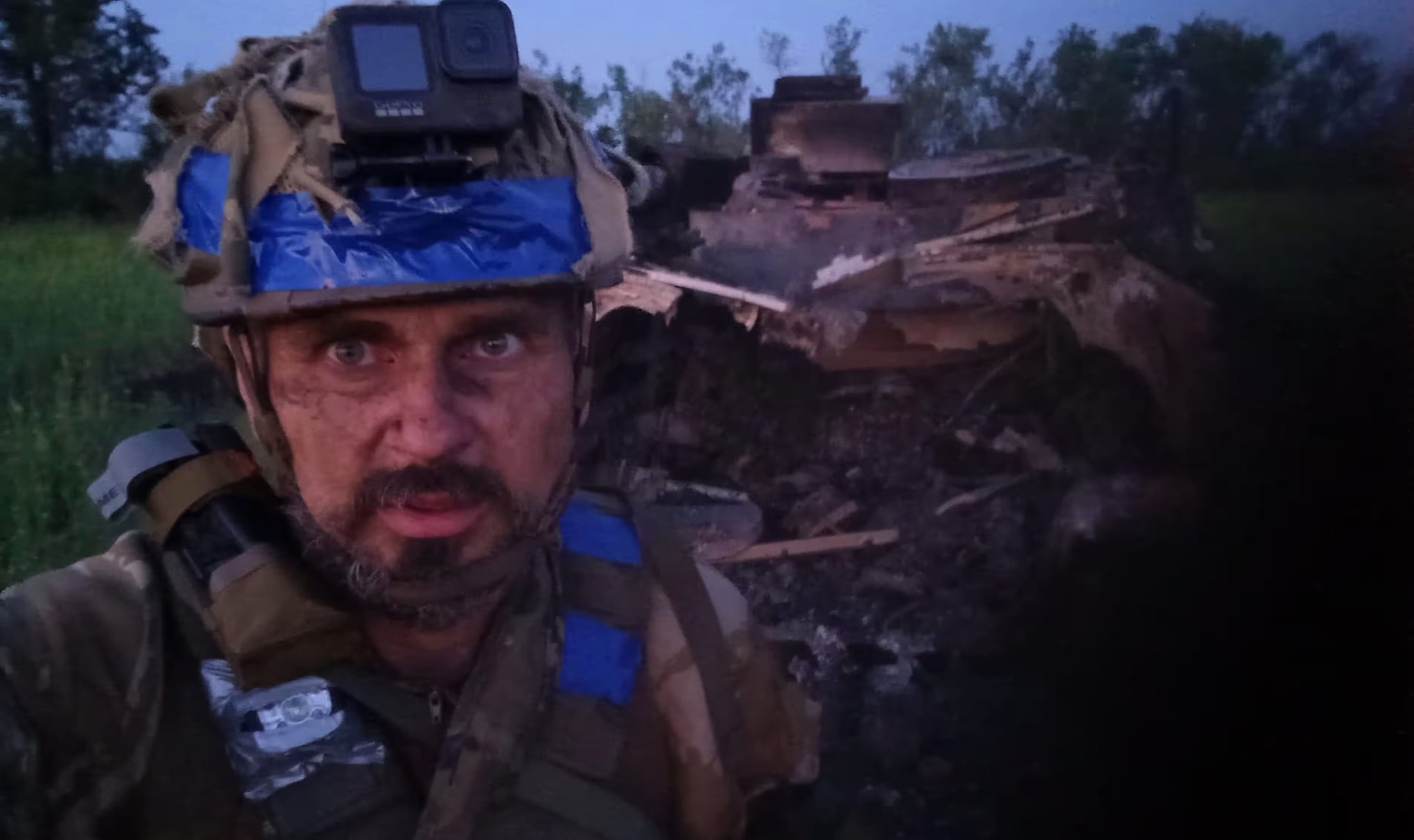
Oleh Sentsov on duty in the Ukrainian army. Image: @Олег Сенцов/Facebook
With Oleh Sentsov, international fame came at the greatest expense: his freedom. In 2014, the Ukrainian filmmaker – who had debuted in his homeland just three years earlier with Gamer – was arrested in Crimea while making a volunteer aid delivery by the occupying Russian authorities, who accused him of terrorism. The international film world soon raised awareness of his arrest and move for his freedom. After being condemned to 20 years, imprisoned at the infamous Yakutsk penitentiary, Sentsov was freed in 2019 in a prisoner exchange. Following the full-scale invasion in February 2022, Sentsov enlisted in the army to fight on the frontlines. Bearing the rank of lieutenant, he participated in the Ukrainian counteroffensive in the Donbas in summer 2023, among other combat zones.
There is, however, a side of Sentsov that often gets overlooked due to the more sensationalist aspects of his life, and that is his primary role as an artist and filmmaker. Even with all the difficulties he has faced, Sentsov has been able to direct four feature films: Gamer (2011), Numbers (2020), Rhino (2021), and his latest, Real. Debuted last month at Karlovy Vary International Film Festival, Real is an experience as much as a documentary, consisting entirely of an uncut, feature-length piece of GoPro footage inadvertently shot by Sentsov from his helmet-mounted camera from within a defensive trench in the Donbas. Across 100 minutes, we witness the director and his troops attempting to evacuate from under heavy Russian fire. Much more of the action is heard than seen. Thanks to its raw simplicity, Real has the potential to represent war in as unfiltered a manner as possible. Aided by his interpreter Veronika Velch, we met with Sentsov in picturesque Karlovy Vary to discuss his very unique film career and Real’s place within it.
If you look back at yourself in 2011, when you had just presented Gamer – at your hopes back then, and what you ended up enduring – what are your thoughts?
Life never goes as planned, as you know. You can have one idea, one image of how it is going to be, but it might become real in a completely different way than you hoped or expected. For example, I never dreamed or wanted to be in a prison, or running in a forest with a gun in my hand. I wanted to make movies; I hope one day I will be able to go back to the filmmaking process.
Through your arrest you became a kind of symbol of the oppressed artist: I myself got to know about you through that tragic event. You inevitably ended up becoming famous for that reason. How did that affect you personally?
I’m just grateful to the cinema community that supported me, as that is how the support started – and the next step was towards the international community, but the push came from the cinema society. I cannot say that I feel affected in anyway, right now many things have happened since.
Life never goes as planned, as you know… I never dreamed or wanted to be in a prison, or running in a forest with a gun in my hand. I wanted to make movies
Your second feature, Numbers, was a film-play you directed from prison. How does the process work, directing and writing under such circumstances?
That had two purposes: one was to make me be involved in something, and the other to keep attention on my case, that of Ukrainian political prisoners, and of Ukraine overall. My level of involvement was mostly in the artistic part: in the casting, envisioning the setting, the idea, and the atmosphere around the movie; that is what I was mostly involved with. But of course, all the process of the execution was out of my reach. You could see it in the result, I would not say it is how I wanted this film to be done exactly, but I’m still very grateful that this project took place, and this movie exists.
One of the key aspects of Numbers is the character of God, who is seen on stage but remains entirely separate from the rest of the action. How did this idea come to you, and what does this concept represent for you personally?
It is very hard to say how an image enters your consciousness, your brain. When this happened to me, at first, I thought it was completely ridiculous stuff, complete absurdity, but the idea didn’t abandon me for a long time, so I decided to write this play – which you have to understand was made for the stage, not for cinema.
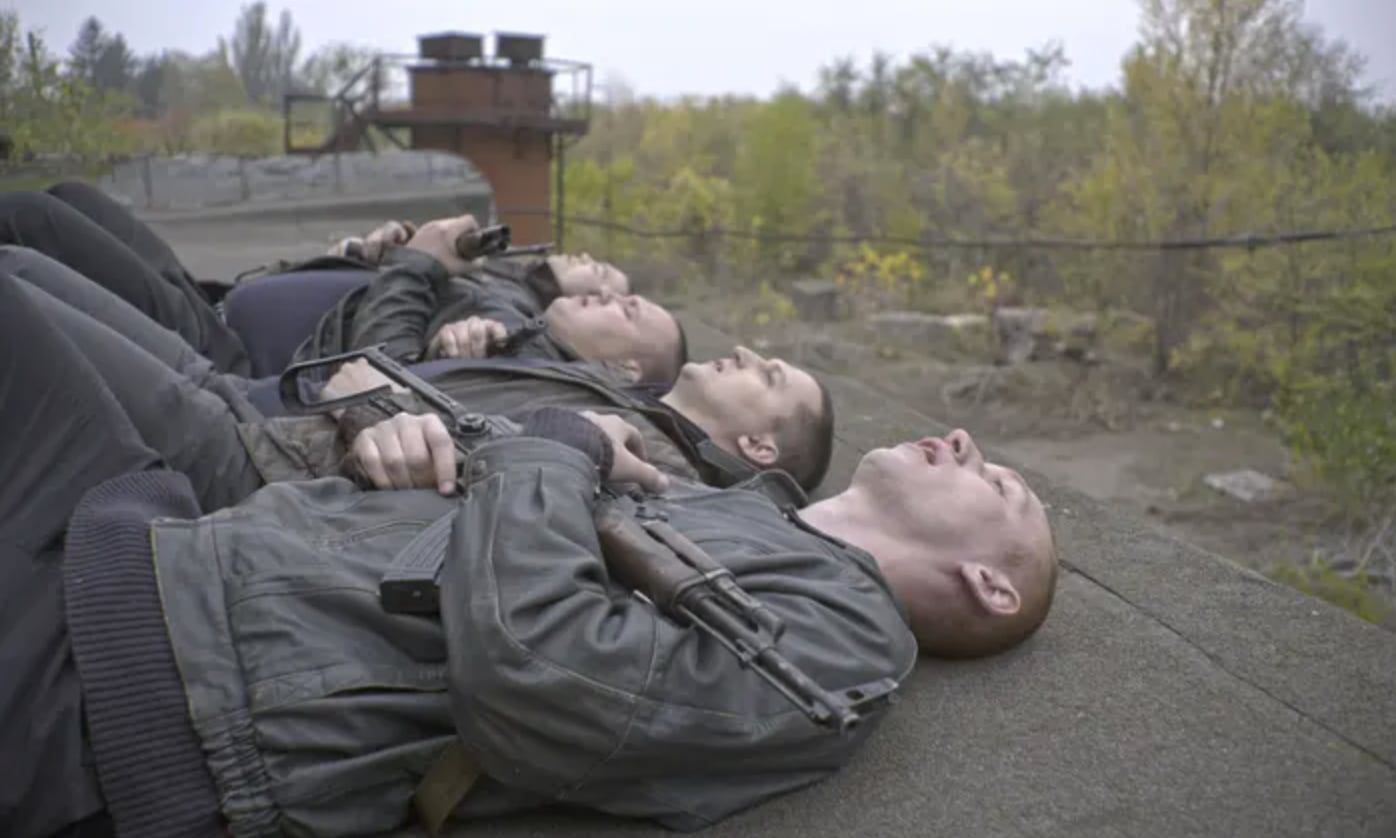
Rhino (dir. Oleh Sentsov, 2021)
In 2021, you directed Rhino. On the surface it’s a gangster movie, but you incorporate moral questions as well. And it has that great, long-take opening sequence that encompasses decades of Ukrainian history under the Soviet Union.
That beginning scene is not my innovation; many directors deal with time and space in different ways. I didn’t want to make this story only as a gangster story: I also [wanted to include] some moral, preaching component. I cannot call this project a complete success because I could not really transmit how I felt, and what people felt while watching it was different [to my intentions]. There could be many factors for that: first of all, that I did not have much experience as a director; second, some of the actors were unprofessional. It was hard for them, but I take full responsibility for this movie. I wish I could [have done] more, to make people feel the same way as I envisioned it originally.
Turning to Real, the film you presented at Karlovy Vary. In your introduction, you pointed out that the footage was a recording you made by mistake on the frontline, and that you found the footage later on. So, no one knew that they were being recorded, and you didn’t know you were recording?
Yeah, but to follow up quickly, it was not a mistake. It was an accidental recording; it wasn’t on purpose, but [it wasn’t a] mistake either. I was trying to get out my vehicle out from under fire, and as I was jumping and riding, I was fixing my helmet, to make sure my GoPro camera was still there. [In the process] I probably turned on the camera, which started to shoot. No one knew in that trench that it was on: this is the battle, a normal day. I discovered the file six months later and wanted to delete it at first because it took too much memory. When I started to watch the footage, it all came together.
When I first heard the title of the film, Real, I thought it referred to the idea of reality: “this is real.” It was only while watching the film that I learned that it was also the codename of the post that you were defending.
In that area, all positions were named after football clubs: you can also hear a position named Chelsea mentioned, and Real [comes from] Real Madrid. Apparently, it ended up having this double meaning – in this case, that we show the reality of the war.
Explore our collections of Ukrainian titles and documentary films.
Viktor Toth is a Hungarian-Italian film critic. He collaborates with the Italian East Journal, ODG Magazine, and Cineuropa. He also runs his own project focusing on Eastern European cinema, East European Flicks.

 Go back to journal home page