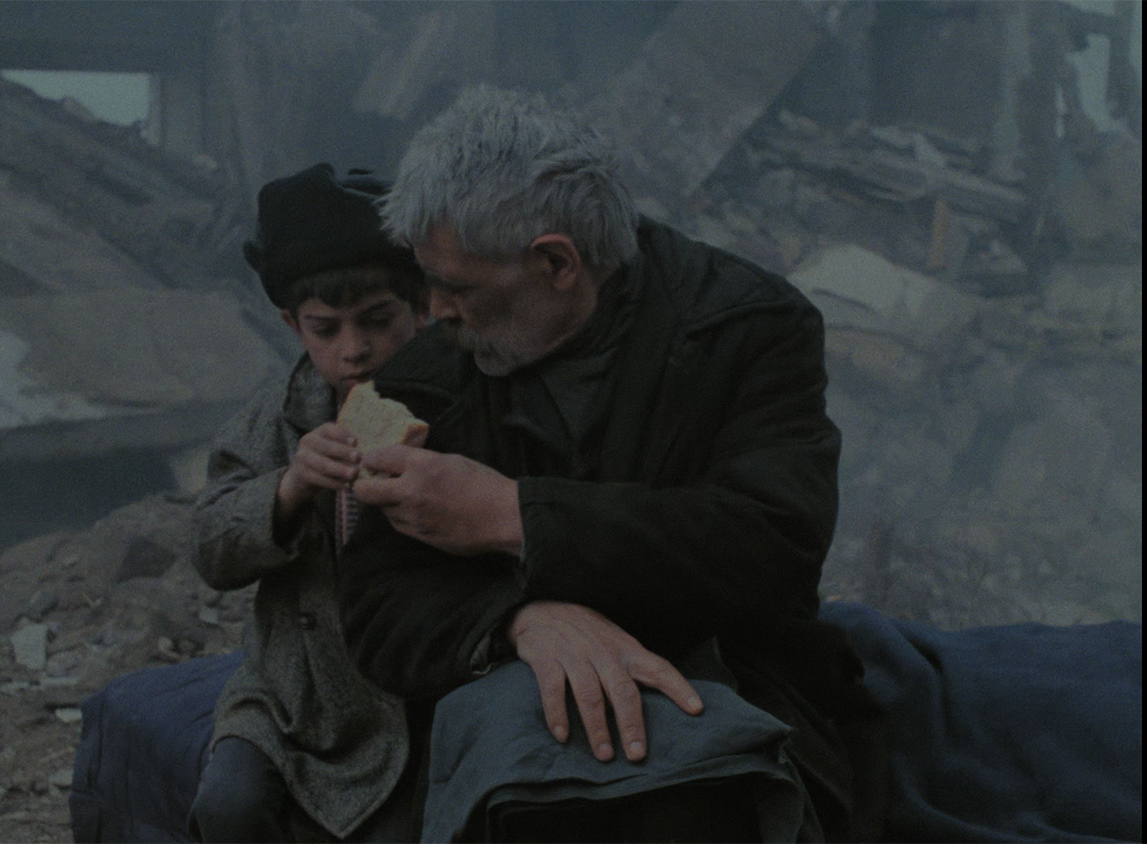
Catastrophe (dir. Dimitri Kesayants, 1993)
The Golden Apricot International Film Festival, which runs every summer in Yerevan, Armenia, is one of the most prestigious films festivals in the Caucasus. Each edition plays host to the GAIFF Critics Campus: an extensive workshop run by critic and mentor Leonardo Goi that provides emerging film writers a vital entry point into the festival circuit. Each year, a select cohort of young critics travel to Yerevan to hone their craft, discussing and reviewing the most exciting titles from the Caucasus and beyond.
After hosting writing from the Campus during the 2023 edition, we are delighted to be heading back to Golden Apricot this year with another batch of exclusive reviews from the festival’s 2024 programme. This year, their report focuses on Armenian cinema old and new, including two low-budget contemporary documentaries and a classic from the early years of post-Soviet independence. Amarsanaa Battulga introduces Shoghakat Vardanyan’s award-winning DIY account of family trauma, 1489; Botagoz Koilybayeva reports on Yervand Vardanyan’s Orbita, a portrait of post-industrial, post-Soviet masculinity; and Clara Cuccaro looks back on Dimitri Kesayants’ Catastrophe, a cult drama from 1993 set in the ruins of the devastating Spitak earthquake.
Art in the Time of War: Shoghakat Vardanyan’s 1489
Amarsanaa Battulga
Watching documentaries from Iran, Palestine, Lebanon, and Armenia at the Golden Apricot International Film Festival reminded me of how political issues that might be pressing in one place are seldom truly felt, understood, or even known about on the other side of the globe, even in our hyperconnected era. Seeing these films in Armenia, whose people continue to suffer from war and occupation, only seemed to add to their urgency and potency.
For me, this was particularly true for pianist Shoghakat Vardanyan’s debut feature documentary, 1489. The winner of the International Documentary Film Festival Amsterdam’s (IDFA) top prize was warmly embraced, with applause and tears, as it screened in a packed Grand Hall at Yerevan’s Cinema House, the largest in Armenia. Just before completing his military service, in 2020, Vardanyan’s 21-year-old musician brother Soghomon was sent to the frontline of the Second Nagorno-Karabakh (Artsakh) War between Armenia and Azerbaijan. After he went missing a few days later, Vardanyan left her piano stool, picked up her phone, and started recording herself and her parents.
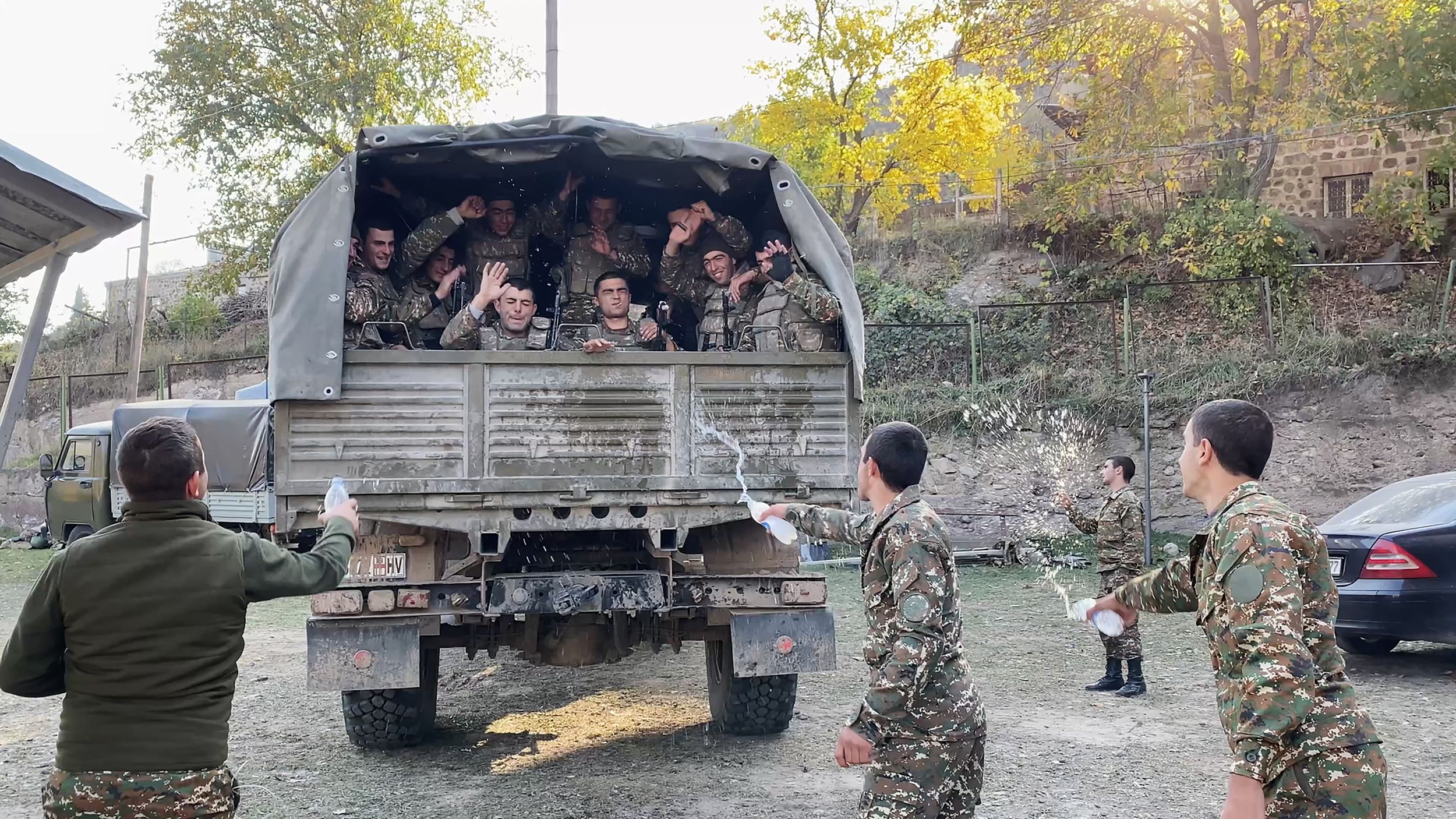
1489 (dir. Shoghakat Vardanyan, 2023)
The war only lasted 44 days, but she would go on filming for two years to find out what happened to Soghomon, assigned the titular number in the army registry for missing personnel. In their heartrending directness, these phone recordings seem more unvarnished than unpolished. A salient example is the low-light, grainy opening scene, which captures some of the utter desperation that pervades the rest of the film, and sees Vardanyan’s father sitting at a kitchen table, weary and resigned, remarking on how a person should have to live, not die, for their country. 1489’s sincerity lies not just in what is shown, but also how the film goes about showing it. Vardanyan learns the ropes of DIY filmmaking before our eyes; she carefully considers camera placements, going as far as to argue with her father over which angle to capture an indoor shot from in one scene, and reminding her mother of the phone placement as she sets the dinner table in another. 1489 is unmistakably self-conscious of its filming process and its desire to inform a foreign audience about these horrors – the clearest example of which comes in the shape of several paragraphs of text, presented in English only, that bookend the film, offering context on both the war and the shoot (incidentally, this was also the case for another Armenian documentary about the war unveiled at the festival, Emily Mkrtichian’s There Was, There Was Not).
But 1489’s success in informing and persuading comes from elsewhere. Rather than offering a detached account of the conflict, the film homes in on the harrowing human cost of war beyond the number of casualties and missing persons. Faced with the prospect of Soghomon’s permanent absence, the daily lives of the Vardanyans turn upside down. The pious mother busies herself with pillowcases she sews for soldiers on the frontline, hoping perhaps that one might find its way to her son. Vardanyan herself can’t focus on music, an inability that’s echoed in the film’s choice to discard non-diegetic songs altogether; the few sorrowful tracks about her homeland she listens to ricochet from her phone. But if Vardanyan at least takes up another art – filmmaking – her sculptor father Kamo no longer sees any purpose in his, and instead goes on the road to find out his son’s whereabouts from other soldiers. “If Soghomon comes back,” he quietly remarks while staring at the sculptures and décor in his studio, “it will all have some meaning.” Faced with the senselessness of war, father and daughter wrestle with the helplessness of their arts. As the burden of uncertainty grows heavier, a feeling of dread creeps over them. Sometimes this happens unconsciously, as when Vardanyan points out to her father that he has started using the past tense to talk about Soghomon.
In 1489, Vardanyan aims to preserve her memories of her brother and parents while documenting the painful uncertain history of her nation and its people. In one scene she attempts to become her own subject: she shaves her head and stands in front of her brother’s portrait, perhaps a hopeful gesture aimed at lessening hers and her parents’ loss. Much as the departed may live on in films we leave behind, 1489 makes a compelling case for how they can also do so in ourselves.
Amarsanaa Battulga is a Mongolian freelance film critic, FIPRESCI member, and PhD student based in Nanjing, China. His bylines include Die Welt, Cineuropa, and Documentary Magazine, among others.
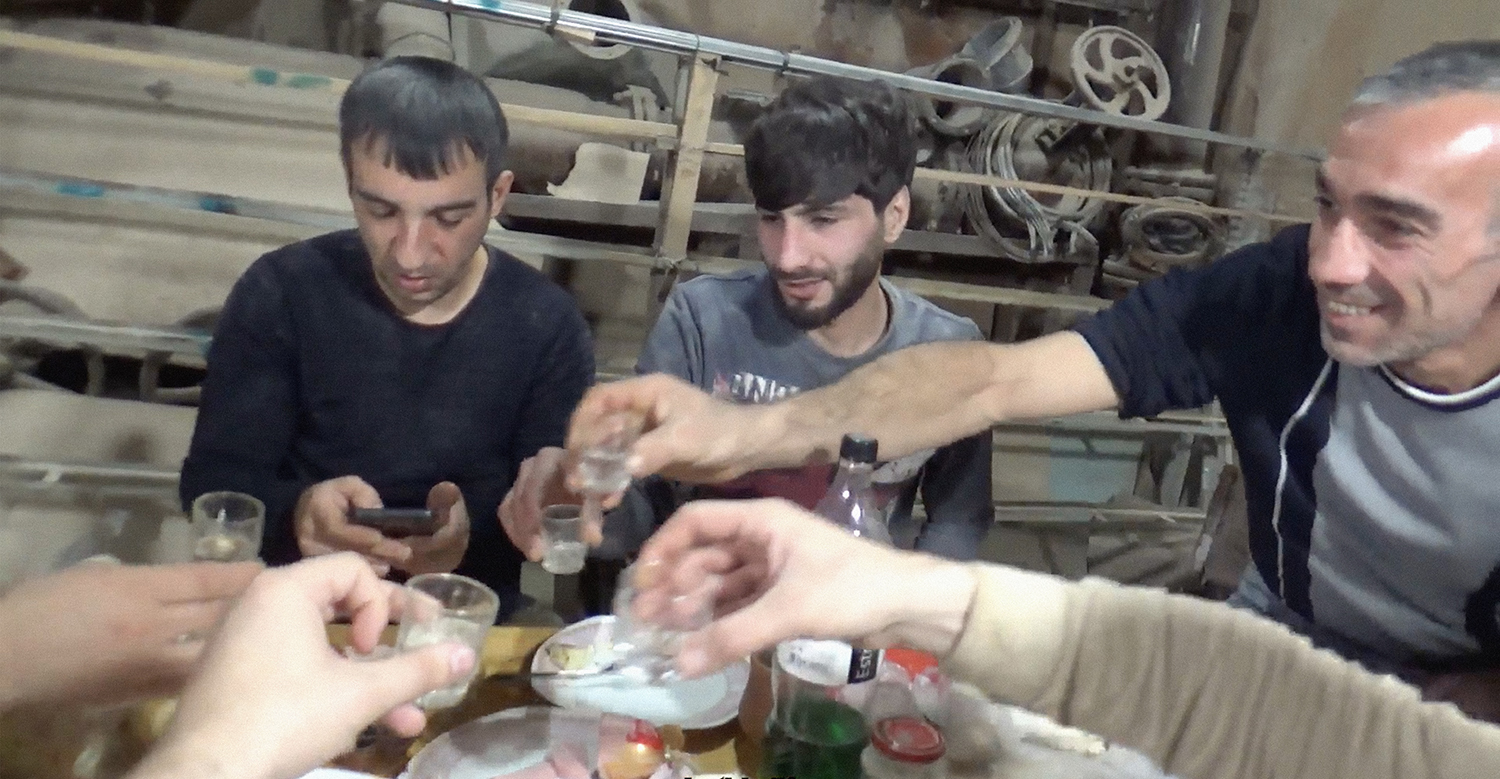
Orbita (dir. Yervand Vardanyan, 2024)
The Inescapable Spectre of Soviet Socialism in Yervand Vardanyan’s Orbita
Botagoz Koilybayeva
In Orbita, historian-cum-filmmaker Yervand Vardanyan’s documentary feature debut, the workers of the titular factory exist in an orbit of their own, a microcosm of camaraderie, working, jesting, and drinking together. The macrocosm – the war between Armenia and Azerbaijan over the Nagorno-Karabakh region – looms large over them all, a background soundtrack to their days spent toiling away. Once a prominent manufacturer of radio details and optical equipment, which rumours have it might have been used for secret Soviet weapons, Orbita is now a run-down building dedicated to the production of wildly different goods: backgammon boards and souvenirs.
Several films unveiled at the Golden Apricot International Film Festival this year highlighted the Nagorno-Karabakh conflict: Emily Mkrtichian’s There Was, There Was Not, Shoghakat Vardanyan’s 1489, and Sareen Hairabedian’s My Sweet Land to name a few. In their different approaches, all of them suggest that the ongoing strife is a wound so raw it has become something almost subconscious for Armenians. “If there is an orphaned child in the world,” a more pious employee poignantly says of the conflict halfway through Orbita, “I am his father” – as if to suggest that war somewhat paradoxically unites people. In Vardanyan’s debut film, however, the conflict is only captured through radio news bulletins, innocuous reminders from the outside world which intersperse the constant stream of rabiz, an Armenian musical genre.
does Orbita ultimately stands as a tribute to Armenia’s Soviet history – and a socialist type of camaraderie, perhaps – or rather to its readiness to leave the past behind?
Orbita narrates a day in the life of five of its employees, which it captures as they make all kinds of souvenirs and etch backgammon boards with traditional Armenian engravings. Vardanyan – whose childhood friend Grno, a stout, bearded, and jovial bloke, is one of Orbita’s woodworkers – acquires a privileged access to the all-male milieu of the factory. The use of a compact HDR Sony camera allows him to maintain a close yet unobtrusive proximity to his subjects. Indeed, Vardanyan succeeds in bringing out the workers’ humanity and their chaotic energy: they seem relaxed in front of the camera, bantering, beer-drinking, and drilling wood. There is a subtle, lurking sense of homoeroticism that transpires from the film’s fly on the wall approach. At his most voyeuristic, the director films an extended sequence of Nver, another factory worker, as he shows off his biceps and six-pack while taking off his dusty uniform. A naked body suggests unspoken feelings, even perhaps some insecurity, under the guise of facetiousness and fun bromance. In this simple yet powerful scene, Vardanyan weaves together his own director’s voyeurism and his subject’s inescapable vulnerability.
While the men dotting Orbita do expose themselves (bodily and verbally), the film presents more of a collective portrait, that of a working class, post-Soviet Armenian generation, pining for former glory and struggling to find their footing in the free market economy – a sentiment shared by many former Eastern Bloc blue collar workers. That said, do we really get to know these people’s personal stories? Were they all drafted into the military at some point? Do they plan to stay in Armenia or sell themselves as cheap labour to the West? Ruslan Nasir’s dynamic editing starts to drag at points, exacerbated by the overall loose narrative arc of Orbita. Clocking in at a mere 70 minutes, the film makes it difficult to even distinguish between the five workers, all of whom remain unnamed. The men’s remarks fly in all directions as they each rotate in their own orbit, and this ultimately does not help us to become attached to them: our impressions are as fleeting as their interactions.
As if to underscore Armenia’s transition from Soviet rule to its entry into the global capitalist market (Orbita’s workers, after all, produce wooden souvenirs that travel across the globe), Vardanyan’s shaky camera lingers on close-ups of discarded Soviet paraphernalia. Abandoned landline phones are scattered around the place, broken chairs and tables stand untouched, the old Soviet clock still shows the correct time; everything is left behind, now enshrouded in the hum of chisels, wood burners, mallets, and hammers. In the end, the film’s nostalgic curiosity left me wondering if Orbita ultimately stands as a tribute to Armenia’s Soviet history – and a socialist type of camaraderie, perhaps – or rather to its readiness to leave the past behind, as an affirmation of the country’s newly acquired agency.
Botagoz Koilybayeva is a Kazakh-born, Prague-based film writer and scholar.
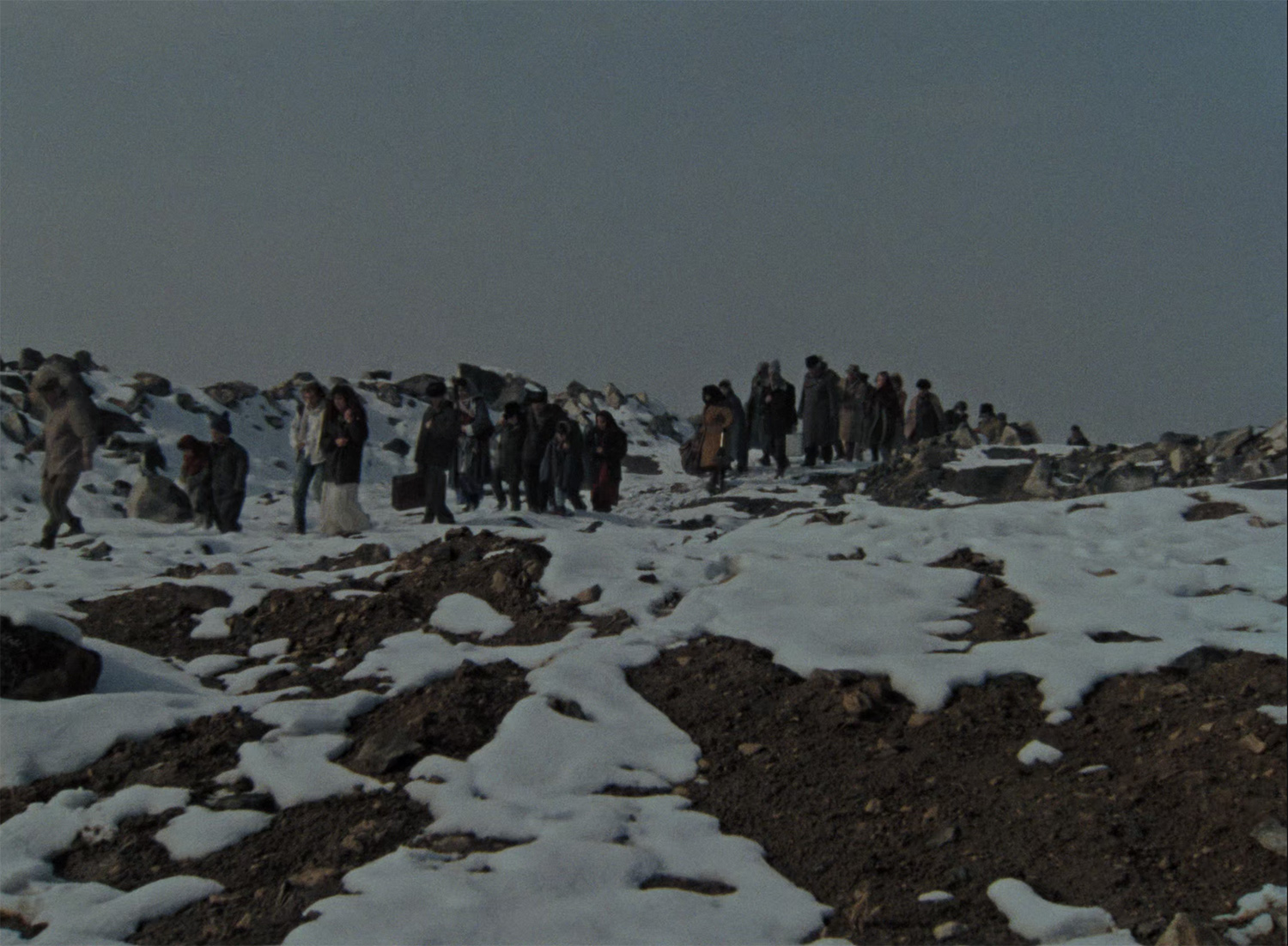
Catastrophe (dir. Dimitri Kesayants, 1993)
Non-Linear Narratives of Alienation in Dimitri Kesayants’ Catastrophe
Clara Cuccaro
On 7 December 1988, the town of Spitak in northern Armenia suffered a devastating 6.8 magnitude earthquake. The cataclysm lasted over 20 seconds and left 25,000 people dead. Spitak was essentially levelled, as were other nearby industrial towns like Gyumri. Former Soviet President Mikhail Gorbachev rushed to the disaster site and was dumbfounded by the scene. “In my entire life,” he declared, “I’ve never seen one-thousandth of the suffering I’ve seen here.” Dimitri Kesayants’s final narrative film Catastrophe (1993) is set days after the quake. Highly stylised despite some physical and technical constraints (limited film stock, for one), Catastrophe presents us with a bleak, struggling view of society that is simultaneously absurd, alienating, and totally reliant on its site-specific location.
Everyone in Catastrophe is at their wits ends, creating a Kafkaesque world filled with despair. Kesayants’ script unfurls as a non-linear multi-narrative, where interlocked vignettes and supporting characters are favoured over a traditional three-act structure, emphasising the collective response to the earthquake rather than a singular vision. Children are crying for their lost mothers while coffins are handed out like loaves of bread. Two lovers perform sonnets from Romeo and Juliet while others starve, begging them to shut up. There’s a woman carrying around a log that she cradles like a baby. Was Kesayants inspired by Lynch? Probably not, yet this woman functions like Margaret Lanterman in Twin Peaks, witchlike but all-knowing, hopeful yet worried for the future. Most of these characters circle around a group of recently escaped convicts whose actions serve as the backbone of the film’s sprawling narrative. There seems to be a hierarchy within the ensemble that’s predicated on these men’s brute force, a “survival of the fittest” logic that manifests itself in a public stoning and a premature burial.
Shot between the end of the Cold War and the energy crisis known as the “dark and cold years” in Armenia, Catastrophe chronicles a chapter in the country’s recent history that few outside it could fully understand
Some of these emotional, heavy-handed moments register as theatrical, but because Catastrophe was shot in the ruins of Spitak itself, reality offers a sobering juxtaposition to the film’s events. Kesayants uses the city’s destruction to express his characters’ emotionally fraught mental states. There are no safe havens here; everything is ruined. Most “indoor” spaces are cracked and drenched with rain, which turns them into liminal areas. This indoor/outdoor dichotomy is reminiscent of Andrei Tarkovsky, who often used derelict houses to hopscotch across different planes of memory. But where Tarkovsky’s cinema painted these interstitial places in a near-dreamlike light, Catastrophe punches us with their reality. Kesayants shuffles his characters’ mental states into further unrest by layering the film’s sound design to make this world all the more hellish. Diegetic noises like the constant drip of water and the shattering of glass combine with Edgar Hovhannisyan and Yuri Harutyunyan’s thrumming score to heighten everyone’s precarious mental states. Home, and the memories associated with it, no longer exist in a place like this.
While people suffer, the camera works like a Rosetta Stone, decoding the film’s absurdity. In the opening scene, we see seven convicts fleeing a penal colony in the snow. As they sprint away from captivity, time washes over them while the camera slowly zooms out, an extreme long shot that doubles as an apt summation of the distant position we will be forced to adopt before these horrific events. Throughout, Catastrophe leaves us watching from the outside in. Cinematographers Levon Atoyants and Ashot Mkrtchyan use impersonal, objective camera angles that align with the audience’s point-of-view rather than with that of its characters, alienating us from the people and experiences on screen. Framing devices such as barbed wire, rubble, and fallen wires function like barred windows, keeping us at arm’s length from the film’s subjects and effectively preventing us from sympathising with anything on screen. Familiarity, and the comforts we associate with the subjective point-of-view shots of conventional narrative cinema, are not entertained in Catastrophe.
Fictional though it may be, Kesayants’s film functions like a snapshot in time. Shot between the end of the Cold War and the energy crisis known as the “dark and cold years” in Armenia, when aid and rebuilding were stalled in Spitak and Gyumri, Catastrophe chronicles a chapter in the country’s recent history that few outside it could fully understand. The almost impersonal camera angles, coupled with the desperation and loose morals the film immortalises, make these experiences almost unfathomable to the typical film viewer – so astonishingly terrifying are their nature and scale. The horrors experienced in Spitak were not universal. They were specifically Armenian.
Clara Cuccaro is a freelance critic from NYC whose work has appeared in Reverse Shot and Screen Slate.
Explore our collection of Armenian titles here.


 Go back to journal home page