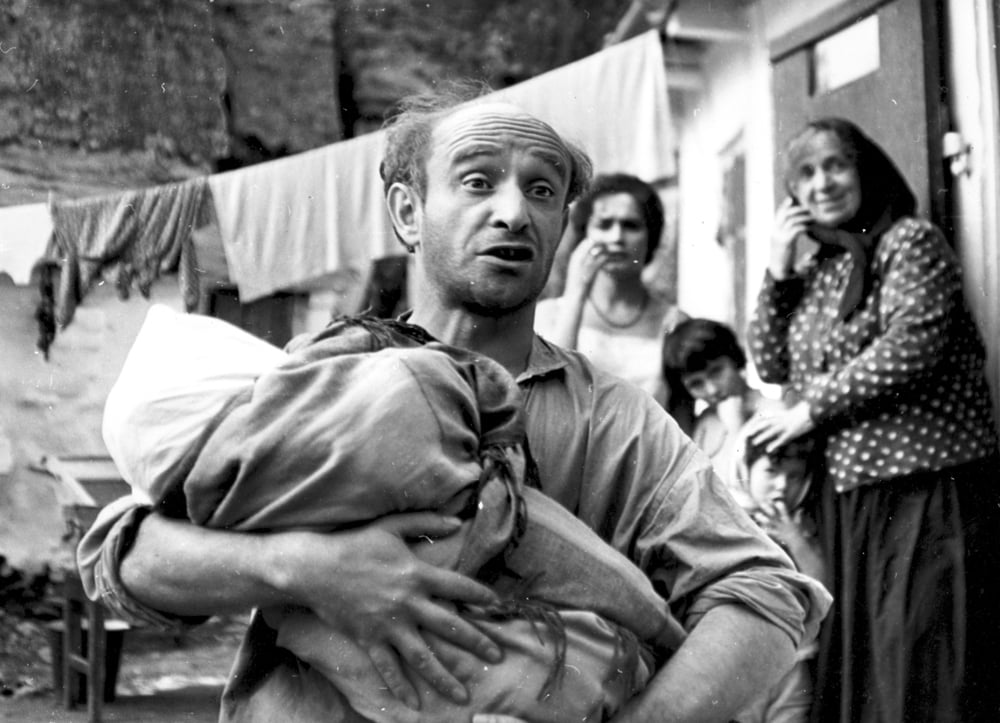
Rolan Bykov in Commissar (dir. Aleksandr Askoldov, 1967)
On the surface, the case of Aleksandr Askoldov’s 1967 film Commissar might not seem extraordinary. Made in a period of conservative cultural backlash in the Soviet Union, it was deemed ideologically inappropriate and shelved. For two decades, it remained unseen, locked away from both common audiences and film professionals. Only during perestroika, when Soviet institutions underwent sweeping changes, was the film finally released from archival obscurity. First shown in Moscow, it soon reached the Berlinale, where it won multiple awards and became a landmark rediscovery of the era. This trajectory – a film suppressed and later celebrated – was not unusual. Yet there is something peculiar about Commissar’s fate. It was one of the last films to be “unshelved”, and even in the late eighties, the Soviet government hesitated to bring it back. Only after Askoldov delivered an impassioned speech at the 1987 Moscow Film Festival was its release finally approved. Something within this film carried a dangerous force; one that, even in a more liberal political climate, was still deemed safer to keep locked away.
Perhaps it was Askoldov himself who made the film so undesirable. He was an outsider inside the system. Born in 1932, he experienced the repression of his parents in the Stalinist Purges at a young age. Nevertheless, after completing his philological education, he entered the Party’s inner circles, becoming a productive Soviet official, working closely with then-Culture Minister Ekaterina Furtseva and other high-ranking figures as a censor. On the other hand, he had his scholarly work. While not overtly nonconformist, it bore a subtle mark of protest – he conducted extensive research on Mikhail Bulgakov, an author whose relationship with the Soviet government was deeply fraught. These contradictions lay at the core of Askoldov’s personality.
Askoldov’s career was derailed, and he was expelled from the Party. Yet his actions in producing Commissar seemed not overtly political, but rather existential: an attempt to preserve his right to see the world, and communism, as he believed it to be
Despite his stable and promising career within the Ministry of Culture, Askoldov eventually stepped away from his administrative duties and enrolled in directorial courses at Moscow’s prestigious VGIK film school. But Commissar proved to be both his first and last feature film. The reasons for its suppression were numerous: it explored Jewish themes, it denied the humanitarian mission of the Revolution, and its style was deemed too “formalistic”. Though regarded as a loyal ideologist and committed communist, Askoldov’s career was derailed, and he was expelled from the Party. Yet his actions in producing the film seemed not overtly political, but rather existential: an attempt to preserve his right to see the world, and communism, as he believed it to be.
Superficially, the film’s subject aligned with the ideological demands of the time. In the late 1960s, the Soviet Union was celebrating the 50th anniversary of the Revolution, and film studios marked the occasion with a wave of historical films glorifying the country’s early years and the violent struggle of the Civil War that consolidated Bolshevik power. Many of these films bore similar titles, emphasising the grand figure of the Commissar, the Party representative who imposes ideological rigour on a chaotic world: The Ballad of the Commissar (dir. Aleksandr Surin, 1967), The Commissars (dir. Mykola Maschenko, 1971), The Extraordinary Commissar (dir. Ali Khamraev, 1970). Within this wave, a quieter, more introspective shift was taking place. Directors like Gleb Panfilov, with No Path Through Fire (1967), began to explore the revolution through a more personal lens. Panfilov’s film follows a young nurse during the Civil War, grappling with the chaos around her, questioning the very necessity of violence. Her response to the war is artistic: she creates folkloric images of destruction, as if trying to reach the essence of human brutality. A romanticised vision of Soviet history persisted, but it was now infused with an undercurrent of doubt and emotional turbulence. These grey areas, where ideology met personal struggle, created a vital contradiction: a state-mandated celebration of history that, paradoxically, fuelled a cinematic reinterpretation of the same.
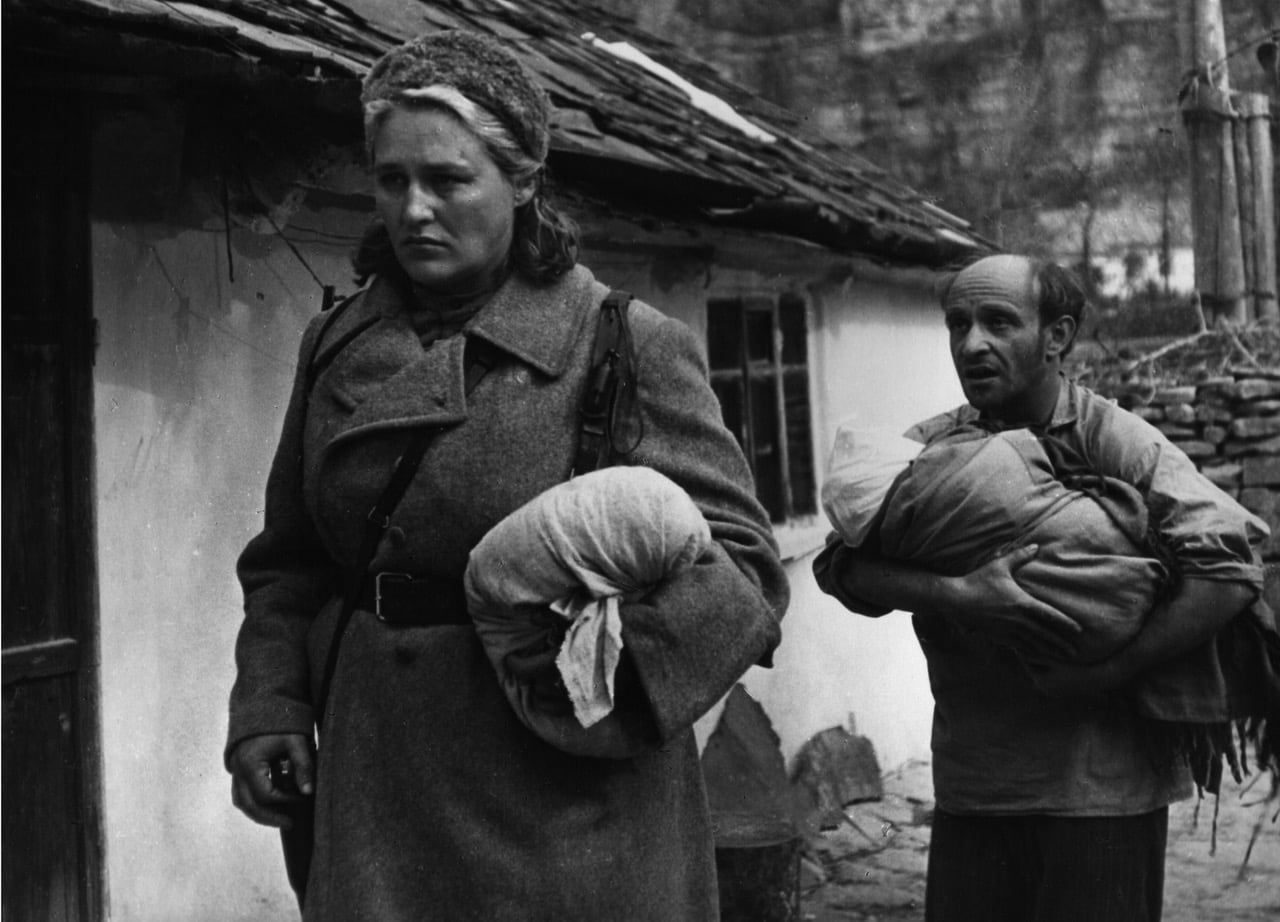
Nonna Mordyukova and Rolan Bykov in Commissar (dir. Aleksandr Askoldov, 1967)
Even within this context, Commissar stands apart. One reason is the origin of the script. For his source material, Askoldov chose Vasily Grossman’s short story In the Town of Berdichev. Though originally published in the mid-1930s, by the sixties its author had largely faded into obscurity – less than a decade after his final novel, Life and Fate, was seized and banned. Set during the Civil War, it follows a Red Commissar named Klavdia Vavilova (Nonna Mordyukova), who finds herself unexpectedly pregnant. She is sent to a village controlled by the Reds and placed in the care of a Jewish family in the Ukrainian town of Berdichev to see out her pregnancy. After giving birth, she abandons her infant to reunite with her comrades and disappears back into the current of the Revolution. Grossman’s story is only about seven pages long, so Askoldov greatly expanded upon it. The film’s narrative follows the same structure, yet its essence derives from the way that Askoldov allows for life to flow freely into the spaces between the dramatic events.
This is the first sense in which Commissar is a landmark film. In Askoldov’s picture, the Revolution is not the dominating force. Instead, the narrative unfolds in a space that is both broader and more profound. It is mainly occupied by Efim Magazanik, the patriarch of a Jewish family, brilliantly portrayed by Rolan Bykov. Vavilova and Magazanik are not directly opposed to each other. Instead, their interaction is more subtle; it lies in the contrast between Vavilova’s militant idealism and the chaotic traditional life that Efim’s family embodies. The vitality of the Jewish world, so ancient yet so vibrantly alive, opens up an entirely new realm of experience for Vavilova, not just an emotional journey but also a physical one. Initially defined by her role as a soldier, Vavilova gradually rediscovers her identity as a woman, as well as the mysteries of motherhood, shared with her by Maria, Efim’s wife. The moment Vavilova dons a dress represents a soft transition. It is as if she is trying to grasp the unfamiliar yet magnetic force pulling her toward an entirely new understanding of herself.
Through its aggressive, almost chaotic aesthetic, the film conveys a simple yet radical idea: war, no matter how sacred, does not preserve life – it undoes it
The Jewish household is portrayed with such nuance that it feels almost tangible – you can sense its textures, its smells, its warmth. Within this small, self-contained world, life pulses with resilience, even as history looms. But the presence of another, militant mode slips into it. This is conveyed powerfully in one of the film’s most intense sequences: the labour scene. For those around Vavilova, childbirth begins as a sacred act. Maria swiftly prepares the space, guides Efim away, lays Vavilova down, and drapes a white sheet over her – a gesture that evokes the solemnity of a rite of passage. Yet, as the labour progresses, pain takes hold, and the sacred dissolves into sheer agony. Amid her contractions, Vavilova is consumed by visions of war: sun-scorched battlefields, struggling soldiers, a carriage stuck in the dirt as its gun wheels sink into the earth. These images do not simply recall Vavilova’s past; they feel prophetic, foreshadowing the inescapable violence that history will continue to bring. These fleeting, fragmented visions come and go until the final, defining image arrives: the death of Vavilova’s lover and the father of her child, a personal catastrophe unfolding within the vast currents of historical disaster.
As the labour sequence makes clear, it wasn’t just the story, but the style in which it is told, that made Commissar so radical, so point-blank. While many films of the era leaned toward realism and a softer, more introspective approach to storytelling, Askoldov arrived with a stark, almost avant-garde aesthetic. His work clearly echoed the cinema of the 1920s, marked by sharp imagery, striking details, rhythmic intensity, and bold contrasts. In early Soviet cinema, these elements were often used to construct a vision of class struggle. Askoldov, however, inverts this mode. Through Vavilova’s fate, he shows how the eternal fight can become a tragic destiny. The unity of life is broken, interrupted, and destroyed. Nowhere is this more striking than in the sequence where children play at re-enacting a pogrom, with guns and faces blurring together in disturbing juxtaposition. Through its aggressive, almost chaotic aesthetic, the film conveys a simple yet radical idea: war, no matter how sacred, does not preserve life – it undoes it.

Commissar (dir. Aleksandr Askoldov, 1967)
During the Stalinist era, historical films served as tools to glorify the heroic past, legitimise the brilliance of the present, and, in doing so, secure a bright future. During the post-Stalinist liberalisation known as the Thaw, filmmakers began revisiting the early years of the Soviet state, not to reinforce past triumphs, but to critically re-examine recent history. Their goal was to redefine the mistakes of the past and reaffirm the “true” communist ideal, assuring that the future remained promising under these ideological principles. Unlike many films of the time, Commissar dismantles the very basics of this myth. In one of the film’s crucial episodes, Efim speaks of a “kind International”: a utopian, almost childlike vision that stands in contrast to the brutality of Vavilova’s world. Yet it lingers as a spark, an alternative that would forever remain a shy dream.
In Commissar’s final moments, as Vavilova reunites with her fellow soldiers, she is suddenly struck by a haunting vision, this time a flash-forward: Efim, his family, and the Jewish population of Berdichev being led to the ghetto, or else the concentration camp. This hallucinatory moment collapses the distance between revolutionary struggle and historical catastrophe. Instead of celebrating the birth of a new socialist world, Commissar is haunted by the uncertain future that lies ahead of it. Askoldov’s vision is apocalyptic, and his perspective carries the weight of twentieth century darkness. For the Soviet authorities, such an approach was intolerable. But for a century defined by unresolved contradictions and unhealed wounds, Commissar remains an unsettling work – one that does not seek to reconcile the complexities of the era, but rather exposes them to the light.
Watch Commissar on Klassiki now and explore our full collection of classic Soviet titles here.
Alisa Goruleva is a Berlin-based filmmaker and film scholar specialising in archival cinema and Soviet film history.

 Go back to journal home page