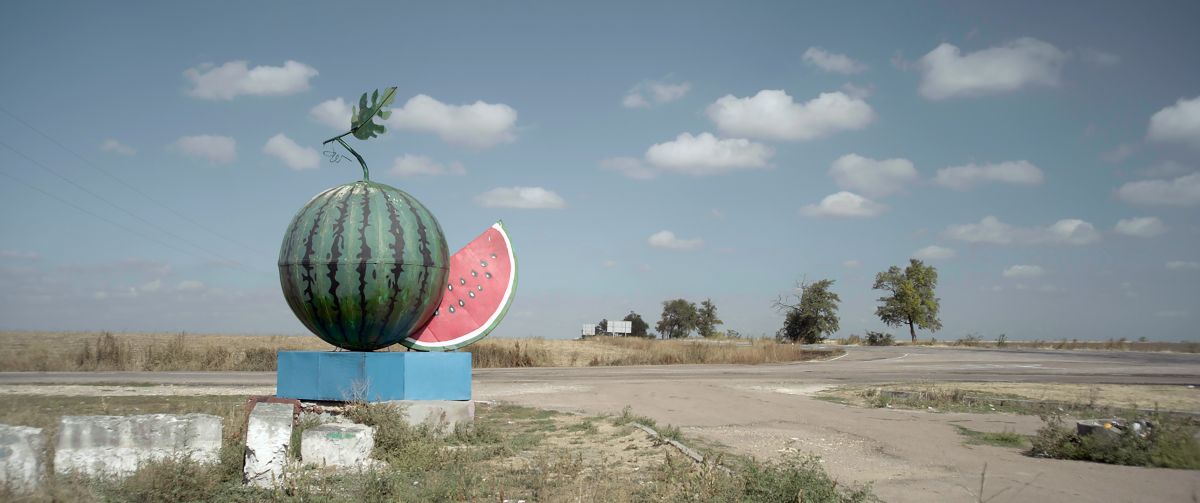
Volcano (dir. Roman Bondarchuk, 2018)
The war against Ukraine has tragically altered our understanding of its territory – place names now resonate for the grimmest of reasons. Perhaps nowhere is this truer than in the south and east of the country, victim of Russian “annexations” and the most entrenched fighting stretching back over a decade. The eastern Donbas region, once synonymous with industrial heritage and decline, is now shorthand for the devastation inflicted on cities like Bakhmut and Mariupol. The metropolitan port town of Kherson, located between Odesa and Crimea has likewise borne the brunt of this combined military and epistemic violence: a strategic stronghold that was occupied and briefly lent its name to a supposed “People’s Republic” conjured by Russia, the city’s liberation in the Ukrainian counteroffensive of 2022 sparked a degree of euphoric defiance in the local population that has since faded as the war drags on; the ecocidal destruction of the Kakhovka Dam in June 2023 has since left its brutal mark.
Watching films from before the full-scale invasion can be a strange and bitter experience. One cannot help but scan them for premonitions of what was to come, a kind of retrospective fatalism. At the same time, they also provide windows onto alternate futures now foreclosed. This blend of pessimism and optimism can be an unsettling one, but it is nonetheless worth sitting with the sensation, bearing witness to the very recent past of a country not reducible to armed conflict. Doing so reminds us of a Ukraine of personal and political frustrations, but also potential – including the potential for comedy.
Bondarchuk is not forgiving of the corruption that blights Ukrainian society, nor blind to its troubled history. But he retains a profound faith in its people. If he makes absurdist comedies, then that is because they reflect life in no-man’s land
In his two fiction features to date, Kherson native Roman Bondarchuk has established himself as one of his country’s most promising filmmaking talents, his drily dark comedies capturing the the stranger-than-fiction texture of life in what the director calls the “no-man’s land” of the southern steppe between Crimea and “mainland” Ukraine. Volcano (2018) arrived halfway between the occupation of Crimea and the escalation of 2022, while The Editorial Office was shot just before the full-scale invasion but only released in 2024. Bondarchuk is well-known in Ukraine as a documentarian – the director of Docudays UA, he made his name with non-fiction titles like Euromaidan. Rough Cut (2014), Ukrainian Sheriffs (2015), and Dixie Land (2015) – and he brings the diligence and analytical bent of the non-fiction world to bear on his fiction films, working with local non-professionals and deriving his subjects from direct encounters with the region and painstaking research into the issues afflicting it. They are bracing to watch in light of Ukraine’s wartime lionisation in the West: Bondarchuk is not forgiving of the corruption that blights Ukrainian society, nor blind to its troubled history. But he retains a profound faith in its people to tackle these problems. If he makes absurdist comedies, then that is because they reflect life in no-man’s land.
A case in point, Volcano began life as a documentary, and the authenticity of local people and locations is key to its success. An encounter with the uncle of his wife and screenwriting partner Dar’ya Averchenko set things in motion. A former fish farmer, in Bondarchuk’s telling, the man “lost everything and wanted to become something again. He constantly invented crazy business ideas. One was to dig up German bombs and sell them. He said, ‘all I need is a good metal detector and some connections in Germany. You should help.’ I took my camera and started to follow him; slowly I was inspired by his philosophy, that every day can be your last.” Together with writer Alla Tyutyunnyk, Bondarchuk and Averchenko abandoned their non-fiction plans, realising that the paradoxes of the location and its people spoke for themselves.
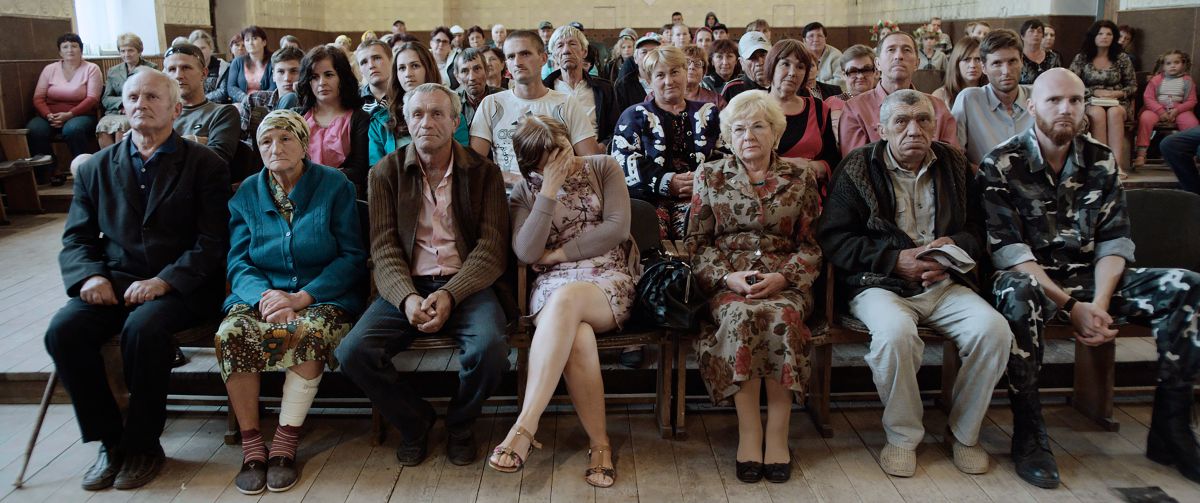
Volcano (dir. Roman Bondarchuk, 2018)
The film follows Lukas (Serhiy Stepansky), a strait-laced interpreter for the Organisation for Security and Cooperation in Europe (OSCE), one of the many international groups who hovered over the disputed territories of eastern Ukraine in the post-Maidan years. Lukas is accompanying a team of foreign delegates across the parched steppe around Kherson when their car breaks down. When Lukas returns after wandering off to find mobile signal, both car and delegates have disappeared. What follows is a kind of deadpan Deliverance, as our hapless protagonist finds himself drawn ever deeper into the obscure corners of this quasi-militarised hinterland. After hitching a ride, Lukas is invited to stay with Vova (Viktor Zhdanov) and his daughter Murushka (Khrystyna Deilyk). Vova is an eccentric who enjoys sticking spoons to his forehead using the supply of glue that was his severance payment from the Soviet fish farm he worked for; things only get weirder from there.
It is a pleasure to watch Bondarchuk and his regular cinematographer Vadym Ilkov working out their distinct style as Lukas’s ordeal unfolds. Stepansky and Zhdanov aside, the actors are non-professional locals, and filming was determined by location (the town of Beryslav on the River Dnieper) rather than any dramaturgical considerations. By shooting only on either fixed tripods or with handheld cameras, Ilkov creates a blend of cinéma verité immediacy and stately, static compositions that is both immersive and alienating, reflecting Lukas’s relationship to the place and people around him. There’s something here of Sergei Loznitsa’s grotesque farce Donbass (2018), but Bondarchuk’s is a gentler, more sincerely ironic, and more generous vision of a world stuck inside its own absurdities. In the words of critic Phil Hoad, the film “feels post-historical, post-democratic and – with everyone comically flailing for their bearings on this disorientating new frontier – almost post-ironic.”
Bondarchuk’s blend of cinéma verité immediacy and stately, static compositions is both immersive and alienating. There’s something of Sergei Loznitsa in here, but Bondarchuk’s is a gentler, more sincerely ironic, and more generous vision of a world stuck inside its own absurdities
Irony, along with truth, may be one of the first casualties of war. The references to the OSCE in the former film speak to the tension of the so-called “frozen” conflict (always a misnomer) before 2022. The Editorial Office brings us right to the brink – and in its bruising epilogue, to the imagined future end – of the full-scale war. Filming took place prior to the invasion, and by Bondarchuk’s own reckoning, the film was “50 per cent” complete by the time the tanks rolled in. The conflict looms large over the finished film, both narratively but also, tragically, in extra-filmic terms: it is dedicated to its editor, Viktor Onysko, who was killed in action defending the city of Soledar.
In Bondarchuk’s words, the film functions as a “time machine”, although the distance travelled into the past is disconcertingly short. Again, it draws on his personal history as well as his research into his native land and his encounters with its people. The Editorial Office, as its title suggests, is set in the world of local journalism. Bondarchuk’s father had been a writer for a party paper in Soviet times, the now-derelict offices of which appear in the film. This left the director, as he puts it, with an instinctive awareness of the “two realities” that any plucky local reporter must navigate: the one that you can write about, and the one that you cannot. Lead actor Dmytro Bahnenko was also working as a journalist when Bondarchuk met him, reporting on both local environmental issues and the Russian occupation. As they had done with Volcano, Bondarchuk and Averchenko incorporated these real-life details into their fictional narrative, even going so far as to send Bahnenko to acting classes for several months so that he could convincingly play the part himself.
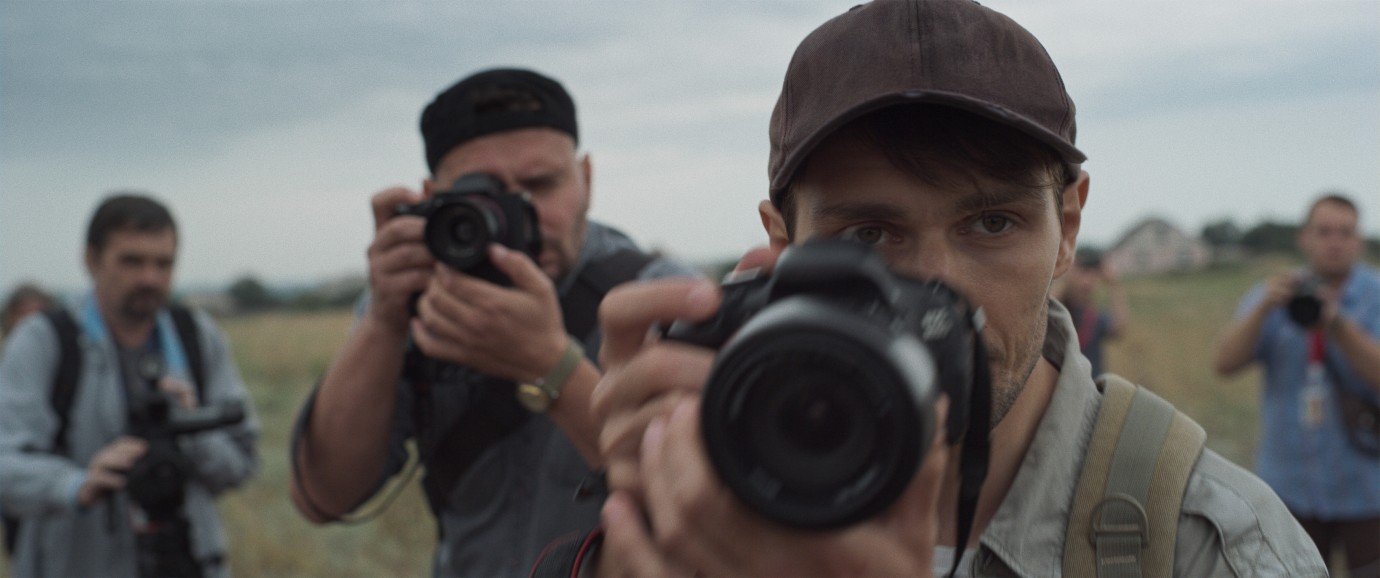
The Editorial Office (dir. Roman Bondarchuk, 2024)
Bahnenko plays Yura, a young biologist at the sleepy Kherson Natural History Museum. Together with his colleague Mykhailo (Oleksandr Shmal), Yura spends his time in the nearby sand dunes and forests in search of an endangered species of groundhog. If found, the critter could make the area viable for inclusion in the European Green Belt, saving it from economic repurposing. But instead of the elusive rodent, Yura witnesses (and photographs) arsonists starting forest fires. It is when he takes the evidence to the local press that his troubles truly begin. Fired from the museum for muckraking, he finds himself on the staff at a sensationalist local tabloid, where he starts to unravel the threads of a bewildering conspiratorial network with designs on the upcoming mayoral elections.
The above summary hardly does justice to the picaresque world that Bondarchuk sketches out over the course of the film. Call it a documentarian’s response to a post-truth world. Sub-plots include his efforts to extract his mother (Rymma Ziubina) from the clutches of a sinister American cryptocurrency hawker; his charged interactions with her lover Ruslan (Andrii Kyrylchuk), a party apparatchik and part-time neo-shamanic cult leader; and his burgeoning relationship with Lera (Zhanna Ozirna) a disgruntled newspaper colleague and activist involved in civilian preparations for the Russian invasion that everyone knows is around the corner but which the authorities are choosing to ignore. Meanwhile, the editors at Yura’s paper are hacks and frauds to a man, knowingly serving up conspiratorial and lurid material in order to stay on the right side of the political fence. Bondarchuk has described the hectic narrative has a “response to the environment… this terrible reality. It’s impossible to wrap this reality in a simple form.” The truly disturbing thing is that this chaos is by design: as Ruslan tells Yura, it’s what keeps the region from being overrun from the outside. But is this instable stability worth the collateral damage?
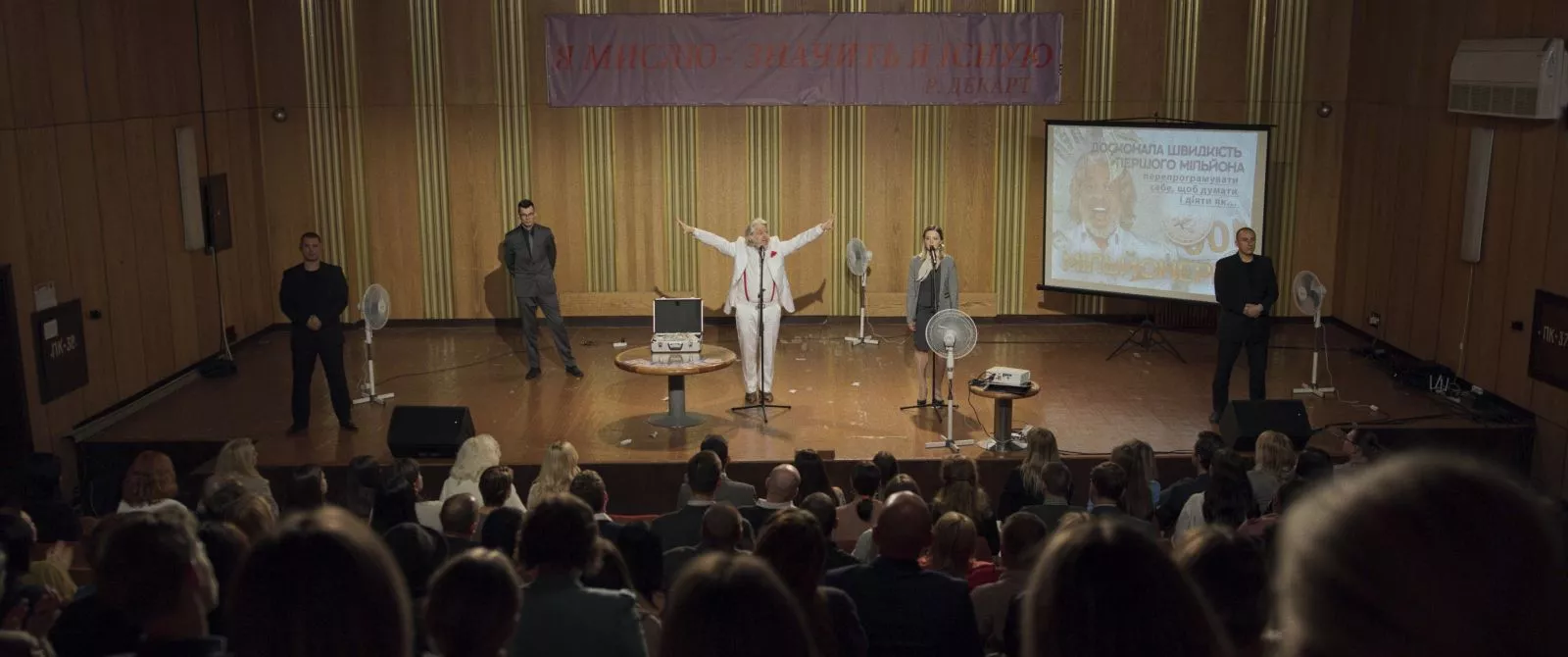
The Editorial Office (dir. Roman Bondarchuk, 2024)
This is not to say that the film lacks a moral core. Yura and Lera may be naïve to the point of self-destruction, but there is heroism in their dedication to exposing the corruption around them. Likewise, the volunteers trying to prepare the ground for Russian aggression in the face of official diffidence. “The most dedicated people with the right values are always the minority, but when they come together, they can change this reality,” as Bondarchuk put it to Cineuropa when the film premiered at the Berlinale. The cause of national self-defence is posited as the glue that will ultimately bind together all these disparate post-truth realities. Certainly, the questions of municipal corruption and media malingering have taken a backseat during the war. Kherson has suffered grievously. “Most of the locations in which the film was shot no longer exist,” Bondarchuk notes in an interview with Variety. “They have been destroyed, flooded, or burned. What happened to the people who starred in the film is also unknown.”
With this in mind, the coda to The Editorial Office is all the more striking. The war is over. A Zelensky stand-in – flanked by comical avatars of Western leaders including Boris Johnson and Olaf Schultz – leads a symbolic tree-planting ceremony as part of reconstruction efforts in the Kherson region, while soldiers sweep for landmines. The villainous politicians and editors we have come to loathe are, of course, in attendance, preening for the cameras and burnishing their own post-war reputations. And the likes of Yura and Lera are nowhere to be seen. In a film defined by deadpan absurdism and flights of fantasy, the sequence is startling for the bitterness of its irony in the face of eventual “victory”. It’s a brief, potent glimpse into the challenges that will be faced by post-war Ukrainian cinema, and Bondarchuk’s uncertain place within it.
Watch Roman Bondarchuk’s Volcano on Klassiki now as part of our new collection of cult contemporary comedies.


 Go back to journal home page