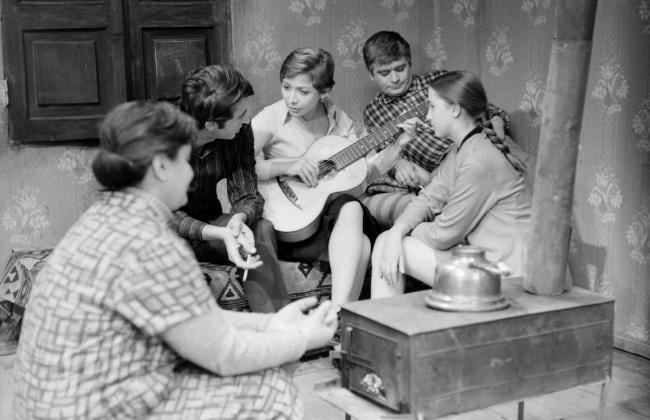
Pastorale (dir. Otar Iosseliani, 1971)
Otar Iosseliani was a Georgian filmmaker. Or was he? On its face, it’s an absurd question. Alongside contemporaries like Eldar Shengelaia and Tengiz Abuladze, he was one of a handful of directors who helped to define the national character of post-war Georgian film: the lyricism, the absurdism, the attachment to folk cultures. Iosseliani remains an icon for many Georgian filmmakers even several decades into post-Soviet independence: see Alexandre Koberidze’s description of Iosseliani in an interview with Klassiki as “like mythology for us.” A handful of epithets swirl around the director when he’s eulogised today: Iosseliani was a confirmed non-conformist, a cinematic anarchist, a champion of misfits, drunks, and underdogs. All of which is true – but then what does it mean to be an anarchist and also an avatar of national identity? Iosseliani was unable to reconcile himself to either the Soviet studio system or to Western capitalist production. To understand Iosseliani’s Georgianness, one needs to get inside the films he produced in the country and figure out how exactly their non-conformism functions.
There is relatively little to go on. Despite working as a director in Georgia for 17 years, Iosseliani completed only five shorts and three features – Falling Leaves (1966), There Once Was a Singing Blackbird (1970), Pastorale (1971) – before emigrating to France in 1982. In Falling Leaves, a young man named Niko (Ramaz Giorgobiani) begins work as a technician at a Tbilisi wine factory, where he quickly learns some handy life lessons for the Soviet sixties. His bosses are pressuring him to deliver a sub-standard product, while his comrades in the cellars are pressuring him to get drunk with them. The well-meaning, reclusive Niko is hard-pressed to maintain his dignity even before his love interest Marina (Marina Kartsivadze) pits him against her violently jealous ex for fun. Four years later, Iosseliani returned to Tbilisi and to another relentlessly lackadaisical male protagonist. This time it’s Gia (Gela Kandelaki), a percussionist in the State Opera House who rushes into the orchestra pit each evening just in time to make his timpani cue. Outside of work, he’s a perpetual motion machine scurrying through the streets and homes of the capital, bumping off of jilted lovers, angry bosses, and a parade of incidental characters shepherding him towards a tragicomic end. Iosseliani’s final feature-length take on his homeland, Pastorale, sees a budding string quartet sent down to the countryside in classic Soviet brigade style. From their rehearsal spot on a balcony overlooking the village, they witness rural life go by in its sempiternal cycle of petty disputes, drunken dinners, and hard labours.
Iosseliani’s films are powered by contradictions: alienated labour versus artisanal craft; city versus country; the Western canon versus Georgian tradition; duty versus responsibility
From the off, Iosseliani’s films are powered by contradictions, structured around sets of dichotomies that push and pull our protagonists through the hedgerow maze of his narratives: alienated labour versus artisanal craft; city versus country; the Western canon versus Georgian tradition; duty versus responsibility. But for Iosseliani, contrast does not invite judgement. The oscillation between settings and value systems is less a means of identifying heroes and villains, and more questioning what it means to live decently in a compromised world. In the words of Raphaël Bassan, “Iosseliani is a watercolourist of everyday life, casting an ethnologist’s gaze on his contemporaries without defending any clearly identifiable ideological thesis;” in the words of Niko’s boss in Falling Leaves, “look around you. This is no time for principles.”
Falling Leaves opens with a trademark Iosseliani gambit: an undifferentiated documentary sequence. A group of villagers is making wine the traditional Georgian way, in huge terracotta qvevri amphorae buried in the earth; when the work is done, they break bread together and join in a round of polyphonic folk song. As the film unfolds, the meaning of this opening gambit seems clear: the urban, Soviet “wine factory” is a Red Fordist distortion of the true craft of the vineyard and the communality of rural life. Principled, diffident Niko is the inheritor of a noble, native tradition; his strait-laced, conformist friends Otar (Gogi Kharabadze), with his neatly ironed shirts and submissive response to criticism from above, represents the cynicism of acquiescence. But these binaries do not ultimately map onto a set of value judgements. Otar is, after all, a conscientious guy. Niko is a city boy through and through, not a transplant from some village utopia. And the ambiguous ending – in which the factory chief congratulates Niko for disobeying his own command not to meddle with the bottling of a defective cask of wine – suggests that decency might run all the way up the career ladder. As critic Konstanty Kuzma puts it, “Falling Leaves is not a black-and-white lesson in dissidence, but rather a meditation on what kind of life one should strive for.”
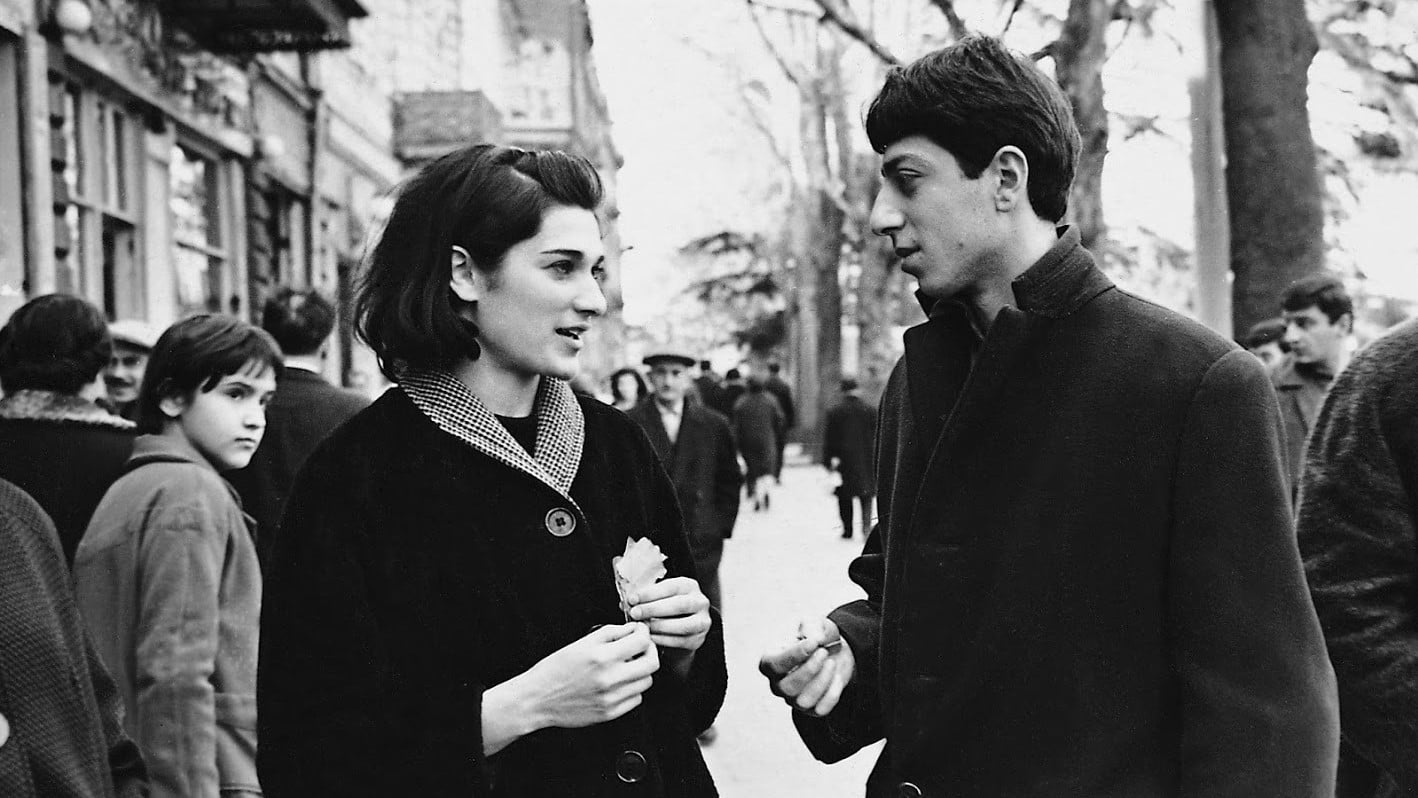
Ramaz Giorgobiani and Marina Kartsivadze in Falling Leaves (dir. Otar Iosseliani, 1966)
The same could be said for both Singing Blackbird and Pastorale. These are films not about who is and is not decent; they are films about decency. Is our wayward percussionist Gia a rebel against the strictures of Soviet sociality, or a self-involved lothario with a seemingly endless succession of pissed off women left in his wake? He is forever doing favours and running errands, while also leading his friends astray in the process. The point that his feckless approach to his job hammers home is that his value as a person cannot be reduced to his labour. Pastorale, meanwhile, allows Iosseliani to dwell explicitly on the city versus country polemic. The film consists of a series of encounters between the city slicker musicians and their village hosts, a string of missed opportunities for connection across the urban-rural divide. Given his affection for certain strains of Georgian cultural tradition, we might expect Iosseliani to set the string quartet up for a fall, teaching them and us a lesson about the earthy values of the village. But the most scathing critique here is reserved precisely for the locals, whose lives are dictated by an impenetrable logic of drinking and quarrelling at odds with the laid-back craft of their guests. It is they who seem attuned to what Carlo S. Hintermann terms the director’s “conspiracy of pleasure.” For Hintermann, Iosseliani’s “subversion of worlds was always an artistic gesture.” All three of Iosseliani’s Georgian features have titles that invoke the natural world; none are Romantic in the generic sense.
Where did this open-ended, multivalent sensibility come from, if it is not reducible to nostalgia for an unspoilt Georgian past? Perhaps from Iosseliani’s peripatetic education, which included composition courses at the Tbilisi State Conservatoire – his love of Western classical music is as evident in his films as his affection for Georgian polyphony – as well as a stint as a mathematician. Of course, he was also a product of Soviet film pedagogy, a graduate of the prestigious VGIK film school in Moscow, where Iosseliani benefitted from the post-Stalinist practice of having classes delivered by elder statesmen of the industry (even if, by all accounts, Iosseliani’s was largely discontented as a student). The lyricism and love of nature of Oleksandr Dovzhenko, the radical editing techniques of Lev Kuleshov, and the expressionistic flair of Grigorii Kozintsev – all of whom taught Iosseliani at points during his time at VGIK – resurface in his work. (Iosseliani, naturally, downplayed the significance of these mentors, citing Jean Vigo’s L’Atalante – released the year he was born, 1934 – as the spark that convinced him to pursue his own brand of cinematic anarchy.)
“Culture is not something where one cellist performs, and the others, who don’t know how to play, listen to him. Culture is when everyone knows how to do something”
Or perhaps we should heed the lessons that Iosseliani learned during his years as a discontented worker. In 1959, his documentary short Sapovnela, a portrait of the elderly florist Mikheil Mamulashvili, was re-cut and then denied distribution; two years later, his medium-length pseudo-silent comedy April likewise fell afoul of the censors. Sensing the uphill struggle ahead, Iosseliani abandoned filmmaking for several years. Between 1963 and 1965, he worked on a fishing boat, and then at the Rustavi metallurgical factory, an experience that informed his 1964 short Cast Iron, a sardonic riff on the peons to Soviet industry produced under Stalin. In a piece published after Iosseliani’s death, the Celluloid Liberation Front describe Cast Iron as “a film that rebukes the liturgical glorification of the Soviet worker,” claiming that “rest in his cinema is not peripheral; on the contrary, it is the fulcrum of human possibility.” While all three of his Georgian features are set in and around workplaces, Iosseliani was dismissive of the notion of labour for labour’s sake. It was a conviction that left him perpetually at odds with the authorities in Georgia: the conventions of boilerplate Soviet film narrative, so often structured around labour achievements, were anathema to him.
A Iosseliani film has flow but not direction. His narratives proceed by a series of contingent encounters that take place in a world seemingly without borders. Singing Blackbird is the best example of this: with our perspective tethered to the ever-roving Gia, it feels as though there is no street or room in Tbilisi that we cannot drift in and out of as our hero does his rounds: the orchestra pit, the conservatoire director’s office, a film set, a family dinner. That sense of radical openness also extends to the film’s soundscapes, one of Iosseliani’s calling cards, which hum with diegetic intrusions, from urban din to snatches of music caught in passing. The effect is like turning the dial on a car radio, leaving us prone to bursts of inspiration or irritation.
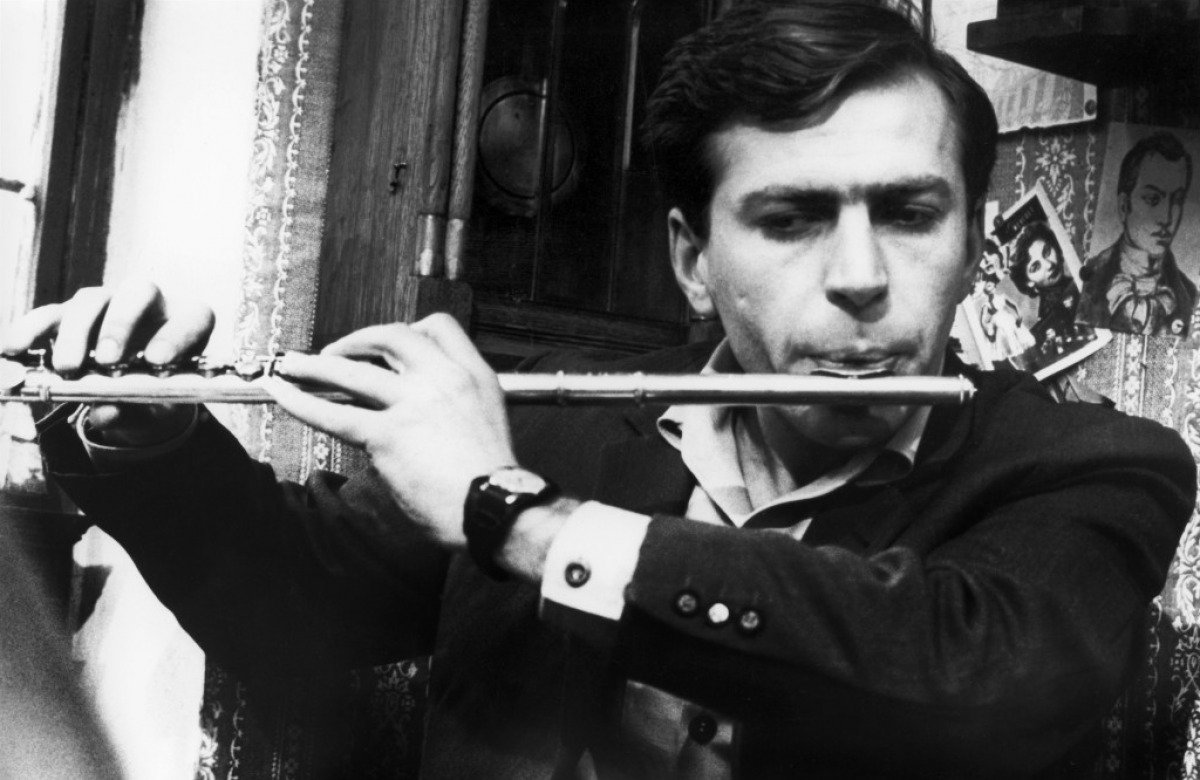
Gela Kandelaki in There Once Was a Singing Blackbird (dir. Otar Iosseliani, 1970)
This is the anarchy, what we might call the horizontality, of Iosseliani’s Georgian films. They dangle simplistic moral lessons in front of us before snatching them away. But this is not to say that Iosseliani is indifferent, let alone nihilistic. He is a generous filmmaker if nothing else, and his works are saturated with the things he thought made life worthwhile: wine, music, craft, flirtation. Together, these constitute for Iosseliani the grammar for his filmic language a value system lost once to the Soviets, and then again to their capitalist replacements. (“In the Soviet Union we have censorship, here you have the box office,” as he once told a French interlocutor.) Maybe this is the best way to read Iosseliani’s Georgianness. In his own words, his films are “parables… and the language of a parable is geared toward a certain kind of universality.” But beneath that universality is attachment to a culture, experienced as a loss, one that the generosity of his films cannot reverse. Iosseliani always refused official political asylum in France: he lived his injuries and his liberties on his own terms.
In an interview with Mikhail Lemkhin from the Soviet twilight of 1991, Iosseliani expounds at length on this question of (national) culture, revealing a kind of fatalism superficially at odds with his fluid film world. “It is the social fabric or the cultural milieu that can change, but no changes occur in our criteria, our notions and systems of values,” he argues. “And if I was born in Tbilisi, in a particular environment, with particular parents, and was moulded by a particular cultural stew – all of that can’t be changed.” As for Georgia at the close of the twentieth century? “Culture, in the sense of a well-constructed system of human relations, has collapsed there.” Typically, Iosseliani can’t help but relate this back to music, for him the purest microcosm of a life lived well with others. “There were songs which required skill, not to mention ability,” he goes on. “They stopped singing the songs, stopped teaching them and stopped learning them. Culture is not something where one cellist performs, and the others, who don’t know how to play, listen to him. Culture is when everyone knows how to do something.” This is the secret to Iosseliani’s strangely traditionalist, even nationalist anarchism. His Georgian films capture a world that he knew was already half-buried, one where “everyone knows how to do something” – and where, as a result, anything can happen.
Our double bill Topsy-Turvy: two by Otar Iosseliani is available now until 17 September.
Otar Iosseliani: Fables of Modern Life opens on 24 July at Asia Society in New York and runs through 8-23 August at Metrograph. Listen to our podcast interview with curators Edo Choi and Inney Prakash here.


 Go back to journal home page