
Margita Gosheva and Maria Bakalova in Triumph (dir. Petar Valchanov and Kristina Grozeva, 2024)
“Guarded by Kalashnikovs, high-ranking officers are digging in search of extraterrestrial intelligence.” So ran the headline in a Bulgarian newspaper in the early nineties, atop a story about a bizarre alien archaeological expedition in Tsarichina, a village around 30 kilometres from Sofia. With orders from the general headquarters and under the patronage of the then-president’s homeland security advisor, a special task force of generals, colonels, and mediums, who were allegedly channelling messages from an advanced alien civilisation, went in search of an artefact that would turn the troubled Balkan state into a post-Cold War superpower.
By the turn of the decade, filmmaker Kristina Grozeva and her co-director husband Petar Valchanov had already made two ripped-from-the-headlines satires about Bulgaria’s troubled post-communist transition. In The Lesson (2014), a provincial schoolteacher is drawn into a debt crisis while trying to investigate a theft at her school; in Glory (2016), a railway worker who hands over a bag of cash found on the tracks to the authorities learns that no good deed goes unpunished. As a child, Grozeva used to pass by the Tsarichina camp on her way to her family’s summer house. It was perhaps inevitable, then, that she and Valchanov would round out their “newspaper clippings” trilogy with Triumph (2024), a fictionalised retelling of the sorry extraterrestrial affair.
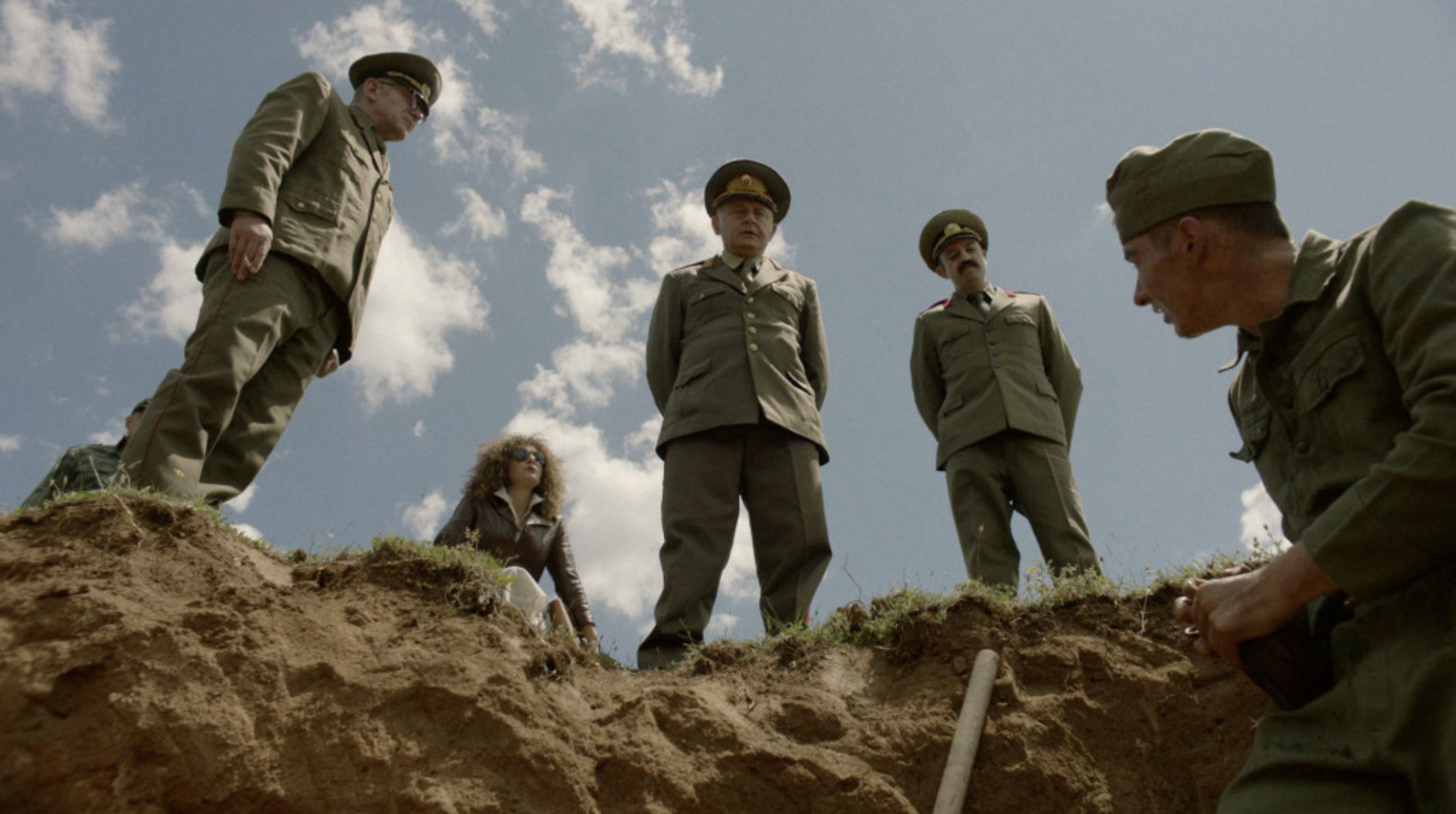
Margita Gosheva stars as Pirina Nyagolova, the personal psychic of General Zlatev (Ivan Savov). Pirina claims to be channelling messages from something called the Galactic Assembly. In this, she is aided by Slava (Maria Bakalova, of Borat Subsequent Moviefilm and The Apprentice fame), the demure and possibly disturbed daughter of Zlatev’s sceptical underling Colonel Platnikov (Julian Vergov). Pirina claims that Slava possesses heightened supernatural powers which will lead the General to an alien capsule, the contents of which promise to elevate Bulgaria to superpower status. As the dig goes on without concrete results, Slava begins to act out of turn, flipping the power dynamic between herself and Pirina with ultimately explosive results.
With Triumph now available to watch on Klassiki, we spoke with Petar Valchanov and Margita Gosheva about the appeal of these stranger-than-fiction true stories, the post-communist supernatural boom, and the unflattering portrait of Bulgaria that emerges their films.
Triumph (dir. Petar Valchanov and Kristina Grozeva, 2024)
This film is the third in a trilogy, going back to The Lesson and then Glory, using sensationalist, real-life news stories to paint a portrait of post-communist Bulgaria. Can you tell us a little about the real-life story behind Triumph? Because it’s possibly the craziest yet.
Petar Valchanov: The real story happened after the fall of communism, between 1990 and 1992. In this period, Kristina [Grozeva] was child. With her family, she was travelling to a house in countryside near to Sofia. And one day, in the middle of a field, they discovered this military camp with soldiers. They stopped them, asked for their passports, papers. It was a very strange and shocking situation for them. They were a little worried, like: “what’s happening here? We’re quite near the border – is this a military base?” Then, three weeks late, a newspaper article came out by the journalist Georgi Stadko, who was the first to reveal the story to Bulgarian society. It had been a year and a half of these guys digging these tunnels when he discovered it. Some months later, the Ministry of Army decided to close the camp.
They never found the alien artefact then?
PV: We don’t know. We don’t know what exactly happened there. There are a lot of stories, legends. We met a lot of people: some local people, some military guys. And all of them have different versions as to what exactly happened. But it’s a fact that high-ranking officers and psychics were involved in this operation. The tunnel was 180 metres long. We know because at the end of the operation, before closing the tunnel, they invited a group of journalists to enter, to see the results of these two years digging. One of the legends was that when you picked up some mud underground and went back up, it became hard. And when you went back down, it became soft again. We tried to look on this operation with a smile. It was very intense period, in this moment after the fall of communism in Bulgaria, when a lot of psychics began to get work.
Margita Gosheva: It was trendy at that time.
[in the post-communist period] people needed help from outer space, because that help wasn’t there for them on earth
Yes, I think people in the West might not be aware, but almost everywhere in post-communist Eastern Europe saw this craze for psychics, telepathy, the supernatural in the nineties. Why do you think that was?
PV: People were locked down during communism, very oppressed, and it was like they were very hungry for the new, for the different… And somehow, with blind eyes and blind stomachs, they tried to taste it, they tried to reach out to these miracles by following their blind faith.
MG: They needed help from outer space, because that help wasn’t there for them [on earth]. There was a desire for somebody or something who would do something for them.
Just on the face of it, this is a very funny story. But there’s also an understandable anger in these films: you’re painting an unflattering portrait of, as you’ve called it, this “fake democracy” that Bulgarians live with. How do you strike the right tone between embracing the comedic and ensuring that the critique comes across?
MG: Well, the absurdity contains truth as well, but in a particular way. It was really interesting to participate in this weird film. I had to go to see tarot readers, astrologers… I watched a lot of Juna’s performances and read her books [Evgenia “Juna” Davitashvili was a Russian mystic who achieved great fame in the late Soviet and post-communist period]. She was involved in Russian political affairs. Deeply involved. She was actually the leader of some operations in Russia – so she was the model for Pirina, my character in Triumph.
PV: I remember that in this period there was another Russian psychic who was very popular in Bulgaria, Anatoly Kashpirovsky. He had a slot on national TV before the beginning of the news in which he would hypnotise the audience. There were nine million [people in Bulgaria] at the time. For example, my father watched this show because my he had problems with losing his hair. He was listening, you know, and repeating the words of Kashpirovsky, just to help his hair. The result was opposite, but somehow, he believed in this and he was happy with it. I think that a big part of our society today continues to dig in this hole, living with this blind faith in the miracle. Somebody will come – some alien, or our Russian brothers – they will come and they will solve our problems, and our life will become a dream.

Maria Bakalova in Triumph (dir. Petar Valchanov and Kristina Grozeva, 2024)
These films have specific Bulgarian inspirations, but do you think that there’s a broader relevance here?
PV: I think that, especially after COVID, this craziness in society was elevated, and not only in Eastern Europe or Bulgaria. It’s the entire world. And I’m worried in which direction this will go.
MG: We hope that audiences throughout the world will see something that connects with different cultures, because I think that most of cultures have this particular absurdity, this craziness in their own folklore.
Every country has a similar kind of story, you think?
MG: Well, yes, something similar.
PV: A fresh example is, I think, [in 2023] in Mexico, when scientists brought the body of an alien to the parliament.
a big part of our society today continues to dig in this hole, living with this blind faith in the miracle. Somebody will come – some alien, or our Russian brothers – they will come and they will solve our problems, and our life will become a dream
I missed that story. What happened there?
PV: I’m not exactly sure when this was, but some scientist, they brought the body of an alien. It was big news, but nothing came of it. They extracted something from the body of the alien. They did some tests to prove that it was something from space… [In September 2023, Mexican journalist and UFO enthusiast Jaime Maussan presented two purported “non-human” mummified corpses to the Mexican Congress during a public hearing on Unidentified Anomalous Phenomena (UAP)]
MG: But the body was smaller than expected.
I see.
PV: So, this collaboration between governments, scientists, psychics has perhaps become more common.
MG: I think America has traditions in this direction.
That’s certainly true. I mentioned the term “fake democracy” earlier, which you’ve said is the subject of this trilogy of films. What do you mean by that term exactly? Why is it an important topic for contemporary filmmakers?
PV: Because we are living in this and it reflects on us. And yes, and we are inspired by it. It’s a natural way for us to speak about this. You know, it’s strange for us to think that the story behind The Lesson actually happened. That was actually the most recent historical event. Ten years before that the story that inspired Glory occurred. And Triumph represents the beginning of this process [going back to the early post-communist period]. And to this day, we still have the question of why this happened. Why did things turn out fake?
MG: When you’re growing up, you are told that some things are the ultimate truth. They are repeated to you a thousand times, countless times. But what lies beneath them is a completely different story. It’s like a cardboard box that looks completely different inside and out.
Watch Triumph on Klassiki now until 31 December 2026.
Explore our full collection of Bulgarian titles here.


 Go back to journal home page