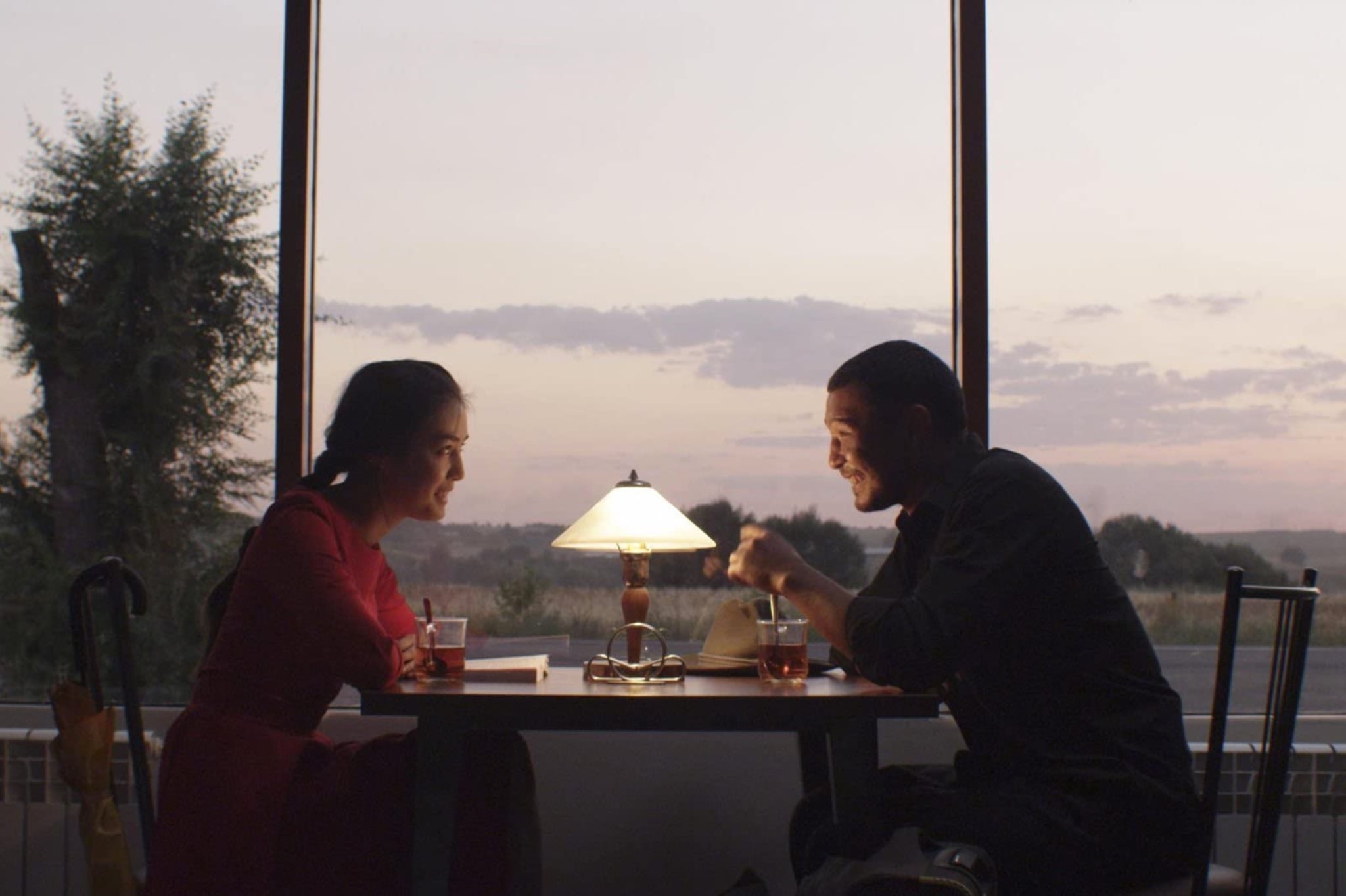
Dinara Baktybayeva and Kuandyk Dyussembayev in The Gentle Indifference of the World (dir. Adilkhan Yerzhanov, 2018)
In 2014, Adilkhan Yerzhanov was a promising if not particularly distinguished filmmaker grappling with the meagre funds and limited exposure inherent to the industry in his native Kazakhstan. The creator of the country’s first ever animated series, Kozy-Korpesh and Bayan-Sulu, all the way back in 1999, at the time he had only two feature films to his name: Realtors (2011) and The Constructors (2013). Both were deadpan, DIY satires about petty corruption and poverty; where the former was a high concept/low budget time travel caper, Constructors was a sombre piece of black-and-white minimalism, the story of two brothers who find their dreams of building a new home threatened by prohibitive local laws, which displayed Yerzhanov’s gift for directing actors and feel for landscape.
Then came a lurch into the unexpected. For his third feature, Yerzhanov took the outlandish decision simply to remake The Constructors – but to transform it in the process into a garish and grotesque musical comedy, complete with buffoonish supporting characters, bursts of bloody violence, and song-and-dance numbers. The Owners, as the new film was known, opened at Cannes, and Yerzhanov was set for a career of festival premieres and arthouse exposure. Rather than miring the director in self-indulgence, this act of meta-cinematic trickery had seemingly liberated him: in the 12 years since The Owners, Yerzhanov has completed 18 features, becoming in the process one of the most singular figures in the landscape of post-Soviet cinema. Simply put, Yerzhanov has managed to construct a self-contained cinematic universe in which to carry on his drolly distinctive genre play, turning the limitations of the Central Asian industry to his advantage. Each new film represents an instantly recognisable repetition and variation on Yerzhanov’s pet themes and stylistic quirks. If the word “auteur” means anything in 2026, then Yerzhanov is a ready example – not to everyone’s tastes, but determinedly himself.
Yerzhanov’s films share an instantly recognisable tone and timbre: sweeping but minimal, naïve but cynical, populist but absurdist. His narratives often blend whimsy with violence.
So, what are the parameters of the Yerzhanoverse? Almost all of his films take place in the vast Kazakh steppe, often in and around the fictional village of Karatas, which first appeared in The Owners. Yerzhanov himself was raised in the central Kazakh town of Zhezqazghan, and his affinity for the rolling plains and foothills of this distinctive landscape is palpable. The director freely jumps between and mashes together genres in his films, from gangster flicks to westerns and romantic comedies, his fleetness of foot enabled by a returning team of core collaborators: producers Serik Abishev and Olga Khlasheva, production designer Yermek Utegenov, cinematographers Yerkinbek Ptyraliyev and Azamat Dulatov.
Yerzhanov’s films also share an instantly recognisable tone and timbre: sweeping but minimal, naïve but cynical, populist but absurdist. His narratives often blend whimsy with violence. He favours quirky, static tableaux which are occasionally interrupted by bursts of sudden action – the result is that everything becomes grist for the director’s bone-dry comic mill. Claustrophobic interiors are offset by classically beautiful landscapes, and characters speak in a laconic, reserved manner that in earlier films was a self-reflexive indicator of the non-professional nature of the filmmaking. Aki Kaurismäki and Jim Jarmusch are often invoked by critics seeking a familiar analogue, while the sheer rate at which he works and his play with repetitions and variations across his films brings to mind another lo-fi Asian auteur, South Korea’s Hong Sang-soo. It is hard, though, fully to comprehend the Yerzhanoverse absent the harsh realities of provincial post-Soviet Kazakhstan, against which his ragtag panoply of strivers, dreamers, and vigilantes must pit themselves.
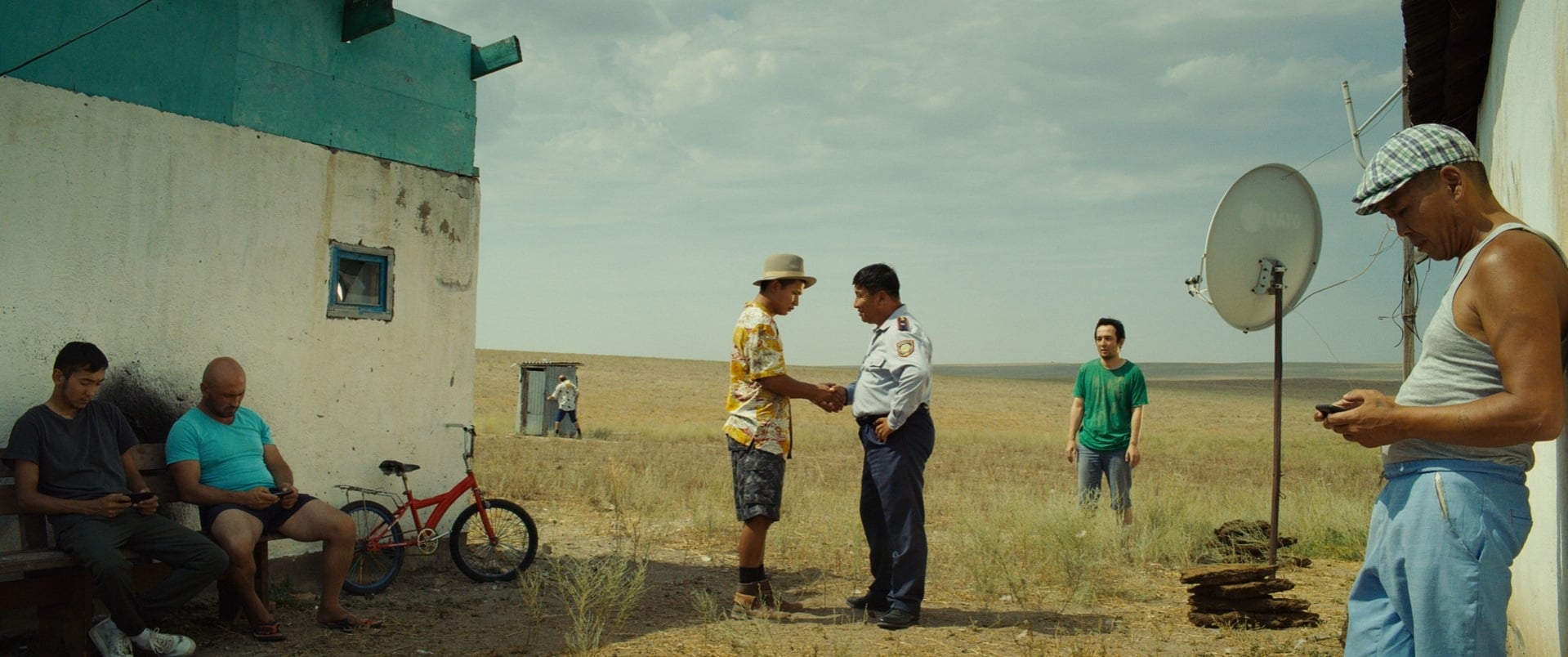
Yellow Cat (dir. Adilkhan Yerzhanov, 2020)
Above all, Yerzhanov is a cinephile, and, taken together, his films often feel like an endlessly unspooling homage to the American and French directors he adores. He has tried his hand at noirish detective tales (2019’s A Dark, Dark Man), underdog sports sagas (2019’s Atbai’s Fight), and neo-westerns (2022’s Assault, whose title may well be a nod to his beloved John Carpenter and his 1976 classic Assault on Precinct 13). In recent years, Yerzhanov has returned several times to violent crime dramas, seemingly fixated on the petty gangsterism that still blights rural Kazakh society – although even here, he has found room for variation. Where Steppenwolf (2024) and Goliath (2022) were often brutal portraits of masculinity in crisis, Ulbolsyn (2020) and Ademoka’s Education (2022) were devoted in their own way to the plight of Kazakh women. His latest film (at time of writing) is both a continuation and a departure of sorts. Moor (2024) is Yerzhanov’s first entirely urban-set thriller, a riff on Rambo that stars regular player Berik Aitzhanov as a traumatised veteran returning to Kazakhstan to enact revenge on behalf of his sister-in-law. References to vintage American action maestros like John Milius and Walter Hill abound.
At the turn of the 2010s, before his lurch into outright action filmmaking, Yerzhanov made a pair of features that perhaps best encapsulate his hermetic blend of self-referential cinephilia and provincial absurdity. Both The Gentle Indifference of the World (2018) and Yellow Cat (2020) are concerned with the poisoning of innocence by the harsh realities of steppe life. In the former, country girl Saltanat (Dinara Baktybayeva) is forced to travel to the city in search of the money that will spare her mother from jail following her father’s suicide. Accompanied by her childhood friend (and ardent admirer) Kuandyk (Kuandyk Dyussembayev), she soon learns how wide the gap between her ideals and the reality of contemporary Kazakhstan truly is. The latter stars Azamat Nigmanov as Kermek (Azamat Nigmanov), an ex-con who heads to the hills with his sex worker belle Eva (Kamila Nugmanova) with nothing but a gun, a stolen box of mob money, and the unlikely dream of opening a small repertory cinema.
Above all, Yerzhanov is a cinephile, and, taken together, his films often feel like an endlessly unspooling homage to the American and French directors he adores.
If Yerzhanov’s films had always been informed by the classic Westerns – in their love of landscape and their concern with the uneasy balance of law and disorder – in Gentle Indifference of the World he adds a colourful spin on post-war France to the mix, from the film’s Camus-quoting title to its references to Paris and Jean-Paul Belmondo. What holds this gladbag of influences together is the director’s ever-earnest indictment of corruption, capitalist heartlessness, and abuse of power. If Kuandyk’s and Saltanat’s relationship seems almost sickly sweet at times, then this only serves to render their fate all the more bitter. Through the contrast between the countryside and the city, Yerzhanov brings cold economic logic to bear on romance. “I realised how vulnerable people in love are and how vulnerable their feelings are because of the reign of money everywhere,” the director has said. “This film is about two people who are trying to protect and preserve the morality that exists in love.”
If Gentle Indifference sees Yerzhanov up the meta-cinematic playfulness, Yellow Cat sees it pushed from the realm of subtext to outright subject matter. Another Karatas feature, it knowingly applies the tropes of Western crime films to the corruption of village life. Most tellingly, its protagonist Kermek is himself a film fanatic, one who understands his own actions in terms dictated by his love of those same crime films. His incongruous outfit of trenchcoat and fedora is an homage to his unlikely hero: Alain Delon in Jean-Pierre Melville’s exquisitely cool 1967 hitman caper Le Samouraï. Critic Lucía de la Torre calls Kermek a “Kazakhstani Don Quixote, with a love for French cinema instead of epic novels, [who] is neither a hero nor an anti-hero.” In Yerzhanov’s own words, his hapless romantic is “a folk character who came to modern times. He has a pure and simple understanding of the world: good is good, evil is evil. It won’t be easy for such a hero to survive in this cruel world. But he is kind, and his kindness will help him to get through everything.”
As the figure of Kermek demonstrates, Yerzhanov is nothing if not explicit about his influences. At points in this Kazakh take on Bonnie and Clyde, he inserts musical cues from Carl Orff’s theme music for Terrence Malick’s lovers-on-the-run classic Badlands (1973). The whole enterprise of Yellow Cat – and of the Yerzhanoverse in toto – is perhaps encapsulated in the scene in which Kermek performs a charmingly shambolic impersonation of Gene Kelly in Singin’ in the Rain for an audience of one in front of a jerry-rigged movie screen in the dusty Kazakh foothills.
Watch Kazakh Capers: two films by Adilkhan Yerzhanov on Klassiki now.


 Go back to journal home page