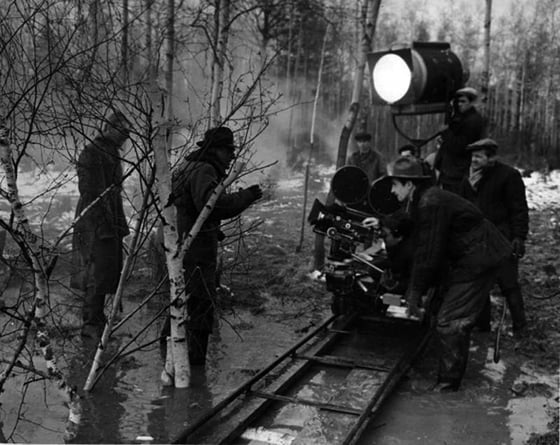
Mikhail Kalatozov and Sergei Urusevsky during shooting for The Cranes are Flying (1957)
Next month will mark 60 years since the premiere in Havana of one of Soviet cinema’s greatest gambits. I Am Cuba, Mikhail Kalatozov’s dizzying epic of revolutionary history, encapsulated the potentials and frustrations of international co-production, signalling the end of Soviet cinema’s post-Stalinist bloom while helping to kickstart Cuban cinema’s era of independence. More poignantly, it marked the end of the collaboration between Kalatozov and cinematographer Sergei Urusevsky. Over just seven years and three features – The Cranes are Flying (1957), Letter Never Sent (1959), and I Am Cuba – the pair had reinvented Soviet (and Cuban) film, kickstarting the cinematic “Thaw” and winning the USSR’s only Palme d’Or in the process. The radical visual style of their collaborations was forged in war but celebrated life in all its freewheeling and tragic beauty. Theirs was one of the great director-cinematographer partnerships.
Although he is remembered now by the Russified version of his surname, Kalatozov was born to a minor noble Georgian family in Tbilisi as Mikheil Kalatozishvili. By the time he entered the national Georgia-Film studios in 1936, he had a wealth of filmmaking experience under his belt. His first major commission had come in 1930, when he directed and shot the experimental ethnographic feature Salt for Svanetia alongside two avant-garde luminaries, screenwriter Sergei Tretyakov and editor Viktor Shklovsky. Nominally a documentary about the harsh realities of life in Ushguli, a village in the remote highland region of Svaneti, the film depicts the history of the Svans and their quasi-medieval present as a continuum that can only be broken by the arrival of Bolshevik modernity.
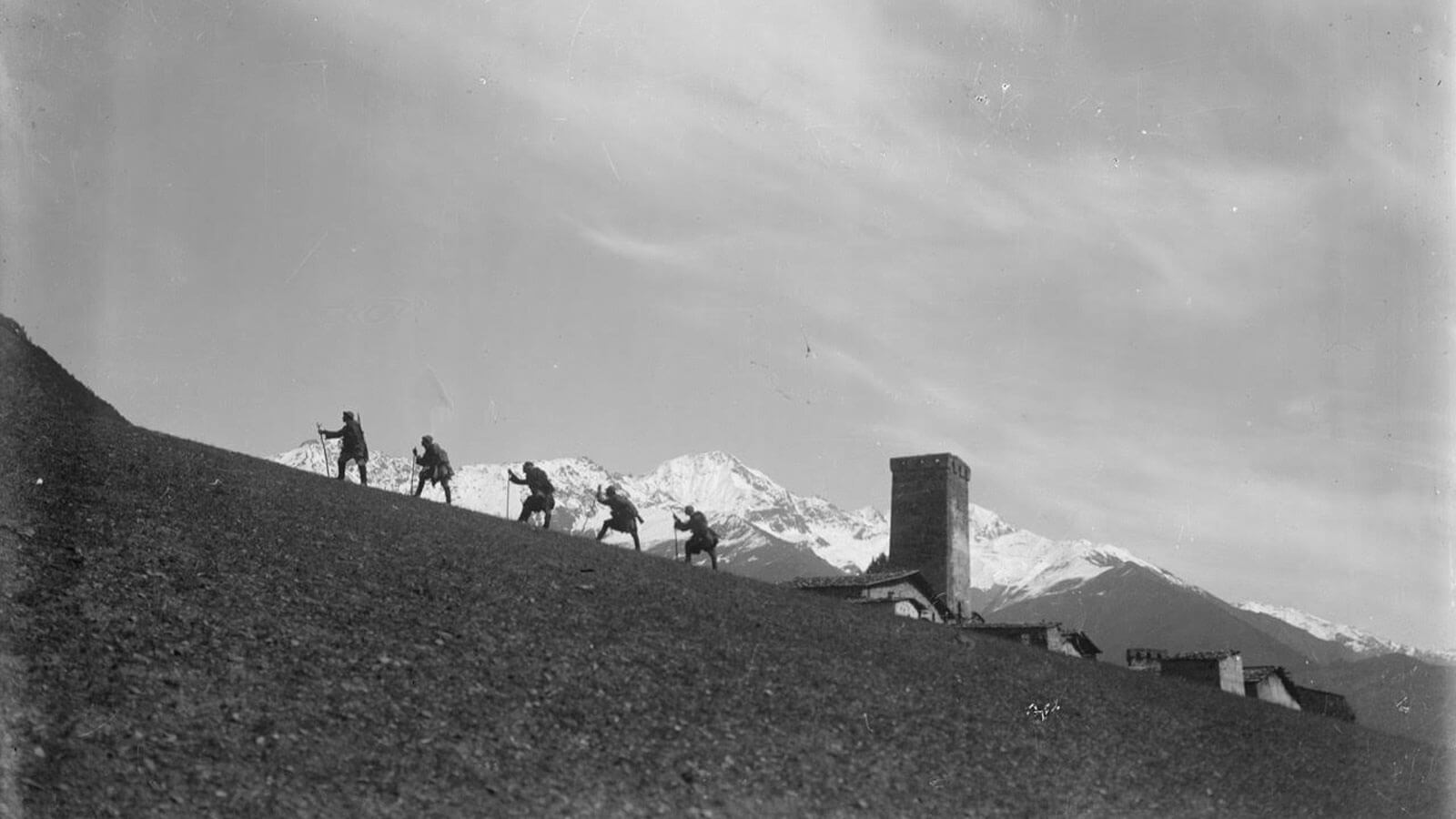
Salt for Svanetia (dir. Mikhail Kalatozov, 1930)
With its extreme close-ups, disorienting camera angles, rapid cross-cutting, and multiple points-of-view, Salt for Svanetia is clearly indebted to the Soviet avant-garde of Eisenstein, Vertov et al. But it also contains the seeds of Kalatozov’s own future career. Its sweeping camera, locked in a dance with the stunning landscape, seems to presage Kalatozov’s and Urusevsky’s post-Stalinist triumphs. Its ethnographic energies and its interest in the battle between man and nature look ahead to Letter Never Sent – in the words of scholar Michail Kunichika, Kalatozov’s was “a vision of the socialist project in which the primitive cannot be avoided nor wholly dismissed.” A nominal non-fiction film bolstered by fictionalised and dramatised sequences, it troubles simple definitions of both documentary and propaganda in much the way I Am Cuba would later do.
After relocating to Russia on the eve of the Second World War, Kalatozov spent the remainder of the Stalin era directing rote genre pieces, including biopics of the feted Soviet aviator Valerii Chkalov in 1941 and former secret police chief Felix Dzerzhinsky in 1953. Like the rest of Soviet cinema, he would soon find himself liberated by the so-called “Thaw” – the period of cultural and social liberalisation that followed Khrushchev’s denunciation of Stalin in 1956. In a sense, though, Kalatozov had already made his breakthrough in 1955, when he was paired with Urusevsky for the first time on the collective farm romance The First Echelon. The film was forgettable, but a crucial connection had been made.
Urusevsky was a frontline cameraman for the Red Army and claimed that he developed his love and talent for handheld shooting while at war, labelling the distinctive style of his Kalatozov collaborations “off-duty camera”
Like Kalatozov, Urusevsky had been working since the 1930s. While Kalatozov had spent the war producing propagandistic features and moonlighting as a cultural attaché, Urusevsky was a frontline cameraman for the Red Army. The experience proved formative in more ways than one: Urusevsky later claimed that he developed his love and talent for handheld shooting while at war and labelled the distinctive style of his Kalatozov collaborations as “off-duty camera”. A move to the prestigious Mosfilm studio in 1950 eventually brought him into contact with the director; two years after The First Echelon came the film that would change both their lives and the current of Soviet filmmaking, The Cranes are Flying.
Cranes was not the first film of the Thaw – the likes of Marlen Khutsiev and Eldar Ryazanov had already made inroads in the preceding years – but it represented the first full blossoming of this new cinematic tendency. In style and subject matter, Soviet film was undergoing a transformation. The keyword in critical circles was “sincerity” – shorthand for a kind of revolutionary romanticism in reaction to Stalinism’s “varnishing of reality”. “It is the task of the masters of Soviet cinema to depict life and people’s emotional being in all their fullness, depth and contradictory complexity,” wrote critic Olga Shmarova in 1953. This insistence on sincerity and interest in ordinary protagonists also informed Thaw film’s treatment of the war and its lingering aftermath. Stalinist film had made little room for the brutal trauma inflicted by the war on ordinary citizens; now, that trauma demanded recognition. The Soviet Union lost between 10 and 14 per cent of its entire population during the conflict: 27 million dead, around 35 per cent of all Soviet men between the ages of 20 and 50 killed in the space of four years.
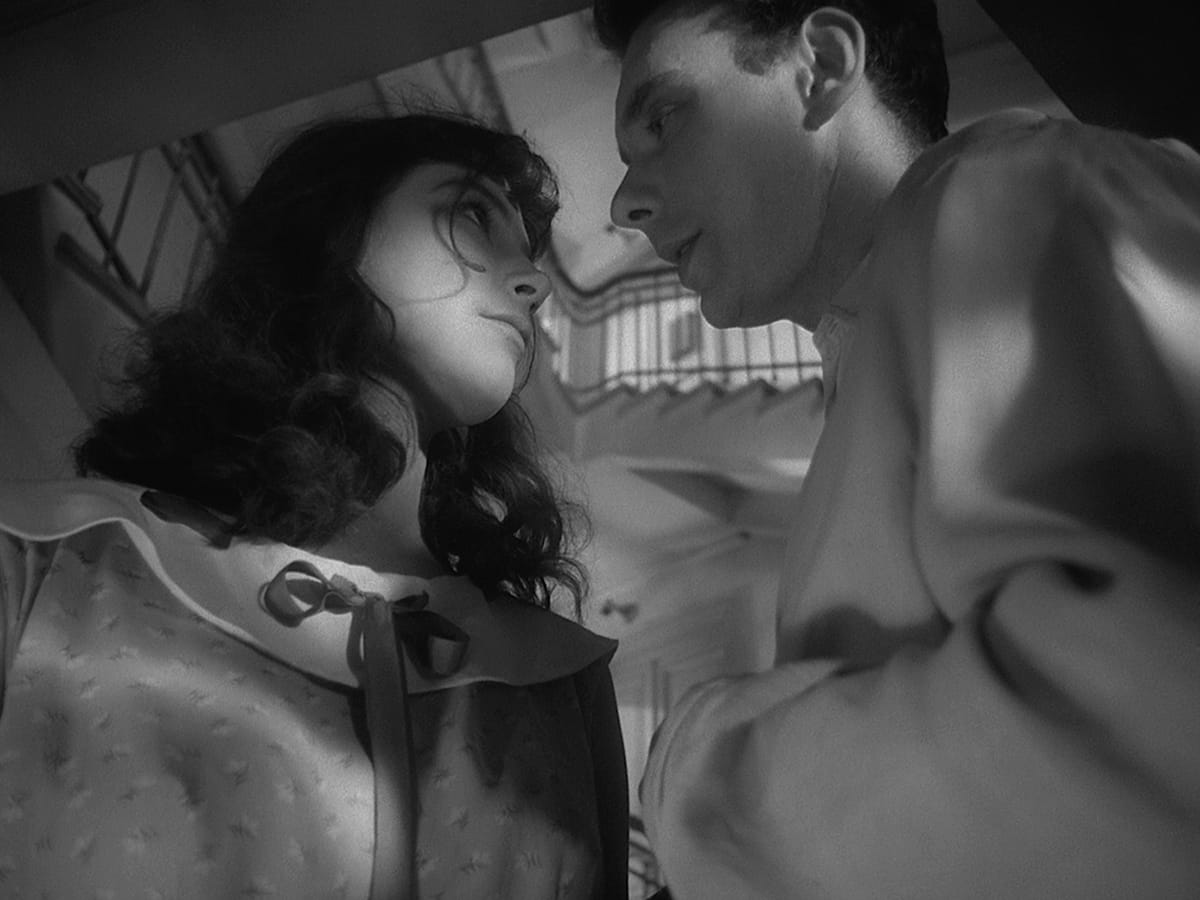
Tatiana Samoilova and Aleksei Batalov in The Cranes are Flying (dir. Mikhail Kalatozov, 1957)
The Cranes are Flying mined this collective trauma for melodrama without resorting to sensationalism or exploitation. The film is built around the electrifying lead performance from first-time actress Tatiana Samoilova as Veronika, who loses both her parents and her lover Boris (Aleksei Batalov) to the war and is forced into an uneasy surrogate domesticity with the dead man’s family. Veronika’s Tolstoyan narrative arc was a radical departure from the secular national saints of earlier war films; here was a protagonist whose endurance had limits and whose concern with her personal tragedy only gives way to a sense of collective affect in the very final moments of the film.
Urusevsky captures the action, from quiet domestic tension to terrifying air raids, with an electrifying, liberated camera. His mix of subjective and objective perspective, his ability to zoom in and pan out of crowd scenes, and his innovative use of handheld cameras helped to make unremarkable characters sing from the screen. As Soviet critic Maia Turovskaia noted, “When you leave the theatre, you don’t know whether the image of Veronika owes her charm to… Samoilova’s talent and sincerity or to Urusevsky’s art, able to catch in the turn of a head, a momentary pose, the blink of eyelashes, the helplessness and obstinacy, the tenderness and pride of this particular woman’s character.” The film was a sensation, winning the Palme d’Or at Cannes and seemingly signalling Soviet cinema’s re-entry onto the world stage.
“When you leave the theatre, you don’t know whether the image of Veronika owes her charm to Samoilova’s talent and sincerity or to Urusevsky’s art, able to catch in the turn of a head, a momentary pose, the blink of eyelashes…”
The Cranes are Flying makes much of the relationship between human emotions and the natural world: the title refers to the return of the migratory birds to Moscow, a traditional marker of the arrival of spring. Kalatozov and Urusevsky pushed pathetic fallacy to its absolute limit in the follow-up. Letter Never Sent reunites the duo with Samoilova, as well as screenwriter Viktor Rozov, here adapting a story by Valery Osipov. The film follows a quartet of geologists dispatched to the depths of the Siberian wilderness in search of diamonds. The titular missive, heard in voiceover, is addressed to the wife of group leader Sabinin (Innokenty Smoktunovsky, the future star of Grigori Kozintsev’s 1964 Hamlet). A love triangle develops between the remaining three scientists – Tanya (Samoilova), her bookish boyfriend Andrei (Vasily Livanov), and the brooding Sergei (Evgeny Urbansky) – that teeters on the edge of explicit eroticism. But this petty human drama is soon overwhelmed as a forest fire sends the group careening into the wilderness, with the second half of the film dedicated to their increasingly hopeless battle against the elements. It is here that Urusevsky comes into his own, deploying a seemingly endless array of cinematographic means to convey the primordial power arrayed against the group. Raging fires, rushing torrents, and biting frost, captured in wide-angle lenses and a yawning Academy aspect ratio by a camera that prowls the landscape like a predator, leave our nominal protagonists receding into irrelevance.
Letter Never Sent refashions earlier Soviet genres for the brave new world of the Thaw. Stalinist film had rejoiced in narratives of adventure and conquest, in which the vast territory of the Soviet empire submitted to Bolshevik bravado; Kalatozov’s own aviation dramas can be considered in this light. Indeed, so could Salt for Svanetia and the director’s 1969 Arctic odyssey The Red Tent. Here, though, there is none of the triumphalism of those earlier titles. Urusevsky’s work on the film was an acknowledged influence on the great Andrei Tarkovsky, whose sophomore feature, Ivan’s Childhood (1962), recalls Letter Never Sent in its sinuous camerawork and the primordial imagery of its flooded forest landscapes.
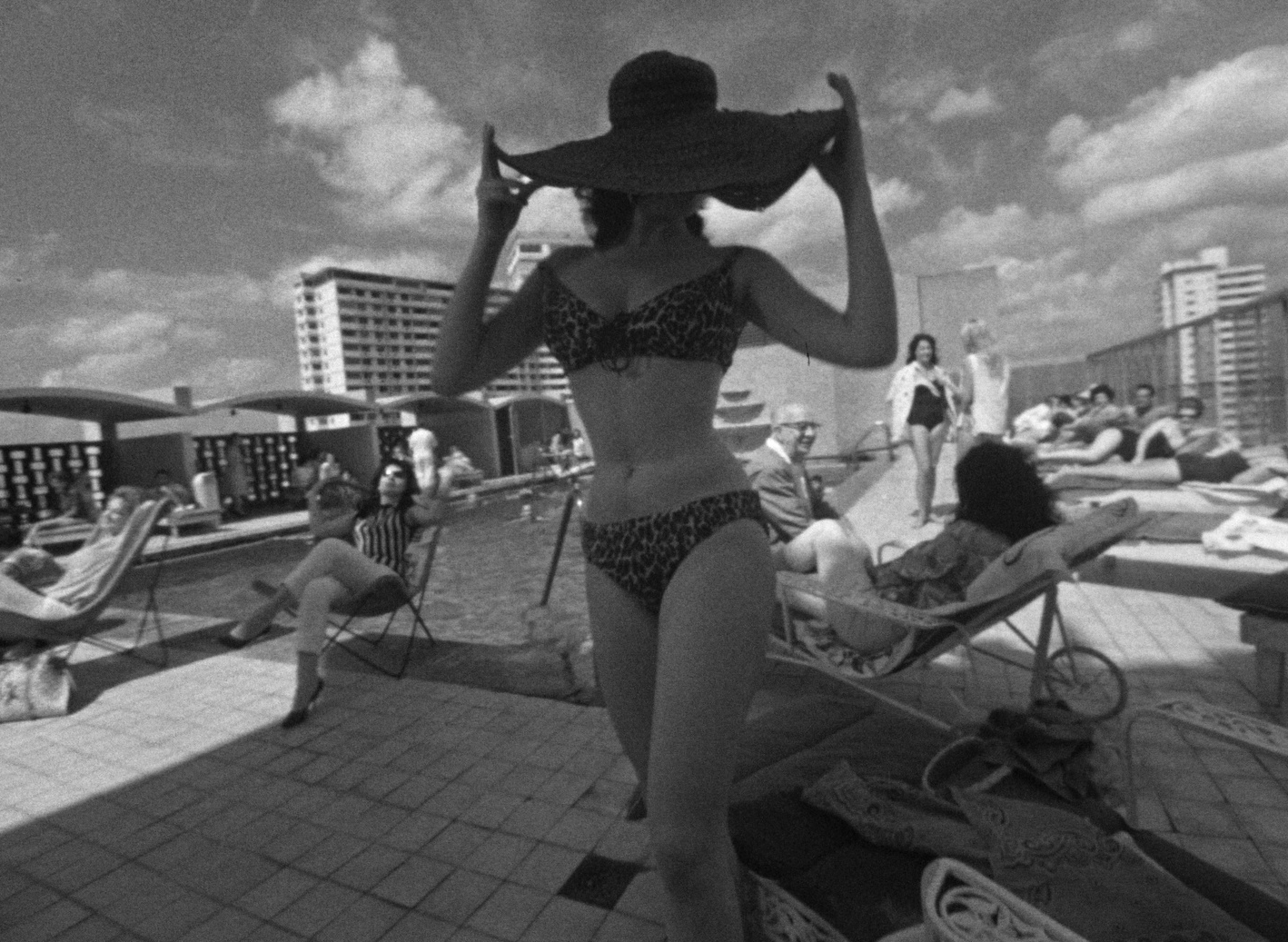
I Am Cuba (dir. Mikhail Kalatozov, 1964)
A few weeks before the premiere of I Am Cuba, Nikita Khrushchev had been ousted as premier of the Soviet Union in a move that many cite as the final nail in the coffin of the Thaw era. Khrushchev’s fall from favour had much to do with his handling of the Cuban Missile Crisis two years previously. It is fitting, then, that the final collaboration between Kalatozov and Urusevsky, who had done so much to advance the Thaw in Soviet cinema, should centre on the Caribbean island. Having consolidated power since the 1959 revolution, the Cuban state turned in earnest in the early sixties to the question of culture. With little in the way of a native tradition to call on, the Instituto Cubano del Arte e Industria Cinematográficos (ICAIC) invited foreign luminaries including Chris Marker and Agnès Varda to the island to train and inspire local filmmakers. Backed by the financial might of Mosfilm, I Am Cuba dwarfed all previous of these international collaborations. Kalatozov’s team included the Soviet poet Evgeny Evtushenko, who co-wrote the screenplay with Cuban author Enrique Pineda, and the Cuban composer Carlos Fariñas.
Across four vignettes that capture Cuban life on the eve of the revolution, Kalatozov and Urusevsky pushed the methods they had honed over their previous collaborations to the edge of madness. Several scenes – the burning of a sugar crop by a desperate farmer; a nightmarish vision of American sexual predation in a pre-revolutionary nightclub; the infamous sequence in which the funeral parade of a student protestor is captured in a single, mindboggling take – push past mere technical proficiency, achieving a kind of hallucinatory intensity. Perhaps ironically, by the time the shoot began in 1963, the relationship between the USSR and Cuba had soured. Castro’s government was incensed by the Soviets’ reconciliatory response to the Missile Crisis, fearing that the gains of the revolution were begin traded over geopolitical concerns. Kalatozov’s film sides firmly with the armed struggle of the Cuban people, which may explain its less than enthusiastic reception back in Moscow. The film was lauded in Cuba, and remains a milestone in the island’s film history, even though many Cuban filmmakers would later cite it as an example of the nation’s need to move beyond foreign intervention in developing a truly native industry.
The received story in the West is that I Am Cuba was largely “forgotten” until it was rediscovered and restored by Martin Scorsese’s World Cinema Foundation in the 1990s. This is standard Anglophone myopia and largely harmless, although the film’s present-day singular reputation among cinephiles does elide the pre-history of Kalatozov and Urusevsky’s collaborations and the circumstances that produced them. After their Cuban sojourn, the pair parted ways. Kalatozov would attempt another big-budget international co-production in 1969 with The Red Tent, a dramatisation of a disastrous Italian airship mission over the Arctic starring Sean Connery and Peter Finch – but the film feels bloated and lifeless compared to his work with Urusevsky. The director would die without completing another film four years later; his cameraman followed a year later.
Watch Kalatozov’s Salt for Svanetia on Klassiki now and explore our full collection of Soviet titles here.


 Go back to journal home page