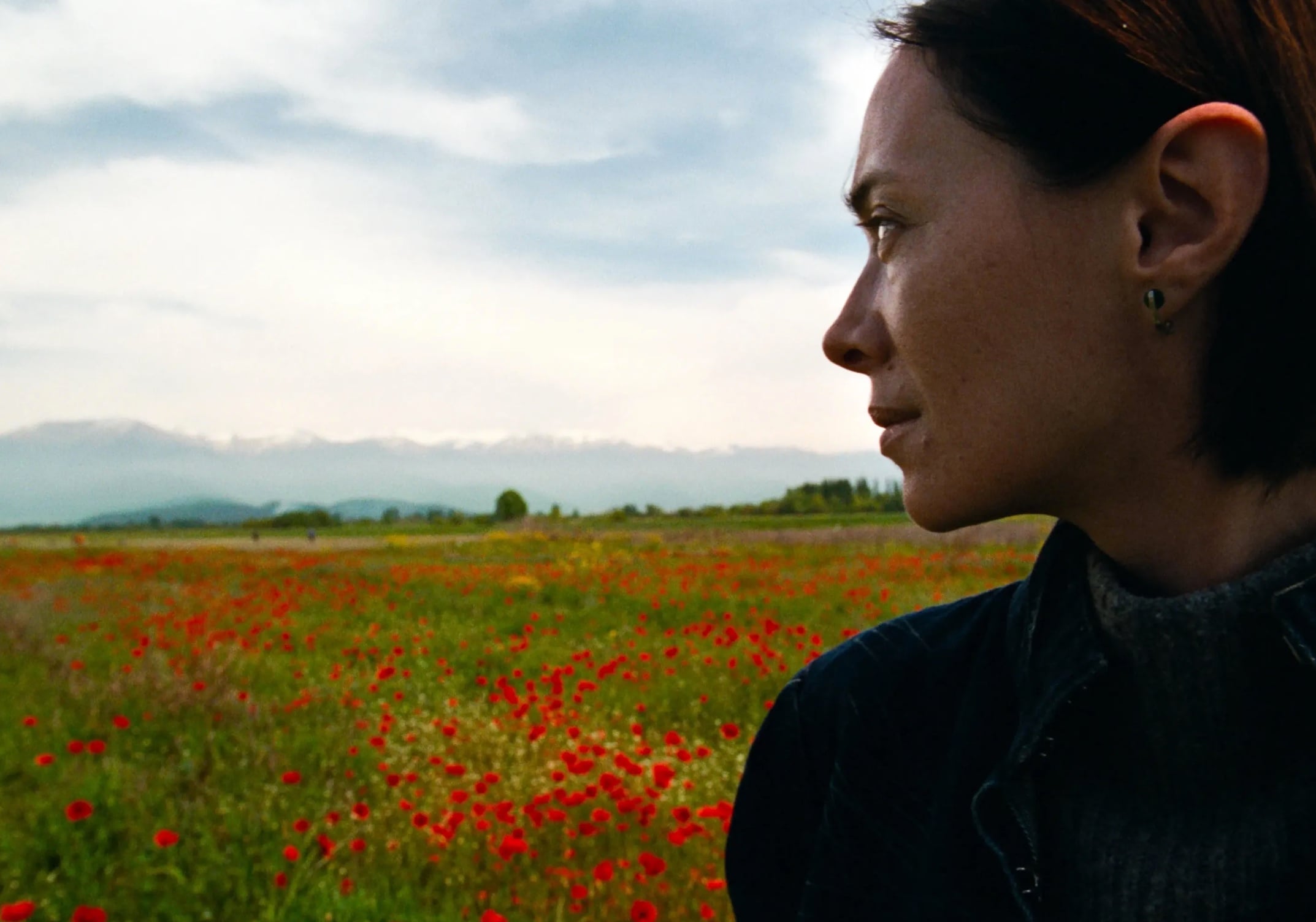
Ia Sukhitashvili in April (dir. Dea Kulumbegashvili, 2024). Image: Arseni Khachaturan, courtesy Memo Films
Nina (Ia Sukhitashvili) is a skilled obstetrician at a maternity hospital in eastern Georgia. After a difficult delivery, the infant dies, and the grief-stricken father demands an inquiry into her methods. The resulting scrutiny threatens to expose Nina’s illicit second career – driving through the stunningly beautiful countryside to the village homes of pregnant girls and women to provide unsanctioned abortions – and to destroy the profession that is the only source of meaning in her life.
This is the intriguing premise of Dea Kulumbegashvili’s sophomore feature, April, which received its world premiere at this year’s Venice Film Festival, coming away with the Special Jury Prize. With its focus on a female protagonist battling against social pressures, the film recalls Kulumbegashvili’s acclaimed 2020 debut Beginning, about the wife of a Georgian Jehovah’s Witness preacher looking for an escape from her religious upbringing. Like the earlier film, April was brought to life through an intensive production process, with a cast that includes accomplished Georgian actors alongside non-professional thespians. But Kulumbegashvili is also pushing into new filmmaking territory – not least in the surreal sequences in which a mysterious, monstrous creature appears to haunt the all-too-human drama.
We caught up with the filmmaker on the Venice Lido, ahead of an intense festival run that will see the film screened in Toronto, San Sebastian, New York, and London. During our conversation, we delved into her creative process, her collaboration with her leading actress, and why this tale sadly remains still timely.
When did you start working on April?
I began working on it in 2021. I just had this [leading] character in mind, then I created and developed the film. The actress I work with [Ia Sukhitashvili] played a huge part in developing her character. I spoke to her a lot during the process.
What did you speak about?
We spoke about many things because we had very different points of view. Back then, she already had children, and I had none. I didn’t want to have any preconceived ideas about anything. In a way, I was trying to abandon my thoughts about what’s right, and I just wanted to listen to everyone – the doctors, the patients, the women living in the villages, and their husbands. That being said, Ia’s presence was crucial; she was very involved [in the project]. Sometimes, we’d go to the maternity clinic together. I stayed there for a year – or maybe longer – but she’d come at least once a week and be there with me, and we would discuss how to craft this character she’d end up playing. Working on this project also required her to do a lot of medical training.
on set, things needed to be very real. For me, when reality is very tangible, overwhelming, and physical, it’s almost unbearable. Then, something unreal begins to happen
How did you balance realism with fantastic elements, especially at the scriptwriting stage?
Writing this script was fun. For me, it was all about one character, and then when these seven producers read it [the picture is a co-production between France, Italy, and Georgia], everybody had a different opinion. And I thought: “Okay, maybe that’s how I want the audience to feel.” But on the page, I had to be more specific because I wanted people to understand exactly what I was doing. And it was impossible to achieve; it required many rewrites. In the end, I just sat down with the artists I was working with, and we started to build it together because, for me, it was very important to create a certain type of reality. Even there [on set], things needed to be very real. For me, when reality is very tangible, overwhelming, and physical, it’s almost unbearable. Then, something unreal begins to happen. [Playing with this duality] always gives the character a way out. It gives them the possibility to hide, to dream, or to be threatened. And, for me, [exploring] this unreal [dimension] is also part of the characters’ transformation process.
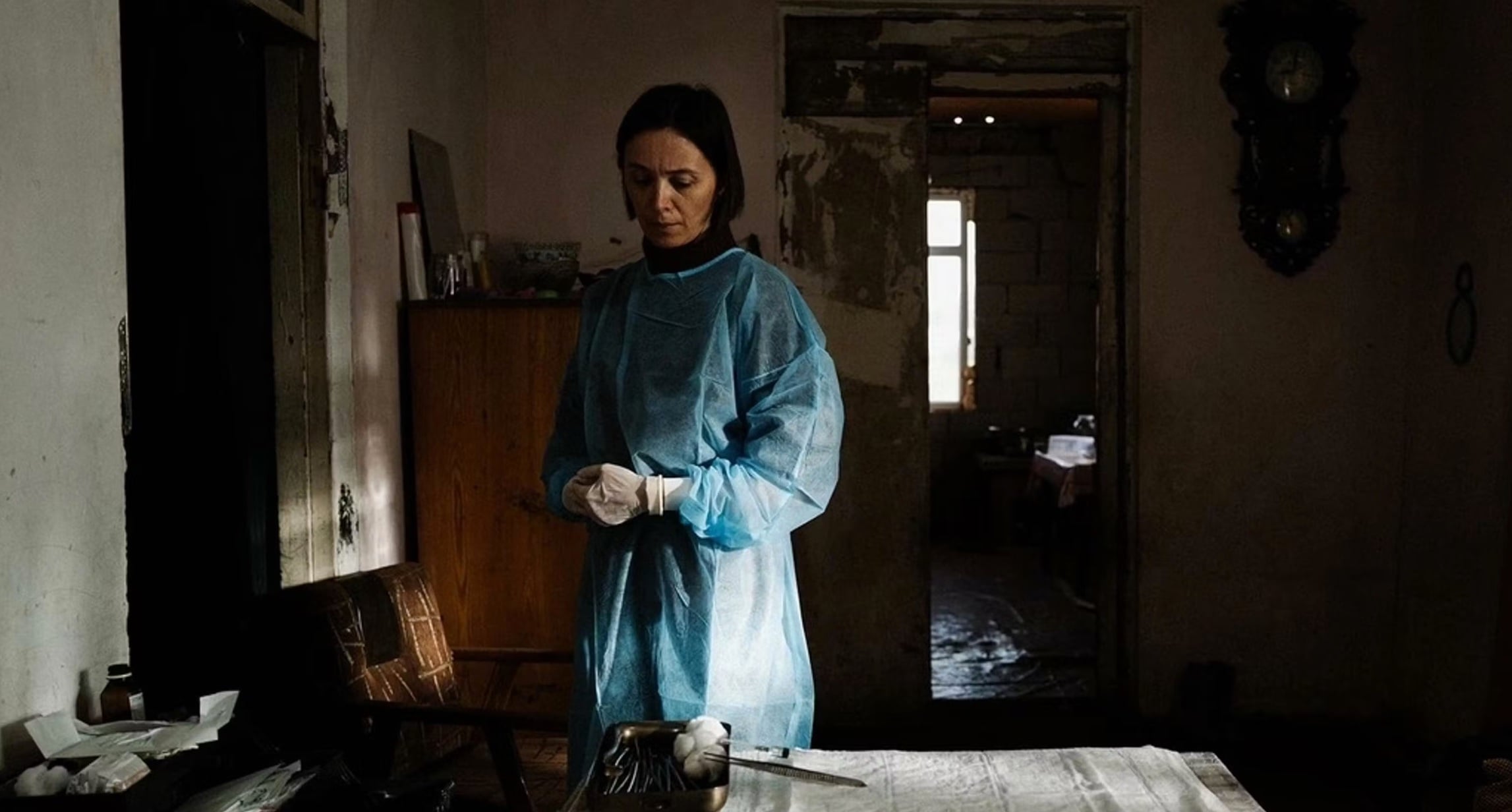
Ia Sukhitashvili in April (dir. Dea Kulumbegashvili, 2024)
Why did you craft the initial delivery scene so realistically? For some, it might be hard to watch…
Oh, but that’s how we’re all born! For me, it’s the most natural thing. I was talking about this scene with my cinematographer [Arseni Khachaturan], and he said: “It’s so strange that the one thing we can’t look at is the most obvious thing, which happens in everybody’s life. We love our mothers, but do we love them to this degree?” So, the most obvious thing makes you want to look away. And it’s a very painful process. But I understood that women want to share it. It’s not that women don’t want to; it’s actually men who find it uneasy. After all, this is a very female film, made by a woman. So maybe this is what female cinema is because it’s not just [a film with] a feminist point of view, but it’s also [about physically] being a woman. And it’s about being a woman emotionally as well. When I gave birth seven months ago, I understood how much I’d be talking about hormones, having a child, and how this would have such a huge influence on my life. All of this also affected the entire editing process. I wondered: Can I talk about this? How open can I be about it? Because everybody thinks women need to be strong, empowered, breastfeeding on set. It almost feels “prescribed” – we need to be very strong and ready to take action. But then it’s a very particular moment, hard to explain or process intellectually when you’re going through it.
my cinematographer said: “It’s so strange that the one thing we can’t look at is the most obvious thing, which happens in everybody’s life. We love our mothers, but do we love them to this degree?”
You said that when you first spoke with Ia, you had different points of view. What was hers?
She was harsher, in a way, because she thought we needed to explain to the doctors that it’s not right not to perform abortions. For me, we didn’t have to explain it to the doctors. Because, you know, in Georgia, doctors and clinics can choose not to perform abortions. They also choose not to perform [them] because the procedure is very difficult. It’s a very convoluted, unpleasant process. Nobody wants to do it, and legally, they can only perform it until 12 weeks, and you need to seek psychological help…
They make it so hard that it’s almost impossible…
Yes, if a woman wants to have an abortion, the psychologist says something like: “Oh, you’re distressed. You’re not thinking.” It’s like your sanity is being questioned at that moment. It’s very humiliating. But for me, explaining something to the doctors was not an option. On the contrary, I actually wanted to hear them. It was very interesting to listen to them because some were really annoyed with our questions. Once, I asked one of them – and my actress was there – what if [the patient were] a rape victim? What would you do? What if she couldn’t go to the police, and she came to you as a doctor? What would you do? It’s a moral dilemma. And she said: “Well, let her deal with her own things.” This tells you so much. And I wanted to hear this because this is what women hear when they go to the doctors.
What about working with your cinematographer, Arseni Khachaturan? Did you share any visual references?
We didn’t share any visual references. We go to places. We just look at things. Personally, I spend a lot of time in museums. A lot of time! I just spoke to a colleague of yours from San Sebastian. I was very lucky, and I was offered this residency there, so I could visit the Guggenheim Museum and the Museum of Fine Arts in Bilbao many times throughout the year. I spent so much time studying things, but those weren’t my references. For me, that was more of an “inspirational education”, I’d say. Other than that, we don’t make mood boards or anything like that. Besides, we grew up together so it’s almost like we don’t even need any more references. Arseni jokes and says that if one day I start making films in a place I don’t know, maybe then we’ll ultimately need references…
April screens at the London Film Festival on 11 and 12 October.
Explore our collection of Georgian titles here.
Davide Abbatescianni is an Italian film critic and journalist based in Rome.

 Go back to journal home page