On 27 January, London’s Institute of Contemporary Art presents Wonders and Disasters: Nature, Architecture, and Colonialism in Central Asia, a collection of contemporary short films curated by Misha Zakharov as part of the London Short Film Festival. Ahead of the screening, we’re publishing this response to the programme from curator and researcher Kseniia Bespalova.
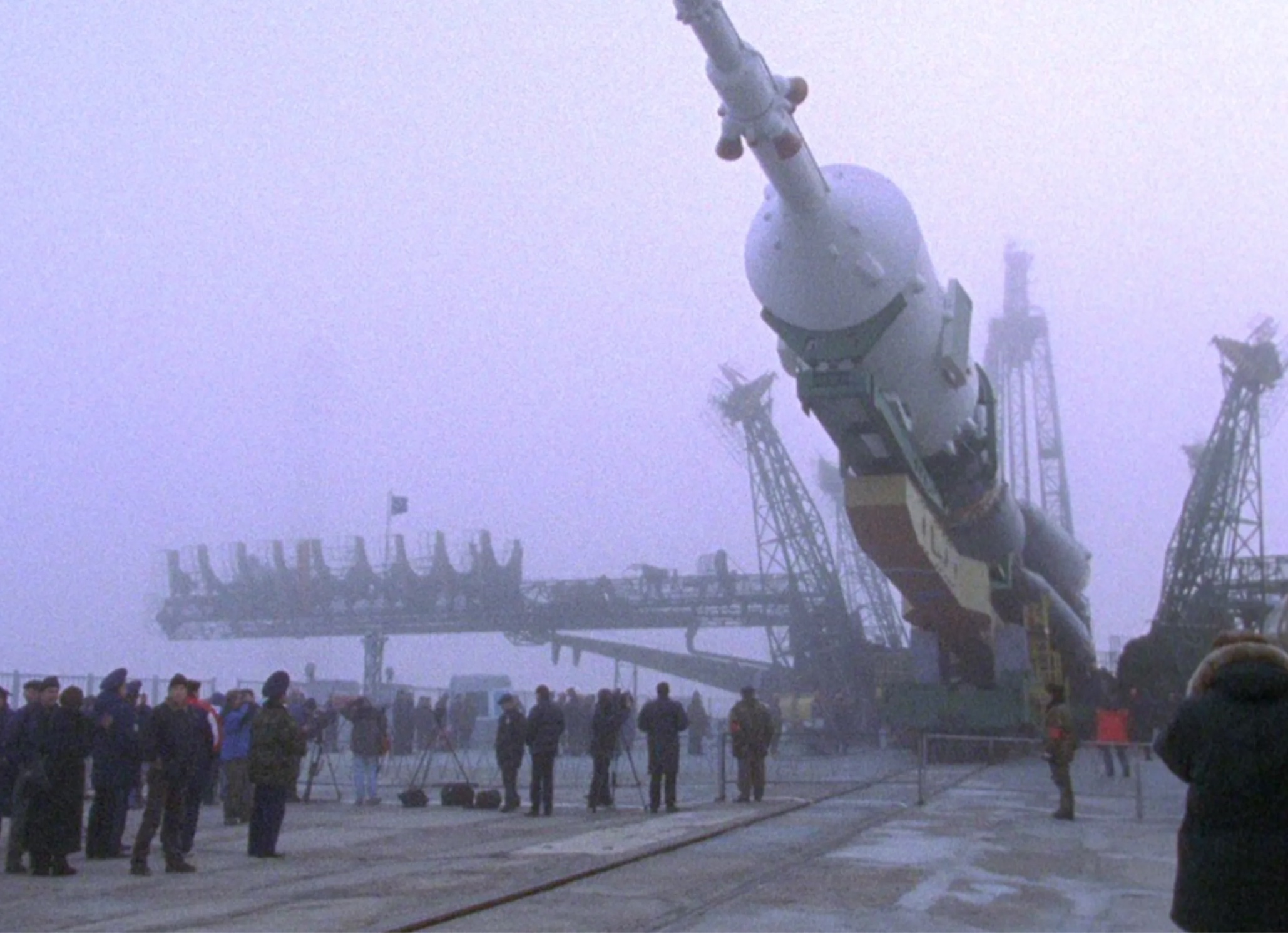
Dreamtime (dir. Jane and Louise Wilson, 2001). Image: Jane and Louise Wilson
In Central Asia, cinema and Soviet infrastructure grew together. Railways, dams, cosmodromes, and energy complexes were not only built from steel and concrete, but from images that taught viewers how to view and understand the natural elements around them. Film trained the eye to read nature as unruly matter requiring discipline to serve human goals; meanwhile, the monumentality and scale of the infrastructure constructed by the Soviets made violence towards the environment seem desirable. Today, these infrastructure projects quietly continue their work of colonising the elements and converting them into resources. Some remain fully operational, such as the Baikonur Cosmodrome, which still functions as a Russian-controlled spaceport on the territory of Kazakhstan, via the asymmetric legal and economic arrangements that constrain Kazakhstan’s territorial and environmental control. Others endure as ruins, toxic landscapes, or hollow monuments to futures that never arrived. Wonders and Disasters: Nature, Architecture, and Colonialism in Central Asia, a collection of contemporary short films curated by Misha Zakharov, returns to these infrastructure sites not to marvel at their engineering, but to ask how industrial transformation came to colonise the elements of air, earth, fire, and water – as well as how we might look at this architecture and these devastated landscapes critically, without romanticising post-Soviet ruin.
One of Soviet cinema’s achievements lay in teaching audiences not merely to accept the transformation of nature but to desire it – to see the good life as inseparable from the promises of infrastructure. In Jane and Louise Wilson’s Dream Time (2001), one of the films in the Wonders and Disasters programme, we move beyond the familiar metaphor of socialism as a collective dream; the film also unfolds as a parable of how dreams integrate with matter. As Dream Time carefully observes the operations and sublime visual qualities of the Baikonur Cosmodrome, it also shows how visions of progress settle into the Kazakh steppe that hosts the site and penetrate the air the spacecraft is meant to conquer. The spectacle distracts from and overwhelms ethical questioning, building a desire for “progress”. The elements become resources, instrumentalised in the move towards the future. The atmosphere itself is a frontier; air should be conquered and militarised.

Aralkum (dir. Daniel Asadi Faezi and Mila Zhluktenko, 2022)
Such infrastructural sublime finds its historical precedence in the Soviet avant-garde, whose famous use of “montage theory” was as much about formal experimentation as a study of the encounter between technology and natural elements. Think about Viktor Turin’s Turksib (1929) or Mikhail Kalatozov’s Salt for Svanetia (1930). Both films depict the construction of infrastructure connecting areas framed as remote, exotic, and backward to the rest of the Soviet empire. Turin’s Turksib celebrates railroad construction that was intended to industrialise Central Asia and overcome climatic obstacles to cotton production; meanwhile, Kalatozov’s Salt for Svanetia tells a similar story of development, but in relation to the Svan people living in the high mountainous region of Georgia, cut off from “civilisation” because of the lack of roads. Both films portray nature as an enemy to be struggled against. Soviet montage organises the encounter between the technology and elements to visually tame “unruly” nature. The aesthetic experience of these films prepares the ground for colonial and environmental violence: people must first see nature as backward and wasteful before accepting its transformation.
This is how infrastructures work: aesthetically and materially at once. What matters is learning to look past the spectacle of infrastructural grandeur, toward the environment that absorbs its consequences and which is often ignored while our gaze fixes on the poetics of construction. What ground, then, supports these dreams? Beneath the ideology lies the Central Asian earth, which underwent major turbulence as a result of Soviet experiments seeking to make nature and climate “productive”.
One of Soviet cinema’s achievements lay in teaching audiences not merely to accept the transformation of nature but to desire it – to see the good life as inseparable from the promises of infrastructure
In places, this earth became dried out, cracked, contaminated. Another film in the Wonders and Disasters programme, Aralkum (2022) by Daniel Asadi Faezi and Mila Zhluktenko, closely examines the textures of the soil. Aralkum is a desert that has appeared in the former location of the Aral Sea, which was partially desiccated and turned into two smaller lakes as a result of failed Soviet irrigation policies. The most ambitious of these was Stalin’s “Plan for the Transformation of Nature”, adopted in 1948, which intended to change the climate of Central Asia: arid steppes and deserts were to become green plantations of cotton through limiting hot winds and diverting rivers into irrigation canals.
The earth was indeed remade: the seabed became new terrain, exposing layers of colonial transformation. The wind persisted, and the desert spread, drying out the Aral Sea. Fishing nets, boats, the story of the last fishing outing – these are all that have remained. Aralkum’s quiet, patient attention to these remnants constitutes a different kind of seeing, one that refuses spectacle and dwells instead in the intimate scale of survival. Aralkum is a film of environmental mourning and survival – the survival of the remaining species of trees and fisherman families who can no longer practice what their ancestors did. Although the new desert is a site of devastation, what remains in the imperial debris is not just ruins but ongoing colonial relations, continuing contamination, and the ongoing necessity of looking at what we were taught to look past.
Balqaş Jyry (dir. Artcom Platform, 2025). Image: Artcom Platform
Water returns in another film in the programme, Balqaş Jyry (dir. Artcom Platform collective, 2025) – a film featuring no infrastructure, but only watery textures and landscapes wounded by colonial histories. Balqaş is an endangered lake in Kazakhstan, which risks repeating the fate of the Aral Sea and disappearing. The film lets the lake retell its own story, reversing the narratives of human victory over nature. It presents its own view on the colonisation of Kazakhstan, which involved the devastation of nomadic lifeways and natural ecosystems. Vision, from this perspective, requires a shift: away from the ideology of progress and toward a submerged way of seeing, attuned to damaged water flows and living textures that carry long histories of violence. The film continues the Artcom Platform’s initiative Care for Lake Balkhash, extending environmental advocacy into the realm of perception itself. It asks how we may learn to see the lake as something other than a resource.
What matters is learning to look past the spectacle of infrastructural grandeur, toward the environment that absorbs its consequences
These films prompt us to understand that infrastructure obstructs our vision, turning our gaze away from what matters towards the spectacle, in the process of making the elements into resources. This World Does Not Fit Into My Eyes (dir. Rouzbeh Akhbari and Felix Kalmenson, 2026) enacts a very literal connection between an energy facility and vision. The film tells the story of Nazira, a partially-sighted woman who works as a janitor at the Institute of the Sun in Parkent, Uzbekistan. She lost her sight due to the intense light emitted from the granular structure of the Sun Institute, a structure of mirrors designed to collect sunlight and convert it into energy. Her loss of vision becomes a type of refusal of the colonial gaze that taught generations to see these monuments as the embodiments of progress. Now, Nazira moves through the Institute immersed in her dream world, remembering her youth as a famous Uzbek singer and actress.
The dream and the infrastructure are continuous – one generates the other. But Nazira’s dreams are nothing like those of Soviet utopia. They mobilise toward no future, transform no elements, serve no collective progress. They quietly turn inward, where memory becomes a form of personal resistance. How can we stop seeing the air as a frontier, the earth as a surface to transform, fire as energy, water as a flow to be tamed? Perhaps Nazira’s partial blindness suggests an answer: we might begin by refusing the visual pedagogy on which infrastructure depends. Not “unseeing”, exactly, but learning to see what was always there beneath the spectacle: the textures, the debris, the wounded landscapes that continue to resist even as they bear scars. Learning to see as Nazira does: moving through the monument of captured light, attending not to its grandeur but to what it cannot colonise.
Buy your tickets for the 27 January screening of Wonders and Disasters: Nature, Architecture, and Colonialism in Central Asia, featuring a panel discussion, at London’s Institute of Contemporary Art here.
A repeat screening will take place on 30 January at the Zoroastrian Centre. Tickets are available here.
Watch Aralkum on Klassiki now and explore our full collection of Central Asian titles and short films.
Kseniia Bespalova is a PhD researcher and film curator who works with experimental film and artists’ moving image from the former Soviet region, exploring the intersection of ecology and colonialism.

 Go back to journal home page