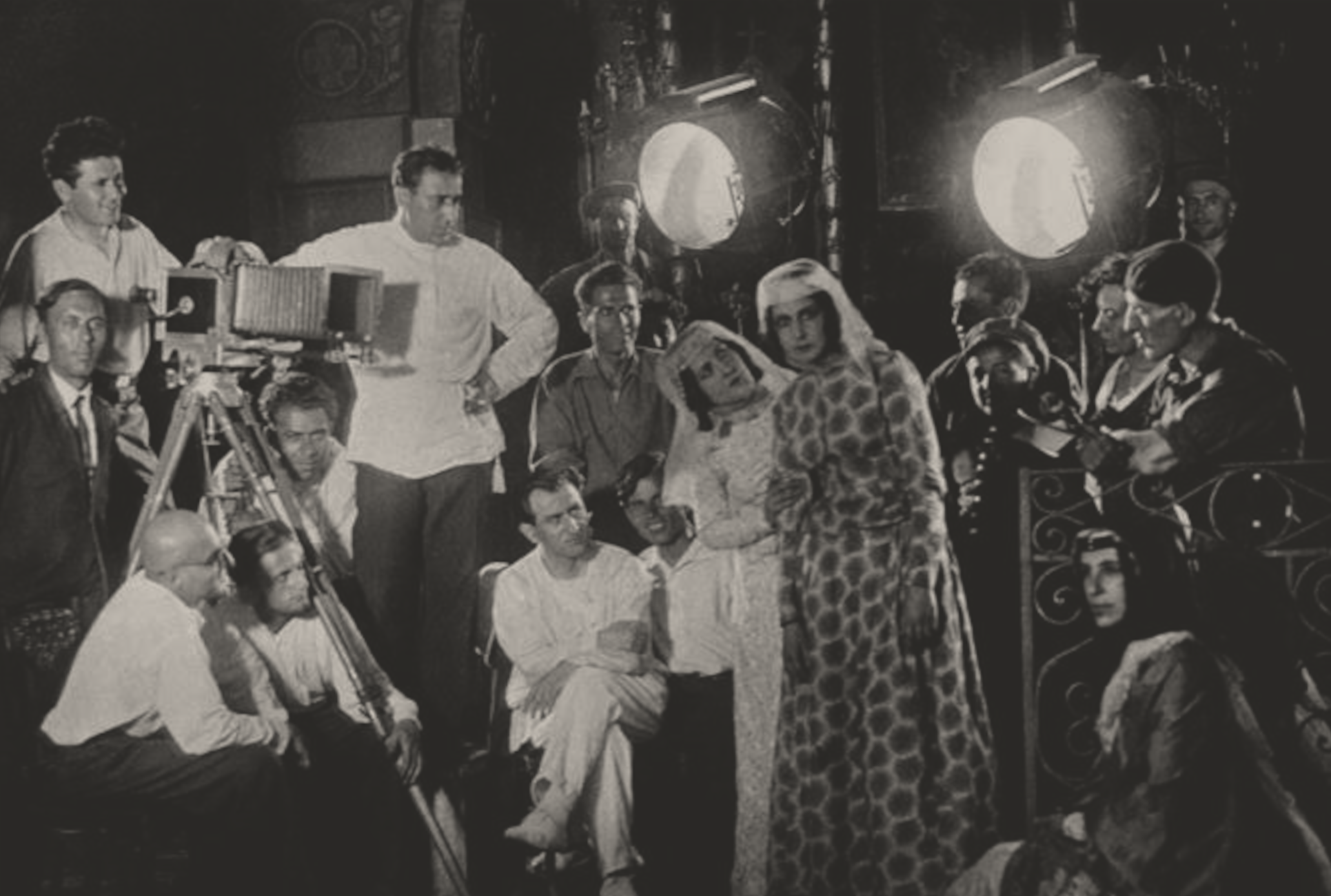
Hamo Bek-Nazaryan with the cast and crew on the set of Namus (1925)
Film history is replete with pioneers: figures who, by some strange combination of talent and circumstance, come to play an outsized role in the evolution of the artform. Hamo Bek-Nazaryan (sometimes written as Beknazarian and sometimes Russified as Bez-Nazarov) was one such character. Subject to the centrifugal pulls and centripetal pushes of first the Russian and then the Soviet empires, Bek-Nazaryan played many roles in many countries in a peripatetic career that spread across Eurasia in the first half of the twentieth century. He is known in his homeland as the “father of Armenian film” – the most consequential of his achievements. But he was also a popular performer of the pre-revolutionary screen; an administrator and co-founder of one of the USSR’s most celebrated studios; a director who married avant-garde sensibilities with crowd-pleasing panache; and a cosmopolitan who forged connections across the diverse landscape of Soviet film. As formerly colonised states assert their native traditions and film history and national history coincide ever more closely, the likes of Bek-Nazaryan can slip through the gaps in the record. 102 years since his directorial debut and 60 years since his death, his biography speaks to an era of collaboration and cross-pollination that is tragically no longer viable.
Born in Yerevan in 1891, Bek-Nazaryan studied in his hometown, Tashkent, and Moscow. In his youth, he was a professional wrestler and circus performer, until a chance encounter with a connected acquaintance led to him taking up a role in his first film in 1914. Hardly the most auspicious moment to launch a career, but by the end of the First World War and the fall of the Romanovs, he had around 70 credits to his name and was established as a fixture on the pre-revolutionary Russian silent screen. In the aftermath of the revolution and the subsequent Civil War, Bek-Nazaryan had intended to return to Armenia. First, though, came one of many fateful diversions. In 1921, he instead headed to Tbilisi to head the film department of the Georgian Commissariat of Public Education – a sign of the interconnectedness of the Caucasian states in the period. The department that Bek-Nazaryan ran was the first iteration of what would become the state Georgia-Film Studio, one of the most celebrated in the Soviet system.
the “father of Armenian film” was also a popular performer of the pre-revolutionary screen; a co-founder of one of the USSR’s most celebrated studios; a director who married avant-garde sensibilities with crowd-pleasing panache; and a cosmopolitan who forged connections across the diverse landscape of Soviet film
The Tbilisi sojourn also represented a creative breakthrough. Imbibing the energy of the then-nascent Georgian cinema scene, he began to direct his own titles; in Patricide (1923), Lost Treasures (1924), and Natella (1925) we begin to see the talent given full voice in the following years. Popular with the majority Russophone audience of the Union, these films would now be described as orientalist melodramas, filled with salacious details like harems, torture dungeons, and tremulous romance. It was not a style that Bek-Nazaryan was willing to entertain when he did finally return to Yerevan in 1924 at the invitation of the influential critic Daniel Dznuni.
Putting to good use his experience over the border in Georgia, within a year of his return Bek-Nazaryan had heeded Dznuni’s call to help establish a national film studio for Armenia: Armenkino (later Armenfilm; the successor studio was renamed in Bek-Nazaryan’s honour after his death in 1965). What’s more, he had written and directed what is widely regarded as the first feature-length, wholly Armenian film, Namus (1925). Here, the filmmaker rejected the populist-orientalist framework, attempting to give cinematic shape to local traditions with a degree of realism and respect – all the better to critique them in the revolutionary spirit of the times. “Namus” is the word for a kind of traditional patriarchal honour. Set in the city of Shamakhi (now Azerbaijan), the film concerns the corrosive power of that tradition: when lovers Seyran and Susan flaunt the strict code of honour that forbids engaged couples from seeing each other before marriage, a wave of violent tragedy unfolds that leaves both dead.
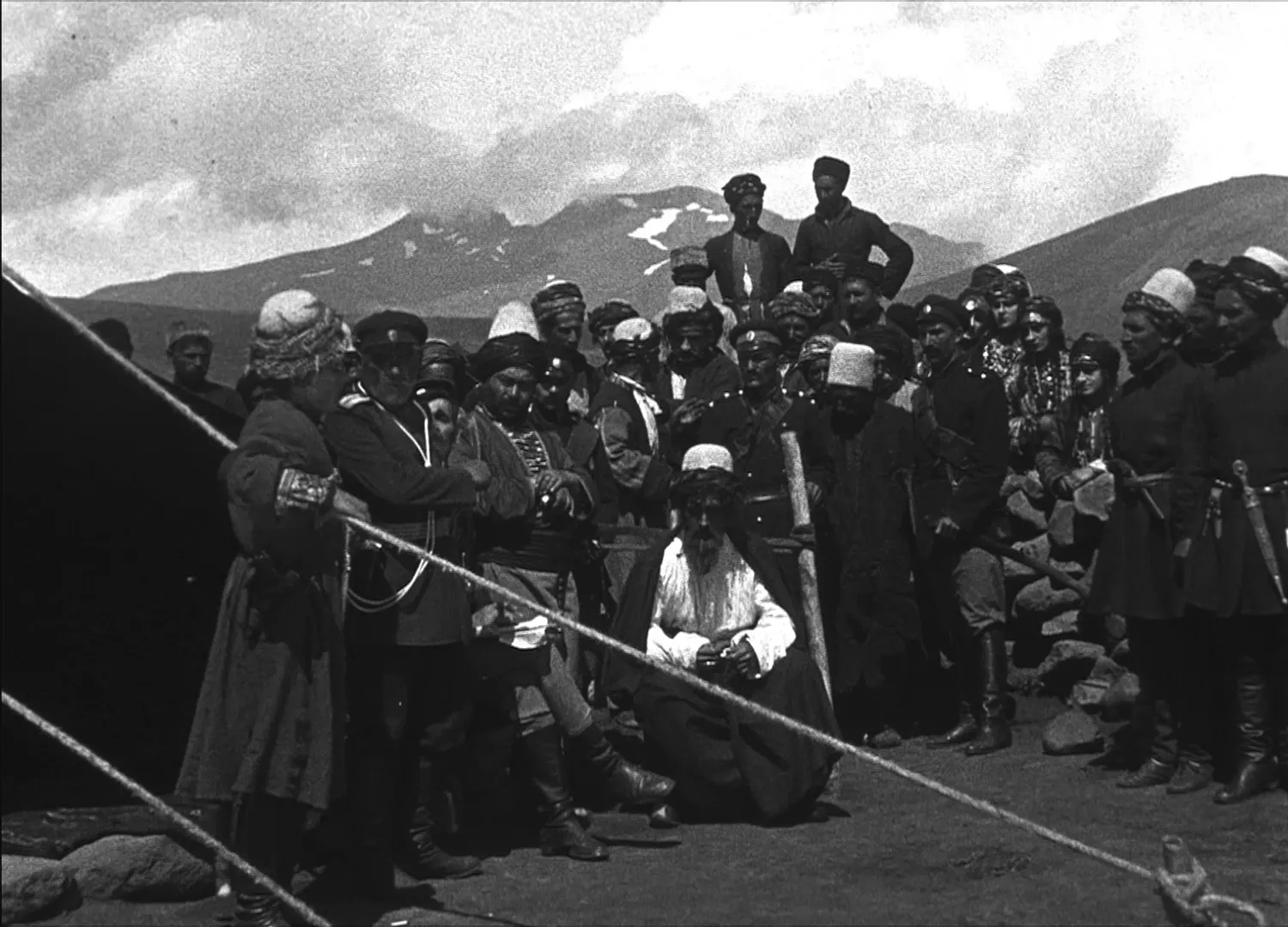
Zare (dir. Hamo Bek-Nazaryan, 1926)
Over the next decade, Bek-Nazaryan wrote and/or directed 15 fiction and documentary films, doing more than anyone to establish a national style for Armenian cinema. In Georgia, Bek-Nazaryan had seen first-hand how the radical formal ploys of the Soviet avant-garde could be married with traditional Caucasian narratives and performance styles – a lesson that he brought to bear in his romances and historical dramas. Armenia’s past and future were put on screen for the first time in films such as Zare (1927), often cited as the first feature film to explore the plight of the Kurdish people. Yekir Nairi (1939), a non-fiction epic celebrating a decade of Soviet rule, possesses a “visual musicality” that scholar Vigen Galstyan suggests inspired later Armenian non-fiction artists like Artavazd Pelechian. Bek-Nazaryan also has Armenia’s first comedy feature (Shor and Shorshor, 1926) and first feature sound film (the hit musical Pepo, 1933, with a score by national composer Aram Khachaturyan) under his belt. Few individuals can lay claim to such a foundational influence on their nation’s cinema.
To modern eyes, though, perhaps the most remarkable phase of Bek-Nazaryan’s career was yet to come. In 1928, he travelled to Baku to head House on the Volcano, a co-production between Armenkino and the Azerbaijani Azgoskino studios. Only a decade earlier, anti-Armenian pogroms had rocked the city; now, in the spirit of Soviet transnationalism, the shared history of the two Caucasian states was brought to the screen. Volcano is of a kind with other historical dramas produced elsewhere in the USSR to mark the tenth anniversary of the 1917 revolution – the most obvious examples being Sergei Eisenstein’s Battleship Potemkin and October. Like the former, it casts its eye back to the pre-revolutionary period, namely 1907. Oil workers in Baku go on strike when they discover that the bosses have built their barracks on top of a dangerous gas bubble – a convenient (and none too subtle) metaphor for the simmering tensions that erupt with tragic consequences in the remarkable, incendiary finale. Bek-Nazaryan’s mastery of his material is complete here. His dramatic close-ups, canted angles, and manipulation of the historical record in service of revolutionary narrative put his more lauded Russian contemporaries to shame. The ethnic divisions amidst the workers are made explicit in the plot; the multi-national cast included Tatyana Makhmuryan, a future star of the Armenian screen.
Bek-Nazaryan’s dramatic close-ups, canted angles, and manipulation of the historical record in service of revolutionary narrative put his more lauded Russian contemporaries to shame
That was not the end of Bek-Nazaryan’s Azerbaijani adventures. Shortly after the completion of Volcano, the director was approached by the playwright Jaffar Jabbarly with a proposal to develop a script based on his popular play Sevil, about an illiterate Muslim woman breaking from tradition and taking her place in Soviet civic life. The resulting 1929 film was an all-Azerbaijani production. In his memoir, Bek-Nazaryan would later write: “I recall my mutual work with Azerbaijan’s great writer with deep gratitude. He died in the prime of life and left great literary heritage. He was a dramaturge of great talent and great soul.” The filmmaker would return to Azerbaijan twice more: in 1939, to finish a film titled The Peasants after the death of original director Samed Mardanov; and finally in 1941, as director of Sabuhi, a biopic of the 19th-century Tartar activist Mirza Fatali Akhundov.
Bek-Nazaryan was not allowed to end his career in his native land. In the post-war climate of fear that preceded Stalin’s death, he fell foul of censorship. It was rumoured that Stalin personally interceded to ban his 1950 film The Second Caravan. Heartbroken, Bek-Nazaryan left Armenia. By the time the post-Stalinist “Thaw” in culture and politics began to undo the worst excesses of the old regime, he was ensconced in the Central Asian republics, having directed The Housewarming Party in Uzbekistan in 1954 and Nasreddin in Khujand in Tajikistan in 1959. He died in 1965.
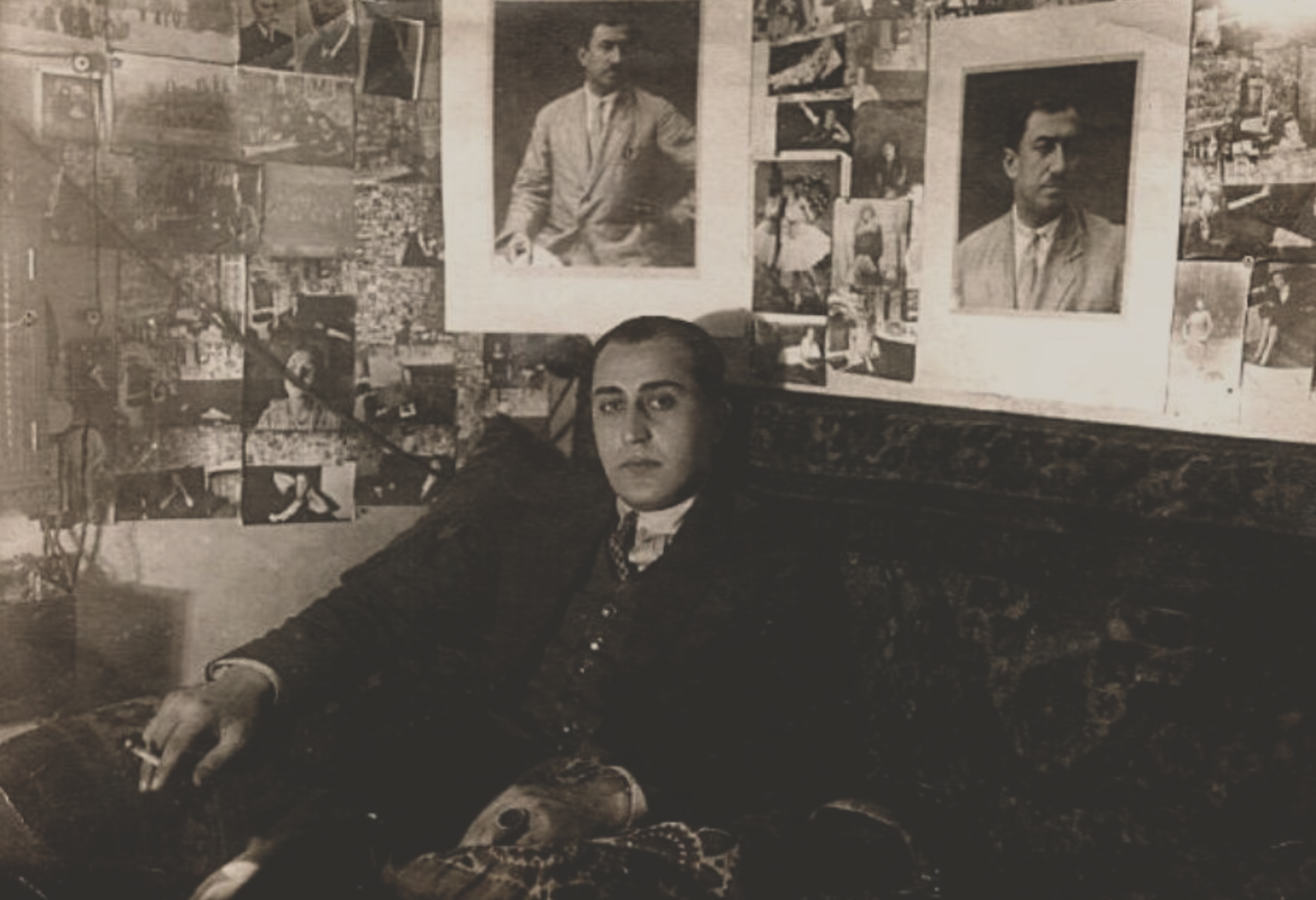
Hamo Bek-Nazaryan in 1915
Bek-Nazaryan’s remarkable life cuts against many commonplace assumptions about film history broadly and Soviet film history in particular. In the words of the curator and writer Daniel Bird, “while today’s cinephilia is animated by a belated drive to reformulate the world cinema canon to include neglected voices from Asian, African, and Arab cinemas, this process when applied to Soviet cinema isn’t straightforward at all.” It can be difficult to unpick the threads that carry a figure like Bek-Nazaryan through the formative years of Russian, Georgian, Armenian, and Azerbaijani cinema, given the contemporary insistence on national identities as arbiters of artistic legacy and the very real and destructive conflicts that have defined the post-Soviet space. The protracted, bloody conflict between Armenia and Azerbaijan over Nagorno-Karabakh – and Azerbaijan’s total ethnic cleansing of the Artsakh Republic in the last two years – highlights the grim historical irony of the collaborations that made a film like House on the Volcano possible. They also cast doubt on our future ability to source and restore these titles. Bek-Nazaryan himself seemed to intuit something of this irony and the disaster-in-waiting of Caucasian ethno-nationalism back in his groundbreaking Namus. The plot of the film is set in motion when a terrible earthquake spares the families of the tailor Barchudar and the potter Hajrapet. They decide to seal their bond through the marriage of their children. “God protected our children and destroyed the wall that stood between us,” the intertitle reads. “We must not defy his will.”
Watch House on the Volcano on Klassiki now and explore our collections of Armenian titles and silent film.


 Go back to journal home page