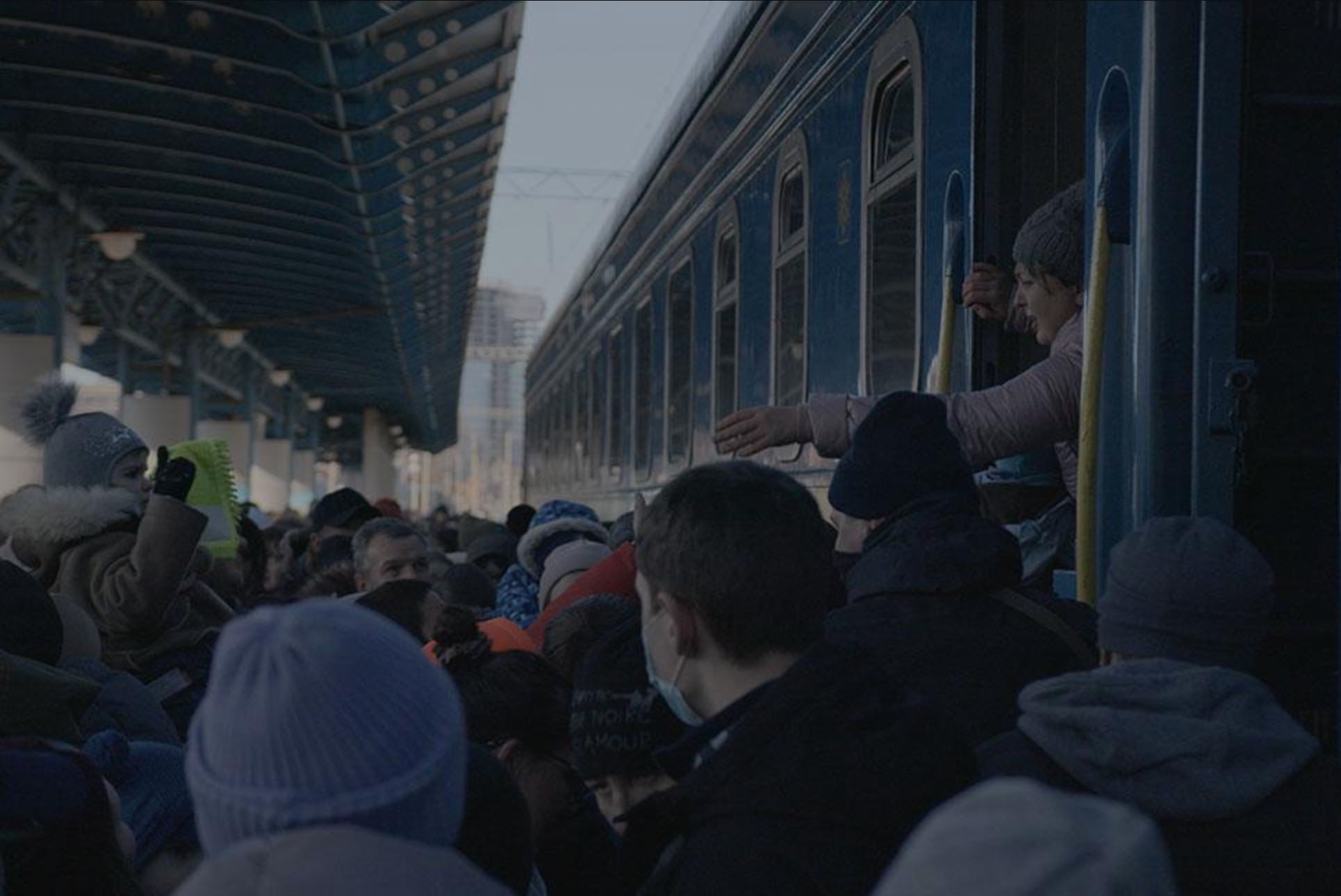
Songs of Slow Burning Earth (dir. Olha Zhurba, 2024)
One of the most important films to emerge from this year’s Venice Film Festival was Songs of Slow Burning Earth, a documentary that critically examines the durational impact of the ongoing war in Ukraine, filtered through a poetic lens. Instead of opting for a literal account of the ravaged land, Ukrainian filmmaker and editor Olha Zhurba constructs a more lyrical work of non-fiction, one that, as the title suggests, plays out like an elegiac song cycle. Paradoxically, it’s a beautiful film about a horrific subject, which traverses a war-torn Ukraine and hones in on the ways war has become engrained in the very fabric of the country.
With its associative montage, evocative sound design, and striking cinematography – shot by three different directors of photography – Songs of Slow Burning Earth manages to capture something profound about the impact of war on a country and its people. The normalisation of living under conditions of war is the main focus here, revealing a society frozen in time. Where the beginning of the film still shows the hurried evacuation of Kyiv under siege in 2022, the film gradually morphs into a melancholic mediation on natural environments and the people that inhabit these war-torn spaces. Zhurba brings her distinct sensibilities to these places and depicts the exhaustion and endurance of Ukraine in a way rarely shown on screen.
We sat down with Zhurba in Venice for a deep conversation about the ways poetic cinema can transcend the many ethical issues that arise when a filmmaker sets out to film the brutal reality of war.
Out of necessity, quite a lot of documentaries have been made about the Russian war in Ukraine, especially since the full-scale invasion of 2022. Within that environment, Songs of Slow Burning Earth takes a unique approach by bringing a more poetic sensibility to this urgent material. With which intentions did you decide to pick up the camera and make this film?
I think it’s impossible to explain what the experience of war is. No work of art can do this justice, nor can any words – it’s just too complex. Perhaps only music and poetry come closer to this. I want to add here that in Ukraine now, many civilians who became soldiers also write poetry. I’m collecting these poems, because, for me, the deepest reflections on the war are transformed into poetry. Through these symbols, metaphors, and complex utterances, I manage to understand the painful experiences of humankind. I understand, for instance, that these soldiers on the front are going through the worst events imaginable on this planet, and I understand that it’s impossible, even amongst themselves, to express what they feel.
With cinema comes the added dimension of time. Within your film you can feel the duration of the war settling into the country, becoming part of every fibre of the things you perceive. How does that work for you on an emotional level?
The most painful aspect of making a film like this is to capture these events. That’s always the most challenging part of documentary filmmaking. When I’m in the process of editing or sound mixing, I’m already detached from the emotional part. I’m just working very logically, thinking about constructing the structure and cinema language of the film. But with the camera, it’s crucial for me to be there in each moment, to feel everything that is going on around me – what is happening to my people, my country, my land, and what I see in front of my eyes. I’m the type of person that tries to feel it all on my skin. I need to feel the experiences of other people, so it becomes possible for me to translate them into the film language. I have to admit that I hate documentary cinema for that, because it’s such a painful process. And yet, it’s crucial, because I am just an instrument, there to translate it all. I see that as a duty. So, yes, it’s hard, but when I’m working, the film becomes more important to me than the personal sacrifices that I am making by connecting emotionally to the people and the events that I capture.
I’m the type of person that tries to feel it all on my skin. I need to feel the experiences of other people, so it becomes possible for me to translate them into the film language. I have to admit that I hate documentary cinema for that, because it’s such a painful process
I love that phrasing, of you seeing yourself as an instrument. It not only relates to this song-like quality that’s represented in the title of the film, but also to the idea of an artist having to be some kind of resonator, attuned to picking up on the reverberations within the spaces around them. Would you say that this is also how you perceive yourself as a filmmaker, and perhaps even as a person in general?
I’m a very sensitive person, and that’s why I need to be in the middle of it all. When I search for my protagonists, I understand that such human beings have unique and powerful experiences to share. On an emotional level, I always try to imagine what it would be like to walk in the shoes of this person. That’s my method, even though I don’t think it’s a particularly good method. That’s also why I’m done with documentaries, because you carry this huge responsibility for the people that you’re filming. It’s a big responsibility not to be traumatised. And it’s a big responsibility when you start putting these people within a cinematic language. Us documentary filmmakers, we are actually very bad people, because we’re using the reality, stories, and lives of other people to tell our story, in the ways we want to tell it. It’s a big ethical question.
And yet, it never feels like you reduce people or places to simple symbols or gestures. In a somewhat beautiful way this film is all about harmony and co-existence. Even though the subject of the film itself may be decay and disarray, the film is also harmonious. Is that something that comes from the editing?
Michael Aaglund was the main editor, but I also edited a bit, as I’m a film editor myself. I think about film through editing. And I was very happy to work with Michael, because he knew me as an editor and was open for this collaboration. Michael was specifically great because he could transform my feelings into the edit. Maybe he is so good because he’s also a sensitive person. In the end, editing is like magic. It’s all about rhythm, which is related to the emotions you choose to show on screen. Choosing whether to show a person with or without a smile can affect the film in very subtle, yet powerful ways. Things like that are crucial to me, to transform this experience that I was part of while filming, and putting it in the edit. That is my most important rule of editing, I’d say.
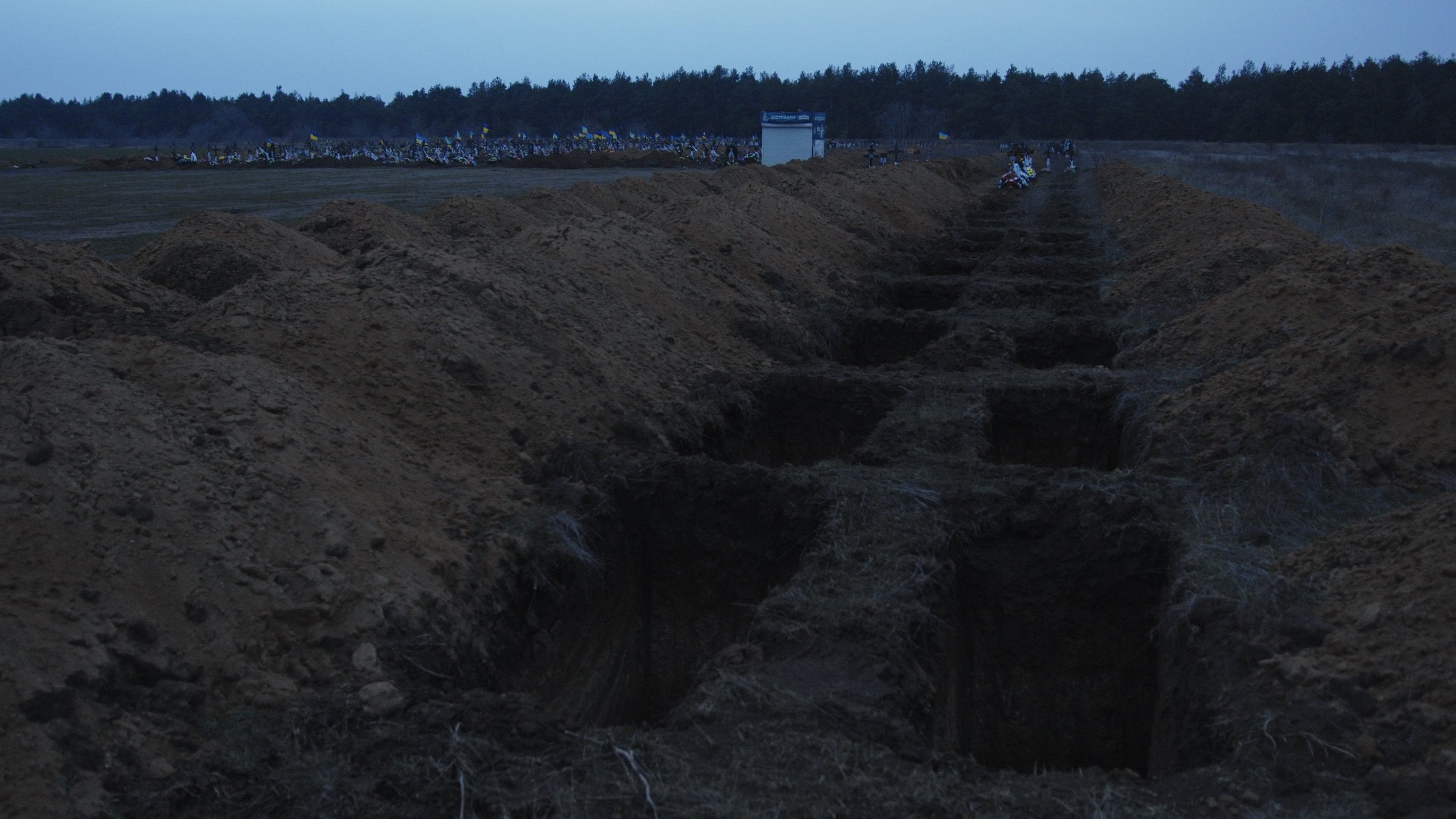
Songs of Slow Burning Earth (dir. Olha Zhurba, 2024)
I was constantly thinking about your presence there, while filming alongside the three cinematographers you worked with. Some of these scenes have such a tender sensibility to them, even in the dourest moments, and that really touched me. A moment in a morgue comes to mind, where you’re not filming the bodies, but the fleeting sunlight that is flickering on the white walls. What does it take to choose something beautiful over something awful within the context of making a film about the war?
Thank you for this question, and thank you for reminding me about this shot. I saw that light and told my cinematographer: “this light is the only beautiful thing in this room, let’s start from there.” Let me tell you that Ukrainian cinematographers are super talented and very professional. I was very lucky to work with three of them. We started the film with Viacheslav Tsvietkov. Then there is, Vova [Volodymyr Usyk], who is my bestie, my buddy. We shoot all our films together, and we made most of the film with him. But this specific episode, we shot with Misha Lubarsky, one of the best cinematographers in Ukraine. Unfortunately, if we’re talking about the three of them, he’s the most sensitive person. It was even more painful for him to be there. So, all the time I see him, I’m saying to him: “I’m so, so sorry.” I didn’t know that day of shooting would be like that because they gave us last minute access to this morgue only. And at first, I wanted to only film the women behind the windows waiting for their files to be processed.
Those shots from behind the glass, with the tension between background and foreground, seeing these women anticipating finding the bodies of their loved ones, made a huge impact on me as well.
That was something we really wanted to capture. At that time, we were already editing parts of the film, so the film language was naturally emerging from the material. That’s the reason why all these different shots from all these different cinematographers look similar to me: we already knew the essence of what the film should look like. But this light that you mentioned is something crucial. We wanted to portray this place as a limbo, as this transitory space between death and life. We were lucky that the sun was shining that day. It symbolises something existential.
Us documentary filmmakers, we are actually very bad people, because we’re using the reality, stories, and lives of other people to tell our story, in the ways we want to tell it. It’s a big ethical question
It also ties into the idea that you consciously don’t film the bodies of dead people within this film.
That’s my taboo. I never film corpses. As human beings I believe we don’t have the right to film dead people.
It’s exactly in the absence of these bodies that you begin to think more clearly about this delicate space between death and life.
It’s much stronger this way because it feeds into your imagination. I think it’s not even just the ethics, but also the language of cinema itself that gets affected by showing corpses. It can shock you to a degree where you just can’t watch anything else anymore. That’s not what I am looking for. Art isn’t there to shock you. It provides you a space to think, to put your experiences through a cultural context. That is actually how we built the film, in a way that it could be readable in different cultural contexts. Ultimately, art needs to suggest experiences to you, and provide the space for you to reflect on them.
Explore our collection of Ukrainian titles here.
Hugo Emmerzael is a Netherlands-based film critic and curator. He is an editor of Dutch print publication Filmkrant and a deputy editor of Locarno’s Pardo Daily.

 Go back to journal home page