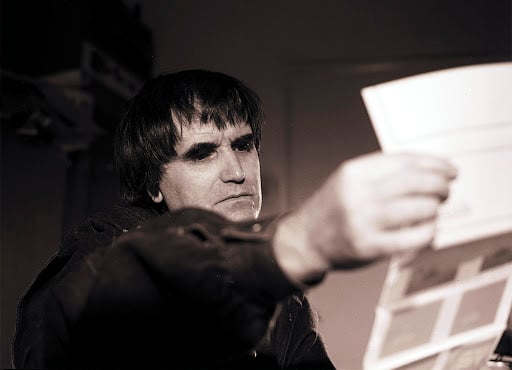
Sándor Reisenbüchler
Icons are often outsiders. By any measure, Sándor Reisenbüchler is one of the most consequential film artists to emerge from post-war Hungary – a notion validated by his being awarded in 1993 the nation’s most prestigious cultural honour, the Kossuth Prize. His hugely influential films are bound up with the flourishing of the Pannónia Studio in the 1960s and ‘70s into one of the communist block’s most internationally acclaimed filmmaking institutions. But Reisenbüchler was ill-suited to the straightforward role of national hero: a self-professed anarchistic hippie equally disillusioned with communism and capitalism, who made friends and enemies on both sides of the Iron Curtain; the “hermit of animation” who laboured away on his strange creations at his kitchen table; the trained documentarian who produced some of the most luridly fantastical short films of the era.
One thing is certain: nothing looks – or sounds – like Reisenbüchler. There is a protean and syncretic quality to his animations the refuses easy categorisation. He adapted epic poems and Jules Verne adventures, drawing on folkloric imagery and popular mid-century cinema, as well as developing his own steampunk take on science fiction. His blend of lurid painted landscapes and paper collage cut outs only adds to the eclecticism – to say nothing of his omnivorous approach to sound design, often cutting up familiar classical pieces into aural mood boards to match his visual energies. This is not to say that Reisenbüchler lacked clarity of vision: much of his work shares a keen ecological sense of mankind’s place in the natural order, and the dangers of pushing beyond its limits. It was a worldview that proved equally well suited for critiques of the state socialism he grew up with and the consumerist free-for-all that followed.
“I stood out from the crowd. A self-taught cartoonist, I was surprised that my colleagues in the world of graphics described things as ‘beautiful’… In my eyes, what mattered was the message of a film, how it was structured, how it provoked, informed, or manipulated.”
Reisenbüchler was born in Budapest in 1935 to a half-Catholic, half-Jewish family. After surviving the war as a child, he enrolled in the capital’s Academy of Theatre and Film Arts. He spent four years in the documentary workshop of the great János Herskó, intending to move into non-fiction filmmaking; Herskó had other ideas. He reasoned that someone with Reisenbüchler’s medical issues – he suffered from lifelong respiratory problems and as a student had already undergone two lung surgeries – was ill-suited to the rough and tumble of documentary work. Instead, he arranged a scholarship for Reisenbüchler to move into animation under the auspices of Pannónia, which would provide the struggling young artist with his own accommodation. Reisenbüchler began work there in 1964.
This was a moment of great serendipity for the young man. In the mid-sixties, Pannónia was one of the most vibrant studios in the eastern bloc. Established at the same time as the nationalisation of the film industry in 1951, the studio was made independent in 1957, and dominated animation in Hungary until the end of the communist era. The 1960s was a period of consolidation and expansion; economic reforms enacted in 1968 further increased Pannónia’s autonomy, and a new cohort of directors, including Reisenbüchler, Attila Dargay, György Kovásznai, József Nepp, and Marcell Jankovics came to the fore, producing works that were both innovative and critically acclaimed. Pannónia often produced cartoons for export, which helped to embed its artists within international circuits, while also easing financial pressures at home, creating more leeway for experimentation. Reisenbüchler would later recall the studio’s “friendly, familial, let’s-not-hurt-each-other-children atmosphere, where we all got along well with each other… This togetherness was important, because behind the smile that kept the business going, there was fear. The director was terrified of the Directorate General of Film, and the director of the Ministry.”
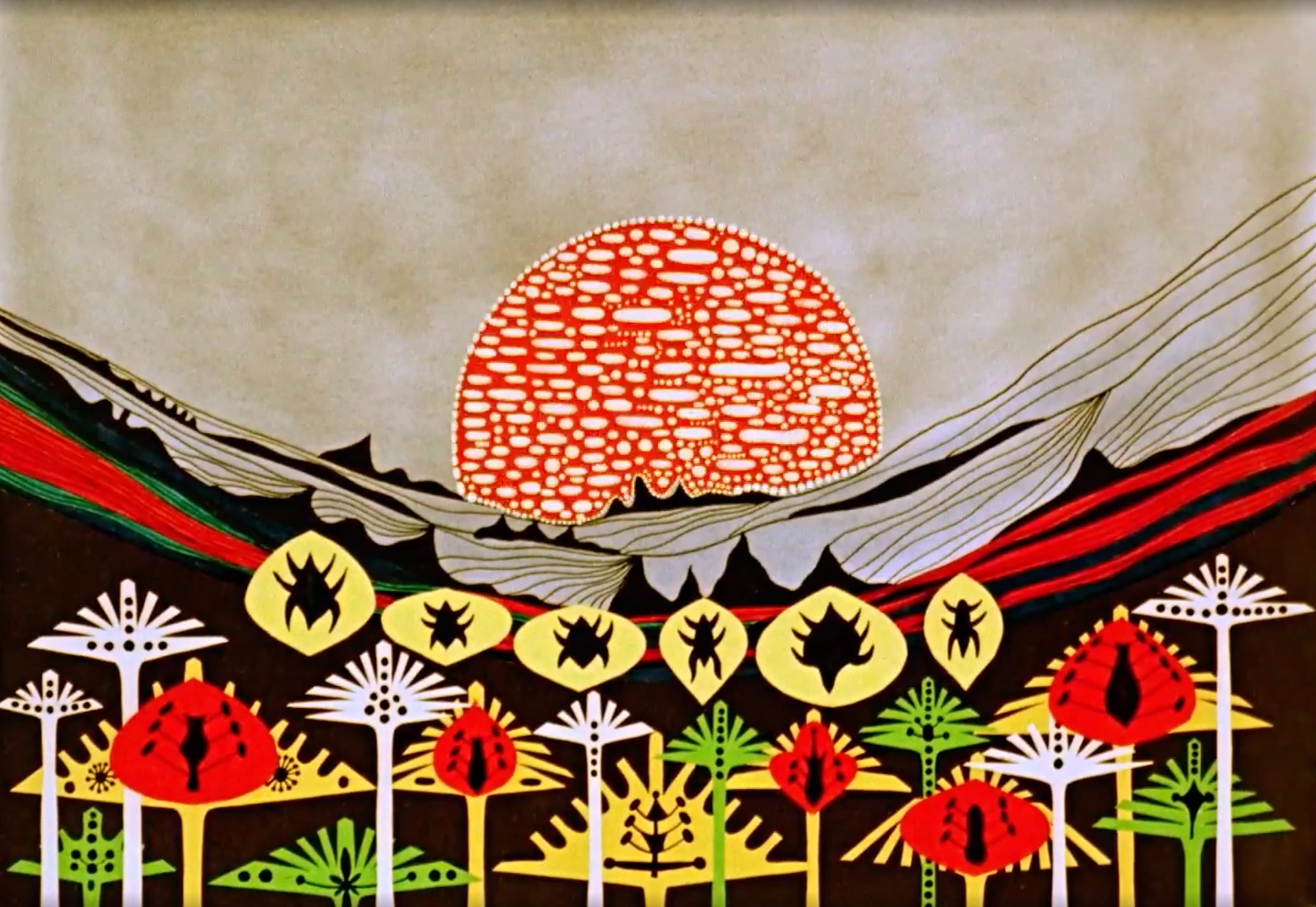
The Kidnapping of the Sun and Moon (dir. Sándor Reisenbüchler, 1968)
Perhaps surprisingly, it was precisely this convivial atmosphere that alienated Reisenbüchler from his Pannónia cohort. His training under Herskó had instilled a critical attitude in him that did not align with the more design-oriented world of commercial animation. “I never liked Pannónia, because I was used to a different style at the Film Academy,” he recalled. “The filmmakers there didn’t look at the world through the eyes of an industrial artist. They questioned everything mercilessly… That wasn’t the case at Pannónia, and I stood out from the crowd.” That he had not come through the ranks as an animation student also told. “Since I am a self-taught cartoonist, I was surprised that my colleagues in the world of graphics described things as ‘beautiful’… For me, all this meant was that they didn’t want to look behind things, never wanting to offend anyone. In my eyes, what mattered was the message of a film, how it was structured, how it provoked, informed, or manipulated.” While admiring many of his colleagues, Reisenbüchler also sought inspiration in the poster art of Polish duo Jan Lenica and Walerian Borowczyk, as well as American popular cartoons. He took to working from home, painstakingly assembling his strange creations at his workbench in the village of Felsőgöd, north of the capital. “The hermit of animation” was on his way.
His debut animated short, A Portrait from Our Century (1965), used collage to capture the precarity and anxiety of the little man. His true breakthrough, however, came in 1968 with The Kidnapping of the Sun and Moon. The 11-minute film is based on an epic poem from 1952 by Ferenc Juhász, itself a composite rendering of folk legends from the Polish Carpathian territories. As the film opens, the glittering spires of man-made civilisation exist in idyllic harmony with the natural world. Then, a seven-headed dragon arrives, decimating the landscape before swallowing the sun and moon, plunging the people into helpless darkness. A hero fashions a burning sword and rides to the rescue, cutting off all seven of the monster’s heads and restoring the celestial orbs to the heavens.
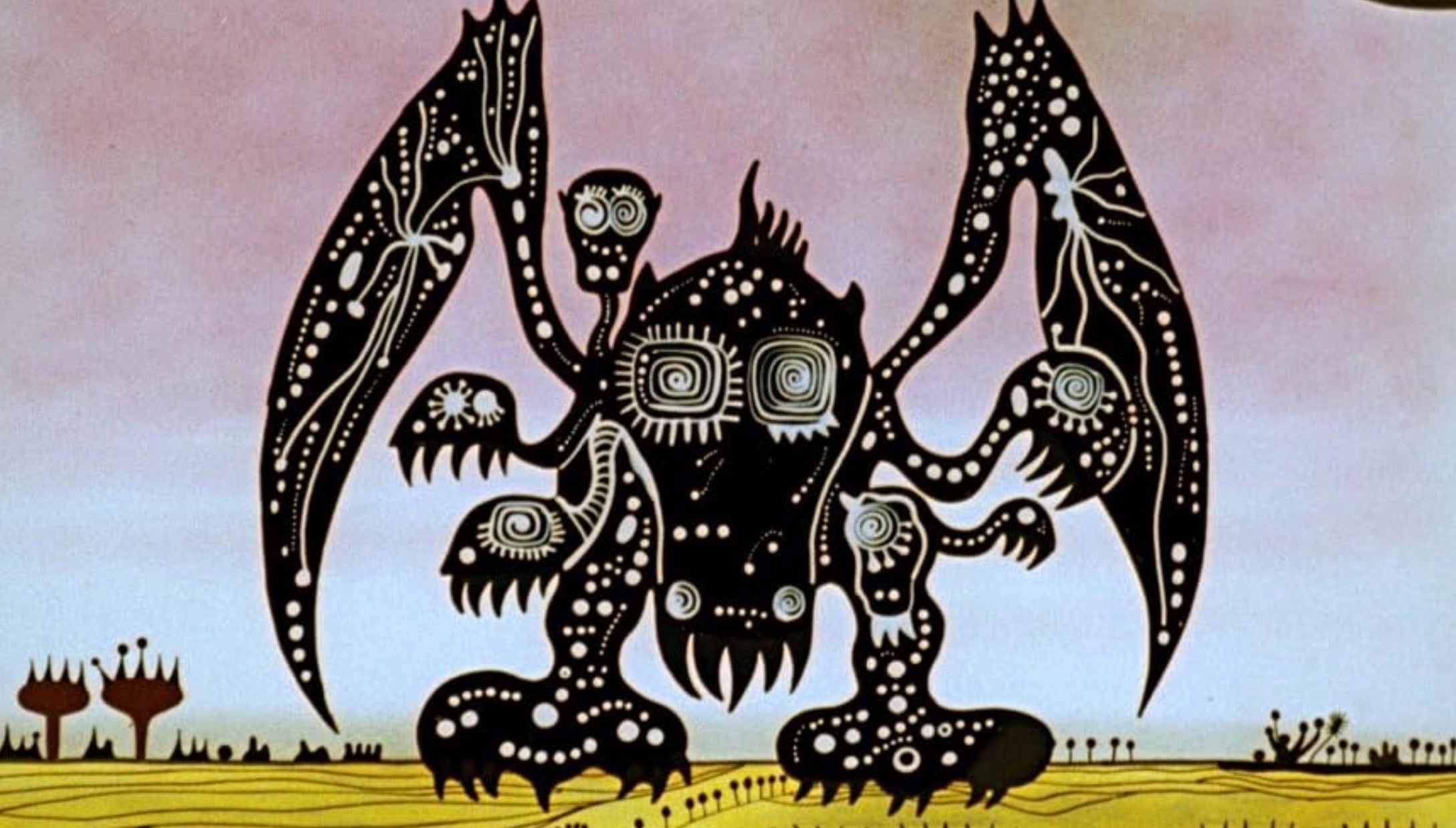
The Kidnapping of the Sun and Moon (dir. Sándor Reisenbüchler, 1968)
Reisenbüchler later described his encounter with Juhász’s work as having “a lifelong significance. This film was and remains my ars poetica. This is faith in the eternal relationship between man and nature and the eternal possibility of renewal.” The sense of a primordial world of archetypal forms and figures is visualised in Reisenbüchler’s eye-popping, quasi-abstract collage style, which recalls the primitivist art of his compatriots Dezső Korniss and Endre Bálint as well as the traditional decorative designs of Polish peasants. Man and beast alike flicker and undulate, metamorphosing before our eyes, here resembling cells under a microscope, there seeming more like intricate architectural models. There is no dialogue: Reisenbüchler preferred to accompany his visuals with snippets of classical music, here deploying Spring from Vivaldi’s Four Seasons during the idyllic scene-setting, and Krzysztof Penderecki’s Threnody for the Victims at Hiroshima to accompany the post-apocalyptic visuals that follow the dragon’s attack. Kidnapping travelled widely and was nominated for the Academy Award for Best Animated Short Film in 1969.
“communism and capitalism really are two untenable systems… Before my travels, I thought that the bourgeois world of the West was more liberated. I had to experience that this was not the case.”
One can discern many of the ideas that would occupy Reisenbüchler throughout the rest of his career in this short. There is a strong ecological element to the film. The circular narrative concerns the disruption and reaffirmation of a symbiotic natural order, and some of the most striking sequences depict the devastation wrought by the dragon on the flora and fauna of the kingdom: flesh falling from desiccated fish, a horse writhing in pain as it’s consumed by flames. Reisenbüchler would explore these themes with even more acuity in later films like The Age of the Barbarians (1970) and God Bless You, Little Island! (1987). Although its cosmology derives from folklore, it also indicates Reisenbüchler’s interest in the imaginary sphere of outer space. In the 1970s and ‘80s, he would develop a peculiar brand of sci-fi animated short, beginning with 1975’s Moon Flight, in which two scientists propose that the moon is in fact an ancient spaceship, and travel into deep space to test their theory. Reisenbüchler concocts some of his most psychedelic visuals through a virtuosic manipulation of layers of collage and striking original visuals, assembling a dreamlike vision of the cosmos that at points resembles the famous “stargate” sequence from Kubrick’s 2001: A Space Odyssey.
In keeping with his strangely syncretic worldview, Reisenbüchler often drew in this work on early twentieth-century literary sources for his futuristic visions, lending them a kind of psychedelic, steam-punk aesthetic. Panic (1978) is derived from the 1936 novel War with the Newts by the Czech author Karel Čapek, about the discovery in the Indian Ocean of a sea-dwelling race of sentient amphibians who are enslaved and exploited by scientists – with dramatic consequences. Also present is the clear influence of the Japanese kaiju or monster films of Godzilla, Mothra, et al. Peacekeeping Expedition borrows from the pomp and circumstance of Jules Verne to decry imperialistic high-handedness, as a gang of jumped-up military men travel to Mars on a “civilising” mission that’s anything but, accompanied by the ironic jauntiness of a ragtime band.
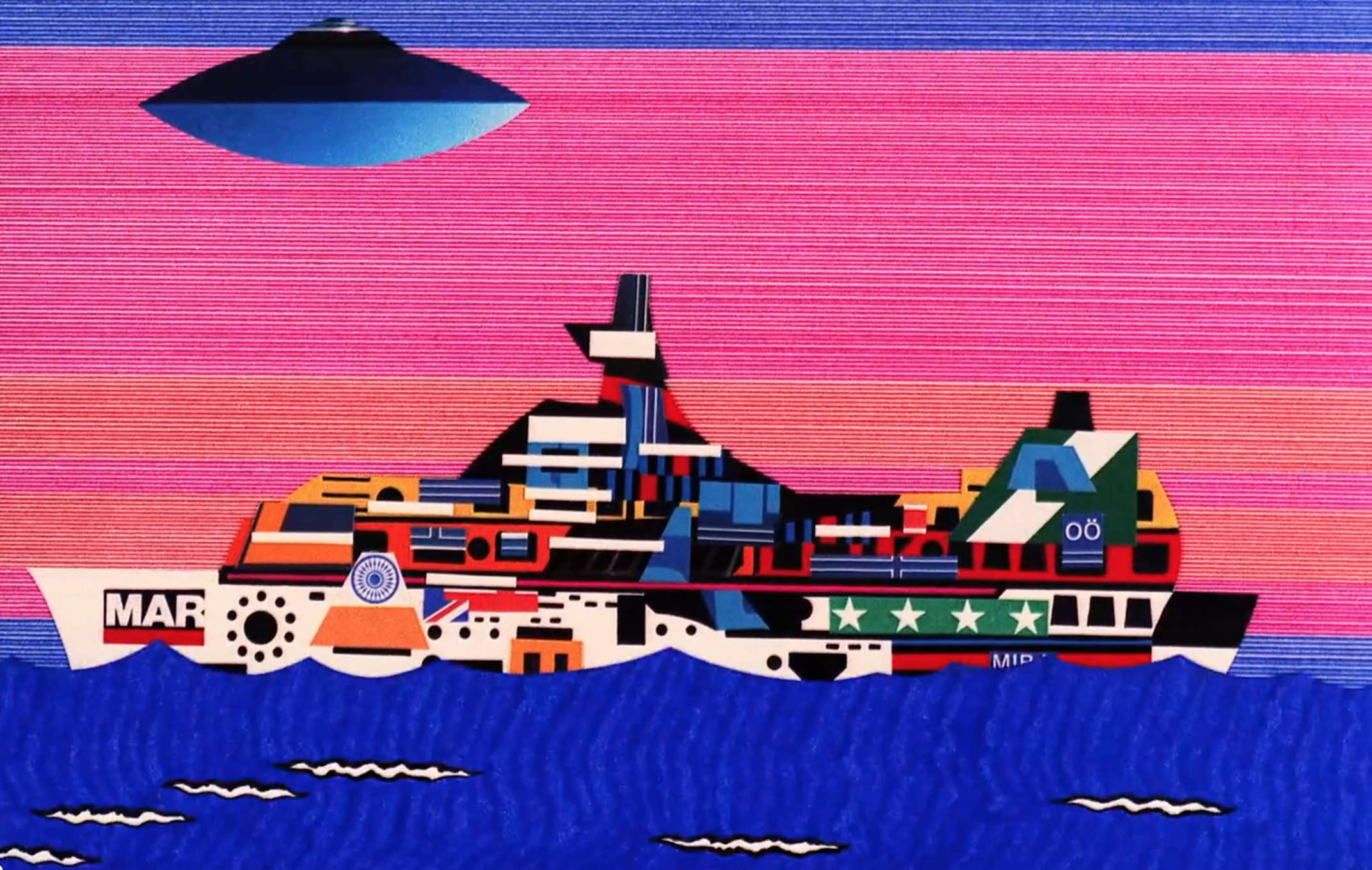
Panic (dir. Sándor Reisenbüchler, 1978)
Reisenbüchler’s cosmopolitan career belies the stereotype that Eastern European artists were laboured in isolation behind the Iron Curtain. He frequently travelled abroad for festivals and masterclasses, and his recollections of his experiences are laced with sly humour about the cultural politics of the era. The Kidnapping of the Sun and Moon was a smash in the USA and Russia – “in Moscow, I experienced the greatest success of my life. The Russians cried, they said they had never seen such a beautiful film” – but was lambasted by “West German radicals” who thought its depiction of a villainous dragon was a coded attack on Maoist China. Moon Flight found an audience during a 1976 tour of England, while Reisenbüchler was fond of Toulouse and the student crowd there; a residency in Geneva, on the other hand, revealed only “great social inequalities and exclusion.” And in Mumbai, “the misery was surreal.” Reisenbüchler was openly sympathetic with what he called “the hippie jeans people” of the sixties counterculture, who were equally disillusioned with both sides of the Cold War binary: “because they really are two untenable systems… Before my travels, I thought that the bourgeois world of the West was more liberated. I had to experience that this was not the case. On a human level, there were the same rungs on the ladder of society as [in Hungary]. And we didn’t even know how talents were trampled over there.”
Reisenbüchler only completed four shorts after the fall of communism – although brief, each of his film was agonisingly slow to come together – but they capture his persistent cynicism and faith in the good life. Ecotopia (1995) is a late career meditation on familiar themes, knowingly dedicated to Fritz Lang, whose silent epic Metropolis helped to shape modernist reveries of the city of the future. Here, we move from frantic cityscapes bursting with lurid colours and a phantasmagoria of commodities to idyllic rural panoramas. Reisenbüchler had long had a special eye for the schematic visual splendour of the cityscape, and the anti-consumerist heft of this post-communist film is nonetheless invigorated by his capacity to capture capitalism’s gaudy excesses as much as its gruelling pressures. His final film, 2002’s The Advent of Light strips these ideas down to their conceptual and visual core. The director publicly declared that there was nowhere left for him to venture in artistic terms and retired from filmmaking on its release. He died two years later at the age of 69. When asked in a late interview what the secret of his success was, he responded with a typically laconic remark that belied the intricacies of his remarkable animated creations: “Perhaps the secret was in my simplicity.”
Watch our collection of psychedelic shorts by Sándor Reisenbüchler on Klassiki now.


 Go back to journal home page