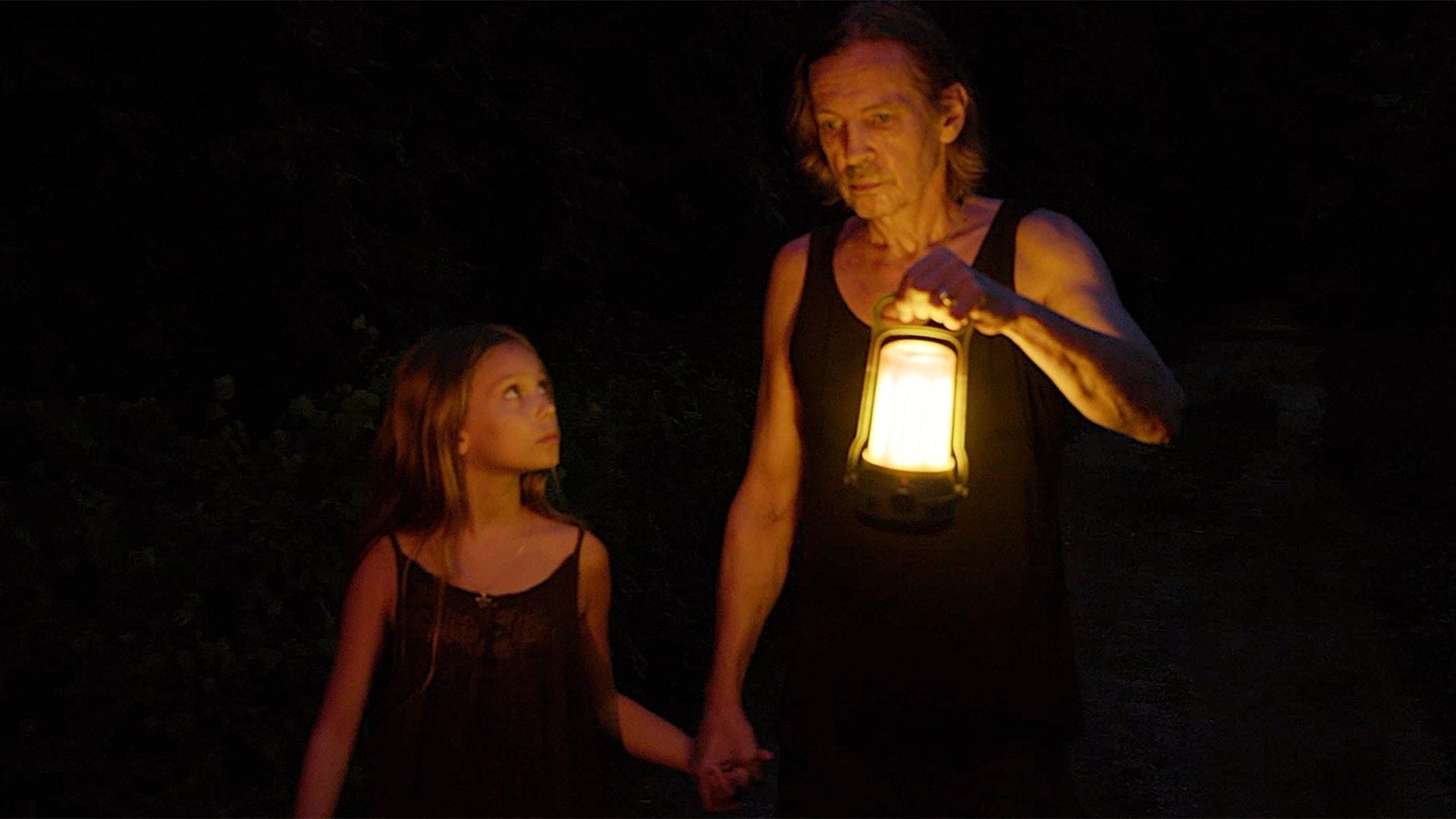
Una Marija Bartaitė and Šarūnas Bartas in Laguna (dir. Šarūnas Bartas, 2025)
In April 2021, Lithuanian actor Ina Marija Bartaitė was killed by a drunk driver while cycling, just a few minutes from her home. Her father, the acclaimed filmmaker Šarūnas Bartas, has spent the years since attempting to reckon with the loss; one aspect of that effort has been his ongoing work on a documentary film that now arrives in the form of Laguna. It’s a film that has been a long time coming, but which maintains a sense of grief and memory as unending and unspooling processes.
Ina Marija had first travelled to Mexico to work on a film. Bartas had joined her in the country with plans to shoot there prior to her death; after the tragedy, he continued to make the trip, capturing the environment and his reactions to it in an attempt to retrace his lost daughter’s steps. Over time, this project evolved into a portrait of Bartas’s relationship with his youngest daughter, Una Marija, who began to accompany her father on these journeys. Amid hurricane-ravaged mangroves and lush jungles, Šarūnas and Una quietly confront their grief and the reality that life and time wait for no one. The result is a documentary that blurs the lines between art and reality, and between pain and hope. Over the course of a career that has coincided almost exactly with Lithuania’s post-Soviet independence, Bartas has quietly fashioned a reputation as one of the Baltics’ most vital directors with titles like Eastern Drift (2010), Peace to Us in Our Dreams (2015, starring Ina Marija), and Frost (2017). Laguna sees his craft applied to great emotional effect to the director’s own deepest emotional currents.
Laguna is available to watch on Klassiki now until 16 July. We spoke with Bartas via email about the journey that he and his family went on in making the film.
Could you tell me a little about how the film evolved over time? My understanding is that you began filming in Mexico before 2021 and then returned over time. How did your sense of what you were capturing and why shift over that time? And at what point did Una Marija become a central part of the process?
I did start filming in Mexico in 2021. At that time, I was travelling with my daughter Ina Marija. At the end of the trip, we found an incredibly beautiful lagoon. As someone who loves nature, I immediately had the idea to film both the lagoon itself and the people living on its shores. That is how we started working.
Unfortunately, my daughter Ina Marija was suddenly killed by a drunk driver, and my life was turned upside down. I can say that for a couple of years after Ina’s death, it felt as though that life simply no longer existed. Eventually, I had to return to Laguna. But by then, all the colours and all the people seemed different. I realised that, as always, I can only speak about what hurts. About what I feel with all my skin, what goes right through me. That is exactly why both I and my younger daughter Una Marija appear in Laguna.
To Una, her sister was like a goddess. She was a great authority, and they shared the sincerest love with each other. Both Una and I were also brought together by this tragedy. And the older one, Ina Marija, who had died, truly loved Mexico and had worked in this country as an actress. So, all the threads came together. That is how Laguna came into being – in it, the three of us touch nature as if we were holding hands.
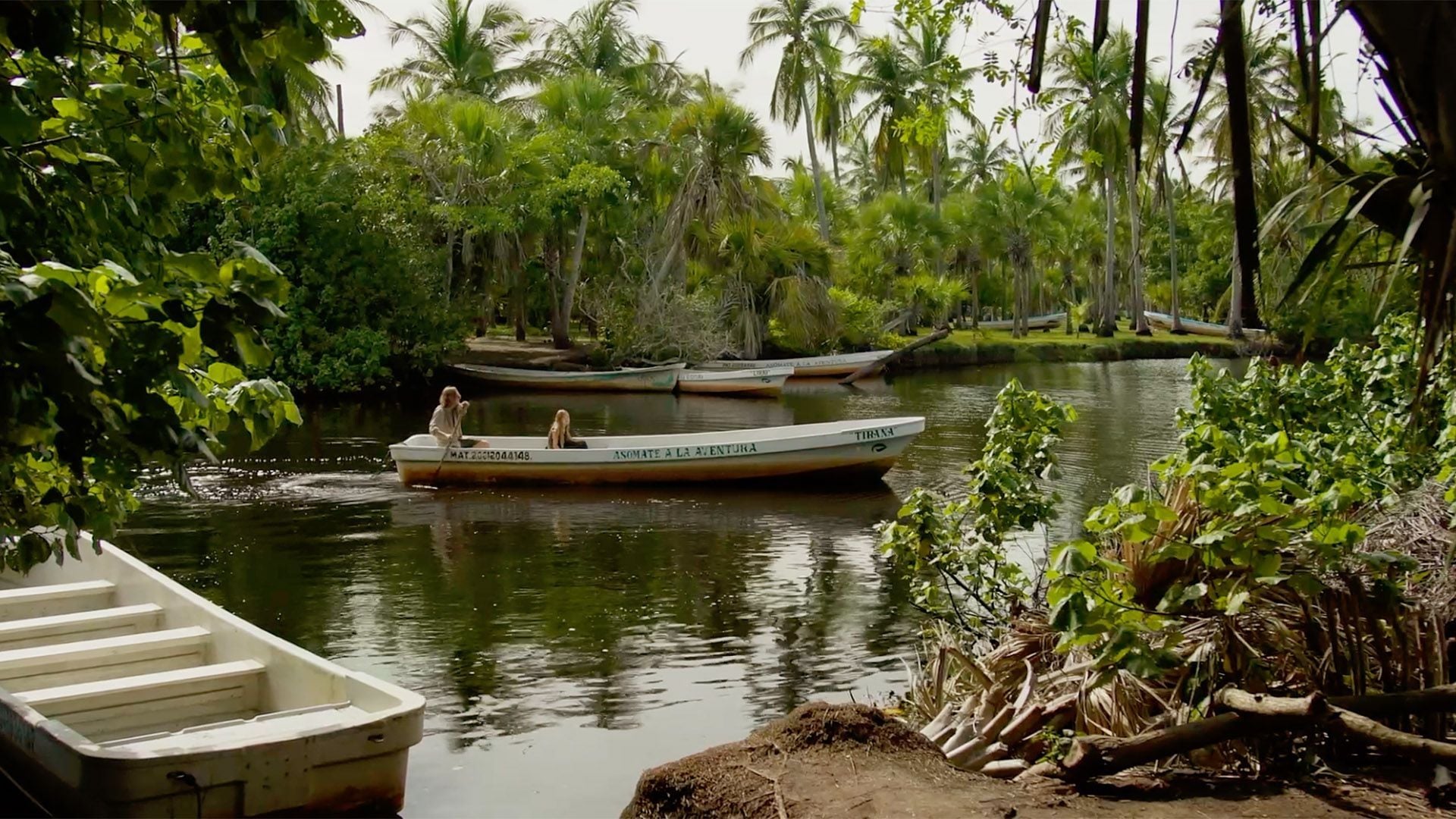
Laguna (dir. Šarūnas Bartas, 2025)
Related to this, was there a point where you understood the final form the film would take? Or did it emerge during editing/post-production?
A more or less precise form of a film never becomes clear during editing or post-production. This has to happen much earlier – while filming. It would be naive to think that during editing you can suddenly discover something that is not there, discover something that was never filmed. That never happens. You can edit only the material that you already have. And for it to exist, it first has to be filmed. And not just in any way: it has to be filmed so that, in editing, the material comes together into one whole film. Editing begins during filming.
I’m interested in the practical question of how sequences with yourself and Una Marija were planned and shot. Was there any scripting to the conversations that you capture? Given the intimacy of those moments, I imagine the crew must have been very minimal.
It is a little strange to think that intimate scenes can only be filmed with a small crew. The size of the crew is determined not by intimacy, spiritual involvement, or improvisation: it is determined only by practical factors – the amount of work that has to be done, its complexity, and the amount of work that has to be done within a certain time. The filming process itself is far too important to compare it to the number of people working on set.
The crew was indeed small, but only because it was able to handle the work that had to be done. As for intimate dialogues and improvisation, they have to be grounded in advance. Any improvisation must have a subject, more or less decided beforehand. If an improvisation has no idea behind it, we will simply have a conversation about nothing.
I was interested by the inclusion of the material with the local villagers, including some direct interviews with them. How did you understand their stories as relating to the family story at the heart of the film?
We are people, animals of the same species. Therefore, regardless of race, language or where we live, we will always find things that are common and that connect us. Moreover, my daughter Una speaks about this in the film, and none of us told her to say it – these are her thoughts – Una says that we are all brothers and sisters. She came to this conclusion from the biblical story of Adam and Eve. I can only add that, in fact, all eight billion of us come from just a few thousand ancestors, if not fewer. Genetic science states this quite clearly. Everywhere I have been in the world, in some people I felt the same emotions, the same vibrations of the spirit, as in myself.
A bond with nature? This question has always seemed a little strange to me. I do not think it is a bond at all. We ourselves are nature. There is nature in the form of cities; nature in the form of jungles; nature in the form of glaciers. They are different, but all of it is nature
The connection of all three of Ina Marija, Una Marija, and yourself to the natural world in Mexico is clearly profound and comes across very strongly in the film. How did you go about balancing or complementing the human and the animal material one with the other?
Yes, the bond is very strong and deep: between me and my daughters, between us. Ina Marija was already old enough when her sister died. That is why a bond had already formed between them, because that is simply what this bond is. It was like this, it is like this, and it will remain like this, despite the fact that one of us has already gone into the unknown. A bond forms by itself. We do not plan it, and we do not control it. Just as we do not plan love.
A bond with nature? This question has always seemed a little strange to me. I do not think it is a bond at all. We ourselves are nature. There is nature in the form of cities; nature in the form of jungles; nature in the form of glaciers. They are different, but all of it is nature. We are part of it; therefore, the connection is naturally direct.
Obviously, this film comes out of an extraordinary, tragic period in your life. Do you see it as standing apart from your earlier work, or do you see connections and continuities between Laguna and your career before Ina’s death?
I do not know. I have always made films only about what hurts me the most, what moves me the most. For several years after my daughter Ina died, you could say that I was simply not there. I breathed, ate and slept, but that was all. That is why there were no films during that period.
And I cannot avoid the most difficult periods of my life. I cannot forget them or put them on a shelf. Of course, the strongest wave of pain eventually eases a little. But it always appears in my films. If I did not work in cinema, perhaps it would appear in books. Perhaps, I do not know. But I cannot avoid the most difficult periods of my life. I simply do not know how.
Watch Laguna on Klassiki until 16 July.


 Go back to journal home page