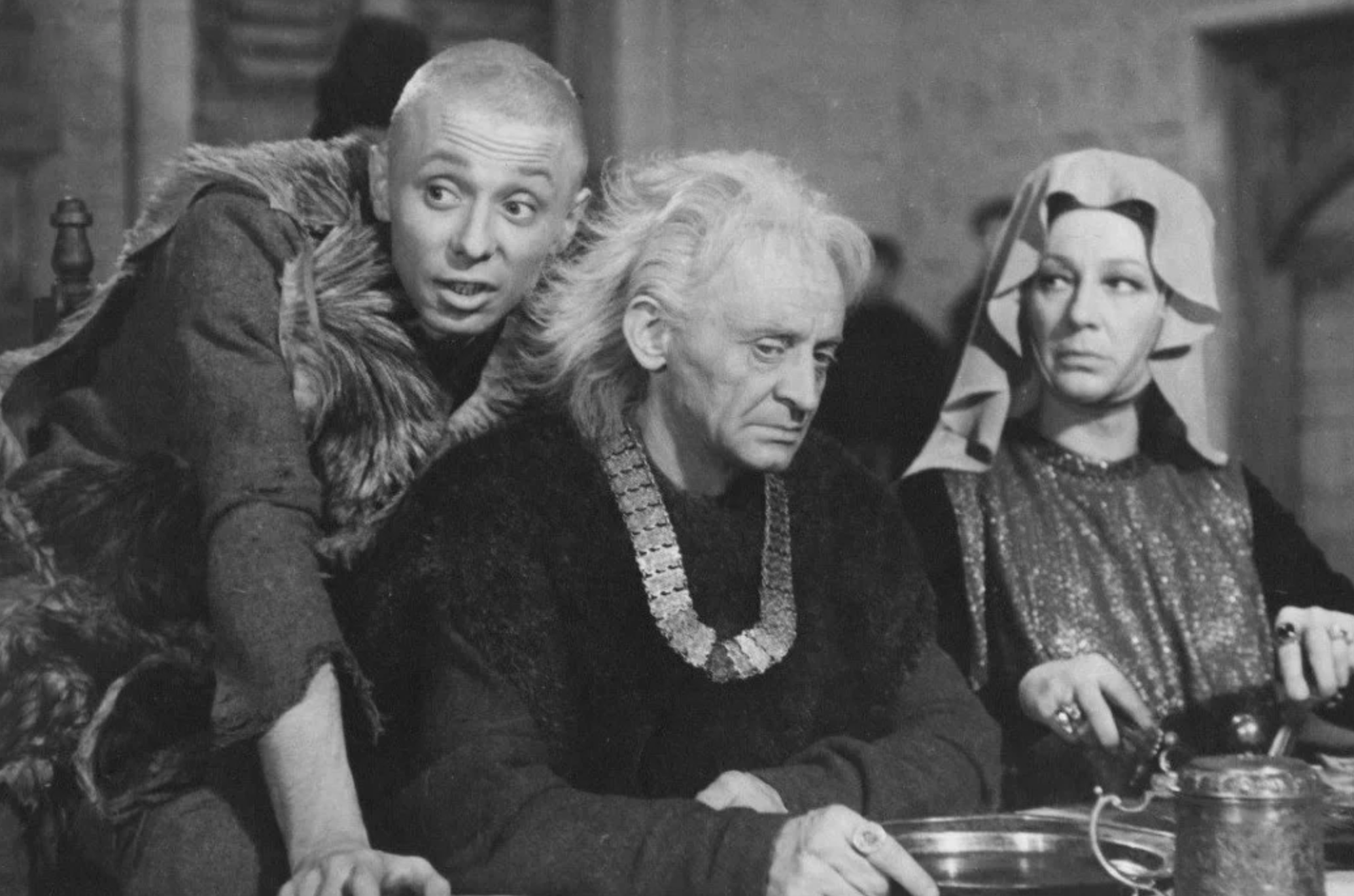
Jüri Järvet as King Lear with Oleg Dahl as the Fool in King Lear (dir. Grigori Kozintsev, 1970)
Recalling his time with the Estonian actor Jüri Järvet, director Grigori Kozintsev wrote that his collaborator was “above all a man of spiritual intelligence. It’s not a question of the number of books read… It’s about the natural, organic qualities of his talent. They can be developed, but not bought. When it comes to an artist’s fate, what matters are not only the parts that he has already played, but those that he never had the chance to realise…” In the title role, Järvet was instrumental in bringing Kozintsev’s daring vision of King Lear to the screen in 1970. That performance came in the middle of a remarkable run during which Järvet was, briefly but brightly, one of the most recognisable and compelling Soviet screen presences. Although he had a long career in theatre behind him and would go on to work on stage and screen until his death in 1995, his reputation outside of Estonia now rests on a small but indelible body of film work from the sixties and seventies.
Järvet remains an Estonian icon and starred in some of the Baltic nation’s most consequential films, but he is not best known for his domestic work – a fate shared with many other breakout artists from so-called “smaller” nations. With first Kozintsev and then Andrei Tarkovsky, Järvet made a name for himself in the more exposed realm of Russophone film, as part of international Soviet casts, his outsider status giving him a slightly otherworldly presence. His dishevelled, birdlike appearance and aura of nervous intelligence lent themselves perfectly to his portrayals of broken-down authority figures – territory that he may well have been drawn to thanks to his own history of familial trauma.
“Järvet was above all a man of spiritual intelligence. It’s not a question of the number of books read… It’s about the natural, organic qualities of his talent. They can be developed, but not bought.”
Järvet was born Georgi Kuznetsov in Tallinn in 1919. His mother, a Russian nurse, soon returned Moscow, leaving the infant with her sister. Before long, he was given up to an orphanage. At the age of five, he was taken in by an Estonian family, although never formally adopted; when his foster mother died suddenly, Järvet was raised in poverty by his three adoptive sisters. As a teenager, he shed his Russian birthname and took the Estonian title by which he is now known. At around the same time, he began to communicate with his birth mother’s sister, who gave him the estranged woman’s address in Gorky, Russia. A few years later, during the war, Järvet found himself in Gorky while touring with the National Arts Ensemble of Estonia; he made it as far as his mother’s front door before deciding against a reunion and walking away.
Against this gruelling emotional backdrop, Järvet slowly began to forge an artistic career. He came to theatre via gymnastics, in which he had been Tallinn youth champion. He made the rounds of a number of Estonian theatre groups, first as a dancer, then as an episodic player, before finally earning his stripes in the 1950s as a respected actor. Although he left gymnastics and dance behind, they continued to inform his plastic, tragi-comic approach to drama: “the role starts in the legs,” as he was fond of saying. At the end of the war, he made it into the State Academic Drama Theatre, working his way from comic roles to tragic heroes. In the words of the theatre’s director Voldemar Panso: “Järvet’s rise was not rapid. He grew stubbornly and steadily, like a northern juniper, crooked, low-growing, thick, strong, stable, and prickly. But this prickly fur coat is nevertheless charming in its amazing tones and shades. Järvet’s acting is passive but precise. He brings silence, he feels the other side of the comic. He knows how to act so that his laughter rings with sadness and trembles with pain.” Two stints as Lear for the National Youth Theatre in 1967 paved the way for his casting by Kozintsev.
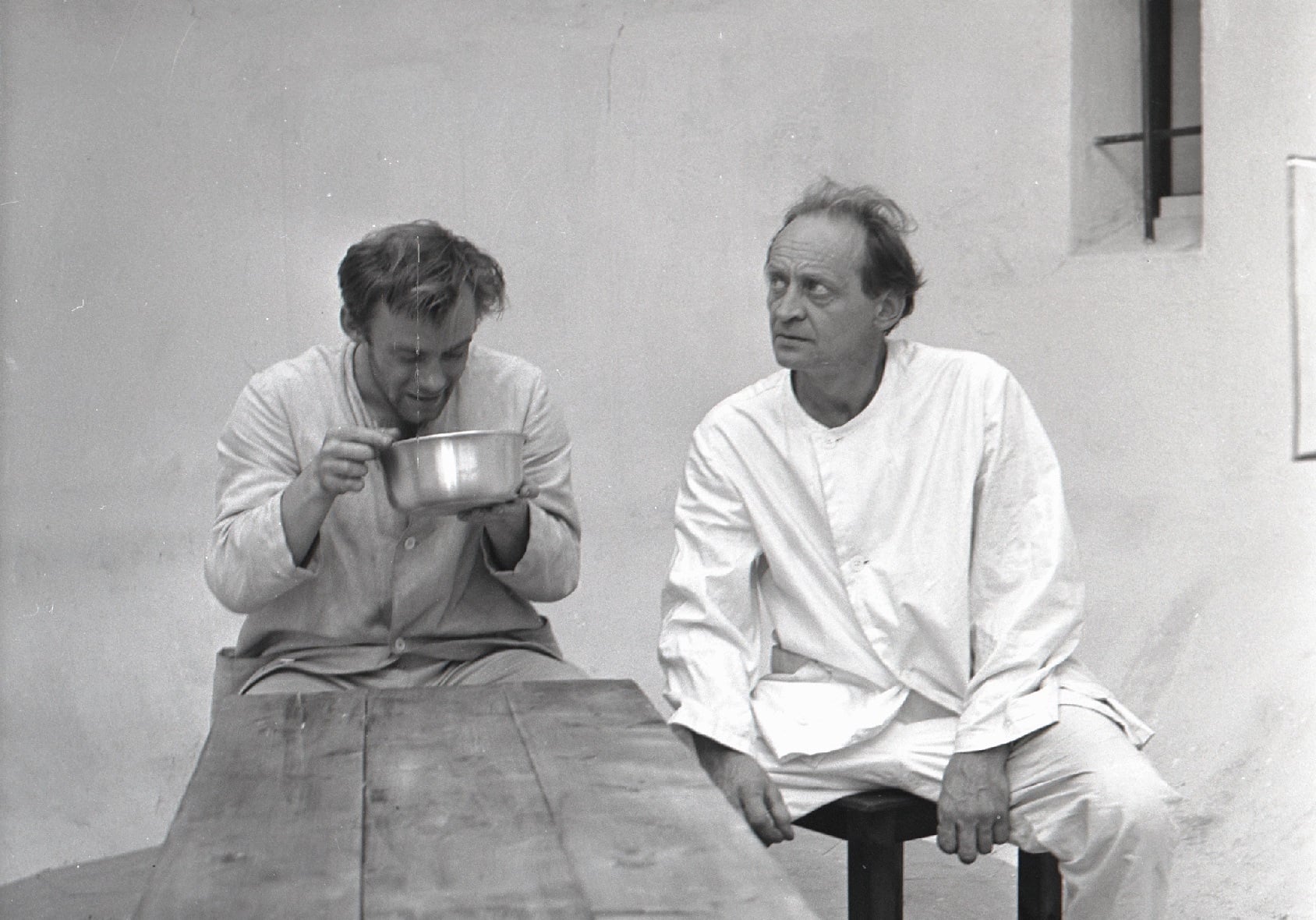
Jüri Järvet in Madness (dir. Kaljo Kiisk, 1969)
In the interim, Järvet established himself as a screen presence in two epochal late sixties features. As Professor O’Reilly, he brought his malleable, lugubrious energy to Savva Kulish’s ground-breaking Cold War spy drama Dead Season (1968). More consequential was his leading role in Madness (1969). Kaljo Kiisk’s mind-bending satire is credited as the first modern arthouse feature in Estonian cinema. Its subsequent fate – a limited release, followed by its removal from theatres for almost twenty years – says much about the strangely purgatorial state occupied by artists on the nominal “periphery” of the Soviet state. Here, Järvet is Gestapo Officer Windisch. In an unnamed country somewhere in Europe in the dying days of the Second World War, the occupying Nazi forces arrive at a remote asylum intent on extermination. But then news arrives that among the hundreds of patients are a handful of British agents feigning insanity to hide in plain sight. Windisch has only a few days to go undercover as an inmate himself to flush out the imposters – but even this short stint in the institution is enough to erode his sense of self. Järvet’s elastic intensity and fragile authority lent themselves perfectly to the role, aided by time spent in psychiatric hospitals in Estonia and Latvia in preparation for the film – a draining experience of which Kiisk later recalled: “you could still hear the silence that reigned in the buses as they drove back… After the prep period, the actors brought a lot to the set with them; it was like fireworks on set.”
“Järvet’s rise was not rapid. He grew stubbornly and steadily, like a northern juniper, crooked, low-growing, thick, strong, stable, and prickly… Järvet’s acting is passive but precise. He knows how to act so that his laughter rings with sadness and trembles with pain.”
After bringing modernity to Estonian film, Järvet was thrown back into the distant past for his defining role as Kozintsev’s Lear. This was to be the final act in the director’s remarkable career, which stretched back into the silent age and his avant-garde double act with Leonid Trauberg, the Factory of the Eccentric Actor. In the post-war era, Kozintsev had reinvented himself as a Soviet statesman, directing foreign classics (including Shakespeare and Cervantes) for the Moscow stage. A 1964 film adaptation of Hamlet had proved an international success, paving the way for his radical take on the Bard’s bleakest tragedy.
Kozintsev’s stated aim was “not to adapt Shakespeare to the cinema, but the cinema to Shakespeare.” Järvet fits perfectly into the director’s desolate, expressionistic vision of a world undone by pride and greed. His Lear begins to unravel from the very first scene, a ball of wiry, dishevelled anger. Kozintsev had offered him the title role after he had only auditioned for an episodic part as a tramp, one of a number of Baltic luminaries in a cast that also included Lithuanians Donatas Banionis as Albany and Regimantas Adomaitis as Edmund. The Baltic character of the production was heightened by the decision to shoot in the medieval coastal twin towns of Narva and Ivangorod, each perched on one side of the Russia-Estonia border – as if to reinforce the dubbed Järvet’s uncanny, distant air.
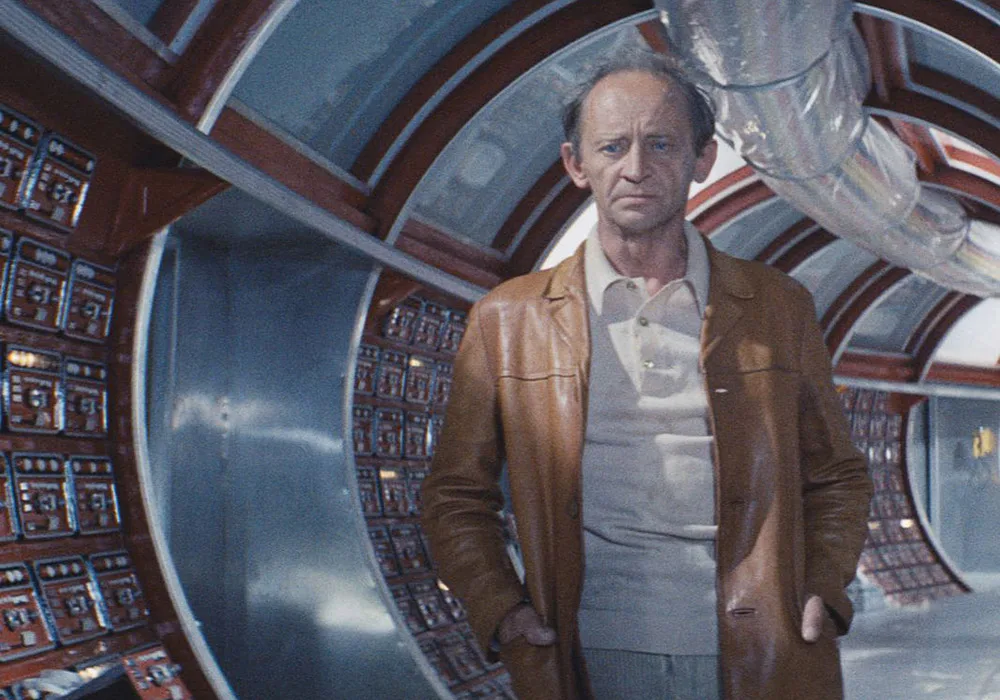
Jüri Järvet in Solaris (dir. Andrei Tarkovsky, 1972)
Järvet was reunited with Banionis for Solaris (1972), by far his best-known film outside of the former USSR. Banionis plays Kris Kelvin, the lead in Andrei Tarkovsky’s adaptation of Stanisław Lem’s 1961 sci-fi novel about the inhabitants of a space station who are haunted by manifestations of their deepest desires. Järvet is Dr Snaut, a phlegmatic scientist seemingly resigned to the mysteries of the cosmos, caught between the smouldering Kelvin and Anatoly Solonitsyn’s irascible Sartorius. Järvet makes the most of his episodic screen time, anchoring Tarkovsky’s cerebral drama with his trademark otherworldly (here literally) emotional clarity. At one point, he also delivers what could serve as a single-line encapsulation of the existential crisis at the heart of the narrative: “We don’t need other worlds, we need mirrors.”
Järvet would never recapture the levels of exposure afforded by Lear and Solaris, though he remained a welcome presence in Estonian and Russian productions for the rest of the Soviet era. The highlight of his later career was his scene-stealing turn in Grigori Kromanov’s Dead Mountaineer’s Hotel (1979). Like Solaris, this was an adaptation of a communist sci-fi icon in the form of the Strugatsky brothers (the source for Tarkovsky’s own Stalker of the same year); like Madness, it was a cult genre piece that hinted at paths unfollowed for Estonian cinema. Järvet is Alex Snewahr, the proprietor of the titular guesthouse, perched high in the hills of some unnamed European country. The chill of the snowy vistas beyond the windows are matched by the uncanny atmosphere inside, as Inspector Peter Glebsky (Uldis Pūcītis) arrives on an anonymous tip to find that things are not quite as they seem. Like Snaut, Snewahr is a character comfortable – perhaps too comfortable – with the mysterious and the macabre. The presence of the Latvian Pūcītis and the Lithuanian Nijolė Oželytė as the gender-fluid Brun is a reminder of the spirit of pan-Baltic collaboration that had infused Järvet’s career from the off. Conversely, the unplaceable setting of the hotel and the suggestions of supernatural intrigue speak to Järvet’s brief but lasting role as the patron saint of the otherworldly in Soviet cinema.
Watch Madness on Klassiki as part of our partnership with the London Baltic Film Festival, available until the end of February 2025. Explore our complete collection of titles from the Baltic states here.


 Go back to journal home page