
Adrianna Biedrzyńska and Janusz Gajos in Dekalog IV (dir. Krzysztof Kieślowski, 1989)
The apogee of communist-era Polish cinema came at its very end. The final decade of Party rule was marked by both brutality and opportunity: the eighties began with the imposition of martial law and ended with the victory of the Solidarity union movement in the elections of 1989. Economic and moral crises seemingly went hand in hand; the nation’s post-war history was reconsidered afresh in daring films that often fell at the hands of the censors. It was in this context that Krzysztof Kieślowski delivered his Dekalog: an intimate epic of everyday life inspired by the Ten Commandments that transcended both political activism and scriptural trappings to hint at something truly universal. As if he were aware just how quickly the world was turning beneath his feet, Kieślowski worked at a frightening, self-destructive pace, completing 12 films in the space of a year. By the time most domestic audiences saw Dekalog, the Polish People’s Republic has ceased to exist, following revisions to the country’s constitution in December 1989; by the time it made its way to Western Europe a year later, Lech Wałęsa was President.
After the fall of communism, Kieślowski produced his final features – The Double Life of Véronique (1991) and the Three Colours Trilogy, released as Red, White, and Blue across 1993-94 – in France. Dekalog is thus the apotheosis of his Polish career, and in more ways than one. It is the grandest expression of his concern for the ordinary citizens of the People’s Republic, but also attempts a level of philosophical inquiry that was new even for Kieślowski. It picks up the social critique of his seventies films, while moving ever further away from outright political condemnation. There is something of his earliest documentaries in its attention to the detail of everyday life, combined with an unusual degree of stylised visual beauty. Stanley Kubrick famously declared the series a masterpiece, writing that Kieślowski and co-writer Krzysztof Piesiewicz “have the very rare ability to dramatise their ideas rather than just talking about them. They do this with such dazzling skill, you never see the ideas coming, and don’t realise until later how profoundly they have reached your heart.”
“Kieślowski and Piesiewicz have the very rare ability to dramatise their ideas rather than just talking about them. They do this with such dazzling skill, you never see the ideas coming, and don’t realise until later how profoundly they have reached your heart.”
Piesiewicz was instrumental in Kieślowski’s mature career and a driving force behind Dekalog. A lawyer, Piesiewicz met the director while consulting on (and eventually co-authoring) his 1985 feature No End, about the martial law-era trial of a Solidarity organiser. (The film also saw the introduction into Kieślowski’s orbit of the composer Zbigniew Preisner, who would score Dekalog and the director’s French features.) The official response to No End was savage – “We really got a thrashing over it,” Kieślowski later recalled – following on from the banning of the director’s previous feature, Blind Chance (1981, released in 1987). Determined to avoid overt political themes, director and writer cast around for more allegorical material. It was the devout Catholic Piesiewicz who landed upon the idea of a contemporary reimagining of the Ten Commandments. Crucially, the series was made for Polish television, but funded by West German investors (a sign of the comparative licentiousness of the late eighties), affording writer and director the room to breathe that the weighty concept demanded.
Dekalog in its final form consists of ten hour-long episodes, stylised with Roman numerals, each of which is nominally related to one of the biblical Commandments; episodes V and VI were later expanded into 90-minute feature films entitled A Short Film about Killing and A Short Film about Love respectively. All ten episodes are set in the same Warsaw tower block complex, with an overlapping ensemble cast. The ten episodes had originally been intended for ten different directors, but Kieślowski found himself unable to relinquish control over the project. He did, however, make sure to hire a different cinematographer for each film, with only Piotr Sobociński returning for two episodes; as a result, the same setting becomes refracted through a range of visual palettes and compositional styles.
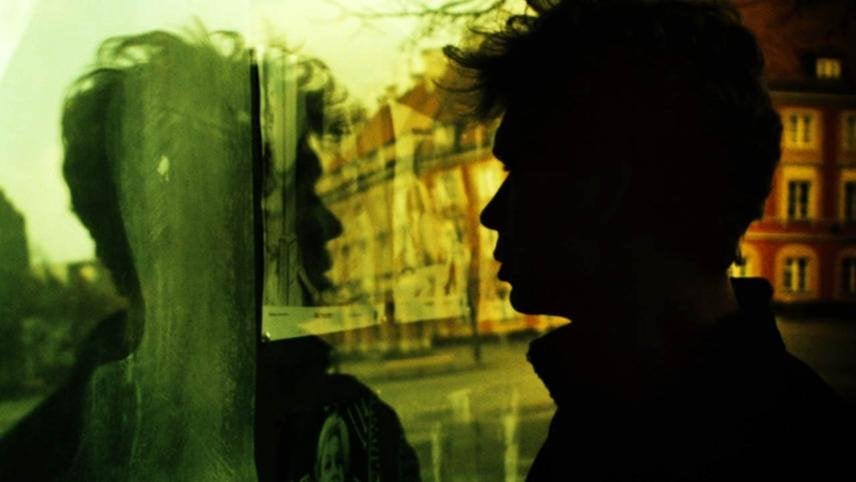
Mirosław Baka in Dekalog V (dir. Krzysztof Kieślowski, 1989)
In truth, it is easy to overstate the importance of Dekalog’s biblical framing device. While some Commandments – thou shalt not kill (V); thou shalt not covet thy neighbour’s goods (X) – are tackled directly, the relevance of others to the onscreen drama is far from obvious. The understated tension between Piesiewicz’s more committed religiosity and Kieślowski’s cool humanism keeps every scenario engaging over the ten-hour-plus runtime of the full series. Viewed as a whole, the clarity of conception and execution displayed by the writing-directing partnership is remarkable: ten perfectly realised episodes of human comedy and tragedy, each standing alone while also working in symbiosis with the next. The Short Film features demonstrate that each of the stories told here could be extended forward or backward in time without losing their power. In Dekalog II, two characters share the following exchange: “Interesting block”; “Like any other. Everyone has a story to tell, and so on.” In other words, the local resides in the universal, and vice versa – that is the significance of the scripture to Kieślowski and co.
If the director arrived at this philosophical stance in part as a result of the political pressures of the eighties, then it was also an organic endpoint to his evolving fascination with the quotidian life of communist Poland. Kieślowski had initially planned to make a career in non-fiction, and from 1968 until 1980 he more than 20 documentary shorts, TV films, and features about the working lives of ordinary Poles – from the direct interview style of 1977’s From the Night Porter’s Point of View to the experimental sociology of 1980’s Talking Heads. The censorship that certain of these films were subjected to helped to convince Kieślowski to abandon documentary for fiction – as he saw it, a more refined medium for truth-telling in an authoritarian state. His first fiction features, from Personnel (1975) through to No End, are often considered part of a loose grouping of critical voices that emerged in the second half of the 1970s, later dubbed the “cinema of moral anxiety”, which included the likes of Agnieszka Holland and Krzysztof Zanussi. Again, provincial settings and unremarkable protagonists were key to the minor-key discontent of the moment.
Kieślowski avoids easy judgement of his characters. His 1988 statement to critic Bożena Janicka that “all my films are made as if through glass” captures not just the proliferating windows of the tower block, but also his cool remove from the intensity of emotional turmoil
The richness of Dekalog resists easy summary. Every viewer will have their favourites among the huge ensemble cast. The series opens with one of its most heart-breaking episodes, about the linguistics professor and amateur computer programmer Krzysztof (Henry Baranowski), whose indoctrination of his precocious son (Wojciech Klata) into the world of scientific reason fails to prevent bitter misfortune. Death haunts many of the episodes (I, II, V, VII, VIII, IX), as does the spectre of romantic dissolution. Krzysztof and his wife in I are separated; elsewhere, infidelity and empathetic ellipses proliferate throughout the tower block. The entanglements of romance and family tend to prompt moral reckoning in Kieślowski’s world. The problem of proving maternity hangs over Dekalog IV; the violinist Dorota (Krystyna Janda) in Dekalog II ponders an abortion while her ailing husband teeters on the brink of death. Dorota’s dilemma is restated diegetically by the ethics professor Zofia (Maria Koscialkowska) in Dekalog VIII, which also raises the spectre of the Holocaust, never far from the minds of post-war Polish artists. Throughout, Kieślowski avoids easy judgement of his characters. His 1988 statement to critic Bożena Janicka that “all my films are made as if through glass” captures not just the proliferating windows of the tower block through which we glimpse the lives of its inhabitants, but also his sense of cool remove from the intensity of the emotional turmoil behind each front door.
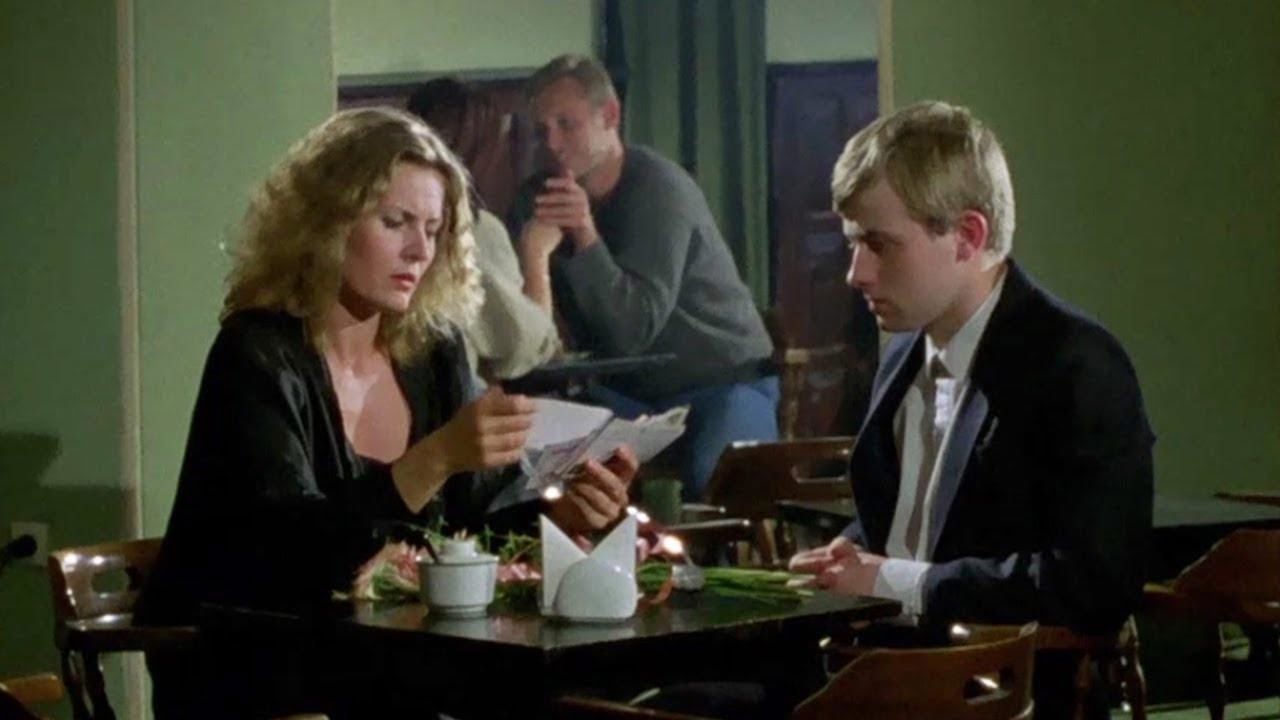
Grażyna Szapołowska and Olaf Lubaszenko in Dekalog VI (dir. Krzysztof Kieślowski, 1989)
The sheer range of the human drama on display is encapsulated in the two Short Film expansions. A Short Film about Killing is Kieślowski at his most brutal. The murder of a taxi driver by a young drifter named Jacek (Mirosław Baka) is recorded in unbearable detail, as is the agony faced by the criminal’s idealistic lawyer Piotr (Krzysztof Globisz) in the face of the death penalty handed down to his client. Conversely, A Short Film about Love is almost shockingly tender in the face of human frailty. 19-year-old Tomek (Olaf Lubaszenko) is an orphaned postal worker who rents a room from his best friend’s mother (Stefania Iwińska). Each night at 8:30, he watches through a telescope as the beautiful, 30-something Magda (Grażyna Szapołowska), a resident of the neighbouring tower block, brings home a succession of men. Erotic fixation soon turns to ardent adolescent love, and Tomek haplessly attempts to bridge the physical and emotional distances between himself and Magda – intercepting her mail and intruding on her liaisons. Once the pair meet, however, and the weight of Magda’s romantic cynicism makes itself felt, Tomek is forced to confront the devastating gap between ideal and reality.
The narrative structure that Kieślowski and Piesiewicz deploy here clearly recalls Alfred Hitchcock’s gripping study of voyeurism in Rear Window, as well as the genre thrills of his post-modern disciple Brian De Palma. But Kieślowski’s own humanism overwhelms the potential seediness of the Tomek/Magda relationship; as critic Eric Hynes notes, “it’s through his confusion over closing the distance that [Tomek] transgresses… But he’s never guilty of watching.” Lubaszenko and Szapołowska give two of the finest performances in the director’s oeuvre, and together with cinematographer Witold Adamek, Kieślowski finds the melancholic beauty rather than the grubbiness in the tower block, all blue and red light and autumnal chill.
Dekalog VI ends abruptly with Tomek renouncing his love for Magda. The expanded film version allows us more time with Magda in the aftermath as she begins to mirror Tomek’s former fascination with her, leading to a stunning climactic scene in which the pair encounter one another in a rarified moment of recognition: what Hynes calls “the love of pure empathy that asks only for the privilege of seeing its object and that requires not even an acknowledgement of its active gaze.” Tomek’s telescope makes literal Kieślowski’s notion of filming “through glass”; Tomek’s and Magda’s story, along with all the others that make up Dekalog, demonstrate that the object of Kieślowski’s “pure empathy” was nothing less than Polish society itself.
Watch A Short Film about Love on Klassiki now and explore our collection of Polish titles here.


 Go back to journal home page