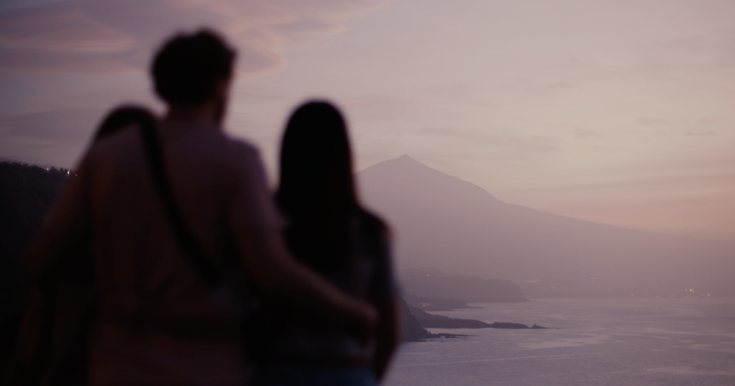
Under the Volcano (dir. Damian Kocur, 2024)
Damian Kocur is one of the most talented filmmakers working in Poland today. His sophomore feature, Under the Volcano, premiered in Toronto in 2024 and was Poland’s nomination for the Best International Feature Oscar last year. The film follows a blended Ukrainian family who are vacationing in Tenerife when the full-scale war breaks out back home, leaving them stranded on the island and forced to reckon with both the private tensions and the geopolitical fallout of the criminal aggression against their distant homeland. Shot in the observational style established in Kocur’s award-winning debut feature Bread and Salt, the film reimagines the war drama outside of the conflict zone.
Under the Volcano is screening in cities across the UK between 6 March and 25 April as part of the Kinoteka Polish Film Festival touring programme, in partnership with Klassiki. To mark the occasion, we’re publishing an abridged transcript of our interview with Kocur on the Klassiki Podcast, originally released shortly after the film screened at last year’s London Film Festival. Kocur tells host Sam Goff discuss how he applied his idiosyncratic filmmaking technique to this story of grief and dislocation, and how the war has affected both Ukrainian filmmakers and their neighbours in Eastern Europe. The episode can be listened to in full here and on all major podcast apps. Subscribers can also watch Damian’s debut feature Bread and Salt on Klassiki now.
How did you arrive at this very particular way of telling a story about the Ukraine war? How did you end up in Tenerife, and with this particular family?
At first, I found an article in a German newspaper about a Ukrainian family that was spending their vacation in, I think, Madagascar when the war started. They couldn’t go back; the flights were cancelled. And it combined my perspective – of being safe, being in part of Western Europe, or at least Central Europe – with the fear and all the feelings they had: that you cannot do much, the feeling of helplessness, and guiltiness as well. I chose Tenerife because it has the biggest volcano in Europe, and I thought that could be very symbolic. And I’ve been there a couple of times before, so I knew the island. When I’m writing something, I really like to know the places and the people. It was exactly the same case with Bread and Salt.
You mention the symbolic value of the volcano. For English-speaking audiences, the title Under the Volcano immediately evokes the Malcolm Lowry book. Was that deliberate on your part?
It has nothing to do with the book. I read the book, but there is nothing to do with the book. I couldn’t really come up with a better idea regarding the title, and I’m not really a big fan of sophisticated titles and all that stuff. That was the idea, the symbolism: it’s kind of safe volcano, on the island next to Tenerife, there was a huge eruption two years ago and many buildings were destroyed. People had to leave the island. So, you never know when the volcano will erupt, and you can feel still that there is a kind of tension and danger [on the island].
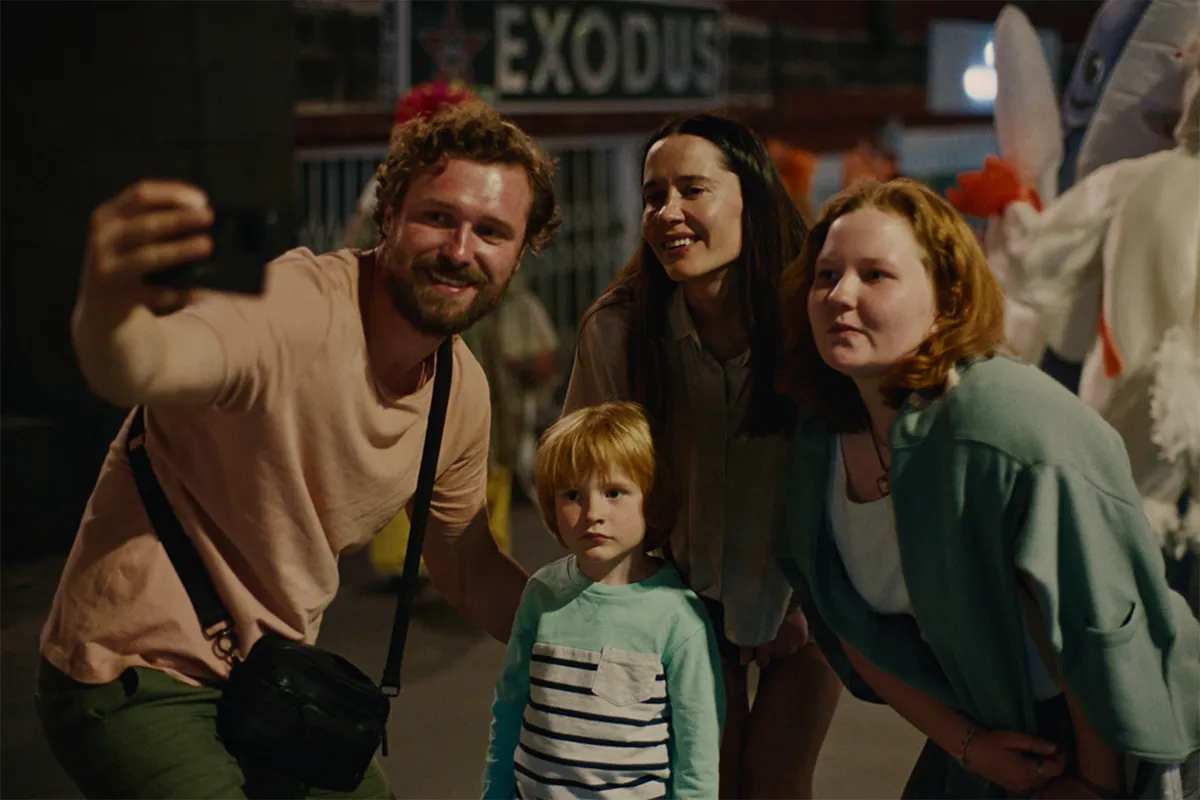
Sofiia Berezovska, Roman Lutskyi, Anastasiia Karpienko, and Fedir Pugachov in Under the Volcano (dir. Damian Kocur, 2024)
It’s a threat that becomes naturalised, that you learn to live with. And learning to live with danger means intentionally ignoring it, which has its own consequences.
For me, the film is about [the fact that] we are living in a world that we feel is safe. War will never appear in our country. But the Ukrainians, they thought the same, you know, even a couple of days before the war started. And it happened. Today, you are choosing which wine you want to drink with dinner, and the next day you have to pack your stuff and leave your country. I hope it’s not going to happen to many of us, but it’s going to happen for some of us for sure.
I know that you have a very particular approach to casting – that’s something we discussed when we spoke about your first film, Bread and Salt, where you cast local people, non-professional actors who had similar life experiences to the characters in question. Could you tell us a bit about the casting process for Volcano?
The cast from Tenerife were playing themselves: the manager of the hotel was playing himself; the receptionist was playing herself and all of that. For the Ukrainian family: they had the same experience as my protagonists, they were from Kyiv, they weren’t living abroad [beforehand], they still have that feeling of threat. Roman Lutskyi and Anastasiia Karpienko are professional actors with huge experience in cinema and theatre and TV series. But the main character is Sofiia Berezovska, who was 16 years old, and that was her first time in front of the camera. I always like trying to combine casting with the writing process. When I chose Nastiia Karpienko for the role, I rewrote the text, because she looked so different to Sofiia, they couldn’t be biological mother and daughter. So, I made from her a stepmother and I built another layer of meaning and tension between them.
I had to work with actors [on this film], but I worked with them in the same way that I work with non-professionals. We did a lot of improvisation. I gave them the text a day before shooting, so they couldn’t really be prepared. There were no dialogues that they had to learn by heart.
For me, just photographing the text is boring. There are things you can make better worse, but they will be always prepared, they will always be kind of obvious. I like to be in the moment. I don’t want to get bored by filmmaking, because this is the only thing I can do in my life.
I was going to ask whether the cast were involved in the writing process. But it sounds like you were working more with an outline than a strict shooting script.
Yes, I give them a lot of space. So, if anybody has anything interesting to say, I implement that in the text. I also give them small headphones to wear, and I have a small mic [to feed them lines during shooting]. I know that’s not a super new method – I know Albert Serra works like that. Let’s say that Sofiia is asking Roman about his first love; Roman responds with his real story, his own first love, you know, not a story that I wrote before. If somebody tells you his or her real story, it will always sound real, because you have the story in your body.
It’s clear from your two features at this point that you use reality to shape fiction and vice versa – that you’re not really interested in a strict divide between the two.
For me, [simply] photographing the text is boring. I mean, it’s just boring. There are things you can make better worse, but they will be always prepared, they will always be kind of obvious. I like to be in the moment, [where] you never know what’s going to happen. I don’t want to get bored by filmmaking, because this is the only thing I can do in my life. Being bored with that would be a terrible thing.
How many cameras do you have rolling at a time when you’re shooting with this semi-improvisatory method? How do you cover the scenes?
I always have at least two cameras, running all the time. Sometimes it’s one take, sometimes it’s 50. I mean, we only had 20 shooting days, and Volcano was much harder for me because there were kids on the set, there were a lot of locations, a different language, a different country. Bread and Salt was easy, because there was only one town, one district, and we didn’t really move around. So, with the two cameras, they always make the work faster, especially when you’re working with non-professionals. They can just repeat many, many, many times. Like Bresson used to make [his] non-professionals do, to make them tired of what they were saying. Nowadays, you don’t really like consider that to be a “naturalistic” way of acting, [what you see in] Bresson’s movies, but that was his method.

Sofiia Berezovska in Under the Volcano (dir. Damian Kocur, 2024)
You’re working with these Ukrainian actors, a Ukrainian cinematographer, and obviously the subject matter is the war in Ukraine. I read in an interview that you said you wrote the film out of a sense of helplessness. It’s an interesting idea: that helplessness might be a kind of a creative prompt or inspiration…
You know, when the war started, I wasn’t able to do anything more than just scrolling my phone and looking at the news. And I think that was the experience for most of us Polish people. Our cities changed overnight, becoming really crowded because of so many refugees from Ukraine, women with kids, everywhere. The streets were packed with those people. And I couldn’t do really much. As a filmmaker, I thought: maybe this is the way that I can do something. I was trying, I was working in this kitchen on the border. But I wasn’t brave enough to go there with my car and take people and drive them across the border.
So, I thought I should make a film about this, from the European perspective of being in a safe place, so to say. And I think my characters also feel this helplessness. What can they do? Especially Roman, the father, they expect from him to act, to be responsible. Everybody is talking about responsibility. How can you prove your bravery when you are on this island, when everything is fine?
This isn’t really a question about your work, per se, but I think it’s important for people to get a sense of how much, since the war started, the Polish and Ukrainian film worlds have been brought together. A lot of Ukrainian film workers and film artists are now being helped or supported by Polish institutions. You’re working with Ukrainian artists here; you’ve produced Ukrainian shorts before. Could you give people a sense of how the war has inadvertently created this international collaboration?
I think for me, it’s very important to tell stories: they’re important from a socio-political perspective. I was working with Ukrainian filmmakers for Volcano – the sound designer, the cinematographer, the technical crew – because for me, they were really engaged in the project, because it’s their story. I mean, I really admire when people still love the cinema and they’re still trying to make films despite financial difficulties.
I just want to say that the Polish internet is like, a lot… I think it’s very painful that part of my country is very supportive, and part of my society is really anti-Ukrainian and anti-immigrant. There was huge hate [for my film] even before the Polish premiere. The reviews were really bad from people who didn’t even have a chance to watch the film. But that’s my country, you know, and I have to deal with that.
Under the Volcano is screening across the UK between 6 March and 25 April as part of the Kinoteka Polish Film Festival’s touring programme, in partnership with Klassiki. Find dates and tickets here.
Watch Bread and Salt on Klassiki now.


 Go back to journal home page