
Rolands Kalniņš
“Our very own Godard”. That’s how Latvian critic Lauma Mellēna-Bartkeviča referred to the legendary Latvian director and screenwriter Rolands Kalniņš in a 2018 retrospective celebrating the filmmaker, who had died three years previously, just a week after his 100th birthday. He was indeed the maverick that such an honorific promises. In Masculin féminin, Godard famously coined the phrase the “Children of Marx and Coca-Cola”, which could be used to describe the colourful, popular, and ideologically oppositional cinema of Kalniņš, one of the most important Latvians to ever stand behind a camera.
Kalniņš was born in 1922 near the border with Russia in Vecslabada, a peninsula situated between three lakes. His youth was spent in the turbulent and belligerent times of Nazi and Soviet occupations and then the Second World War. He was a contemporary of both Jean-Luc Godard (1930-2022) and Federico Fellini (1920-1993), leaders in the French and Italian New Waves that re-negotiated the cinema conventions of the 1960s. He was also a great iconoclast to status-quo filmmaking, just like his Western European peers. Narrative conventions and ideological guidelines mattered less to Kalniņš than making the films he envisioned the way he envisioned them.
The political musicality of the so-called Singing Revolution by which the Baltic states regained independence from the Soviet Union is anticipated in the cinema of Kalniņš
After school, Kalniņš worked a series of short-stinted jobs in the early 1940s, including as a newspaper delivery boy and sports journalist, before finding a job in a theatre. In 1944, he finally landed at Riga Film Studio, successfully dodging the military draft along the way. He never formally studied film. This biographical coincidence, as well as the shared surname, draws attention to the main character in his most famous work, Four White Shirts (1967). Cēzars Kalniņš (Uldis Pūcītis) is a lyricist for the edgy rock band The Optimists with no formal art schooling, who is accused by a bandmate of not knowing a musical key from a closet key. At Riga Film Studio he worked his way up from assistant director to director with relative haste. By 1959, at 37 years old, he had endured the system long enough to make his directorial debut with Ilze, a propaganda film set in 1947 around the murderous drama of a countryside collective farm. It would be the first of 25 films.
Four White Shirts, or Breathe Deeply as the censor’s title had it, would represent his greatest mark on Latvian cinema. A production still from the film serves as the title image of the National Film Centre of Latvia’s free online selection of classical films, a selection created in honour of 100 years of Latvian cinema. It’s also the only film from Latvia to ever compete in the Classics competition selection at the Cannes Film Festival.
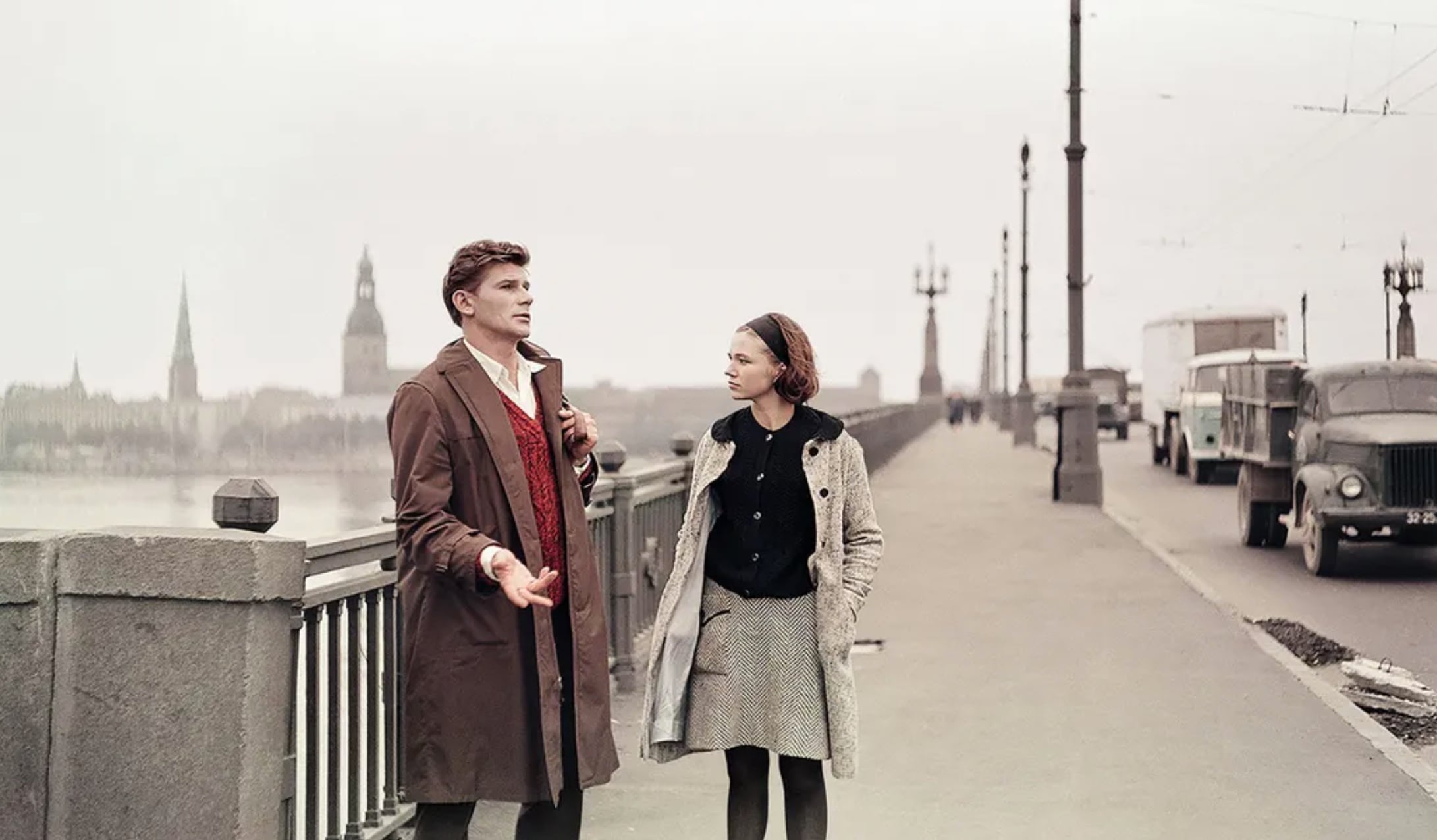
Four White Shirts (dir. Rolands Kalniņš, 1967)
Uldis Pūcītis, sometimes referred to as the “Latvian Harrison Ford”, plays Cēzars Kalniņš, affectionately known as Jūlijs to his closest friends. He is a stubborn rabble rouser whose song lyrics irritate Anita (Dina Kuple), a Youth Aesthetic Education Committee member and censor. She calls one of the band’s songs “borderline pornographic” in her review, an accusation that Cēzars sees no problem with. The ensuing drama between the youthful, arrogant, and targeted artist and the “aesthete” critic and censor almost pre-empts the film’s real-life antagonistic relationship with the authorities. The picture, in a rejection of narrative tightness, ends with an ambiguity reminiscent of canonical French New Wave titles like François Truffaut’s The 400 Blows.
A strong thread in Kalniņš’s filmography is his unimpeachable fondness for popular music. Tunes play frequently and loudly in his fictional worlds. The music of Four White Shirts was written by the famous Latvian composer Imants Kalniņš, adding another famous Kalniņš to the list of possible referents for the protagonist’s name. The songs became household anthems for many Latvians, via performances by the progressive rock band Menuets, with whom Imants Kalniņš collaborated. When the film was finally shown to the public in the 1980s, the general public was already familiar with the songs, helping to fast-track Four White Shirts into classic territory.
The sheer frequency with which his films avoid the occupied present in favour of the past hints at nostalgia for the Latvia of his younger years, a Latvia more open to the world than the Latvian SSR
Keeping with the tradition of the boundary-pushing New Wave, the songs’ lyrics border on nonsensical. In one song, with lyrics written by Latvian poet and journalist Māris Čaklais, a refrain compares Napoleon Bonaparte to a cat – “I only know that a dead Napoleon is buried in the ground so he doesn’t smell, but a live kitten is fed warm milk” – a clear deviation from mainstream songwriting in any language. The comparison of iconic authority with a feeble domesticated animal probably doesn’t help in this case either. The song also points to the great equaliser: death. “In my opinion, it really talks about how in the end, what does it all matter – wars, fame, dictatorships – when we die, we are all the same. Life goes on and kittens will still drink warm milk,” observes Aija Dreimane, Chair of the Boston Baltic Film Festival. The political musicality of the so-called Singing Revolution by which the Baltic states regained independence from the Soviet Union is anticipated in the cinema of Kalniņš.
Ceplis, his 1972 film set in the 1920s around the workings of a brick-making businessman, showcases his emphasis on Latvian culture as a way to see through Russification and toward a freer future. The plot revolves around the failures of a venture capitalist and easily checks the right political boxes for the party authorities, but it also slyly creates nostalgia for an earlier, pre-USSR Latvia. In this regard, Cēzars Kalniņš’s profession – laying telephone lines – cannot be ignored either: just as with his music, he spends his professional hours connecting Latvians to the world. See also the incensing of a new apartment with juniper in Four White Shirts, a custom one character emphasises as an “ancient Latvian tradition”, or the abundant vacations to Western Europe and even the United States in the 1930s-set Rocky Road (1983).

Ceplis (dir. Rolands Kalniņš, 1972)
Kalniņš’s use of photographic stills and poetic pillow shots of Riga also supplement this hypothesis of Latvian patriotism. His cityscapes rarely work as establishing shots that ground the geographical setting of the scene; instead, they operate as poetic and reflective asides or even as dream sequences. The Riga of old is a city to be dreamed of. The sheer frequency with which his films avoid the occupied present in favour of the past hints at nostalgia for the Latvia of his younger years, a Latvia more open to the world than the Latvian SSR.
His boundary pushing resulted in several clashes with the authorities and led to several outright or implicit bans on his films. Authorities shelved his 1966 film Stone and Flinders, also known as I Remember Everything, Richard. The film is set in the world of the Latvian Legion, a Waffen-SS formation staffed by ethnic Latvians during Nazi occupation, a subject that would be difficult for any filmmaker to escape the heavy hand of Soviet censorship. Four White Shirts was scheduled to have a screening for high-ranking party authorities in Leningrad, but the screening was cancelled and the film was shelved until the 1980s. Kalniņš described it as having been “disappeared” from the world and his filmography. Perestroika created an environment that enabled the film to be politically revived and screened publicly.
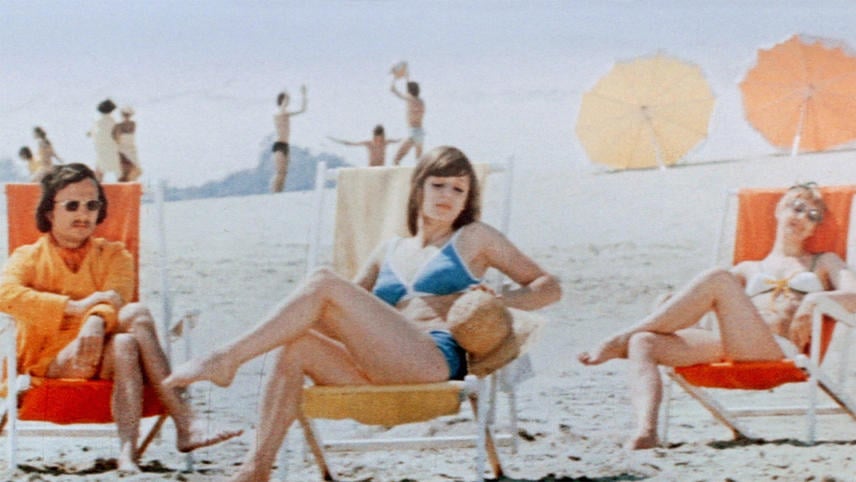
Maritime Climate (dir. Rolands Kalniņš, 1974)
Most tragically, the negatives for Maritime Climates (1974) were ordered to be destroyed. Only 34 minutes of the comedy survive today, and what persists is borderline experimental cinematography that has more in common with Dziga Vertov than anything coming out of 1970s Mosfilm, replete with wild satirical musical numbers and gorgeous young people having fun on the beach. It seems to anticipate the experimental work of music videos later in the 20th century. The compositions are weird, often partly obscured, and a completely new and innovative angle appears every few shots. The bright primary palette that pops in Maritime Climates carry over to the director’s other works in colour and even to his lesser-known documentary works.
Latvia has a proud documentary history and Rolands Kalniņš’s contributions to the genre are under-appreciated. Several of his documentary works give preferential treatment to Latvian culture, such as his tracing of the influence of Johann Wolfgang von Goethe on Latvian literature and other arts in 1999’s The Eternal Faust. His most significant foray into documentary filmmaking would come about twenty years after the golden age of the Riga School of Poetic Documentary Cinema with 1980’s Conversation with the Queen, a personal excavation of the lionised actor Vija Artmane (1929-2008). A mix of archival footage, interviews, and still photographs, Kalniņš strips Artmane of stardom and gets to Vija, the human: her doubts, her regrets, her unhappiness. Her reflections on the passing years of her career project the immense gravity of change onto the Latvian SSR. Interestingly, Kalniņš also collaborated on this film with the great Juris Podnieks (Is It Easy to Be Young?), the most important documentarian in Latvia after the Riga School’s golden age. It’s also one of the six documentaries included in the National Film Centre of Latvia’s online documentary selection, another sign of the Kalniņš’s position as a figurehead in the officially curated canonisation of Latvian cinema.
“Rolands Kalniņš is one of the most significant Latvian film directors who, under the conditions of Soviet isolation and ideological control, dared to live in a global space,” in the words of Dita Rietuma, film theorist and director of the National Film Centre of Latvia. “His most outstanding films were once banned from public screening for being too modern and ironic for the Soviet system. Nevertheless, these films are among the most stylistically daring in the entire 20th-century Latvian cinematic experience”.
Watch Four White Shirts on Klassiki now and explore our collections of Latvian and Baltic titles.
Joshua Polanski is a Tomatometer approved critic and a member of the Michigan Movie Critics Guild. His writings on Baltic cinema can be found on his website.

 Go back to journal home page