Letters from Wolf Street (dir. Arjun Talwar, 2025)
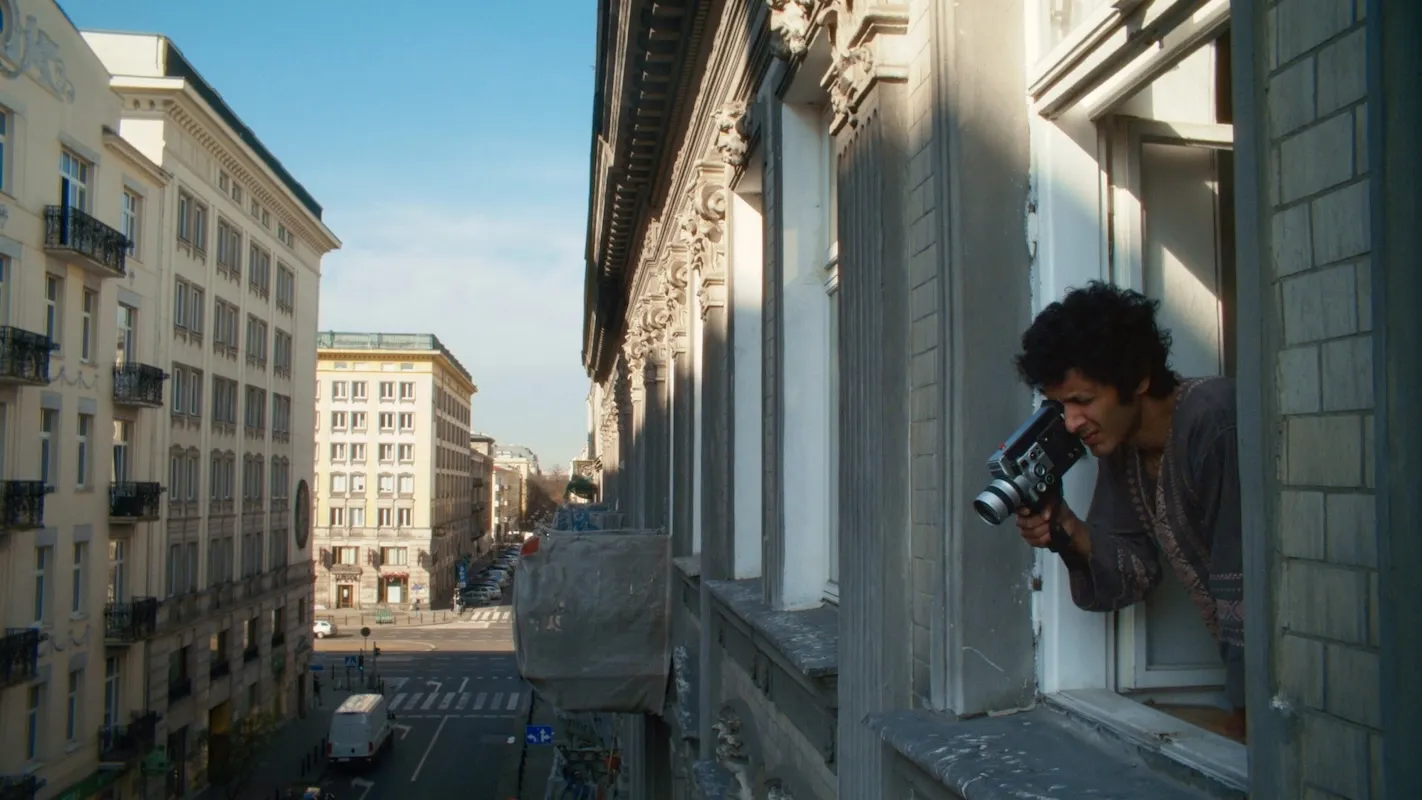
“Even after ending up in hospital, beaten up by skinheads, I walked out full of love for Poland.” The paradoxical sentiment in this statement encapsulates the emotional tightrope walked by Indian filmmaker Arjun Talwar in Letters from Wolf Street, his self-reflexive documentary on the immigrant experience in his adopted homeland. Talwar moved to Poland over a decade ago to study at the famous film school in Łódź. In recent years, he has lived on the titular downtown road in Warsaw. His surroundings and his neighbours are familiar to him, but still distant. In an attempt to close that gap, he begins to film himself, his street, and the people he encounters. The seemingly humble scale of the endeavour soon falls away as Talwar’s personal reflections begin to interweave with commentary on Polish history, the power of cinema, and the thorny question of identity in a globalised world. When all these layers are peeled back, we find the painful core of the film in the keenly felt absence of Adi, the director’s best friend, with whom he made the move from Delhi to Poland all those years ago – and who took his own life a year or so before filming began. For Talwar, to document the immigrant experience in modern Poland is also an exercise in survivor’s guilt. His film uncovers the web of contradictions and anxieties that lie behind contemporary political posturing, eschewing stereotypes in pursuit of genuine human connection.
Letters from Wolf Street screens on Klassiki until 18 June. We spoke with Talwar about his personal history of immigration, the inspiration he drew from Polish cinema, and the complicated web of personal and national histories that his film reveals. This is an abridged transcription of that interview; subscribers can watch the full video version here.
I’d like to start with the prehistory to the film, which is your decision to move to Łódź to study film. What came first: discovering Polish film, knowing the history of the film school there, which is very prestigious?
Me and my friend Adi, who makes an appearance in the film, we had an impulsive desire to study cinema. We researched some film schools. First, we found out that there is this famous film school, and then we started to watch some Polish movies. Watching those movies, I felt very transported to a whole other kind of universe and also another kind of cinema, which I wasn’t used to, having not seen a lot of Eastern European cinema at that point in time. But, as I mentioned in the film, it was also about having an adventure, you know, to go to this place that we didn’t really know much about. There was definitely that element there.
Which films were you watching? Are we talking the classics: Andrzej Wajda and so on?
Just the classics, you know; some [Krzysztof] Kieślowski, Wajda, [Roman] Polański, that’s pretty much it.
Letters from Wolf Street (dir. Arjun Talwar, 2025)
You’ve since said that what really interested you was actually Polish documentary, more than the Polish fiction films that you’re mentioning there. Is that right?
That came later. When I first applied to film school, I wanted to study directing, but then I found out that the director is not the one who operates the camera – which was kind of a shock to me. I thought the director makes the movie, so he has the camera. So, then I applied for cinematography. Because it just made sense to me, I wanted to have the camera in my hands. Polish fiction cinema, especially contemporary cinema, never really inspired me. I mean, the older films that I mentioned, sure. But watching documentaries by people like Jacek Bławut and Marcel Łoziński – people who are not really known outside of Poland, but who are famous in the country – I discovered this whole world of documentary cinema. Just this idea that you could transform everyday life into something epic and beautiful was new to me. Those filmmakers were really inspiring. They were also our professors. So, that’s how I got into that.
For a Western European audience, I think there’s this presumption that Eastern Europe is particularly monocultural, white, potentially racist – so a story about immigration set in Poland takes on a different kind of edge for them. One thing I appreciated about your film was the way that you situated your own story within these really long-standing histories of immigration in Poland: the Vietnamese community that’s been there since communist times, the Ukrainians, Georgians, Turks, Chinese people living around you.
There is a tradition of immigration. It’s not as dense as in Western Europe. But in Poland immigrants don’t really have a voice in popular culture. Once in a while, a Vietnamese person might appear as an extra in a film or something, but other than that, it’s very, very rare. And Indians – forget about it. That was something I really wanted to go against in this film, you know? Because the kind of society that I was living in was diverse, as it is in the film: one of the characters is Roma, one is Syrian, one is Chinese. That’s how my life there looked like. But those kind characters never appear in Polish documentaries or fiction films. That was also very much in my mind, that I had to break this barrier and that I was in a position to do it.
There is a tradition of immigration. But in Poland immigrants don’t really have a voice in popular culture. That was something I really wanted to go against in this film, you know? Because the kind of society that I was living in was diverse
It’s not something that you make really make explicit, but something which comes up at different points in really interesting ways is the strange nature of modern Warsaw. The city was almost completely destroyed in the war: your building still has bullet holes in the walls, most of the old town was totally reconstructed. At one point, you’re talking to an elderly tango teacher, and he points out that there aren’t many “generational Varsovians,” because there was this great rupture. So, in a sense, the whole city is made up of newcomers, relatively speaking. The question of identity and belonging has been troubled for 70 or 80 years.
Yeah, that’s true. You can argue that it’s more a film about Warsaw than a film about this street. But I did try to capture that atmosphere of downtown Warsaw, which is one of the few places where there are still these old buildings. The city was actually reasonably diverse, as was Poland as a whole before the Second World War: there were Jewish people, Roma people, but there were also other kinds of subgroups. There were African Americans who played in the music scene, Tatars, curious groups of people. But that disappeared after the Second World War as the city became more homogeneous. In the last 10 years, the city has become more diverse, so you could argue that this is kind of return to the diversity of pre-war Poland.
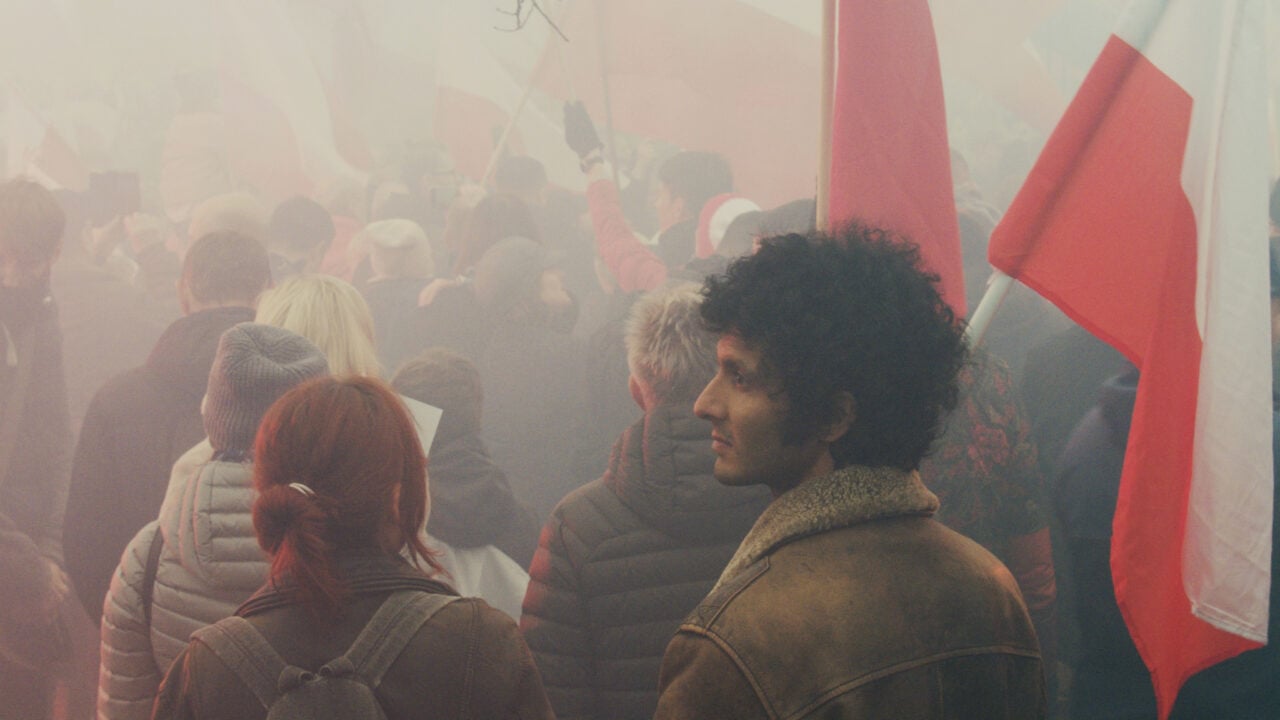
Speaking of contemporary Poland, I wanted to ask you about the sequence where you and [fellow immigrant and film school student] Mo attend and film the Independence Day march – an even that is now strongly associated with and dominated by nationalists and far-right forces. Why did you decide to attend?
At one point of time this march used to be more innocent and more about celebrating Polish sovereignty. But then it became hijacked by these extreme factions. And I think that’s actually happened with national festivals in many countries in the world. I knew from the beginning that I wanted this scene in the film and that I wanted to extract some kind of humour out of it. Because it’s not hard to go and show how grim it all is, but to get the absurdity of it and the funny side of it is a bit trickier. So, that was my intention. And yeah, you do find really extreme racists there who shout things at you and so on. But we didn’t enter those kinds of crowds. We were with the “gentler” racists. But, you know, Mo is Chinese, and the sight of us together was amusing for these people. A lot of them wanted to take selfies with us. And that was already funny. I improvised the scene and I think it works. It shows how strange the atmosphere of this event is.

Letters from Wolf Street (dir. Arjun Talwar, 2025)
There’s another character I’m really interested in, which is Oskar, the Polish Romani man who you meet and towards the end of the film. You end up attending his wedding, which is a very touching sequence. He provides another angle towards the end of the film: you can’t class him as an immigrant, obviously, but he is still racially persecuted, and he still suffers from a lot of the same psychological or emotional complexities that you yourself describe as a much more recent arrival to Poland.
I found him totally spontaneously. I went out to shoot the gay parade that crosses Wilcza [Wolf Street], and I just saw this man with an interesting face and I thought, let me talk to him. I didn’t know he was Roma. Like many Polish Roma or Roma in general, when I told him I was Indian he reacted in a really friendly way, because the Roma are conscious of the fact that they originate from India. They’re also excluded from their societies very often and they just feel like they’ve met a compatriot. So, that was the basis of our bond. I went to the small town where he lives with his partner and two kids, and they are really persecuted there. They get shouted at so much on the street. It’s not a joke. But the way he deals with that was inspiring for me actually, because he doesn’t let it get him down. And it’s surreal to sit in a Roma household in the middle of nowhere in Poland and hear these words in their language that are identical to words in Hindi. There’s this word chhuri, which means knife. It’s just the same. And then you really feel, wow, OK, we really are related. It’s quite a strange thing. They are the original Indian immigrants.
Watch Letters from Wolf Street on Klassiki until 18 June and explore our full collection of Polish titles here.


 Go back to journal home page