After Dreaming (dir. Christine Haroutounian, 2025)
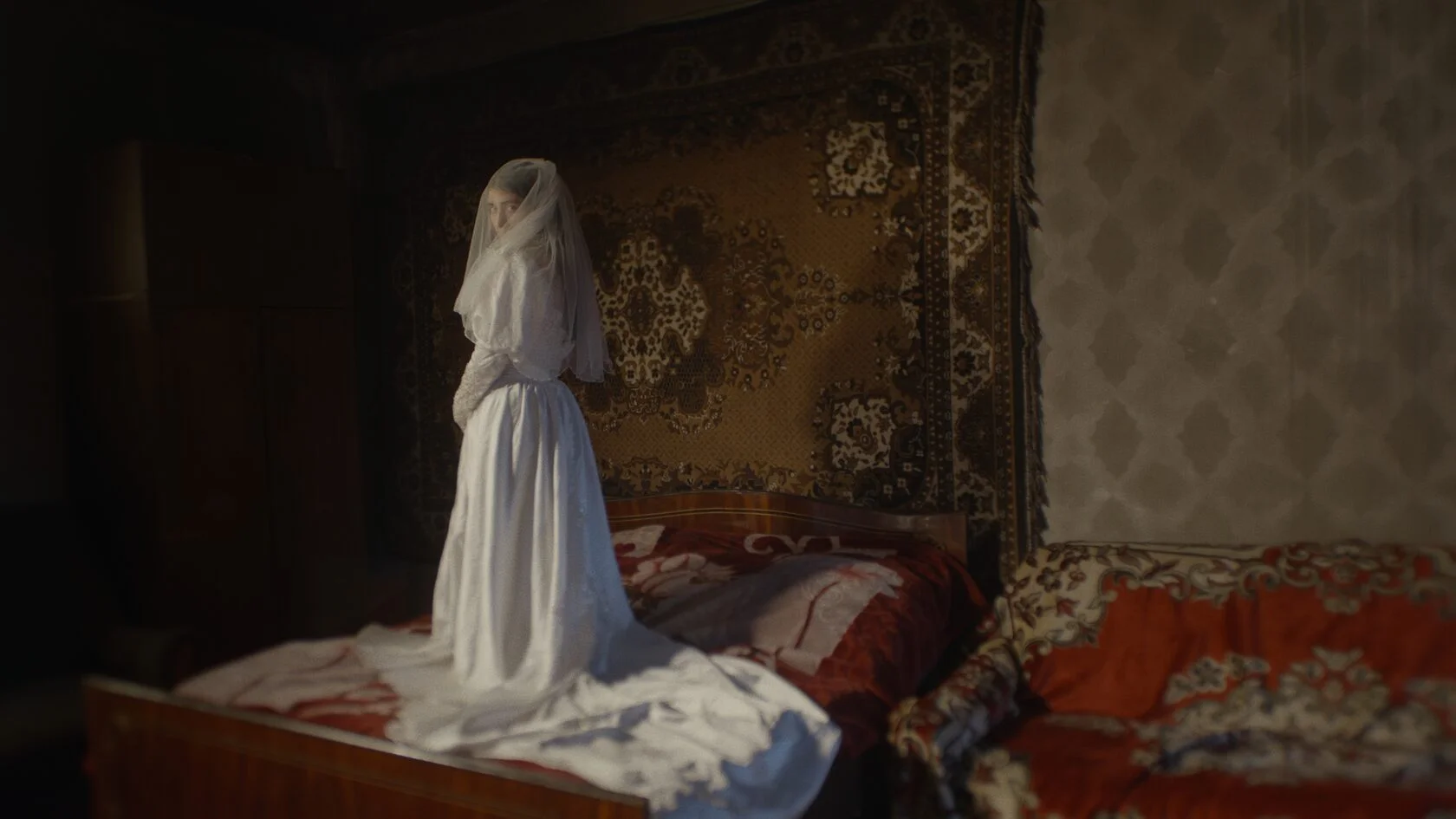
In an Armenia haunted by recurring cycles of conflict, a well-digger is mistaken for an enemy and killed by villagers. Wanting to withhold the news from their daughter Claudette, the victim’s family asks a taciturn soldier named Atom to take Claudette on a road trip until the funeral is over. On the road, as Atom and Claudette find themselves increasingly drawn to each, their journey turns into an intimate drift through the scarred spaces of a country. This is the premise of After Dreaming, the remarkable debut feature from Los Angeles-born Christine Haroutounian, which premiered in the Berlinale’s Forum sidebar in 2025. Co-produced by Carlos Reygadas, the film reflects obliquely on the traumas of the Nagorno-Karabakh conflict – and the ethnic cleansing of Artsakh during production – through a series of dreamlike vignettes, captured in startling shallow focus by cinematographer Evgeny Rodin. The result is a road movie that verges on abstraction while remaining bound to the landscape and traditions of a scarred homeland – most strikingly in a hypnotic musical sequence set during a mass wedding.
Our friends at the Armenian Film Society London are screening After Dreaming at London’s Institute of Contemporary Arts on Tuesday 16 June, featuring a Q&A with Christine Haroutounian. Find out more and get tickets here. Ahead of that screening, we spoke with Haroutounian via email about her intuitive approach to filmmaking, the cosmic inspirations behind her work, and the tension between destruction and creation in militarised societies.
I was interested to read your description of your process: starting with a script then discarding most of it, trying to remain alive to the places, people, and sounds that you encountered while scouting and shooting. It sounds very open-ended, but you also describe yourself as a control freak in formal terms – how did you find the balance between those two impulses?
Openness and control are often seen as opposites, but for me it’s more like walking a tightrope. The challenge isn’t choosing between them. It’s remaining open enough to recognise when the film is telling me to abandon a plan but knowing what to do next because I retain total formal control. I feel like my eye knows what it likes as if it is muscle memory.
A vast majority of what you see in the film was already in the screenplay. During production I began discarding the scenes that existed for the purpose of “information”, like narrative clarification, relationship-building, or the practicalities of how we get from point A to point B in this road trip. It was always a struggle whenever we shot these scenes. One of the biggest lessons I learned making this film was that forcing something usually meant something is wrong. The sooner I recognised our undue efforts, the sooner I’d find a better approach that corresponded to the reality in front of me and aligned with the film’s true language, which is experiential and libidinal. At some point, the film itself was rejecting anything that leaned too heavily on conventional storytelling. Something that continually struck me was the hegemonic power of narrative structure itself, and how deeply these conventions have been internalised by us all, operating like a straitjacket on the imagination. I am not opposed to narrative, and there is a plot in all of my films, but I do think we have absorbed the formulas of Western storytelling so completely that they can prevent us from seeing differently.
After Dreaming (dir. Christine Haroutounian, 2025)
Could you describe how you and your cinematographer Evgeny Rodin arrived at the very particular method you use in the film to play with focus and depth of field? I was put in mind of Aleksandr Sokurov and Terrence Malick but also felt strongly that you were not trying to replicate the principles of either of those directors’ works – and then I read an interview where you literally said: “I’m not Terrence Malick!”
The only principle I have for cinema is that each film must create a self-contained world. It’s hard to be in a village in Armenia, in the middle of the production, during the tenth hour of your shooting day, and say, “make it look like Tree of Life” or “let’s make a film about diasporic consciousness.” That’s too abstract for me and triggers my brain to solve a preposterous riddle. There are a time and place for the intellect, but it is not while you are creating a work of art. I am guided by my instincts and the physical reality in front of me, because there is nothing else to work from. I am the central engine of the film and nothing outside of the film feels like it exists when I am shooting.
With After Dreaming, the biblical lore of Armenia was more influential than any film reference. I am not religious, but I am awestruck that my family is originally from the plains of Mount Ararat, where Noah’s Ark allegedly landed. Beyond the big bang, this is the original spectacle. How is it that I can point to a map and trace this site of abject destruction and creation, which also happens to be where my ancestors come from? Immenseness is an important quality for me. With my cinematographer, I’d talk a lot about an angel falling down to earth for the first time and landing in Armenia of all places. What would it see and feel? What would it be like to be divorced from human sight, custom, and morality? I was obsessed with the innocence of this entity, its lack of pretence around personal space, let alone the rules of cinema, like landing on a character on the perfect beat. How would it move through the world? What would be its fixations? What would it report to God?
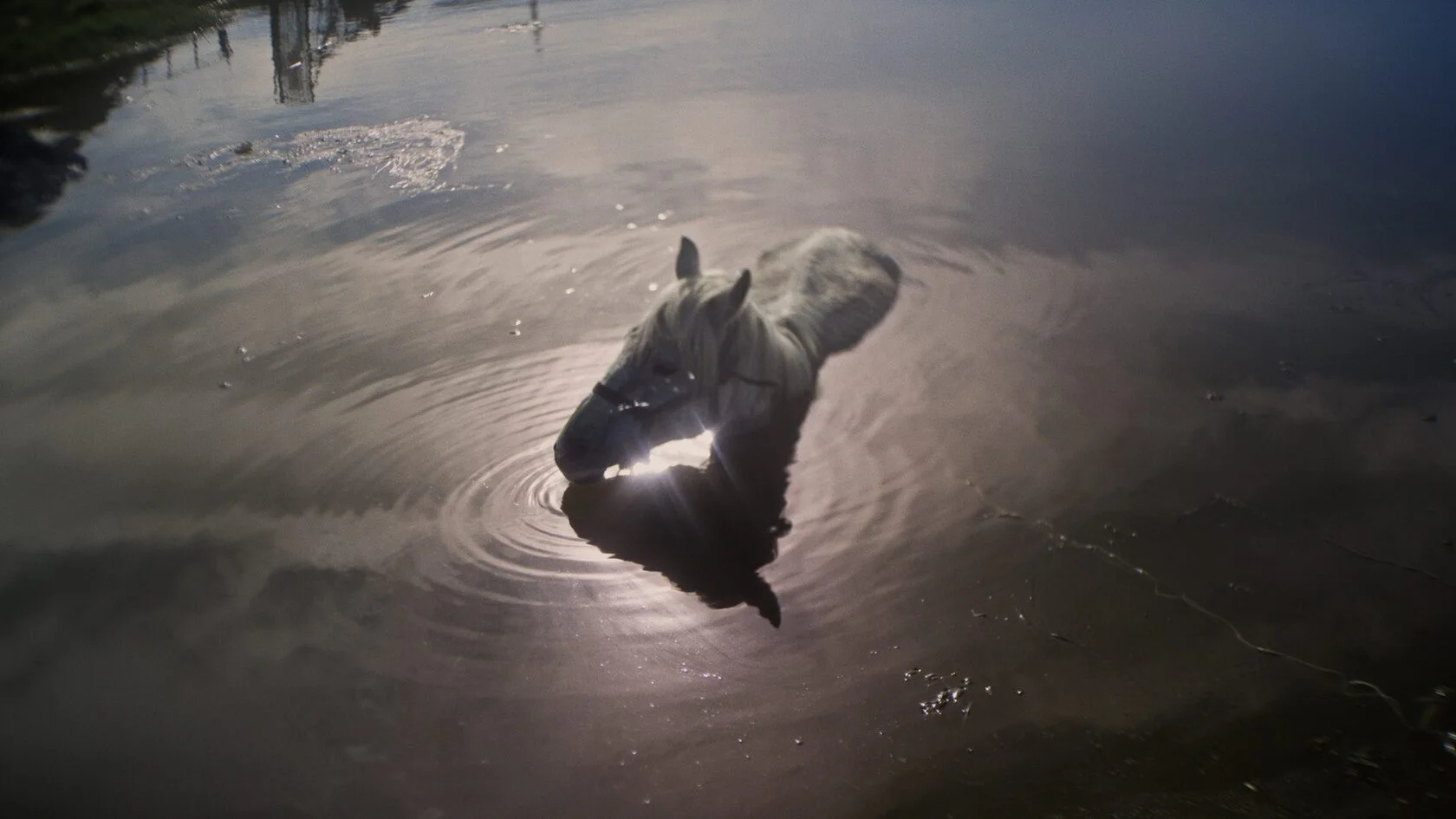
This was not something that I could truly describe to my cinematographer in practical cinematic terms but something I had to show. During the first driving scene with Atom and Claudette, I squeezed myself next to the driver in the front scene of the car and operated the camera, responding to what I genuinely loved in front of me, like an unabashed voyeur. That was a critical moment in the shoot because it established the non-logic of the camera for the rest of the film, which was so freeing. With the lens, it was inspired by Neptune. At the top of my script was a quote by the Jungian astrologer, Alice O. Howell, which was a list of things that had the essence of Neptune, ranging from plastics, fanaticism, martyrdom, and sleep, to film, photography, drugs, the ocean, incense, and so forth. It is feeling so intoxicated by love that you lose yourself entirely in the highest octave of romanticism. The seduction of disappearing, the breakdown of boundaries translated in the images. My cinematographer would hold a detached lens in front of the body of the camera, racking focus as far as his hand could manage. It produced an ever-changing perception of the world. I don’t need to use filters when I am the filter.
With my cinematographer, I’d talk a lot about an angel falling down to earth for the first time and landing in Armenia of all places. What would it see and feel? What would it be like to be divorced from human sight, custom, and morality?
I was fascinated by the representation of and discussion of the figure of the soldier in the film. At one point, Claudette asks: “what’s the point in being a soldier; if you die, people remain vile and ugly.” I don’t know if this is an appropriate comparison, but I was put in mind of [Thai director] Apichatpong Weerasethakul’s film Cemetery of Splendour, which portrays being a soldier as something like being in a trance or spiritual coma.
I don’t know anyone who is willing to die for anything. In Armenia, military service is compulsory. You have a legal, moral, and ethical obligation to serve a state that was built by the orphans of an unrecognised genocide, only for Russian imperialism to take over for a century and suddenly collapse overnight, leaving millions in cold darkness. Then, of course, war, war, war, goaded by foreign influence. These colossal historical influences have led to so much death and depopulation that there can be a certain mentality that this ship is sinking, so you might as well cash in, literally. Corruption becomes rampant. There is no trust in authority. It is tempting to abandon this place, which to some is another form of betrayal. The police officer in the films says in Armenian, “après moi, le déluge,” which again, is a reference to the Great Flood. This saying is a nihilistic disregard for anyone who remains after one leaves. This is a human problem, not an Armenian problem. As a soldier, you have to face this wickedness in mankind and still believe in something, then defend it with your life. That’s extremely difficult and terrifying. Maybe it is us civilians who are in a trance of comfort, who do not have to reconcile these things. Either way, it’s fascinating how history affects regular people.
I suppose I offer a bit of a counterargument to Claudette’s point, in that multiple times we are taken in by total strangers throughout this film. Armenia is still the only place I have ever been where I can knock on a random person’s door and they will welcome me with open arms and host me like I am royalty. This is unthinkable in America, which is the richest country on earth, and, ironically, has had no war on its soil for about 160 years. So, the sense of honour in these small acts of hospitality, or the simplicity of listening to beautiful men play music cuts through everything. Despite every reason to shut out the world, there is still a remarkable trust in life.
After Dreaming (dir. Christine Haroutounian, 2025)
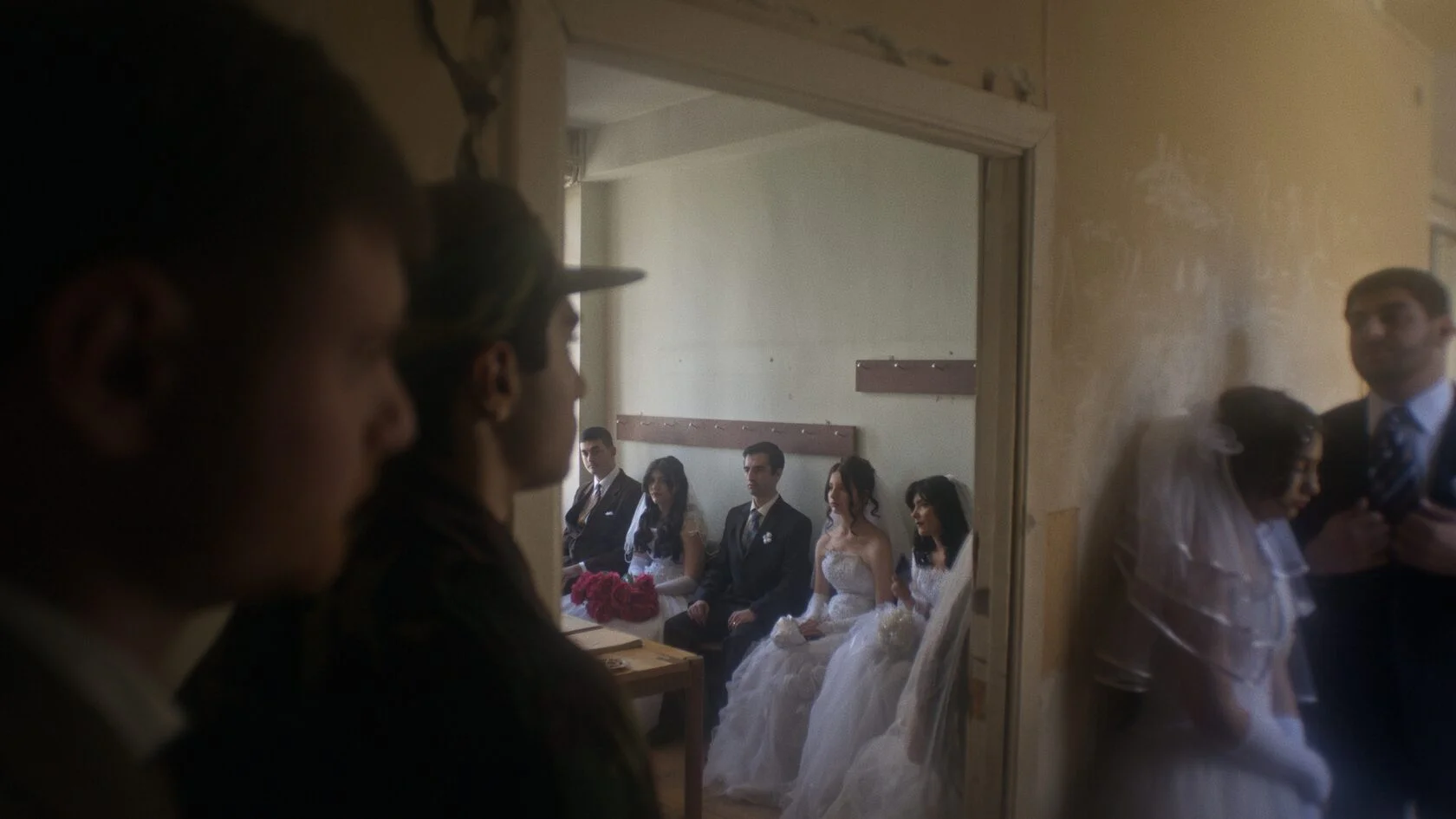
Weddings also play an important part in the symbolic language of the film – more specifically, mass weddings, both staged and incorporated via TV footage of events in (if I’m not mistaken) Artsakh in the early 2000s. The regimentation of those events mirrors that of the soldiers: the destructive and creative sides of social reproduction. Can you speak to the significance of the wedding scenes for you? I imagine the central sequence involved the most detailed choreography.
I didn’t want to replicate the real documentary footage from the Artsakh mass wedding because then we’d get caught up on the technicalities of the replication. Plus, I would fail because there is nothing as good as the real thing. The act of looking, the act of image-making, is my primary interest, not watching fake elaborate wedding scenes for entertainment.
The archival wedding footage had to function as images we see through a screen – images which disseminate the ideas we have about the world, who we are as a nation, as a call to arms, as individuals facing duty, as revolutionary subjects, as sexual objects. With my staged wedding scenes, I wanted to present this world as naturally as possible and be in the moment, because that’s how you experience life. You don’t necessarily go to a wedding and think about how your behaviour is informed by the ideas from imagery consumed in the past, and how we have all opted in to these norms. It’s only later, when we look back on these scenes after seeing the huge scale of the real mass wedding, that this knowledge crystallises: the habitual posing for portrait photography, the beautification of the brides, the bureaucratic translation of romance, how war requires sex, and so forth. By the time we see the archival footage, the wedding is over and the world is darker. We have lost everything. You have to question, what do you do with these ideological images, both literal and archetypal? Soldier, bride, priest, mother, infant. Did these images lead us here, or are these the images that survive? And now my question is, in our vapid culture [where we are] inundated with images, why is it that more and more people are incapable, or even intolerant, of reading images in cinema? They want the story to tell them the meaning. The aesthetics are beside the story. But to me, the image is the narrative.
I will be honest with you though; all of this meaning-making became apparent to me in the edit. On set, again, I was following my instincts and directing myself, listening to what I loved. We could’ve chosen anything to show on the TV later with the kids, but I only wanted the Artsakh footage because I was obsessed with it for years. I simply had to have it in the film. I can’t understand this intellectually at the moment, but human intuition is the most intelligent machine on earth if you allow it to fully operate inside you. It’s not random.
in our vapid culture where we are inundated with images, why is it that more and more people are incapable, or even intolerant, of reading images in cinema? They want the story to tell them the meaning. The aesthetics are beside the story. But to me, the image is the narrative
To me, this reads as a film about war – inasmuch as Armenia continues to be formed (or deformed) by the experience of conflict – but you’ve been clear that you don’t consider it a “war movie”. What is the distinction there for you? Is it a question of genre, narrative structure, and so on?
I started working on the film in 2019, not long before the second war [in Nagorno-Karabakh] began. As the victors of the first war, Armenians within the country and in the diaspora held the false belief that Nagorno-Karabakh would remain a frozen conflict, so it was hardly at the forefront of the collective Armenian consciousness. To say After Dreaming was a war film would not reflect my inspiration to make the work. There were always a girl and a soldier in the script. Beyond that, I take material directly from life. Unfortunately, war became part of that material and made its way into the film. I started location scouting in Armenia on the one-year anniversary of the second war in 2021, scouting in remote parts of the country alone for long stints until we shot the film in 2024. During this time, there were invasions of Armenia proper, and the total ethnic cleansing of Artsakh.
I don’t like talking about this, but the earliest seeds of After Dreaming came from a tragedy in my family, in which my grandmother’s brother died in a car accident. My family decided to keep his death a secret from her, until long after the funeral. When I learned about this as a child, it was cataclysmic. I had very little information about this event, but it consumed my imagination like nothing else, and I projected myself constantly into this world. I was never told why this decision was made, and even if I was given a fairly practical answer, it didn’t fill the void inside my heart. But that is how grief works. The “why” will never be answered. In a sense, my fixation on form mirrors this. The “why” of backstory, psychology, character motivation – all the pillars of story – do not satisfy me in a truly meaningful way.
I will never know who my grandmother was before this life-changing event, and I will never know if I would exist today had it not happened, because this one death triggered my family’s migration to America. The pillars of this major story are scant. Father dies. Family changes forever. But these immediate elements were all I needed, and the rest I’d develop on my own, through my own way of looking. This approach is centred more on the “how.” How does the father die, how does family change forever? How do image and sound come together to make me feel deeply about this? How do image and sound create an unmistakable atmosphere? How do they build a self-contained world?
After Dreaming screens at the Institute of Contemporary Arts on Tuesday 16 June, followed by a Q&A with Christine Haroutounian. Get your tickets here.
Explore our full collection of Armenian titles here.


 Go back to journal home page