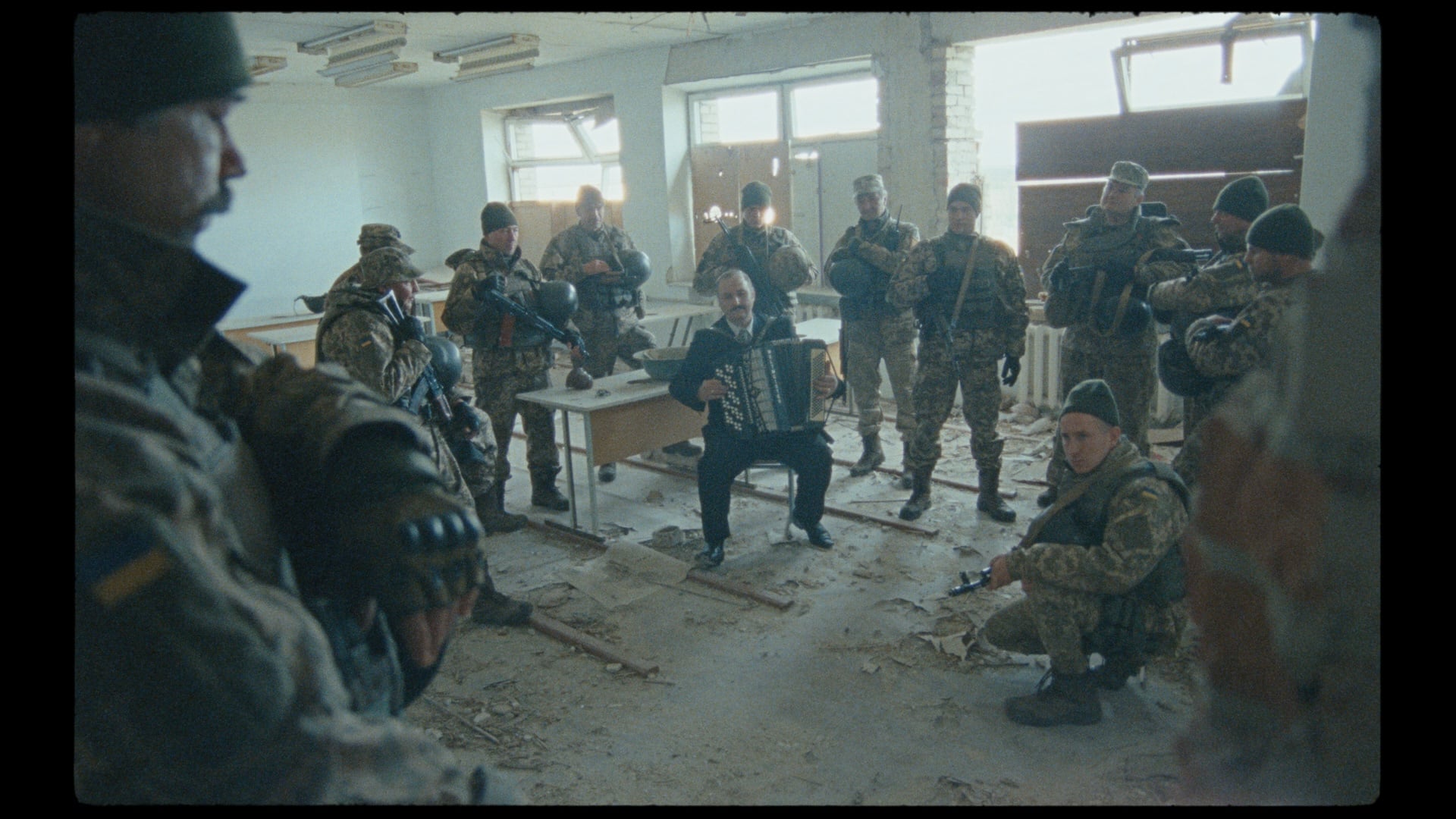
Mariinka (dir. Pieter-Jan De Pue, 2026)
Twelve years into the Russian war on Ukraine, the conflict now has accumulated a veritable canon of cinematic treatments. The genre of the war documentary in particular is fertile terrain for local and foreign filmmakers – not least because of the challenges involved in producing large-scale fiction films in the midst of ongoing assault and occupation. Within this ever-growing body of work, Pieter-Jan De Pue’s Mariinka – which premiered at this year’s Copenhagen International Documentary Film Festival and is now screening in London as part of the city’s own festival – stands out. The film is the result of a decade of living and filming in eastern Ukraine, during which time the Belgian director embedded himself in the lives of the population of the titular Donbas town.
Shooting on vivid 16mm film and intertwining poetic reflections on the Donbas landscape and staged dream sequences with visceral front line combat footage, Mariinka is centred on the lives of six young adults. There are four brothers – Mark, Maksym, Ruslan, and Daniil – whose diverging lives inform De Pue’s portrait of a town torn apart. Maksym is disabled; Mark is fighting in the Ukrainian army; Ruslan takes the side of the Russian-backed separatists; Daniil was adopted by an American couple as a young boy and has grown up worlds away in Mississippi, vicariously living the conflict through video calls with his distant family. Alongside the brothers, we are introduced to two women: Natasha, a former boxing prodigy turned paramedic in the Ukrainian army, and Angela, who smuggles goods across battle lines on behalf of desperate and isolated locals. In focusing on the fate of a single town, De Pue is able to offer a rare and intimate perspective on both sides of the fight – an approach that is not without controversy among his Ukrainian colleagues.
With the film now screening as part of the BFI London Film Festival, we spoke with De Pue about the long history behind the final film, shooting on 16mm inside a combat zone, and the responses that his work has provoked within a country at war.
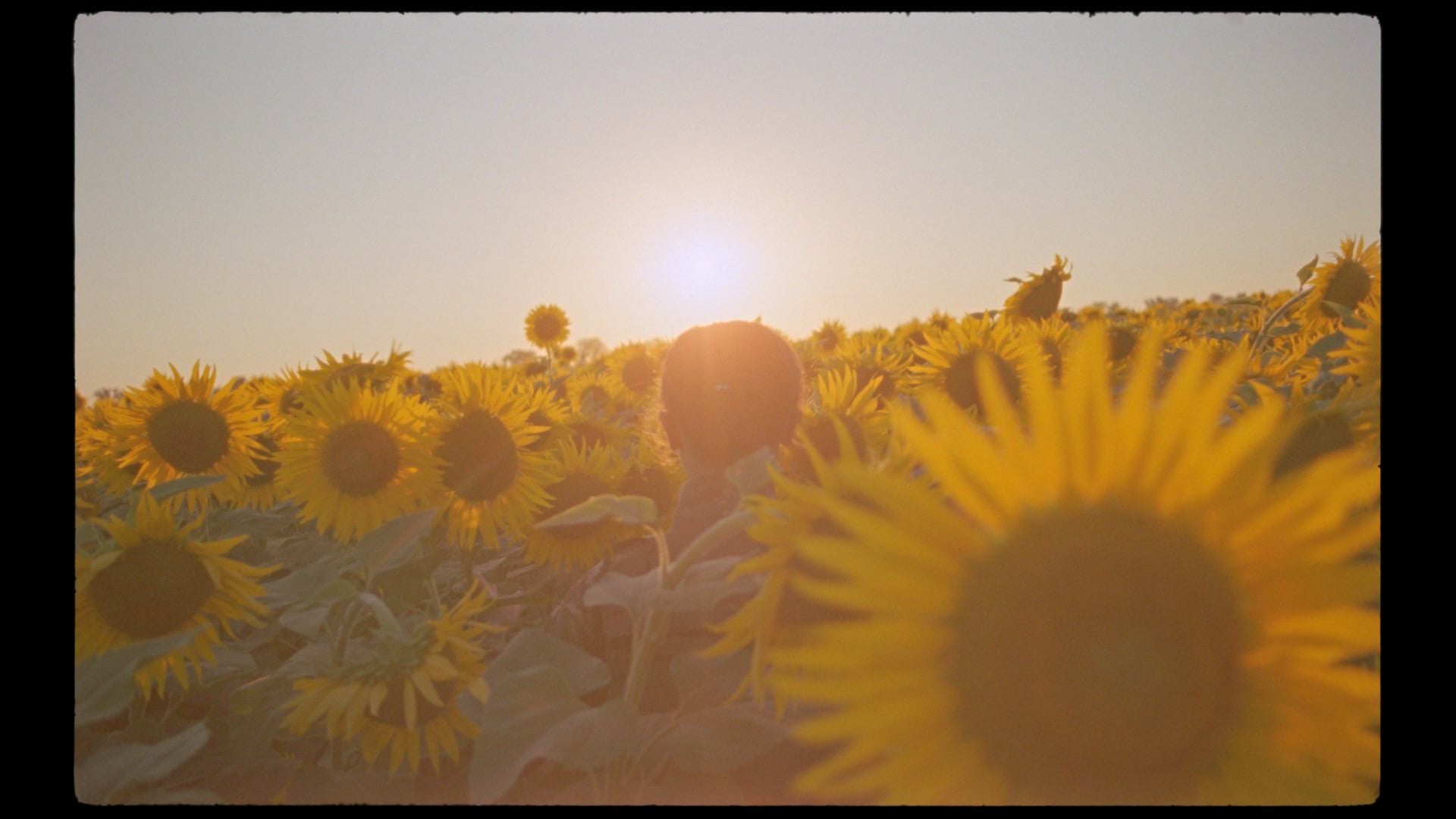
Natasha in Mariinka (dir. Pieter-Jan De Pue, 2026)
I think it’s important to get a sense of how the project evolved over the nine years of shooting. When you started filming in 2016, did you have a vision of what the film would become? And how did you arrive at the collection of protagonists in the final film – the four brothers alongside Natasha and Angela?
It’s a longer story, how I entered into Ukraine; it was linked to my previous film [The Land of the Enlightened, a 2016 docu-drama about the war in Afghanistan]. The last year we were filming [in Afghanistan] in 2014, I found an extra storyline that I wanted to create, which was about a Ukrainian guy who had served there in the Soviet Army in 1988 and had this dream to go back once in his life. He was a kid, like 18 years old, two years there with the Soviet army in a very remote corner in Afghanistan and Pamir. I found two pictures that he posted on Google Earth, very old archive pictures from those times that he was taking secretly, sending the negatives to his father, who was a photographer in Kyiv, who was developing them. I got in touch with him, and I went to Kyiv in 2013. Maidan was already happening. I offered him to go with us back to Afghanistan on the condition that we could film it. So, he went with us, it was very nice. And then in 2014 the war started in Donbas. And since he had military experience, he was immediately called up by the Ukrainian army. Suddenly this whole trip to Afghanistan became a rush back home, and we followed him. It was through him that I came to Ukraine.
During the project in Afghanistan, I was working for the International Red Cross as a photographer. Since I had those contacts with the Red Cross when the war started in Donbas, they asked me to do the same thing for them. So, I went to Ukrainian-controlled territory and then to Russian-occupied Donetsk in 2014-16, and I start making these photo stories and video reports for them. That was whe I met one of the main characters of Mariinka, Ruslan. He told me that he had a brother fighting in the Ukrainian army, that he had a younger brother that had been adopted by this American family, and that they all grew up in an orphanage in Mariinka – a satellite town of Donetsk that at that time was already on the front line. Then I got this assignment in 2016 from Belgian television to make a short film, and I said OK, I’m gonna do something in Mariinka. It was during that time that I found all the brothers that I eventually wanted to make the story about, as well as Angela and Natasha.
They were also orphans living in Mariinka: many people there were orphans or had been abandoned by their parents. I was with these young people, and when Ruslan told me the story of his four brothers, that was like a trigger for me – this kind of divided family in Donbas was something I wanted to make a film about. Obviously, we did not know that the full-scale Russian invasion was going to happen in 2022. We wanted to make a story about these four brothers, a bit about Mariinka, and also about the two girls. Things turned out very differently.
I was literally going to school in Mariinka with little kids – they were learning English, and I was then learning the opposite in Russian
Clearly there’s a long period of establishing relationships with this kind of project. At what point did you start filming in earnest?
When I met the two female characters, they were very strong to me, even stronger than the brothers. I mean, the strength of the brothers was very captivating, but they were less empathetic than the girls, I would say. When I met Natasha, she was very fierce and ambitious. I was very intrigued by her character, and I started filming her without knowing how her storyline would influence the story of the brothers, or how this all would merge together. We started making like little trailers, little maquettes. I knew this material would fall into place at some point. Right after I met Ruslan, we started doing long interviews with all the brothers. We went looking for the two other guys in Ukrainian-controlled territory, and we went to America. That was the period 2017-18. I understood that if I wanted to make a film that went deep into the emotions of these characters, I had to speak their language. I was literally going to school in Mariinka with little kids – they were learning English, and I was then learning the opposite in Russian.
The parts with Ruslan in Russian-controlled territory were shot mainly in 2018-19; it was all before the full-scale invasion. We did some parts with Mark in the [Ukrainian] army in 2020-21. We had already shaped the story of the four brothers before the full-scale invasion. After that, I knew that the story of the brothers was not going to renew or develop much. The war would become more dramatic. But the brothers are going to keep on fighting until they die. And Ruslan did die, by the way.
Is that confirmed? In the closing credits, he’s listed as missing following the offensive at Pokrovsk.
Now it’s confirmed. He was still missing when the film was released, but since then his mother got the message from the Russian army. So, we knew that story would go on. They’re going to be in the same trenches, and the weapons systems are going to become more advanced and more brutal and more dramatic. That’s why, after the full-scale invasion, we put much more focus on the two female characters and the American brother, because we thought that offered a more original perspective on their lives that had been completely destroyed, and on the town of Mariinka, where all the stories originated. In the editing, we created Mariinka as this kind of umbrella – a place that everyone belonged to before they were scattered by the war.
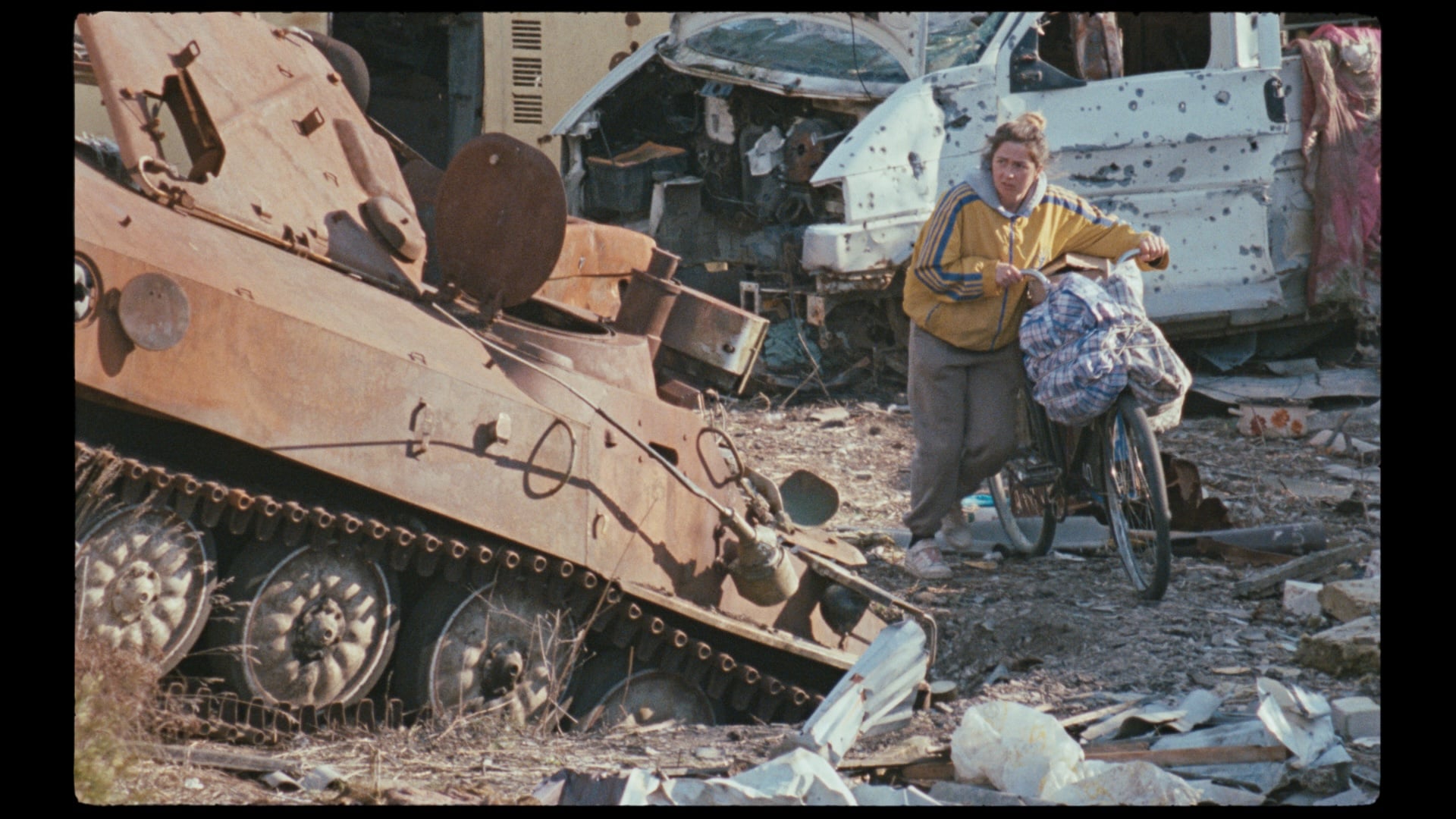
Angela in Mariinka (dir. Pieter-Jan De Pue, 2026)
The footage you’ve captured raises a lot of logistical questions, too. It’s an ugly word, but I’d like to ask about access: you’re moving between Ukrainian and Russian positions, filming from within active combat situations and in field hospitals as people are dying on operating tables. That must have been a constant negotiation, in order to keep filming?
First of all, to gain that access was a matter of time. That’s also the reason this film took ten years. I wanted to be with Ruslan and Mark on the front lines. Obviously, it’s not easy to get there. Maybe it sounds cynical, but it’s a kind of a privilege to be on the front line. Basically, it’s not allowed, according to the Ministry of Defense. It’s all about personal contacts, the creation of relationships. It’s about being friends with a certain brigade commander or a certain brigade. We did a lot of humanitarian missions to Ukraine, and some of that humanitarian aid, medical aid, for example, was also destined for Natasha’s unit. Ukraine is based on knowing people in that way; not just official institutions and your press card, but negotiations on a personal level. It’s a matter of time, and things never turn out the way you want.
We only went to the Russian side before the full-scale invasion, because I realised that afterwards it no longer made sense. Ruslan provided us with some footage, and we captured video calls he made. But all the characters who were valuable for the film were on the Ukrainian side, and going to Russia would burn all our bridges. And for what? Some more footage from a trench, where Ruslan is there with the Wagner group? The story was told with him. He was going to kill his brother, or his brother was going to kill him. That’s why we spent much more time in America at the end of the project with Daniil, trying to imagine his brothers over there fighting.
You might be sick of this question by now, but why shoot on Super 16mm? Were there conceptual reasons for choosing to continue shooting on it as the situation around you grew so much more violent and desperate? Just in purely aesthetic terms, it’s not a format that we associate with raw war footage – though there’s a visceral aspect to celluloid that adds to the material, immersive aspect of the film.
There are a couple of reasons for that. First of all, I’m not going to hide that I love film. I think it’s such a beautiful material. My film in Afghanistan was also shot on 16mm, also in complicated circumstances. But the thing is, I learned how to work with film in the sense that you make choices in the field that help you a lot in editing: if something isn’t necessary for the story, you don’t shoot it. And one of the biggest constraints, beside the fact that I love film, was the enormous problem with electricity. You’re in a trench, or the commander sends you out with a platoon for five days to a remote position with no generator, just what’s in your rucksack. I don’t want to imagine myself with a laptop, with backup drives, with batteries that consume so much energy… The thing is, film is a stable format. You just have to be sure that when it’s exposed, you treat it well. You can just put it in your rucksack: it’s cold at night and hot in the day, but it keeps its colours. The cameras are super sturdy, the Bolex or the Ari, they’re like little tanks. My little kit was just an Ari with a Bolex as a spare, two magazines, a couple of rolls, and we were good to go. I had a couple of lavalier microphones, and I could just focus on what was in front of me.
The thing is, in the film it looks like the war is everywhere, that we were constantly in trenches, but it’s not true. Less than ten percent of the shooting was in the midst very kinetic, intense war sequences. It was very dangerous, of course. But I think most of the time, once again, I spent together with the characters, not filming, just gaining their trust: going with them to the local discotheque, camping beside the lake, doing barbecue. In the end, that was a gift. Mariinka was destroyed. But Natasha could go back to those places just before they were taken over by the Russian army, and that’s how we were able to play with time: to show her going back to the cultural house, to her school, to her house, to her mother’s grave.
We should be able to talk about the fact that before the invasion, Ukraine was not black and white. It was grey, there was already a lot of division. There are many cases like this in Donbas, and I don’t even want to speak for the whole of Donbas. The film is about Mariinka
What about the sequences that involve staging and reconstruction – how did you navigate those with your protagonists?
There are a couple of moments that are written. I would say written together with the characters, but of course it’s staged, in the sense that we created something together. For example, when we returned to Natasha’s house, she went into the backroom looking for something. All of a sudden, she finds this green dress, the same one that we filmed her in six years ago [when she wore it to her school leaving ceremony]. I remembered how important it was to her. Her school was just on the opposite side of the street. I said: why don’t we go over there now, before the Russians arrive, and recreate that last dance, but with a soldier instead of a classmate? We brainstormed it on the spot – the Russian lines were less than a kilometre away.
There are some parts with Angela, too: the sequence when she’s in the bathtub having this dream, this nightmare. She had told me this story about how she was smuggling a thousand rose and got caught up in rocket fire, how the roses were blown in the air and the leaves started raining down in the snow… We decided to create that nightmare sequence. I think it’s pretty clear in the film that you are inside her head. But I think it allowed us also to lift the film to another level, to step out from that brutality of war, and to get closer to the characters in a more poetic way.
That sequence is striking in part because it introduces a new vulnerability into Angela’s incredible, stoic personality.
It was important for me to capture that story of the smuggling of these roses and this explosion, but also, for example, the moment she recalls in voiceover about being raped. That was actually a Ukrainian soldier, which was a very sensitive thing to talk about. We created some suggestive sequences that tells you about this moment. A lot of those moments are flashbacks that we embedded in the current reality. This is a much straighter documentary [than Land of the Enlightened], it captures the reality in Ukraine, except for these moments of reflection from some of the female characters.
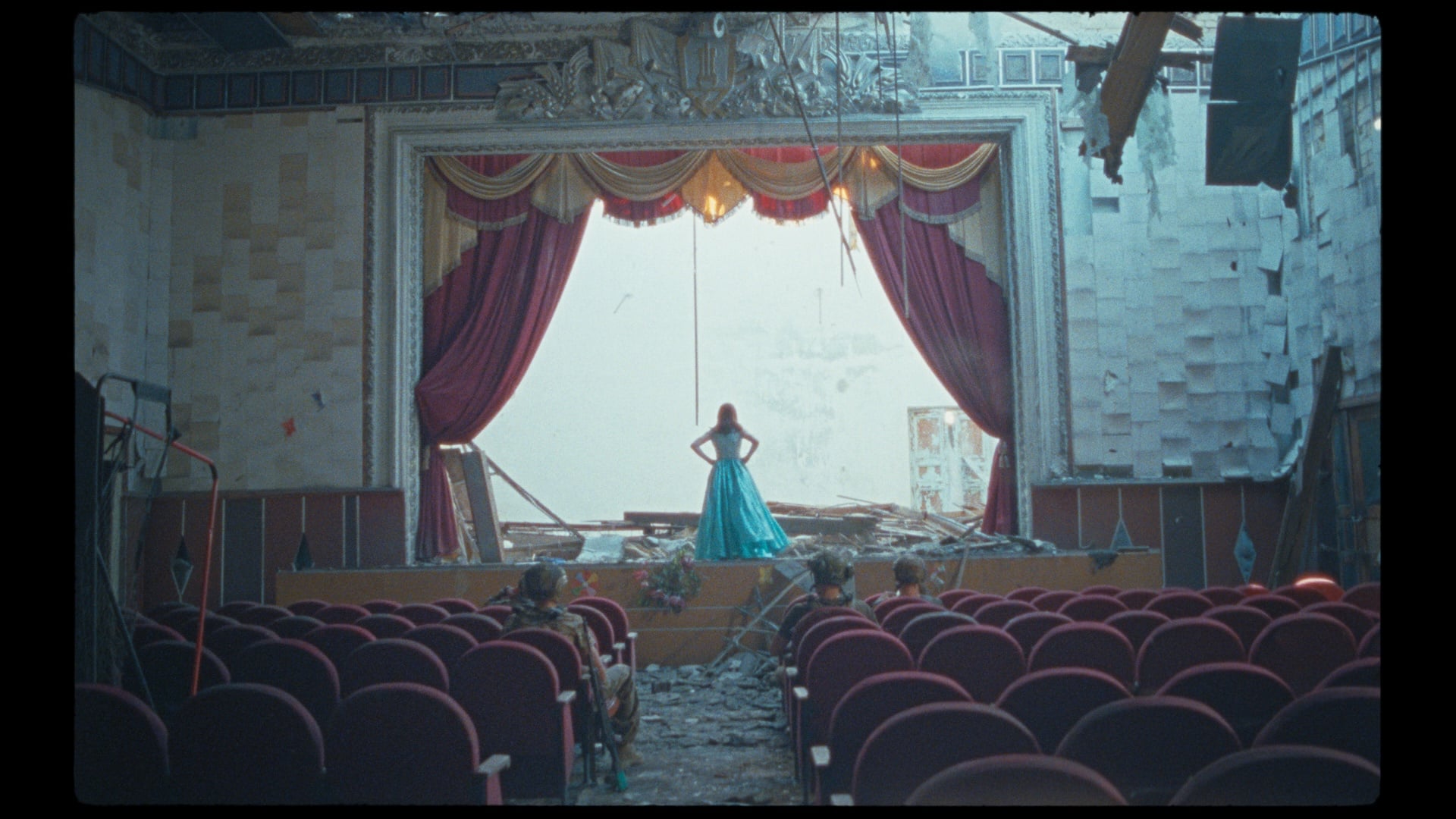
Natasha in Mariinka (dir. Pieter-Jan De Pue, 2026)
Have they seen the film?
They like the film very much. Natasha especially. She’s super proud of the film. Angela likes the film a lot, but she’s a bit scared. I’ll give you an example. The film is getting its Ukrainian premiere soon, at Molodist Film Festival in Kyiv. I invited her to present it. But she is expecting some harsh reactions from the audience. In the end, she has a pro-Ukrainian stance – she says that the Russians destroyed her Mariinka. But still, the fact that she had a relationship with people like Ruslan is not going to be accepted by many Ukrainians.
Natasha is very different. I mean, she’s very pro-Ukrainian. She’s a paramedic in Ukrainian army. I did many, many festivals with her after the film was released. And she told me: Pieter, you know my position. You know my patriotic stance on Ukraine. I’m expecting you to respect that. I will do anything you want; I’m going to collaborate with you. I trust you, I don’t need to see any images, any trailer or anything. I only want to see the final film. We filmed together almost ten years, you know? I knew Natasha when she was 14 and the film came out now when she’s 24.
I’d be interested to see how a Ukrainian audience reacts to the film.
There’s going to be some fireworks, that’s for sure. Some members of the crew, when they saw the film, they told me: “I’m sorry, but I don’t want to have anything to do with this. I want my name taken out of the credits.” Because we gave Ruslan a voice, who is fighting for Russia, even though he’s Ukrainian. It’s just the situation Ukraine is in today. But I think that’s not what the story is about. The story is about how these young people grew up in Mariinka, how they got divided, and how they took certain decisions, and how they are dealing with the consequences of all these decisions. I’m not going to say that it’s an apolitical film. I don’t know how you interpret it, but I think the film has a Ukrainian stance, it’s told from the Ukrainian perspective. We were editing for two years and I think we made correct, ethical decisions in the edit regarding the extent to which we sympathise with the Russian side. We didn’t show Ruslan in his private life, with his girlfriend – it’s just him fighting for the cause. You only see him in the military context, or talking about his brothers. It’s the story of this brotherhood.
Related to that, I did want to ask about one of the credits at the end of the film, which struck me as unusual, and which refers to the Ukrainian documentary maker and soldier Alisa Kovalenko: “Special thanks to Alisa Kovalenko for all the fair critiques that we did not take into consideration.” Is that something you can expand on, and does it reflect a broader local filmmaker response from those who have seen the finished film?
Alisa and I know each other very well. We’ve worked together a lot. We are very good friends. Now a bit less, of course. But I really admire Alisa. There has been no change in my respect towards her. I clearly understand her pro-Ukrainian position and I think the country needs people like her. The films that she’s been making, like Traces or My Dear Theo, are needed in this new Ukraine. But I knew she would react harshly [to Mariinka]. She’s angry at me that I did not portray the Russian side as evil. The guys Ruslan is aligned with are bombing the houses and killing the children of her people. That’s true. But that’s not what I wanted to talk about in this film. Nevertheless, I wanted to thank Alisa for her input into the film – input I didn’t act upon much, as the intention was never to turn the film into a piece of Ukrainian propaganda, but rather to tell a personal story about six characters making choices, bearing the consequences of those choices, and each of them dealing with the destruction and the scattered dreams caused by the war. I asked Alisa how she wanted to be credited, and the wording used reflects exactly how she wished to be listed and described. It might come across as arrogant – especially to those who might assume I look down on her work or vision, or who might mistake her views for the director’s – but this credit was entirely her own choice.
There is no debate that the Russian invasion is completely unjustified and the brutality is unmatched. We should be able to talk about the fact that before the invasion, Ukraine was not black and white. It was grey, there was already a lot of division. Natasha also has one brother fighting for Ukraine and one brother fighting for Russia. There are many cases like this in Donbas, and I don’t even want to speak for the whole of Donbas. The film is about the city of Mariinka.
Mariinka screens at the BFI London Film Festival on Friday 9 and Saturday 17 October. Find out here. Explore the full programme of the festival here.


 Go back to journal home page