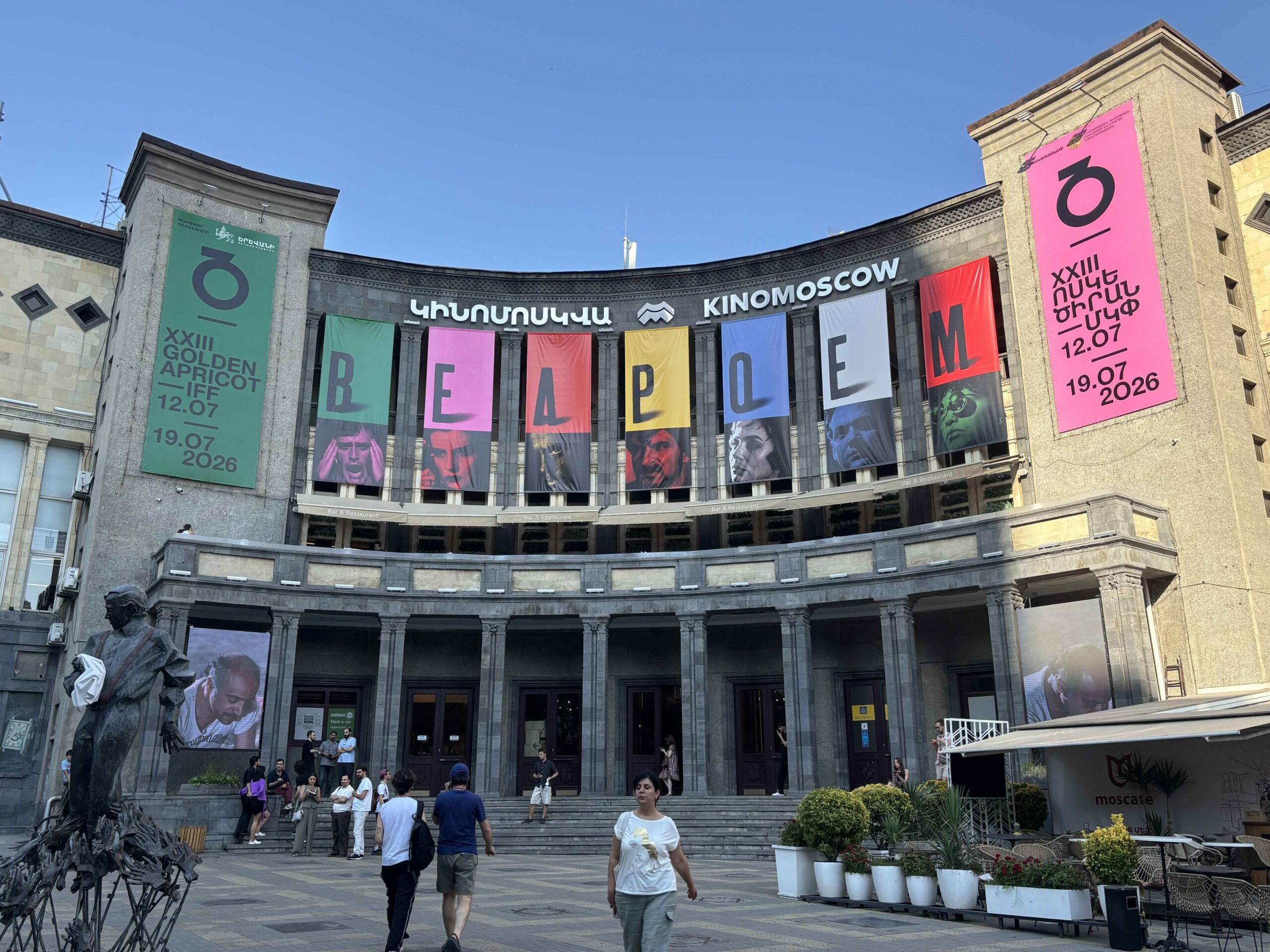
Moscow Cinema in Yerevan during the 2026 Golden Apricot International Film Festival. Image: Samuel Goff
There is nothing in Armenia’s cinematic calendar – or indeed that of the Caucasus as a whole – that can compete with Yerevan’s Golden Apricot International Film Festival. That produces its own pressures, and opportunities. Golden Apricot capitalises on Armenia’s very particular geographical and cultural positioning, to good effect: its “regional competition” extends westwards into Eastern Europe, while also drawing on Armenia’s deep connections to Near East neighbours like Iran. As Yerevan hums in the July heat, a healthy, roving crowd of locals and visitors rotates between a mix of charmingly old-school Soviet-era venues and newer cinemas, engaging (from this visitor’s perspective) as rigorously with local talents as with the always-impressive line-up of international guests and hefty festival circuit titles. This year’s roster included Jessica Hausner, Mark Cousins, and Pawel Pawlikowski, and a programme featuring the Palme d’Or winner, Fjord by Cristian Mungiu.
It is not usual for a nation the size of Armenia to boast a festival of Golden Apricot’s stature, but the prospect of using its platform to champion Armenian identity is complicated by a long history of displacement and diaspora. The Genocide of 1915-17, perpetrated when the Armenians lacked a recognised state of their own, scattered them across the globe. Longstanding communities in Near East countries like Lebanon have subsequently been subject to their own emigratory pressures. Then there is the ethnically and linguistically Armenian population of the unrecognised and now extinguished Republic of Artsakh in disputed Nagorno-Karabakh, ethnically cleansed from their territories in 2023, following defeat in the 2020 iteration of the longstanding conflict with Azerbaijan, and now largely residing in a kind of limbo within Armenia proper; their status (and future) was one of the animating questions in the recent elections won by incumbent Nikol Pashinyan.
It is not usual for a nation the size of Armenia to boast a festival of Golden Apricot’s stature, but the prospect of using its platform to champion Armenian identity is complicated by a long history of displacement and diaspora
Which version of “Armenian film” is on display at Golden Apricot? The money is simply not there within the Republic to foster a competitive industry, but Armenian-heritage filmmakers living and working in the West are more likely to have access to funding. The festival’s programming reflects this. This year’s opening gala was In the Land of Arto (2025), an Artsakh-set drama by the France-based Tamara Stepanyan. Appearing out of competition was Antonin Baudry’s nationalist historical blockbuster De Gaulle: Resistance (2026), which qualified on the basis that the title role was filled by legendary Franco-Armenian actor Simon Abkarian. This trend extends to Armenian festivals organised outside Armenia. The 2025 edition of London’s own Armenian Film Festival featured the likes of Monsieur Aznavour (2024), an international co-production from Mehdi Idir about the French-Armenian singer Charles Aznavour; Eric Nazarian’s Die Like a Man (2025), about gang violence in the Armenian community in Los Angeles; and The Sweet Hereafter, the 1997 supernatural drama by longstanding doyen of the diaspora Atom Egoyan – a Canadian-Armenian artist born in Egypt.
Alongside the usual spread of Iranian and Middle Eastern titles, Golden Apricot’s regional competition this year featured two Armenian films: Marlene Edoyan’s A Fire There and Comes Chahbazian’s Here, Elsewhere (both 2026). Taken together, the pair encapsulate the dilemmas of Armenian identity beyond Armenia in complimentary and contradictory ways. The surface-level parallels are pronounced: both directors are members of the Lebanese Armenian community who have made lives and careers in the Francophone West (Edoyan in Canada, Chahbazian in Belgium); both films previously screened and won Jury Prizes at whose films won Jury Prizes at the Visions du Réel documentary festival.
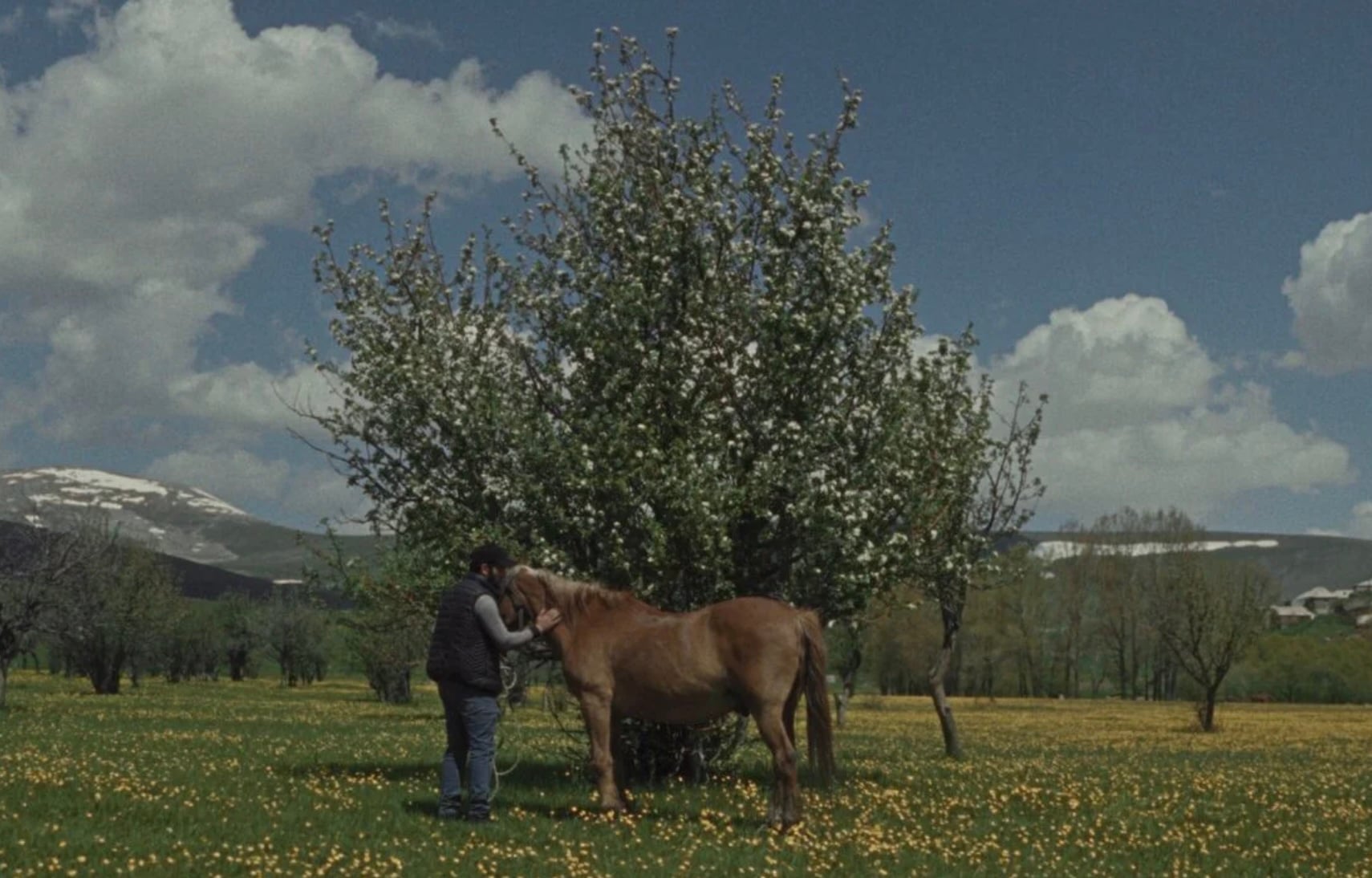
A Fire There (dir. Marlene Edoyan, 2026)
These films reflect the complexity involved in finding a filmic language that can contain the question of Armenian identity and relate the local to the universal. A Fire There is a hybrid documentary-fiction set in the remote village of Gandzani in southern Georgia. Here, an ethnic Armenian community ekes out a modest living. Edoyan focuses on three young men who represent the possible futures for this financially and socially precarious community: restless Henrikh, who leaves to study in Tbilisi and join the protest movement against the national government unfolding there; muted Karlen, pondering migrant labour in Russia over the family lot as a shepherd; and lovelorn Hakob, rooted in the community but pained by the disintegration of his long-distance relationship with the departed Monika. Here, Elsewhere, meanwhile, is Chahbazian’s latest contribution, following his 2022 feature Our Village, to the small but growing canon of films about the life and death of Artsakh. Quickly conceived in July 2023, when Azerbaijan’s siege of the territory had left its residents without basic goods for months on end, the film consists of footage shot by Artsiv and Tatev Lalayan, a married couple who Chahbazian had befriended on his previous film, edited from a distance by the director. As the shadow of war ultimately forces the Lalayan’s and their five children into exile in Armenia, their unassuming iPhone images gain a grim but tender potency.
When I spoke with the two directors after their films’ first screenings at the festival, both stressed the deep level of engagement that informed their work. For Edoyan, this was more a question of setting than characters, even though she had known some of the villagers involved for more than a decade: “The spaces that I had visited were brewing in my mind: the landscape, the eyes, the people, the mood, the atmosphere were things that I was very attracted to. I spent a lot of time thinking about this film viscerally.” Chahbazian likewise stressed his intimacy with his subjects. “We are family, actually. When I shot [the Lalayans in] Our Village, I stayed there for five years. The first thing people from the village who see the film tell me is that it’s shot from inside. It’s not [the film of] a stranger.” The challenge for Chahbazian this time around was to convey that immersion from a distance. “This is the most difficult thing, I think: to explain to an amateur. For me, a point of view is the basis of cinema. Amateurs don’t imagine how difficult and long it will be. To start, I gave him three keywords: the siege, the resistance, and the war that will come sooner or later.”
“The spaces that I had visited were brewing in my mind: the landscape, the eyes, the people, the mood, the atmosphere were things that I was very attracted to. I spent a lot of time thinking about this film viscerally”
For both directors, this intimacy produced alchemical, perhaps unexpected results as their subjects began to take over the medium and the mesage. Edoyan notes the “truly hybrid” nature of A Fire There: the film was largely scripted and lit like a fiction film. “But the documentary element came in when I started hitting certain walls with certain families or certain characters” – most often young women, members of a conservative, patriarchal community uncomfortable with the intensity of the dramatic process. This back and forth between scripted and unscripted visions of the village comes to a head in a striking late sequence in which Henrikh, freshly returned from Tbilisi, lays out in an impassioned monologue how his friends must help him to fight back against the government. The speech was entirely improvised. “I was in tears,” Edoyan admits. “I could not believe what he was doing. I had no idea what I was about to capture. This was two years after we’d shot in the same location. [So, by then] they kind of knew what they were giving me; they were running their own film. I was just following them.”
If Edoyan was following, Chahbazian was leading, instructing Artsiv Lalayan from afar on the art of directing. “I was taking screenshots of the footage, and then marking them up with red, telling him: ‘I don’t want this in the shot. You have to shoot from here. From the right, not from the left.’ And then I sent back the screenshot by WhatsApp.” Frustration soon gave way to recognition. “One month later, I don’t know what happened, it’s a miracle. The footage started to come, and it was good. It reminded me of my own images in my previous films. And the second miracle was when his wife Tatev started to film. She was filming better than him; she understood me from the first moment.” This collaborative but guided approach extended to the voiceover, with Chahbazian rewriting Artsiv’s initial efforts (though never, he stresses, without his friend’s ultimate blessing).
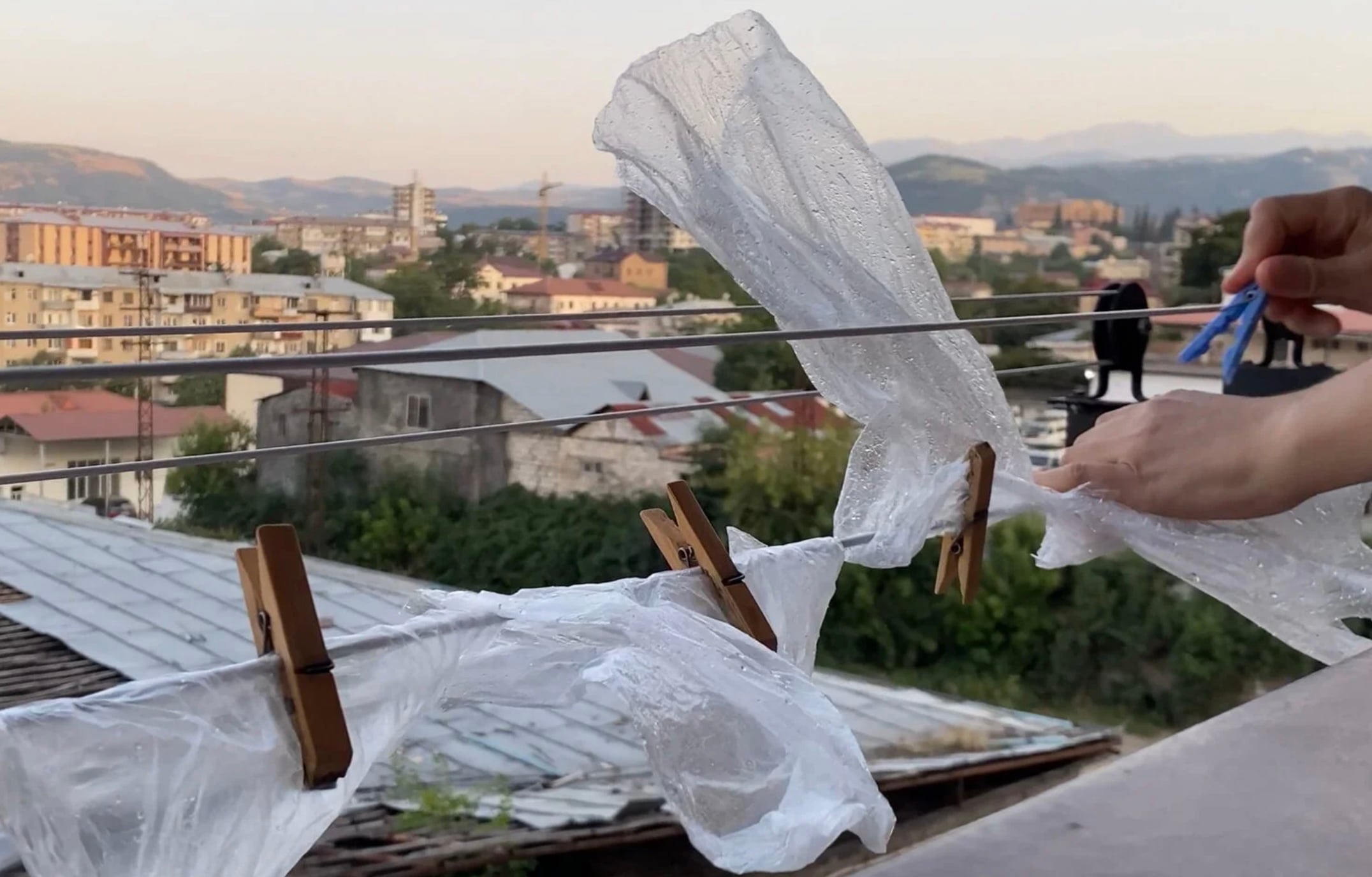
Here, Elsewhere (dir. Comes Chahbazian, 2026)
What of the question of Armenian identity in each film, though? Strikingly, Armenia proper is mostly absent in both A Fire There and Here, Elsewhere – although the final sequences of the latter do take place there after the Lalayans have fled Artsakh. In Edoyan’s film, Yerevan does not even seem to be a consideration for the central trio, whose see their futures in binary terms: either Russia or Georgia. But for Edoyan, it is precisely this precarious and circumscribed existence that speaks to Armenian history. Indeed, she recognises her own typically Armenian biography in that of her characters. “The connection is my background,” she says. “My grandparents escaped the Genocide. I’m second generation Armenian, born in Beirut. [In the film,] they’re from Erezum, which nowadays is in Turkey. So, their grandparents had the same trajectory of displacement; my family went to the Middle East, and they went north to what is now Georgia. That could have been my life, in a sense. When the land underneath you is really unstable, it affects your prospects, it affects the person that you become.”
In Here, Elsewhere, meanwhile, the Republic of Armenia is explicitly not “home” for our ethnically Armenian protagonists. There is a deeply funny and sad scene towards the end where the Lalayans’ eldest son jokes at length about the “vile place” they have ended up in. Artsiv laments Armenia’s refusal to grapple with the scale of the loss inflicted on their shared culture in Artsakh, to “mourn the cradle of our fatherland.” Chahbazian tells me about an Artsakhi girl who attended two screenings of the film in one day at Golden Apricot; during a Q&A after one showing, she pointed out that if Tatev had turned the camera around at one pivotal moment, she would have been filming her own home, now lost. “She said all her feelings were in the film. Listen, it’s not easy to lose land and just leave. They are tourists now, even in Armenia. And if you told them: you can go back tomorrow in a caravan, everybody would leave. And I understand this world very much.” Again, the personal history of the filmmaker informs his sympathy: “it’s because I was born in Beirut and I’ve lived in Brussels almost 40 years now. And I build up my identity like this: I’m 100% Lebanese, 100% Armenian, 100% Belgian.”
“It’s very hard to sell a film about Nagorno-Karabakh. It’s not Palestine, it’s not Syria, it’s not Beirut”
The parallels and divergences in the personal lives of these two directors – and the inadvertent dialogue that their films create when they are viewed side by side – speak to the fractured stories that Golden Apricot ends up telling about Armenia beyond Armenia. But that does not mean that Edoyan and Chahbazian agree on what they are up to, and their differences of opinion are just as instructive. Chahbazian describes the material struggle involved in producing a film about a territory as poorly understood as Nagorno-Karabakh. “It’s very hard to sell,” is his laconic phrasing. “It’s not Palestine, it’s not Syria, it’s not Beirut. So, I sold them the film not in terms of a question of territory, but as a family film. Something universal. Even though I hate this word, ‘universal’.” Edoyan, on the other hand, is happy to claim universality for her three local lads. “The thing is, for me, this isn’t necessarily about identity,” she argues. “It’s really a very global subject: it’s the trajectory of three young men at the start of their lives. The context is they’re living in a region that is precarious because of all these geopolitical issues. But is this a film about diaspora? Is this a film about Armenia? It’s a film about young people, about what it means to struggle for your future.” One lesson of this year’s Golden Apricot? A story told about oneself can bring the rest of the world closer, if only for one hot July week.
Read more writing from the 2026 edition of Golden Apricot and listen to our podcast episode on the programme.
Explore our collection of Armenian titles here.


 Go back to journal home page