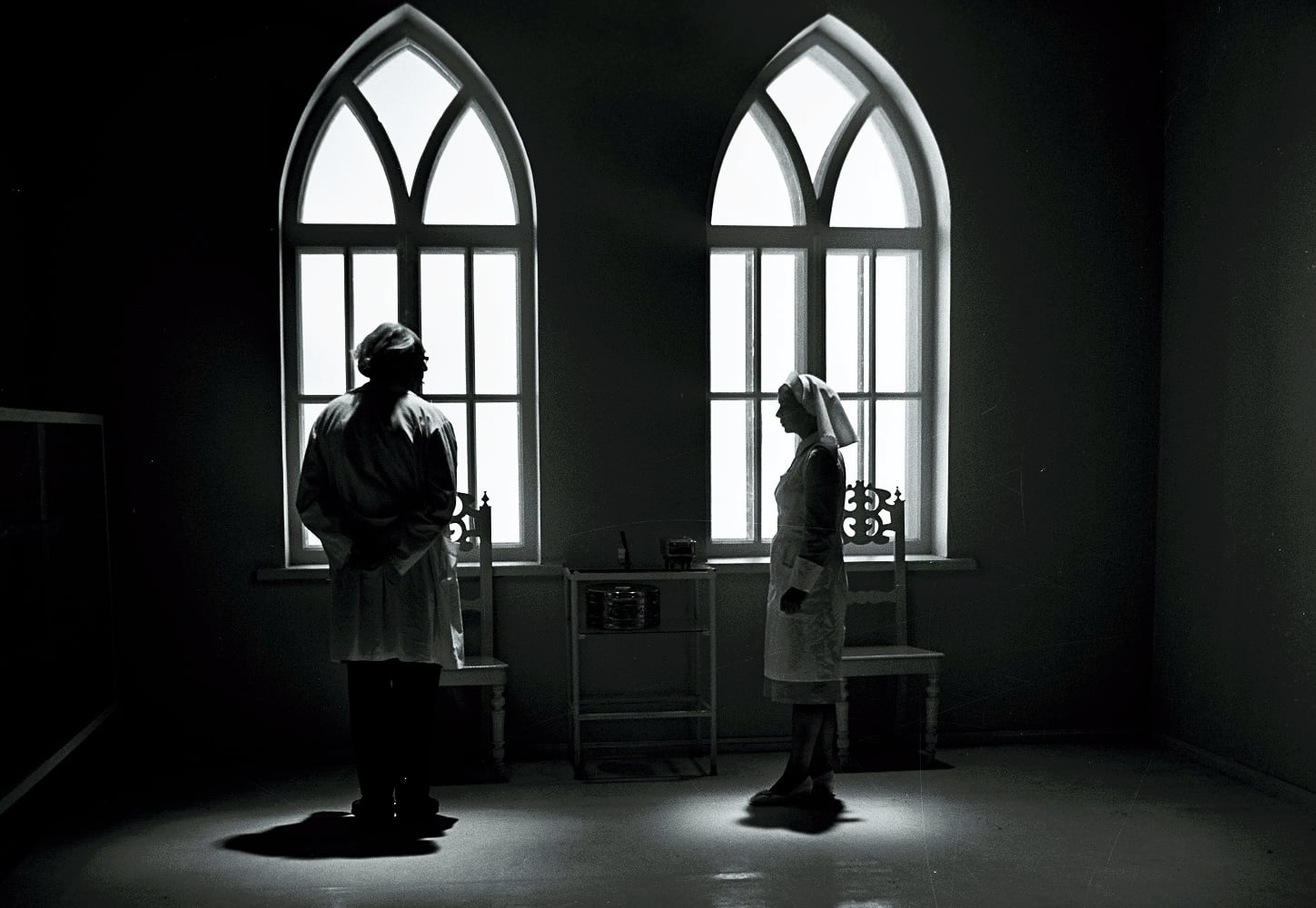
Madness (dir. Kaljo Kiisk, 1969)
Judenfrei reads a sign outside of a rural village in the opening of Estonian director Kaljo Kiisk’s classic 1969 film Madness. It’s the first word either spoken or seen and promptly establishes a sombre mood appropriate to the Second World War setting. The Gestapo marches triumphantly onto the property of a remote asylum. A morally clairvoyant narrator sets the scene: “The invaders had already succeeded in executing all Jews, Marxists, gypsies, guerrillas. Now it was the turn of those mentally ill.” The solemnity of the Nazi march is broken by a dark gag: an establishing shot of the exterior of the asylum and its meandering, listless, and threatless patients. Madness creates a world where genocide and occupation are material facts. It’s also a world where the weird and the satirical reign supreme, making it a fitting North Star for Estonian cinema, which, for the last half-century plus, has been characterised by genre films that wrestle with the country’s political past.
Following shortly after the New Wave movements in Western Europe, 1969 was a pivotal year for Estonian cinema. Madness, alongside Arvo Kruusement’s Spring from the same year, would become a pillar of Eesti cinema. Its subversive, modernist themes and playfulness with form made a significant contribution to what could be called the Baltic New Wave. It also ranked as the second greatest Estonian film of all time in the 2002 poll of Estonian film critics and journalists, behind only Spring. It is difficult to overstate the film’s import. “Madness stands as one of the most distinctive works in Estonian cinema throughout its 114-year history – an allegorical, visually striking film by the highly productive Kaljo Kiisk that challenged ideological boundaries and expanded the artistic language of film under Soviet rule,” says Edith Sepp, Head of the Estonian Film Institute. “It is simply a masterpiece.”
“Madness stands as one of the most distinctive works in Estonian cinema throughout its 114-year history – an allegorical, visually striking film that challenged ideological boundaries and expanded the artistic language of film under Soviet rule”
The Nazis have entered the asylum to eradicate its residents. Just before this final act of psychiatric genocide – part of the Aktion T4 campaigns – Gestapo Officer Windisch, played by the legendary Estonian actor Jüri Järvet, receives a secret report of a British spy hiding among the asylum’s patients. Windisch has limited time to rat out the spy. Only revealing his true intentions to the chief doctor (Voldemar Panso), he first pretends to be just a new doctor, and later a patient himself, in his predatory cat-and-mouse game to find the reported Ally agent.
Cut off from mainstream life, the patients resemble prisoners or exiled dissidents. Mare Garšnek plays the memorably unflappable Sophie, wearing anachronistic make-up straight from the wardrobe of Anna Karina and with a kindred nonchalant charm too. Sophie has been declared crazy for “harassing” state institutions with letters. Yuri Krohn (Viktor Plyut) earns a spot in the asylum because he is an Aryan who prefers to live in a Ghetto, the most malign form of mania as far as the SS is concerned. Elsewhere, a former propaganda writer has been driven mad by the system he defended in his writings. The most obtuse of the political abstractions represented by the inmates comes in the form of Patient 01 (Vaclovas Blėdis), who unironically believes he is the Führer. All of Windisch’s primary suspects are “mad” in ways that point to the totalitarian state’s control of the truth: by definition, deviators must be categorically insane.
Järvet was the most consequential Estonian actor of the twentieth century, and Madness kicked off a decade rife with canonical performances. The following year he would translate William Shakespeare’s King Lear (1970) to Soviet audiences in the titular role, and he would reach even greater international fame as Dr. Snaut in Andrei Tarkovsky’s Solaris. Those performances came in Russian; Estonian audiences would again hear their biggest star speak their tongue in 1979’s ineffably strange Dead Mountaineer’s Hotel, another iconic Estonian film from the Soviet era. But his performance in Madness might be the capstone to his exceptional career. His prominent ears made it seem as if he was always listening, while his long face wore an unspoken and exhausted drama. With Järvet, there is never a moment without philosophical intrigue or moral drama, never a moment of boredom, never a reason to walk out of the cinema or turn off the television.
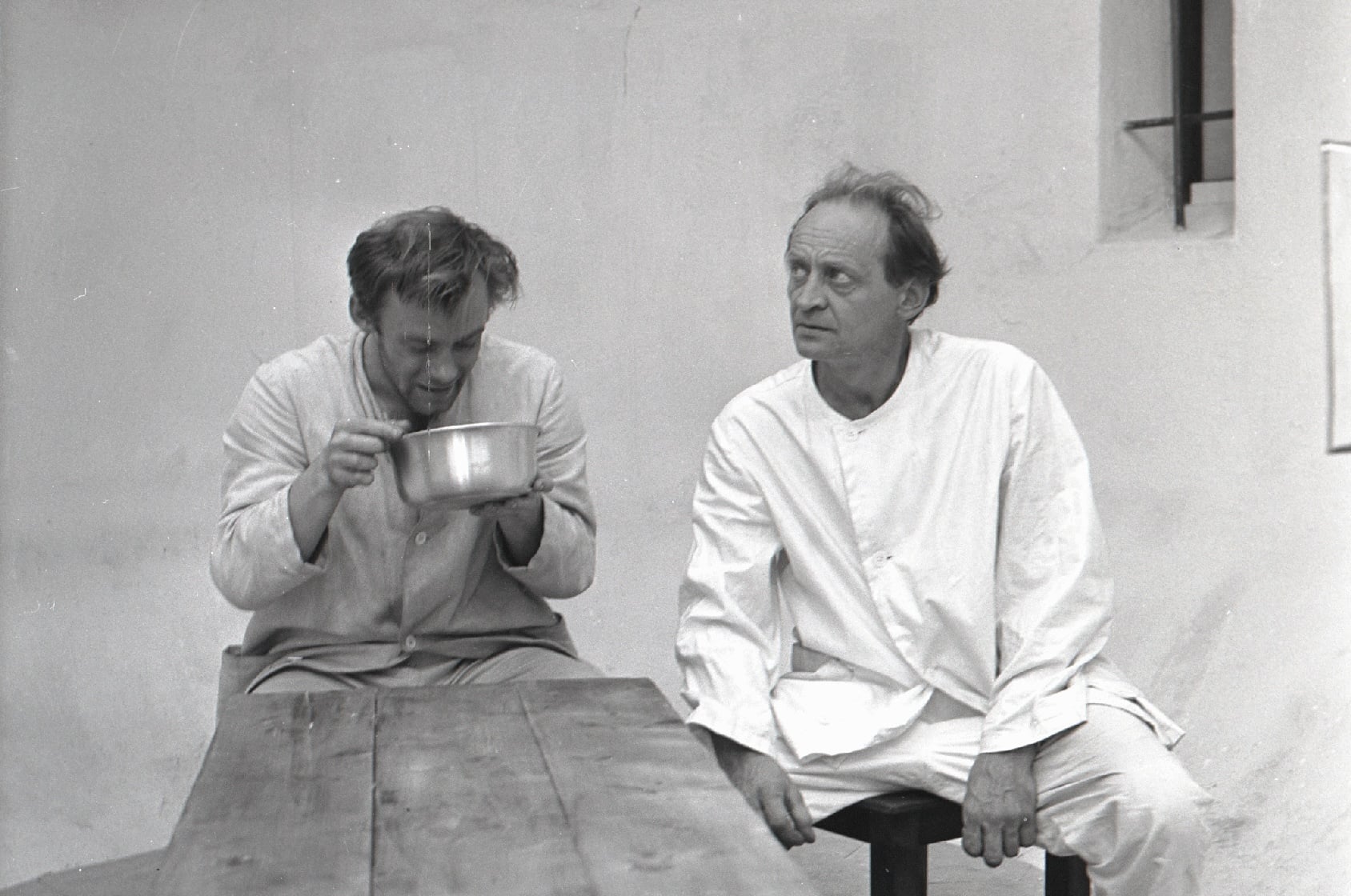
Jüri Järvet, right, in Madness (dir. Kaljo Kiisk, 1969)
As much as Madness owes its enduring legacy to Järvet, it’s the Kubrickian production design of Halja Klaar that hooks viewers. The doctor’s office in the hospital is a slick, painful white, militaristically clean – an aesthetic twin to the genocidal fate awaiting the patients. The exterior of the asylum too is a bright white. The patients, as well as the doctors and nurses who care for them, also wear the same monochromatic white. The dark uniforms of the Gestapo break this uniform palette to create a literal (and metaphorical) contrast.
The cinematography by Anatoliy Zabolotskiy finds symbolism in the strange ordinariness of asylum life. A man plays with chess pieces but doesn’t play the game itself. He doesn’t even have a partner, calling attention to the artificiality of the doctor’s witch-hunt. Sophie stares at the goldfish swimming in their aquarium, their confinement mirroring each other. The most politically charged symbols are artistic, though. The head doctor takes Windisch through a room full of patients’ charcoal drawings, materialising a relationship between art and control that the film’s censored release would unfortunately relitigate. A worker cleans a caryatid, a decorative female architectural support that originates in Athenian democratic culture. The figure being cleaned calls further attention to it, as if Kiisk is telling viewers to pay close attention. The caryatid is an obvious reference to Classical Athens – known as the world’s first democracy – yet caryatids also became associated with slavery, a curious contradiction of meanings that is either a stroke of genius or brilliant luck.
Should we take the doctor’s final actions to prevent the massacre of his patients as repentance on the part of the former Luftwaffe man turned filmmaker, a rewriting of national history via allegory?
Technically speaking, Madness takes place in an unnamed European country occupied by the Nazis near the end of the war. The film never names a geographical setting. Along with the ambiguity of the screenplay, this elision has led many to conclude that Madness uses its critique of fascism to veil one of the Soviet Union. “The possibility that, in evoking one form of ‘totalitarian system’, filmmakers might be mounting a critique of another, was raised already at the script stage by Lennart Meri, writer, film director, polyglot, and in due course, president of Estonia (1992–2001),” summarises scholar Catriona Kelly in her survey of Baltic and Moldovan cinemas in the 1960s. Estonian film historian and critic Lauri Kärk concurs: “Madness was one of the very few Soviet films, if not the only one, besides Mikhail Romm’s Ordinary Fascism… containing criticism of a totalitarian regime, including criticism of the Soviet system in particular.”
Meri wasn’t the only one concerned about the film’s release. As was common from other films in the Baltic New Wave, like the Latvian Rolands Kalniņš’s Four White Shirts, Kiisk’s film clashed with the Soviet censors. Latvian screenwriter Viktors Lorencs’s first script was rejected and required significant changes, including a very important re-write turning Järvet’s investigator into a Nazi, before production. Kiisk managed to get the film made without alleviating every request from the authorities. The troubles didn’t end with the rewrite, though. Madness was immediately banned outside of the Baltics and Belarus. And, given the limited nine prints initially created (all a Russian cut), it was effectively censored in the Soviet Union.
If authorities knew more about Kiisk, the film would have been in even hotter water. As a teenager, Kiisk spent time as a member of the 20th Waffen Grenadier Division of the SS, manning a 20-millimetre anti-aircraft gun – work often forced upon underage boys in Nazi-occupied territories. It appears that he went AWOL after the Battle of Tannenberg Line when he was 19 years old, and later hid his time in the German army from the Soviet authorities. And he hid it well: had his military past been more transparent, his ability to pursue an artistic career would have been nearly impossible.
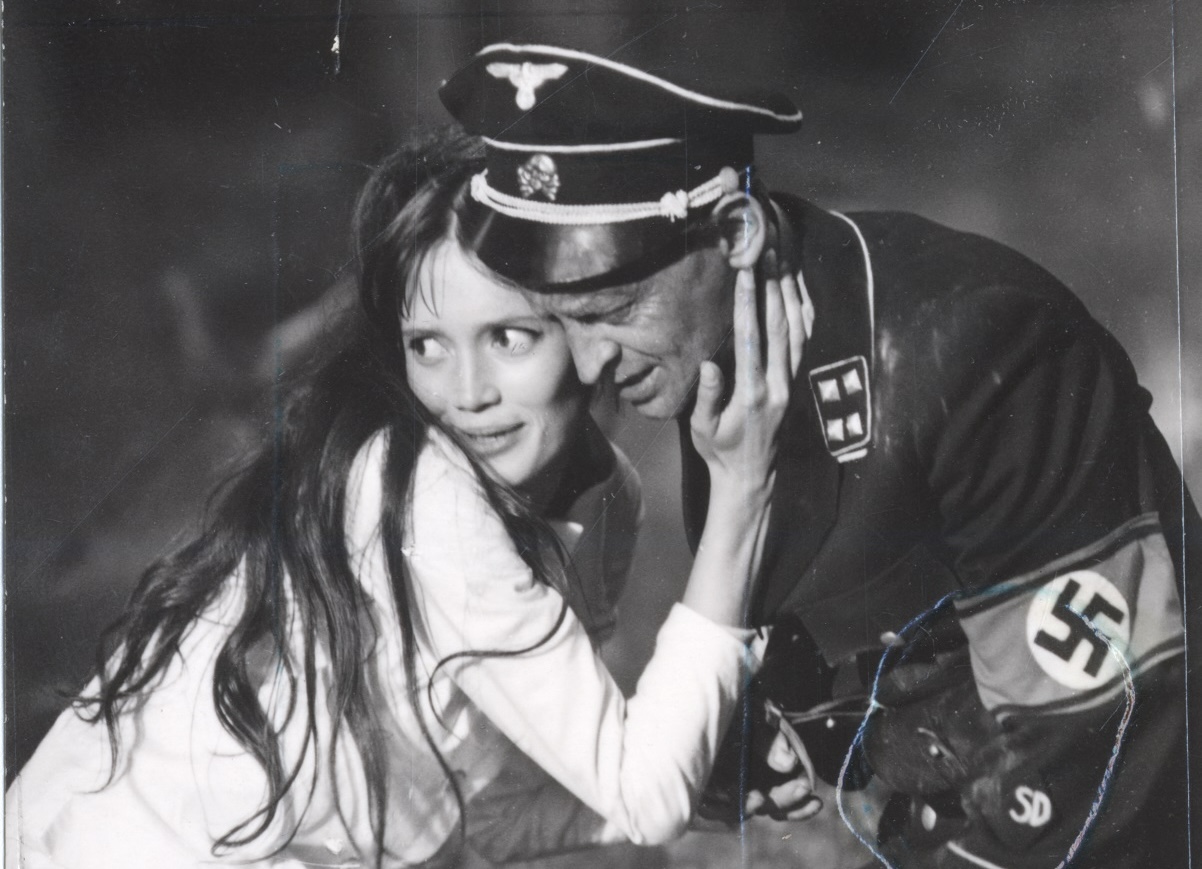
Mare Garšnek and Jüri Järvet in Madness (dir. Kaljo Kiisk, 1969)
The director’s personal history and the Judenfrei, or “free of Jews,” sign at the film’s start make it hard to separate the film from the Holocaust. In January of 1942, at the Wannsee Conference, the German powers declared Estonia officially “free of Jews”: the first country to receive the declaration. Given Kiisk’s personal history alongside this grim national trajectory, what does it mean to project an Estonian setting onto the ambiguous non-place of Madness? Should we take the doctor’s final actions to prevent the massacre of his patients as repentance on the part of the former Luftwaffe man turned filmmaker, a rewriting of national history via allegory, in the tradition of D.W. Griffith’s direction of Intolerance as an apology for The Birth of a Nation? If this is the case, why was Windisch not a fascist until the rewrite?
To end the film, Windisch looks straight down the camera’s lens and gives a pedagogical warning: “You think I am a lunatic? As you wish. We will meet one day, for sure.” Kärk interprets this finale in conversation with Mikhail Romm’s excoriating collage documentary about the rise of Nazism, Ordinary Fascism (1965), whose final scene features a very similar visual of the human eyes in a close-up: “Romm gave us a look at the victims of totalitarianism, with the painful look from those being killed in concentration camps; Kiisk presented us with the maddened look of a totalitarianism’s lackey and executioner.”
A more simplistic – and perhaps sadistic – angle to Windisch’s words is to take them at face value. Nazis like Windisch will always be around to bump into: in the streets, at the park, and, of course, in the hospital. As Sepp observes, Madness remains “profoundly relevant today: who is our enemy now — the one we suspect, or the one who walks among us? And when looking at today’s morning newspapers — how sane are the sane, really?”
Watch Madness on Klassiki now as part of our new Soviet Sixties collection and explore our full range of Baltic titles here.
Joshua Polanski is a Tomatometer approved critic and a member of the Michigan Movie Critics Guild. His writings on Baltic cinema can be found on his website.

 Go back to journal home page