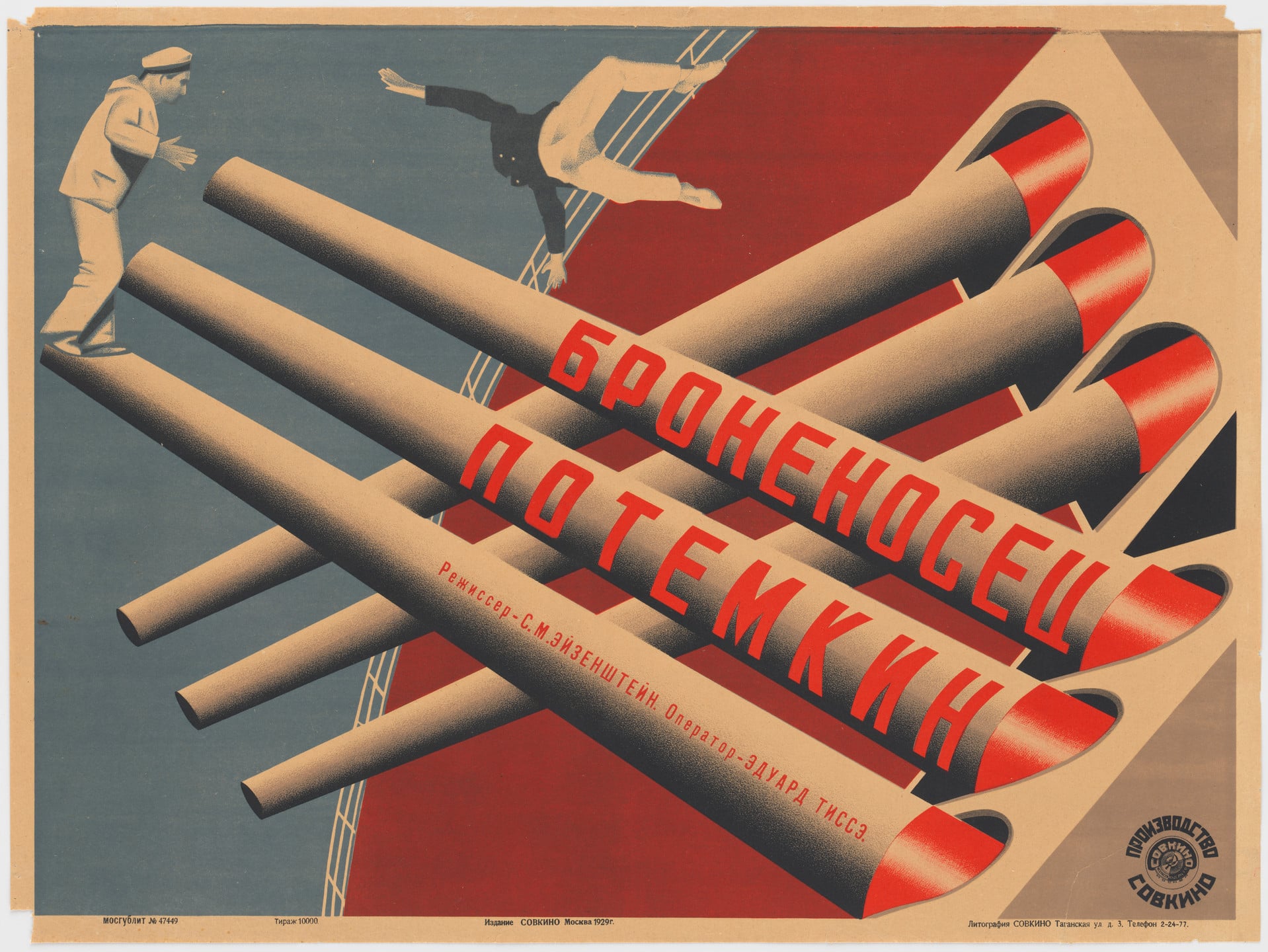
Poster for Battleship Potemkin by Vladimir and Georgii Stenberg. Image: MoMA
A century after its release, there’s little left to say about Battleship Potemkin. Sergei Eisenstein’s silent celebration of class consciousness and avant-garde technique could not be more firmly ensconced in the canon; there can scarcely be a film studies course in the world that doesn’t tip its cap to Potemkin’s innovations in montage and the staging of action. As with any canonised film, we are left with more historiographical questions. What does this film produced in the heat of the early Soviet experiment mean in 2025? Have Eisenstein’s political and cinematic convictions (for him there was little distinction between the two) been vindicated or left obsolete? Do we have the film right in our memories?
With Potemkin, these questions are doubly appropriate, since Eisenstein’s intention with the film was, in part, to reveal the mechanisms of history itself: how class consciousness is fomented and expressed, how repression produces a revolutionary response. In 1925, the fledgling Soviet culture industry was preoccupied with the 1905 uprisings of 20 years prior – the precursor to 1917, which had produced Russia’s first parliament but had failed to dislodge tsarism. Eisenstein was originally charged with producing a film that took in a wider range of events from 1905 – the Russo-Japanese War, riots in Petersburg and Moscow – but narrowed his focus to the mutiny on board the titular Black Sea warship. Although necessarily dramatised and exaggerated by Eisenstein, most of the now-familiar events in the film are drawn from the historical record: the mutiny was prompted when crewmembers were threatened with execution for refusing to eat rotten meat; the murder of ringleader Grigory Vakulinchuk prompted the killing of seven of the ship’s officers, including the captain; a general strike was called in nearby Odesa in support of the mutineers, where riots were violently suppressed by armed police; several other battleships were sent to sink the Potemkin but refused to fire on her.
Watching the Odesa Steps today, we appreciate why Leo Mur described the sequence as “montage not only on the screen of the movie theatre, but also on the screen of the brain”
If these distant events burn brightly in our minds, it is thanks to Eisenstein’s unprecedented skill in bending the formal properties of cinema to his political and aesthetic will. Of all the filmmakers associated with the “montage school” of the Soviet avant-garde – those directors invested in the capacity of the cut or edit to juxtapose images and thus to produce new sensations and ideas in the viewer – the young Eisenstein believed most fervently in the power of film quite literally to rewire consciousness. As the sailors of the Potemkin and the citizens of Odesa realised the oppressive nature of tsarism, so too would the audience in the cinema hall. Hence Eisenstein’s bullish proclamation that film should be: “a brilliantly calculated blow of the billiard cue at the audience’s cerebral hemisphere […] a tractor, ploughing over the psyche of the spectator from a given class position.” To this day, the rapid-fire cross-cutting of the famous “Odesa Steps” sequence, in which armed troops massacre fleeing protestors, emerges unscathed from a century of homage and pastiche, from Brian De Palma’s Untouchables to The Naked Gun. Watching the carnage unfold, we appreciate why the scholar Leo Mur described the sequence as “montage not only on the screen of the movie theatre, but also on the screen of the brain.”
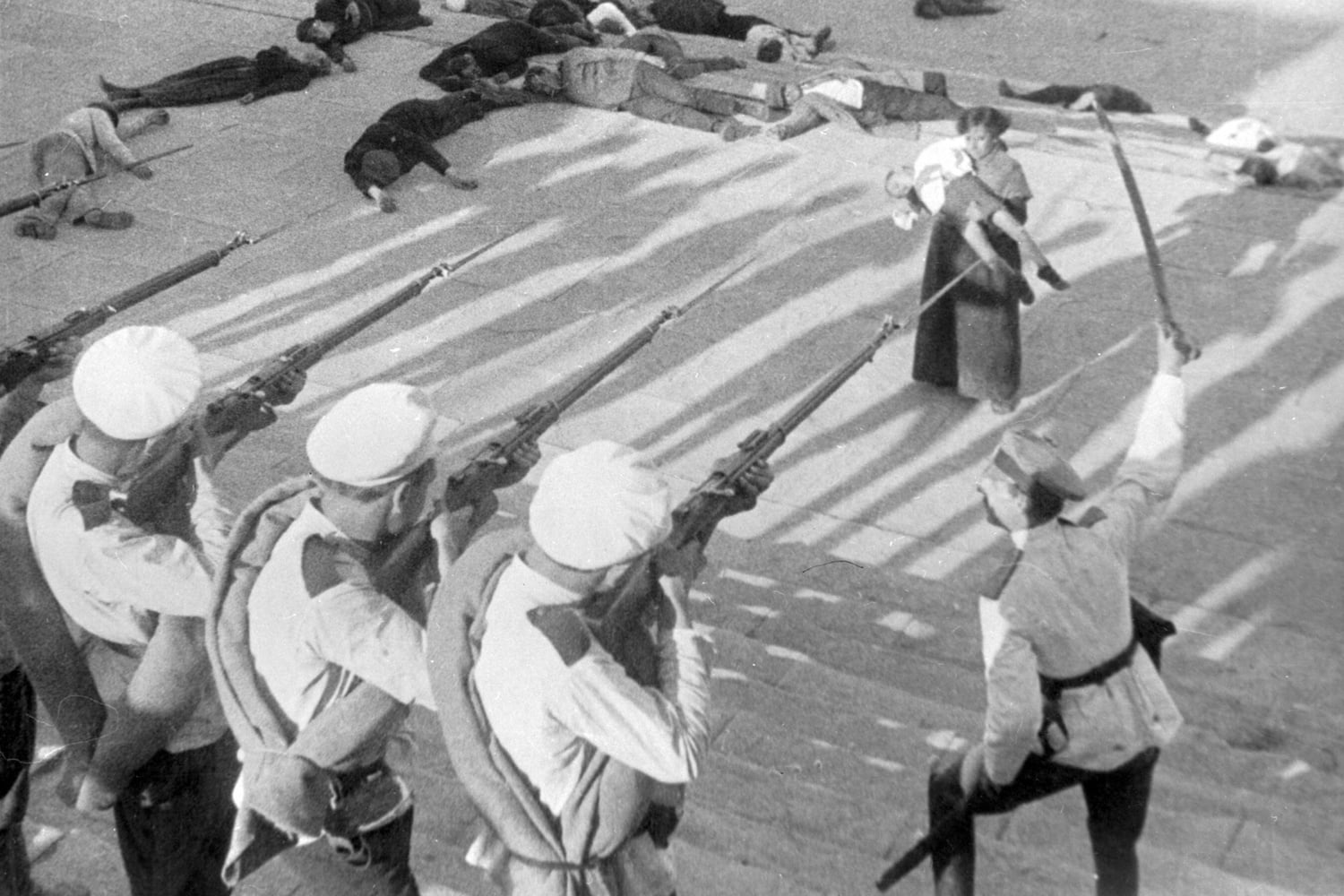
The “Odesa Steps“ sequence in The Battleship Potemkin (dir. Sergei Eisenstein, 1925)
Of course, history always gets away from storytellers. The radicals of the Soviet avant-garde continue to grace course syllabi, while the revolutionary optimism that prompted their influential experiments is anachronistic in the extreme, more than 30 years into our post-Soviet postmodernism and with Russian imperial revanchism running roughshod over the heroism of 1917, let alone 1905. Eisenstein retold history in an attempt to shape it, only to be swallowed by it in turn. His successors and detractors can wallow in that while failing to match even a degree of his visual intelligence and formal mastery. More valuable would be to reframe both the real Potemkin and its onscreen mythologisation, taking account of the subsequent histories of Russia, Ukraine, Soviet communism, and state-sponsored art production. And if all this could be wrapped up inside 20 minutes, that would be a plus. Enter Radu Jude.
Jude has always been the most cynically cinephilic of the figureheads of the Romanian New Wave – a movement that he was lumped in with in his early years before rapidly outstripping. In true postmodernist fashion, he has an obsessive but irreverent relationship with film history, which he strips for parts in his quest to represent the imagistic anarchy and political febrility of contemporary life: see his breakout 2024 gig economy satire Do Not Expect Too Much from the End of the World, which deployed TikTok and European arthouse convention while harking back to the dawn of cinema via knowing tributes to the Lumière Brothers. Jude is also a confirmed Eisensteinian: several of his sorely under-seen shorts are stated attempts at (and homages to) Soviet-style montage, and his delight in mashing together disparate and discordant images speaks to his love of Eisenstein’s concussive theories of editing.
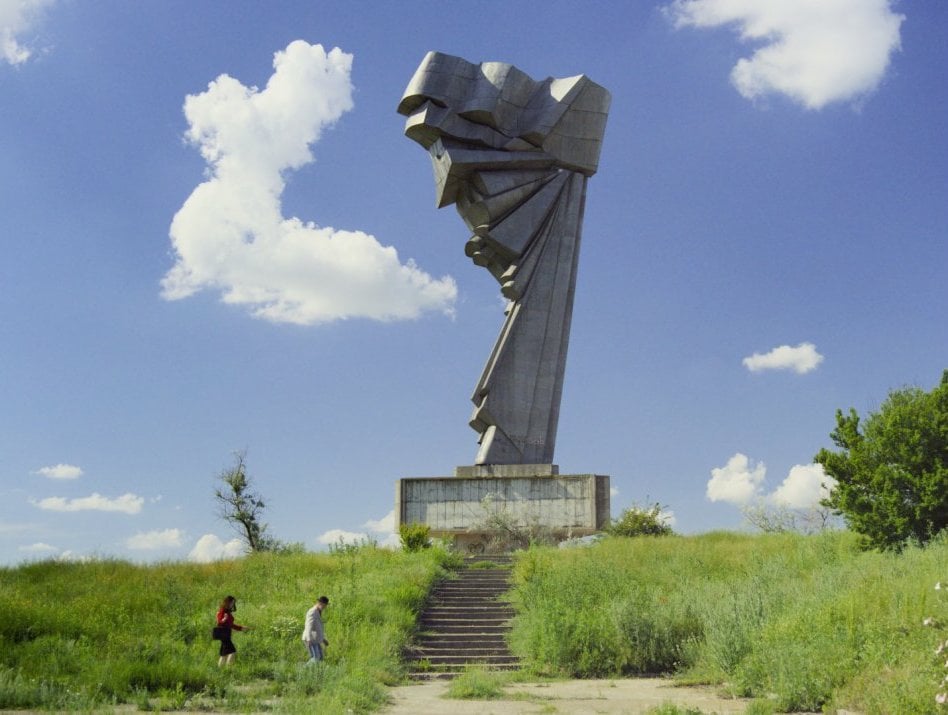
The Potemkinists (dir. Radu Jude, 2023)
In his 2023 short The Potemkinists, Jude lays his cards on the table, directly confronting and subverting the myths of Potemkin and Potemkin. The scene is set on a bluff overlooking the Danube-Black Sea Canal, the product of a force-labour campaign under Nicolae Ceaușescu. A sculptor (Alexandru Dabija) has dragged a reluctant representative of the culture ministry (Cristina Drăghici) to this isolated lookout, the site of a communist-era monument to the Union of Communist Youth, with a proposal – and an impromptu history lesson. Everyone knows about the mutiny on the Potemkin, he says; what no one remembers is that the battleship was eventually forced to retreat to the port city of Constanța in neighbouring Romania in search of asylum, which was granted as a retort to the unfriendly tsarist power to the east. It is this forgotten coda to the Potemkin story that the sculptor wishes to commemorate by renovating and reimagining the existing monument. The film plays out as a mock-Socratic dialogue between artist and functionary as to the feasibility of such a venture, intercut (in true montage school fashion) with clips from Eisenstein’s film. The result, in the words of Romanian critic Andrei Gorzo, is “a cross between a Caragiale sketch and a Mark Rappaport video essay.”
the protagonist of The Potemkinists is faced with the conundrum of reframing the Potemkin mutiny and the art of the Ceaușescu era in an age of official nationalism, Russophobia, and anti-communism
Battleship Potemkin and the contentious monument in The Potemkinists are both products of a period of total state capture of the arts. Jude deploys them as the staging ground, both literal and rhetorical, for a debate between a public artist and a government official. That is just the first historical irony among many that circulate during the brief runtime. The casting of Dabija recalls another Jude film about the dangers of revisiting the past: his 2018 feature I Do Not Care if We Go Down in History as Barbarians, in which a theatre director attempts to stage a reconstruction of a Second World War atrocity committed by the Romanian army; in that film, Dabija is the cunning local official who greases the wheels of the protagonist’s disillusionment. In The Potemkinists, his character is faced with the conundrum of reframing both the Potemkin mutiny and a relic of the Ceaușescu era in an age of official nationalism, Russophobia, and anti-communism. His response is to propose a “postmodern collage” that remixes rather than revives the legacies of the twentieth century. This is surely as close as Jude has ever got to having a character deliver a directorial mission statement: consider his own description of Potemkinists as “a comedy about the layers of history – or, better put, about misunderstandings coming from our relationship with history.”
There is one final historical irony that inevitably colours our viewing of The Potemkinists, Battleship Potemkin, and everything in between: Russia’s full-scale invasion of Ukraine, which commenced between Jude shooting the short in 2021 and its eventual release in 2023. If Jude could not have predicted this particularly brutal historical reiteration, he nonetheless pre-empts it: with typical forthrightness, Dabija’s sculptor points out to the reluctant official, wary of indirectly glorifying these heroes of Soviet propaganda, that “by harbouring the Potemkinists, Romania fucked Russia in the mouth! Pardon the language.” Just as Eisenstein understood the need to explode film form in service of his revolutionary agenda, so Jude is alive to the ways in which world events outrun even his determinedly present-tense cinema. In his director’s statement on Potemkinists, he notes that, conceived and shot before the invasion, the film includes only a passing joking reference to the Russian president. But disaster also provokes clarity: “One year later, I would only have one line of dialogue in the film, and that would be: Fuck you Putin and your supporters! Forever!”
Watch Battleship Potemkin and The Potemkinists on Klassiki now.


 Go back to journal home page