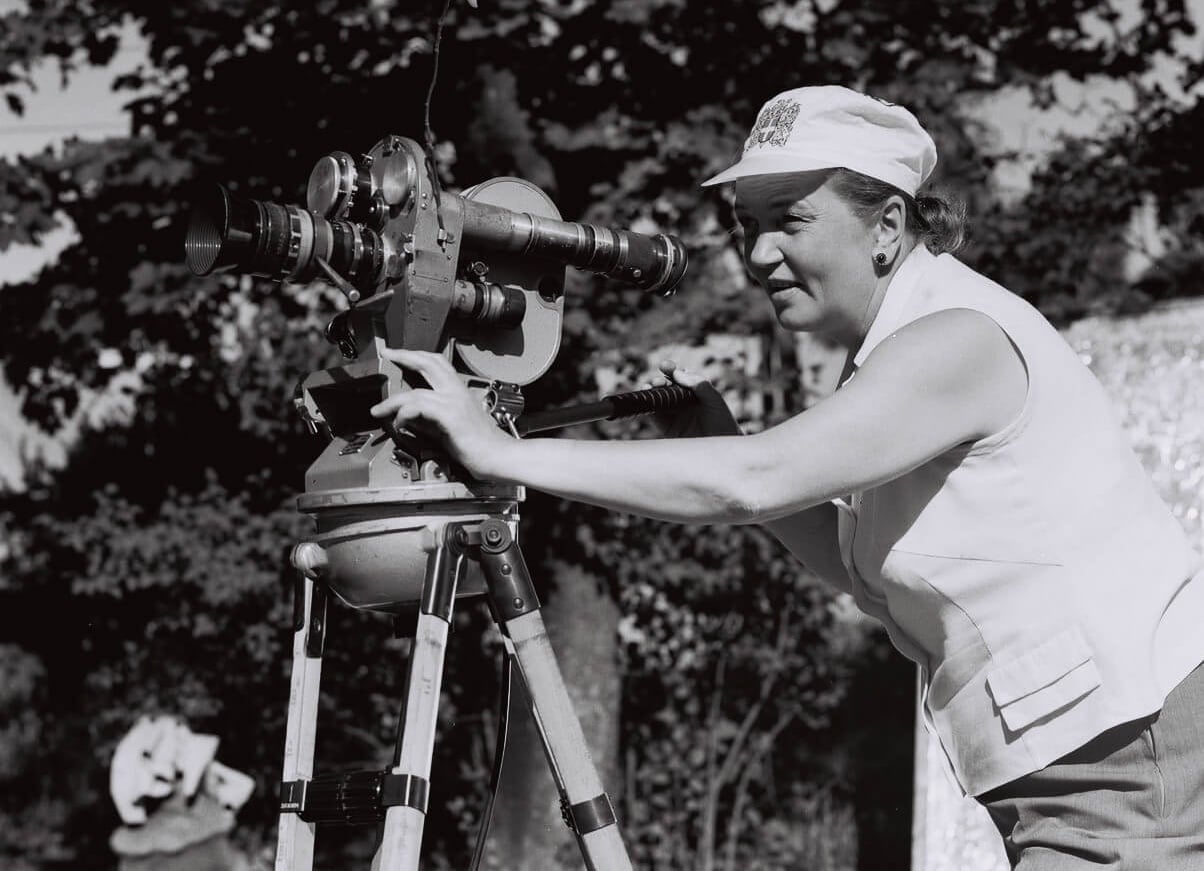
Leida Laius. Image: Tallinnfilm/Film Archive of the National Archives of Estonia
Leida Laius (1923-1996) was an ingenious adaptor of diverse literary works, one of Soviet cinema’s true “actors’ directors”, and both a chronicler and a living example of the relationship between her native Estonia and neighbouring Russia, both imperial and communist. But above all she was a filmmaker of and for women. To say so is not to diminish the complexity and universality of her filmography, which ranges across centuries and from neo-realism to folk horror. Rather, it reflects the kaleidoscopic way Laius refracted and reappraised fundamental questions of female experience from within the Soviet studio system. Whenever a relatively unknown female filmmaker gains a degree of critical reappraisal – is “rediscovered”, as people love to say – they tend to be labelled a “pioneer”; even more so if they belong to a national tradition like Estonia’s that is doomed to be relegated to “minor” or “peripheral” status. If the signs are promising that Laius’s work is belatedly undergoing this process of rediscovery – her 1985 teen drama Smile at Last returned to the Berlinale, where it won the UNICEF prize, for a fortieth anniversary screening in 2025; partial retrospectives featuring a handful of new restorations have since played out in New York and the La Rochelle festival in France – then it is to be hoped that increased attention will not flatten out her thorny, compassionate work into marketable slogans about either womanhood or Estonian national identity.
Laius was born in Horoshevo, a small town outside St Petersburg, later moving to the city of Kingisepp near the Estonian border. As was common in the region, her family was a mixed affair: her mother Armanda came from a well-to-do Estonian family in nearby Narva; her father was a Russian farmer. Laius would describe her relationship with Armanda as contentious, even bitter, but close – the two are buried side by side in Tallinn’s Pärnamäe Cemetery – a dynamic that is reflected in the complex maternal bonds that underscore so many of her films. Her mother loomed larger, too, after Laius’s father was arrested and executed as a kulak in the Stalinist purges of the 1930s.
“[when the war ended] there was only a moment of so-called pleasant surprise, then silence came. Now everyone’s gaze seemed to turn inward. I had the same question: what will happen tomorrow?”
Laius served as a sanitary nurse and librarian during the Second World War. When victory was declared, she was on a train outside Riga. “I was surrounded by only soldiers,” she later recalled. “There was only a moment of so-called pleasant surprise, then silence came. Now everyone’s gaze seemed to turn inward. I had the same question: what will happen tomorrow?” For Laius, the answer was a fateful move to the maternal homeland of Estonia, now reoccupied by the Soviets. A merry-go-round of jobs followed – as a functionary for the Food Industry, a clerk at the Union of Architects, and finally a theatre inspector. This role proved auspicious: it led Laius into the State Theatre Institute, where she graduated in 1950, spending four years treading the boards at the capital’s Drama Theatre. When it became clear that an acting career would not be forthcoming, Laius made the switch to cinema, moving to the state studio Tallinnfilm in 1960 and graduating in 1962 from VGIK in Moscow, the USSR’s most prestigious film school. Her diploma film, the war short From Evening to Morning (1962), already captures two of her defining traits as a director: her eye for a promising literary source (in this case a short story by Mart Kalda) and her intuitive approach to casting and collaboration. Her lead, Kirill Lavrov, went on to become a bona fide Soviet screen star, while the score came from none other than Arvo Pärt in what was his film composition debut.
Over the next 34 years, Laius would direct seven features and five documentary shorts; she was also a dubbing director at Tallinnfilm on dozens of foreign films. Hers is an oeuvre dominated by questions of compromise and commitment, of ideals pursued and squandered, in which formal diversity is paired with a determined insistence on the centrality of women’s domestic and social experiences. Laius herself tended to demur when asked about her position as a woman in an industry dominated then as now by men. Her insistence was on the purifying, levelling nature of artistic work itself. “Work is equal,” she told one TV interviewer. “You have to behave equally and demand the right to act. But if you haven’t proven yourself yet, you will inevitably end up being pushed away.” It was an attitude that served her well in the sometimes unforgiving Soviet studio system. In the late seventies, Laius spent several years working on an adaptation of Aino Kallas’s The Pastor of Reigi, only for production to collapse when the lead actor abandoned the set; the stress landed her in hospital, with her colleague Jüri Müür installed as director in her place. Laius’s response to what was surely the most challenging moment in her career was to reaffirm her commitment to filmmaking through a series of documentary shorts about birth (A Human Is Born…, 1976), childhood (Childhood, 1976), and old age (Tracks on Snow, 1978); via her introduction to cinematographer Arvo Iho, these films ended up laying the ground for the late career triumph of Smile at Last and A Stolen Meeting (1988). As she herself put it in one interview, “work heals.”
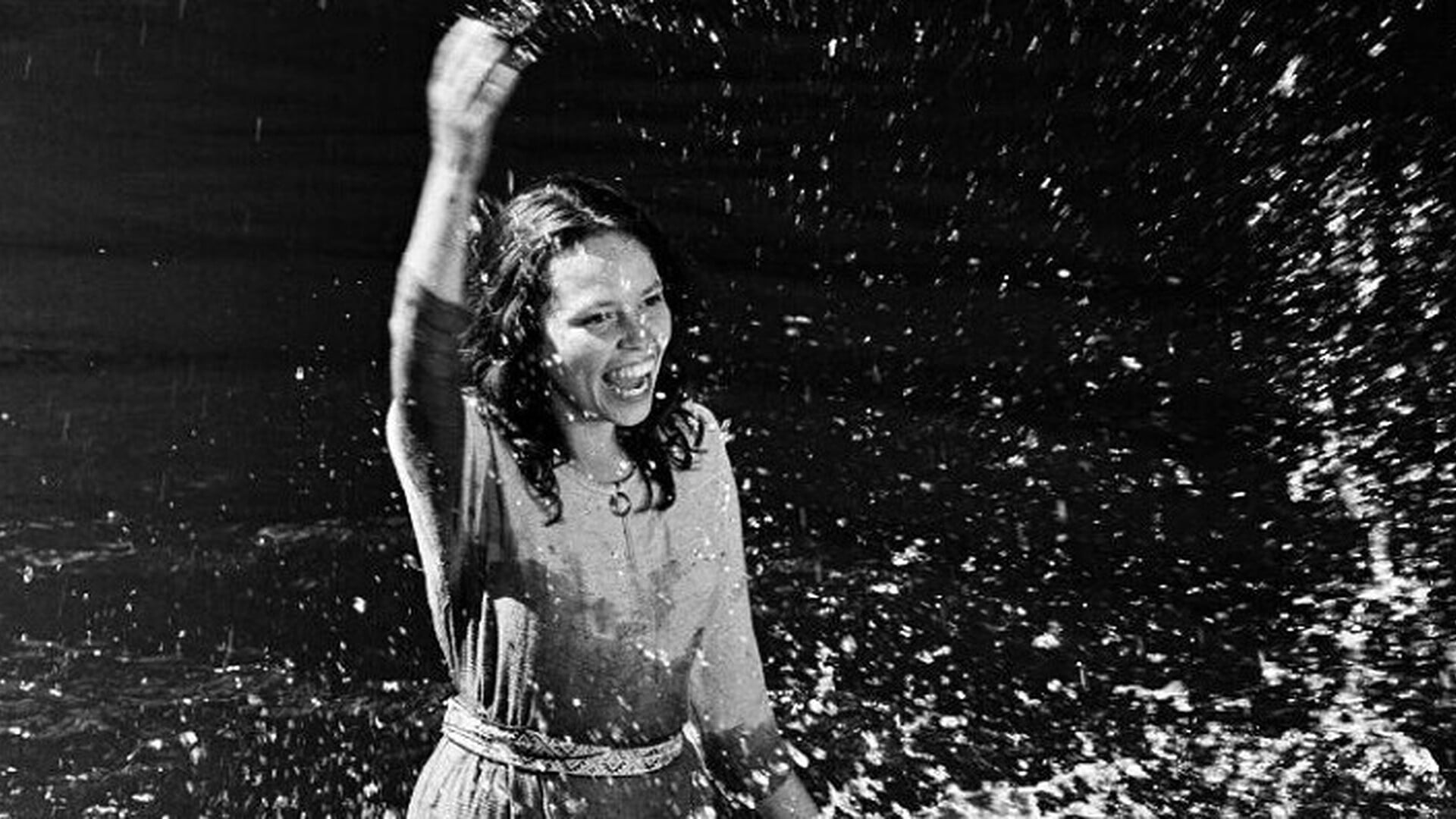
Ene Rämmeld in Werewolf (dir. Leida Laius, 1969)
Laius’s first three features were literary adaptations stretching back into the feudal past and forward to the early years of Soviet rule. Writing in Le monde, Mathieu Macheret describes these films as “anchoring the novelistic in a pre-Soviet rurality, the old regime of territorial property where women feel the effects of the conflict between desire and vested interests.” The Milkman of Mäeküla (1965) is a take on the pioneering realist author Eduard Vilde, in which a baron makes an indecent proposal to one of his peasant labourers (the first of several roles for Laius by Estonian screen icon Jüri Järvet): a cushy job as a milkman in exchange for his wife’s company. Werewolf (1969), adapted from a play by August Kitzberg about a family torn apart by accusations of witchery, delves even further into the past, capturing the syncretic Christian-pagan lifeworld of rural Estonia in the early nineteenth century. This is Laius’s most formally daring feature, a quasi-folk horror firmly situating her within the postwar European arthouse tradition; it is reminiscent of the period pieces of Ingmar Bergman in its expressionistic flourishes and fractured narrative, as well as the Carl Theodor Dreyer of Day of Wrath (1943) in its depiction of the misogynistic paranoia undergirding this benighted community.
Werewolf was a critical calamity, and it was several years before Laius was able to make another film. Within Estonia, Spring in the Forest (or Ukuaru, 1973) is perhaps her best-known feature; the returning composer Arvo Pärt’s “Ukuaru Waltz” is still a fixture at weddings to this day. The literary source material this time was Veera Seer’s 1969 story of the same name, which recounts the fluctuating fortunes of a young couple attempting to fashion an independent life for themselves in a remote forester’s outpost in the years leading up to the Second World War. Laius’s precarious position within Tallinnfilm at the time meant that she was subjected to the kinds of pressures that she had thus far avoided in her career: officials demanded that the plot be altered to emphasise the positive influence of Soviet power; the studio’s editor-in-chief Lembit Remmelgas rebuked Laius for focusing on the place of women within rural life rather than more overtly ideological questions; the inexperienced lead actress Elle Kull was only approved at the eleventh hour at Laius’s insistence. In the event, Kull’s performance as the stubborn but wounded Minna is indelible. Her spirited responses to the tribulations that afflict Minna rescue Spring in the Forest from cheap nationalist sentiment, which might otherwise overwhelm this tale of simple sons and daughters of the soil facing down a parasitic overclass and foreign invaders.
“I have not set a goal to look only at women. I have been interested in universal human problems and values, and the study of the development of the human personality”
If The Master of Kõrboja (1980, from A. H. Tammsaare) continued Laius’s routine of adapting period pieces, then her final two features swerved abruptly to the present day. Working on her documentary shorts trilogy with Iho had perhaps regrounded Laius in the world of contemporary Estonia: a country on the verge of radical transformation in an empire on the brink. Smile at Last and A Stolen Meeting are like nothing else in Laius’s oeuvre: almost neo-realist in their dedication to meeting the outcasts of Soviet society on their level with clear-eyed empathy. It was as though the opportunities opened up by Gorbachev’s twin liberalisation policies of perestroika and glasnost had finally allowed Laius to bring her stock characters – women forced to compromise on their ideals by a world structured by cruelty – to bear on the USSR’s profound social crises.
Although Smile at Last preceded the declaration of perestroika, it reflects the fact that on the ground, centralised control over the production process had already begun to slowly unravel. Laius and co-director Arvo Iho – who also served as cinematographer – chose to shoot the film far from any prying Muscovite eyes, in peripheral Estonia, deploying amateur actors and shooting in a real children’s home to free the production as far as possible from the remit of studio bureaucracy. This immediacy and freedom are deeply felt in the resulting film, where the subject matter – young people left to their own devices in a ramshackle process of self-discovery – aligns uncannily with the social context of a generation raised by a system on the brink of collapse. Monika Järv plays Mari, a sensitive if hard-nosed 16-year-old sent away to a rural orphanage by her alcoholic, widowed father. Mari’s fractious relationship with the more cynical girls in her cohort is further troubled by her complex love-hate bond with the rebellious bad-boy Robi (Hendrick Toompere Jr), who himself is caught in an antagonistic spiral with his morally upstanding cousin Tauri (Tauri Tallermaa). Laius and Iho create a wonderfully unassuming visual language, defined by eye-level handheld camerawork and moments of unobtrusive lyrical beauty amidst the grimmer textures of the orphanage, which perfectly suits the rawness of their young performers.
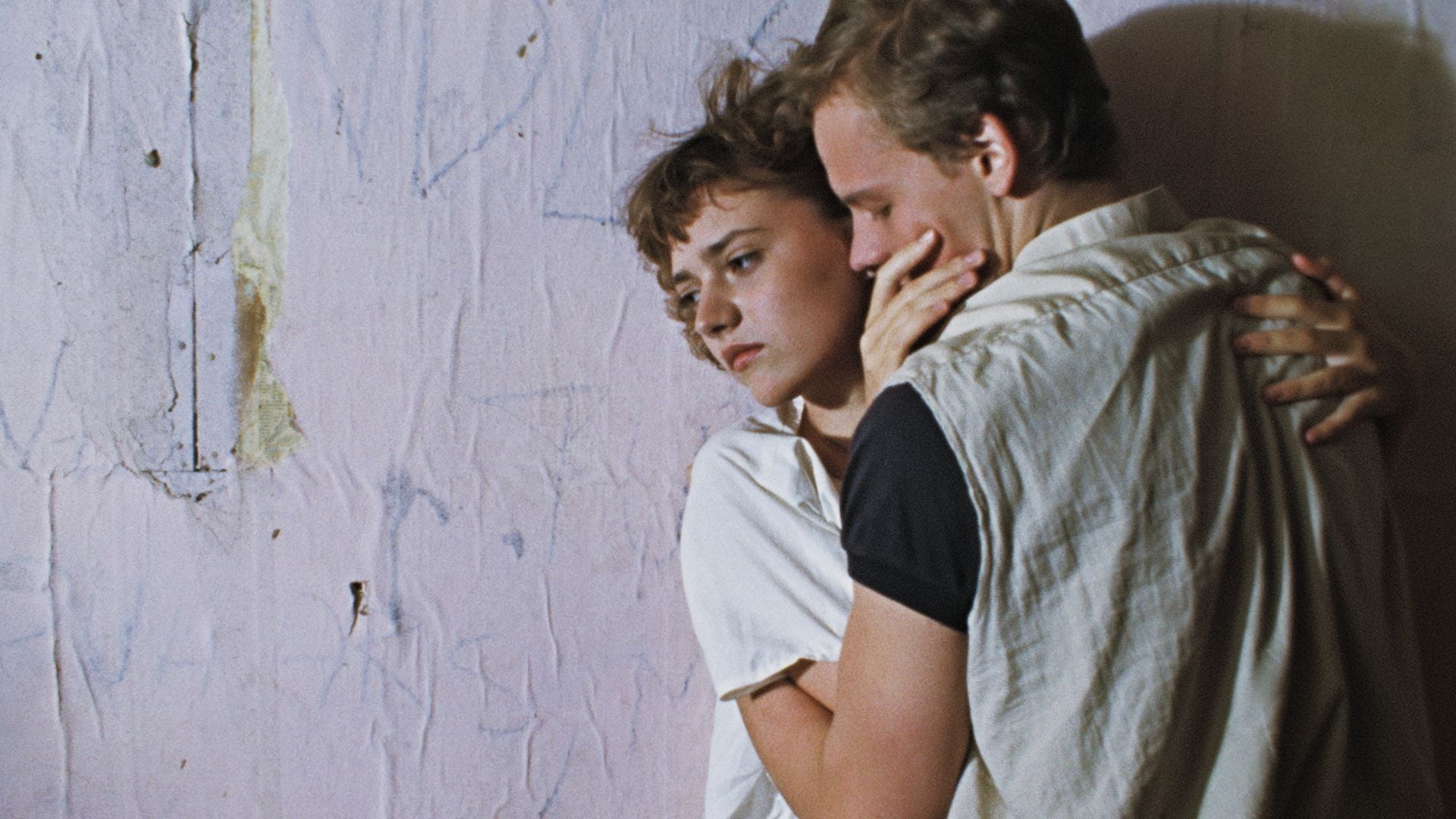
Monika Järv and Hendrik Toompere Jr in Smile at Last (dir. Leida Laius, 1985)
Three years later in A Stolen Meeting, Maria Klenskaja brings a coarse and tender energy to her portrayal of Valentina, recently released from an all-female prison somewhere in the wintry Russian hinterlands. Returning to her native Estonia, she falls back in with old friends and finds temporary employment as a carer for cantankerous old woman. But Valentina’s sole focus is to find her now 8-year-old son Jüri (Andreas Kangur), who she was forced to give up for adoption years earlier. Eventually she tracks him down in the city of Tartu, where he is being raised by a solidly middle-class family. In a long, exquisitely realised sequence, Valentina absconds with Jüri, attempting to strong arm a reconciliation that, on some level, she knows to be impossible. Klenskaja’s performance is a wonder, harsh and brittle, perfectly balanced between empathy for a woman forced through the humiliations of a punitive system and moral clarity as regards her failure to account for her own responsibilities. Veteran Estonian cinematographer Jüri Sillart was perhaps best known for his work on Grigori Kromanov’s sci-fi noir oddity Dead Mountaineer’s Hotel (1979), and there is something of that film’s blend of wintry haze and rich contrast in Laius’s panorama of suburban wastelands.
The creative energy the Laius captured in these two films would prove to be a twilight glimmer: she made no more films after the fall of communism and died in 1996 at the age of 73. If her work is only now receiving the global attention it merits, within Estonia she has long been a figurehead for the social potency of cinema. In the words of the critic Johannes Lõhmus, “there has been no other director who has acted as such a prominent and profound advocate for women in our cultural space.” Crucially, hers is not a pessimistic cinema. The lasting power of Laius’s films derives as much from her female characters’ imaginations, their libidos, their energy, as it does from the unflinching depiction of the ways these are curbed by social forces. Writing in Cahiers du cinéma, Mathilde Grasset notes how Laius’s women “long to put down roots, dream of families, tend to their micro-territories… [her films exist] at the crossroads of tonalities, just as her characters are at the crossroads of fate.” If her own trans-national biography (reflected obliquely in the figure of Valentina in her final film) has allowed Laius to play the role of Soviet-Estonian avatar, then the director herself always insisted that her work be read on the simplest – and therefore the most difficult – of terms: “I have not set a goal to look only at women. I have been interested in universal human problems and values, and the study of the development of the human personality.”
Women on the edge: two films by Leida Laius is available to watch on Klassiki now.
Explore our full collection of Estonian titles here.


 Go back to journal home page