The Watchlist is Klassiki’s series of themed viewing recommendations drawing from the cinema of Eastern Europe, the Caucasus, and Central Asia. In this edition, we select six essential titles to introduce you to the decades-long career of Poland’s most celebrated film artist.
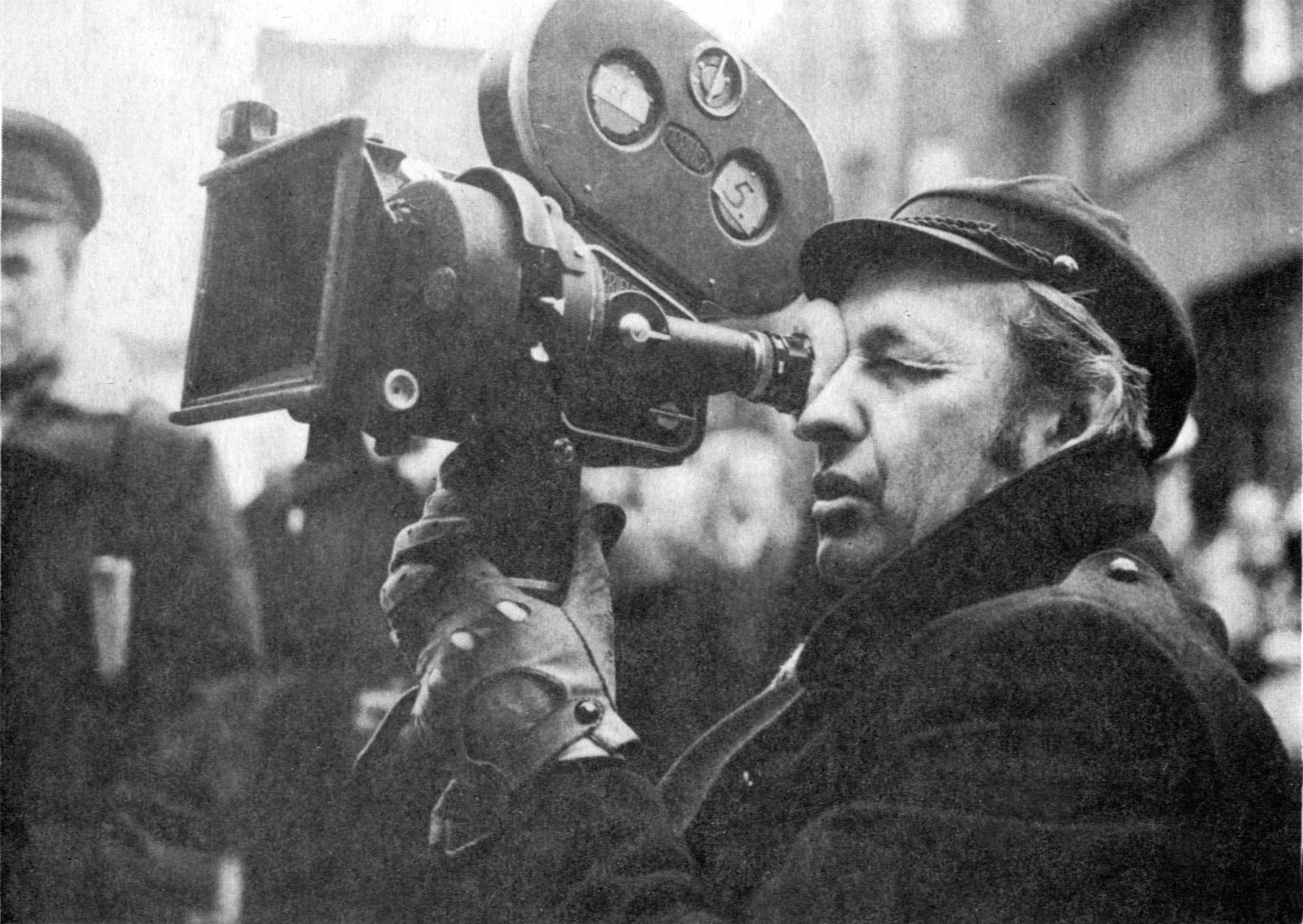
Andrzej Wajda in 1974
Undoubtedly one of the most important figures in the history of Polish cinema, and a giant of European film more broadly, Andrzej Wajda’s career spanned more than six decades and 40 features. Intending to become a painter, Wajda trained at the Kraków Academy of Fine Arts, before enrolling at the Łódź Film School in 1949, alma mater to many of Poland’s finest filmmakers. A key figure in the nascent “Polish Film School” of the 1950s – alongside the likes of Jerzy Kawalerowicz, Andrzej Munk, and Tadeusz Konwicki – Wajda’s epochal “War Trilogy” established him as a force to be reckoned with.
Wajda’s importance to Polish film history is a result of his relationship to Polish national history. No other director who emerged from the Film School was as committed to historical exploration. Two of Wajda’s epochal early features were set during and immediately after the Second World War – Kanal (1957) and the iconic Ashes and Diamonds (1958) – and he returned to the conflict many times over, from Landscape after Battle (1970) to his late-period masterpiece Katyń (2007). Along the way, Wajda turned his attention to the place of the Jews in Polish history (Samson, 1961; Korczak, 1990), the “jazz age” of the post-Stalinist Thaw (Innocent Sorcerers, 1960), the Stalinist stagnation (Man of Marble, 1977), and the Solidarity union and martial law (Man of Iron, 1981). Small wonder that, on his death, former Polish prime minister Donald Tusk said: “We all stem from Wajda. We looked at Poland and at ourselves through him. And we understood better. Now it will be more difficult.” Here are just a handful of his most incisive films to get you started on Wajda’s trail.
War Trilogy (1955-58)
Perhaps it’s cheating to start off with three films in one, but the impact of Wajda’s so-called War Trilogy on Polish cinema is hard to overstate. For one, the triptych was formative in the consolidation of the Polish Film School, the nascent tendency emerging from the Łódź Film School that responded to the post-Stalinist, post-war reforms of the nation’s new premier, Władysław Gomułka, by mining newly available foreign films from America and Italy for stylistic inspiration. The influence of the Neorealists and Hollywood genre merchants is abundantly clear in the Film School’s attention to lowly protagonists and its humanistic depictions of a nation in the process of reconstruction. The School’s fixation on the question of national identity and its abrupt rejection of the strictures of socialist realism allowed for a fresh reconsideration of Poland’s brutal recent history.
Few countries suffered so profoundly during the war as Poland: its position as victim of invasion, occupation, and tragic resistance, and as site for many of the most infamous crimes of the Holocaust, left open wounds not easily tended to by peacetime filmmakers given the ideological demands of communist-era commemoration. The war’s impact was both universal, and deeply personal: Wajda’s father was killed by the Red Army. He himself described the emergence of the Film School in this context as “a natural birth… directors couldn’t help but make films about their sole experience – the war… The facts were so terrible that to fictionalise them was difficult. However, since our artistic and literary traditions are romantic, the documentary element appearing in our films soon was blended with fiction. The baroque images, the bitter ironies, the romanticism of my films were all created by the Polish School.” The War Trilogy remains a towering achievement. A Generation (1955) charts the gradual involvement in the communist resistance of two young Warsaw layabouts; Canal (1957) was the first film about the Warsaw Uprising and depicts a group of Home Army resistance fighters escaping Nazi encirclement in the city’s sewers; and Ashes and Diamonds (1958) is (fittingly) the jewel in the crown. Zbigniew Cybulski, “Poland’s James Dean”, gives an indelible performance as Maciek Chełmicki, a member of the post-war anti-communist underground caught in the trap of his own cynicism.
Read our Companion to the Polish Film School here.
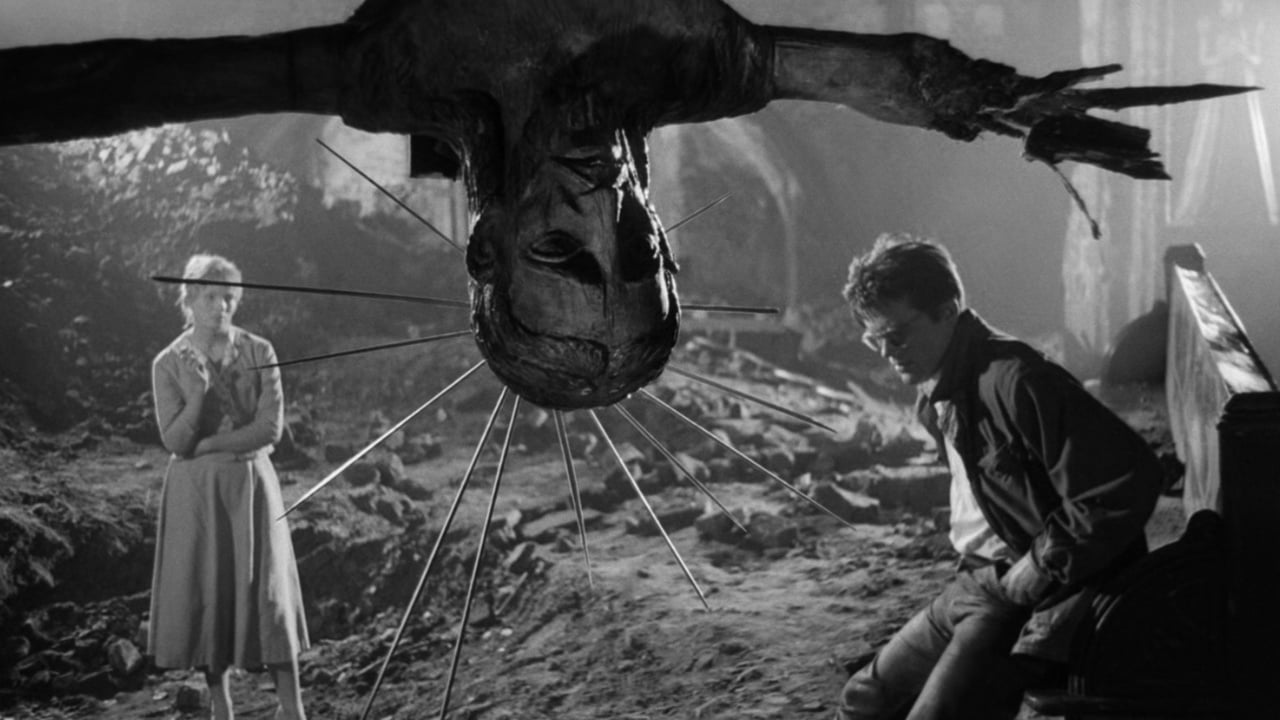
Ashes and Diamonds (dir. Andrzej Wajda, 1958)
Samson (1961)
This adaptation of Kazimierz Brandys’s eponymous novel was Wajda’s first attempt to grapple with the horrors of the Holocaust. In a subtly simple, expressionistic, and symbolically freighted visual style, the film tells the story of a young Jewish man (Serge Merlin) as he moves between the anti-Semitic institutions of thirties Poland: from private school to prison to the ghetto. Wajda claimed that the indirect, allegorical style was an attempt to match the powerful simplicity of the Biblical tale that gave the film its title – but it was also an intelligent way to speak about the Polish-Jewish experience in a post-war political climate that was not yet primed for open discussion of the Shoah. Indeed, when the camps feature in Polish Film School works, this is often indirectly and always offscreen. Wojciech Has’s Farewells (1958) documents a doomed affair interrupted by the war, during which the male lead is interred at Auschwitz. In Jerzy Kawalerowicz’s The Real End of the Great War (1957), the young wife of a deportee struggles to rebuild her life in the shadow cast by his absence. Tadeusz Konwicki likewise offered a diptych of films about abortive relationships hindered by the ghosts of the massacre, The Last Day of Summer (1958) and All Souls’ Day (1961).
The Promised Land (1975)
Wajda’s commitment to Polish history ran parallel to his love of Polish literature. Over his career, he adapted writers as disparate as Jerzy Andrzejewski (Gates to Paradise, 1968), Jarosław Iwaszkiewicz (The Birch Wood, 1970), and Stanisław Wyspiański (The Wedding, 1972). But his fascination with the social and literary histories of Poland never intersected with such scale and intensity as they did in his 1975 epic The Promised Land, his reimagining of the eponymous 1899 novel by Nobel laureate and godfather of Polish realism, Władysław Reymont. Tracking Poland’s painful transition to industrial modernity, the film is set in late nineteenth-century Łódź, where three friends – one Polish, one Jewish, one German – unite to build their fortune amidst the city’s bustling textile factories. Capturing Reymont’s realist prose in vivid panoramas, Wajda plunges us into a world in which faith, family, and tradition are cast aside in the pursuit of power. The communist authorities were certainly happy to read the film as an attack on the moral depravity of capitalism. One contemporary review stated that “Wajda’s city is an exaggerated and monstrous black kingdom of capital and financial speculation. This is Łódź, but also the jungles of Manchester or Chicago.” Polish viewers at the time of the film’s release, however, would have been hard pressed to miss the more contemporary symbolism of the final sequence, in which Daniel Olbrychski’s magnate Karol turns the guns of the police on protesting workers: a direct echo of the bloody anti-regime demonstrations that rocked the factories of Warsaw and Gdańsk in the 1970s.
Watch The Promised Land on Klassiki now.
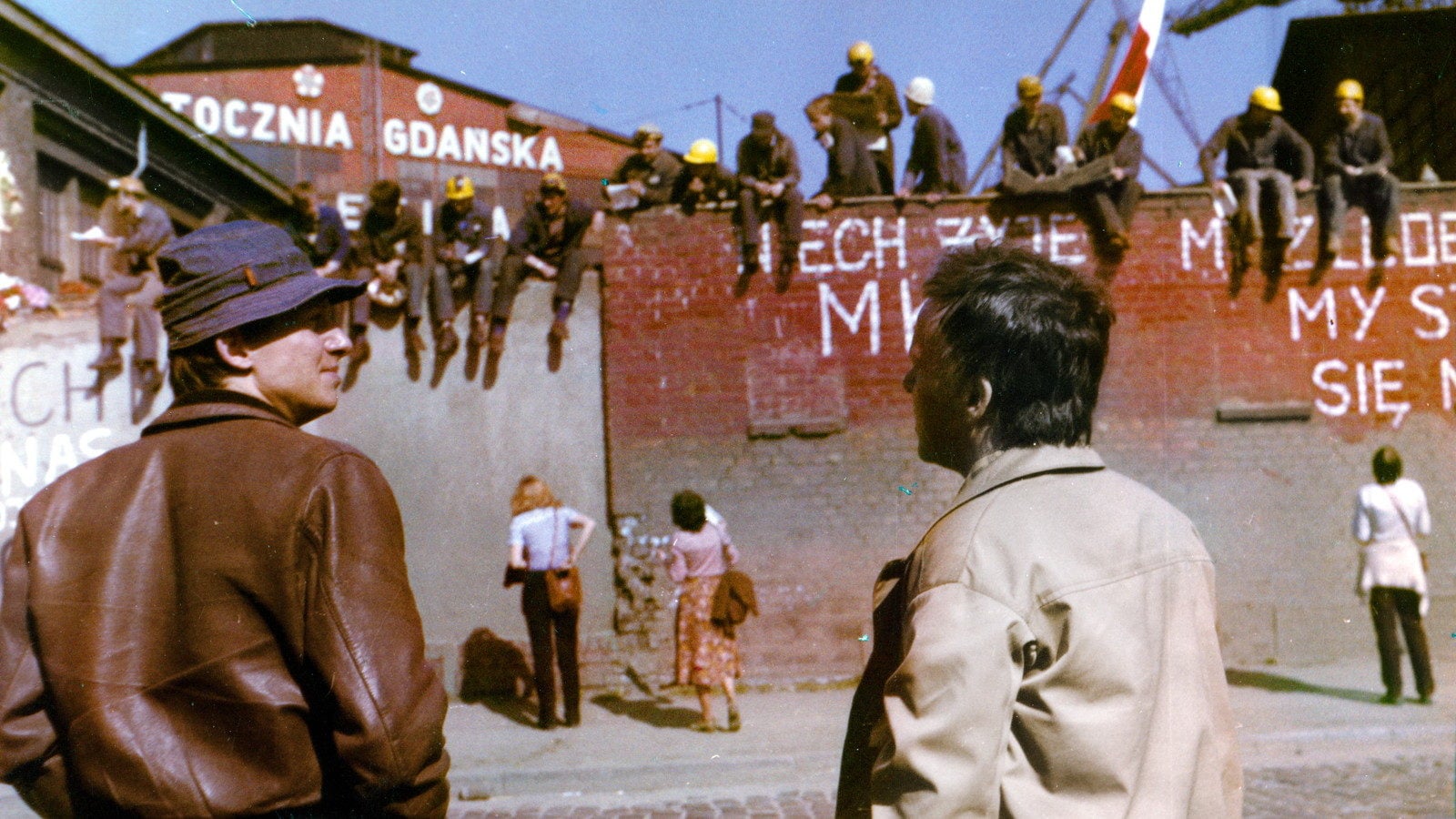
Man of Iron (dir. Andrzej Wajda, 1981)
Man of Iron (1981)
It was in the shipyards of Gdańsk that Wajda would create one of his most vital films. In 1977, he had dissected the propaganda myths of the Stalinist fifties the black-hearted Man of Marble. Four years later, he followed up with an ad hoc sequel that was not just a historical drama, but a historical artefact in its own right. In August 1980, Wajda, a cultural celebrity in Poland, had visited Gdańsk’s Lenin Shipyards to capture ongoing strikes – a response to the grim economic fortunes of the country and the spark that would eventually give rise to the Solidarity union movement. A labourer escorting him around the shipyard suggested that he make a sequel to Man of Marble about the strikes, and even proposed a title: Man of Iron. Realising that the window to release such a film might be shut at any moment, Wajda hurried into action, recruiting screenwriter Aleksander Ścibor-Rylski, shooting and editing at breakneck pace in order to premiere at Cannes in May 1981.
Winkel (Marian Opania), a disgruntled radio reporter, is sent to Gdańsk to discredit activist Tomczyk (Jerzy Radziwiłowicz). Slowly, the story emerges of Tomczyk and his father, Mateusz – the Stakhanovite hero of Man of Marble. Wajda was able to complete the film during a brief interregnum in state censorship of little over a year before the imposition of Martial Law, which would deny the film a full domestic release. His capacity to situate intimate drama within the sweep of popular history won him the Palme d’Or. In the words of Jonathan Bousfield, “Wajda was extremely aware that social protest was a public spectacle of short duration, and that by making a film of the Gdańsk events he was helping to ensure that they would resonate for a long time.”
Watch Man of Iron on Klassiki now and read our Companion to Polish film in the eighties here.
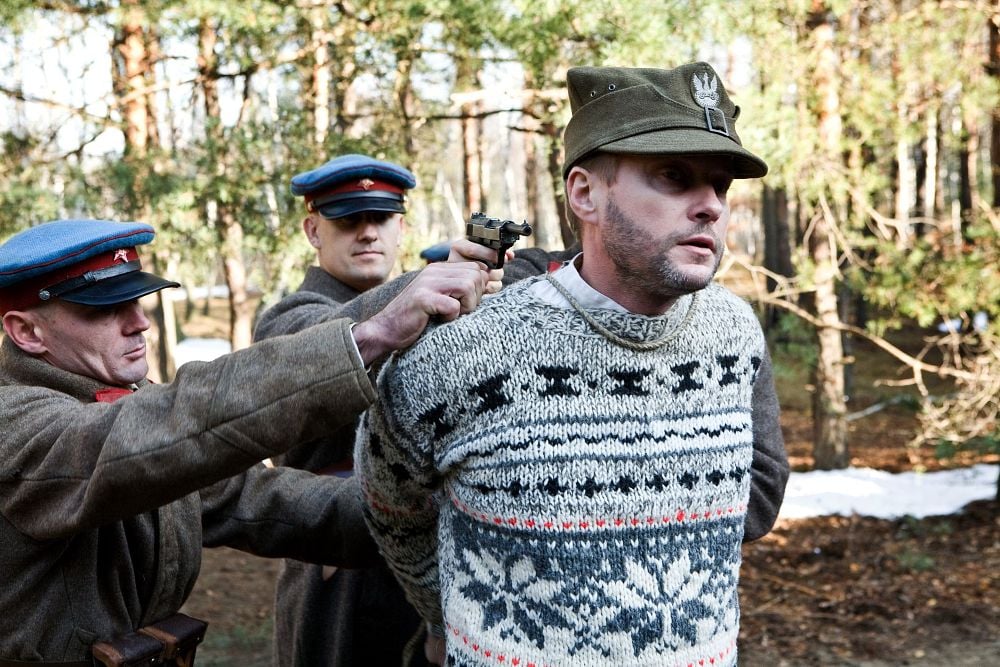
Katyń (dir. Andrzej Wajda, 2007)
Katyń (2007)
In April and May 1940, the Soviet secret police force executed around 22,000 Polish officers and other prisoners of war in the forest of Katyn, near the western Russian town of Smolensk. This brutal act was intended to incapacitate the Polish military by eliminating its leadership cadres; around half of the entire Polish officer class was killed in the massacre. Among them was Wajda’s father, Jakub. Premiering exactly 68 years to the day after the 1939 Soviet invasion of Poland, Katyń was his own attempt (and the first feature film) to grapple with this traumatic personal and national memory, to this day a source of bitter controversy between Russia and Poland. Based on the work of the author Andrzej Mularczyk, Wajda’s film dramatises the massacre through the eyes of two young officers, Andrzej (Artur Zmijewski) and Jerzy (Andrzej Chyra), as well as the former’s wife and daughter. Perhaps fittingly, this film about the political pressures of remembrance and forgetting became embroiled in contemporary controversies on release: ultra-conservative Polish president Lech Kaczynski attempted to turn the film into a campaigning tool for his nationalist Law and Order party, leading Wajda to denounce his former patron in one of his final interviews before his death in 2016: “We are now facing attempts by the authorities to intervene in art. They talk about what national art should be or what it shouldn’t be. I’ve made a film about the events of the past, with the message that interference in art is not a task for the authorities. It is a job of the artists, not the government.”
Afterimage (2016)
Wajda was still unravelling the thorny issue of “national art” when he died at the age of 90. His final film, Afterimage, returns to the Stalinist era to tell the story of Władysław Strzemiński, an influential artist and theorist who pioneered the Constructivist avant-garde in Poland in the 1920s and ‘30s. Taking up Strzemiński’s story in 1948, in the violent early days of Communist rule, Wajda meticulously details the artist’s degradation at the hands of the new authorities following his refusal to give up abstraction in favour of state-approved socialist realism. His works are removed from display or destroyed; he loses his position as a teacher; eventually he is denied the right even to scrape a living painting signs and blocked from accessing food stamps. It is a bleak, even punishing portrait that seems to speak to the despair that Wajda felt at the very end of his long life – the film was released in September 2016, and the director died the following month. But it also speaks to Wajda’s enduring belief in, and testimony to, the restless human spirit.
Watch The Promised Land as part of our new collection Period Pieces: historical dramas for the modern world.
Explore our full collection of Polish titles here.


 Go back to journal home page