The Watchlist is Klassiki’s series of themed viewing recommendations drawing from the cinema of Eastern Europe, the Caucasus, and Central Asia. To mark the arrival on Klassiki of our new collection of shorts by Radu Jude, this edition offers a crash course in the Romanian maestro’s daring, obscene, and hilarious body of work.
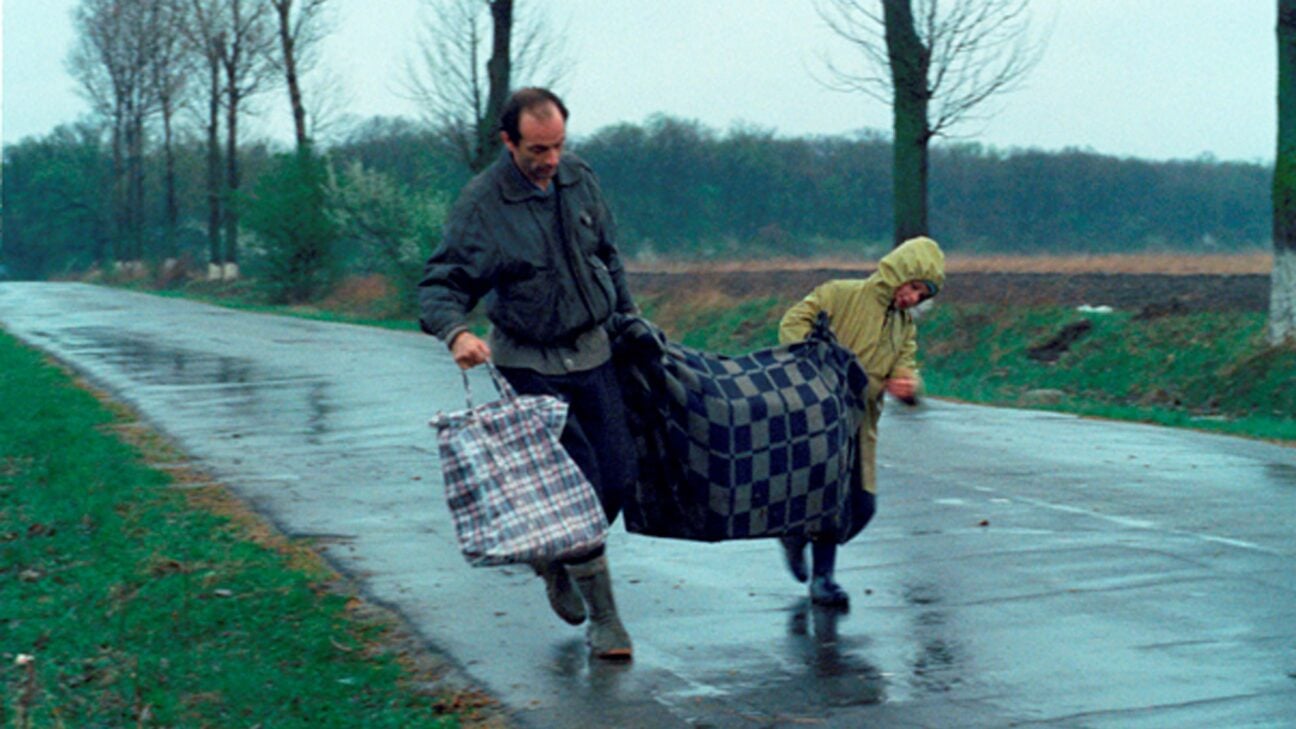
Marian Bratu and Gabriel Spahiu in The Tube with a Hat (dir. Radu Jude, 2006)
Since the turn of the decade, Radu Jude’s international profile has gone through the roof. Although he had long been a regular at the Berlinale, winning Best Director for his 2015 Roma slavery western Aferim!, his finally taking home the Golden Bear for his Covid-era sex satire Bad Luck Banging or Loony Porn in 2021 catapulted him into the arthouse A-list. His follow-up feature, 2023’s Do Not Expect Too Much from the End of the World, garnered rave reviews on both sides of the Atlantic for its scabrous and rigorous deconstruction of gig work, corporate malfeasance, and Romanian film history. The acclaim is well-deserved, but Jude’s prolific career, which stretches back to the formative years of the Romanian New Wave and has incorporated documentaries, shorts, and all manner of genre experiments, deserves closer attention.
The Tube with a Hat (2006)
After making his bones in commercial and television projects, Jude launched his filmmaking career in earnest with this short, which landed festival prizes from Sundance to Uppsala. The Tube with a Hat is a miniature odyssey, in which a father and son (Marian Bratu and Gabriel Spahiu) haul a battered old TV set through mud and rain from their remote village to the nearest town, hoping to get it fixed in time for a Bruce Lee film screening that evening. The tenderness with which Jude treats his characters here would not carry on into his mature career, but it is instructive, reminding us that he emerged alongside the first generation of the Romanian New Wave, with its handheld social realism and focus on the forgotten corners of Romanian society. At the time, Jude declared: “I didn’t make any moral judgement about the characters, their actions and the world they live in.” This detached attitude would soon disappear from his work as he dedicated himself to trenchant political critique.
Watch The Tube with a Hat on Klassiki now.
Everybody in Our Family (2012)
The New Wave template was still visible in Jude’s debut feature, the anti-consumerist satire The Happiest Girl in the World (2009). It was in his sophomore full-length, however, that the director truly found his form. When divorcé Marius (Șerban Pavlu, soon to become a Jude mainstay) arrives to take his young daughter Sofia (Sofia Nicolaescu) on holiday, his ex-wife’s refusal to relinquish the girl sets off a whirlwind of confrontation. Marital strife was a common theme for New Wave filmmakers: from Radu Muntean’s adultery fable Tuesday, After Christmas to Cristi Puiu’s Aurora, in which a disgruntled middle-aged singleton pursues a murderous vendetta against those he holds responsible for his divorce. But what begins as a comedy of divorce for Jude descends into something more caustic and unnerving. His fondness for obscenity comes into its own in the endless barbs, arguments, and monologues of its self-deluding characters, while cinematographer Andrei Butica (who also shot Cristi Puiu’s New Wave trendsetter The Death of Mr Lăzărescu) mines the single-setting conceit for all its worth by playing the cast’s naturalistic performances off against choppy, handheld camerawork and disjointed editing.
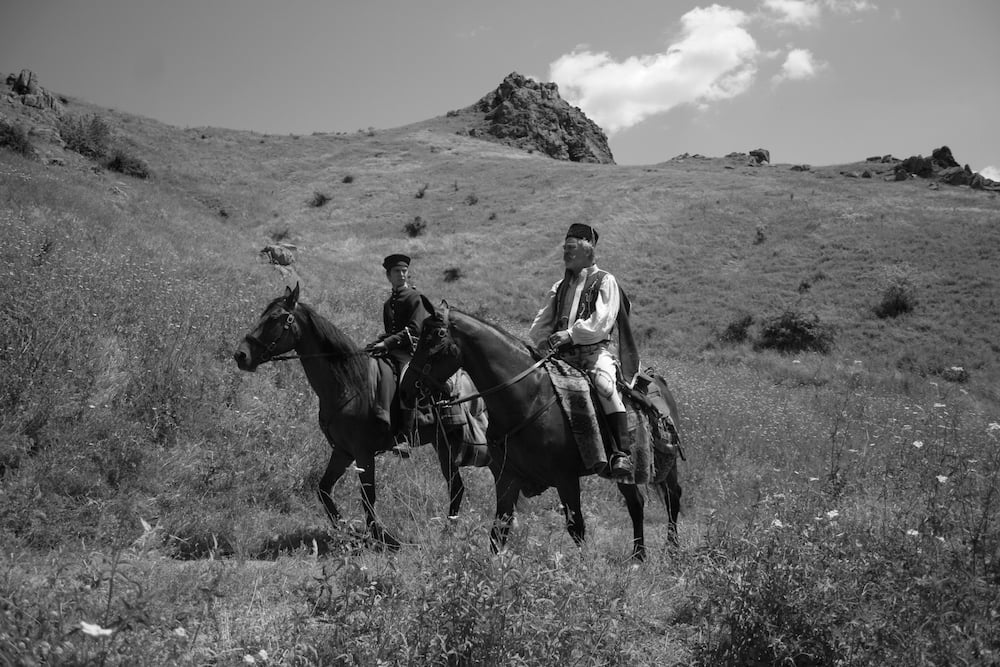
Mihai Comănoiu and Teodor Corban in Aferim! (dir. Radu Jude, 2015)
Aferim! (2015)
One of Jude’s most important films, yet one of the least well-known in the West, Aferim! was the first film to address the legacy of Roma enslavement in Romania: a historical fact still too often ignored or denied by mainstream society. It also marked Jude’s turn towards national history, which would be the subject matter for his next five features. The action unfolds amongst the rolling hills of the province of Wallachia in the 1830s. Aging constable Constadin (Teodor Corban) and his feckless son Ioniță (Mihai Comănoiu) travel on horseback across the county, seeking out the fugitive Roma slave Carfin (Cuzin Toma), accused of having seduced the wife of a local nobleman. The script – constructed by Jude and co-writer Florin Lăzărescu from events described in historical sources like court records, arrest warrants, and diaries – presents a cavalcade of vernacular prejudices, set against pristine landscape photography from veteran cinematographer and Jude favourite Marius Panduru. Deploying the tropes of the classic American western in both homage and critique, with Aferim! Jude landed on a formula that would serve him well: mining film history and historical documents for the means to deconstruct the self-serving myths of Romanian national history.
I Do Not Care if We Go Down in History as Barbarians (2018)
Another excavation of nationalist mythmaking, I Do Not Care if We Go Down in History as Barbarians capped an unofficial trilogy of films about Romania’s embrace of fascism in the 1930s and ‘40s, following period drama Scarred Hearts (2016) and photocollage documentary The Dead Nation (2017). In October 1941, after Odesa was captured by the forces of Nazi Germany and their then-allies Romania, military dictator Marshal Ion Antonescu ordered an assault on the city’s sizable Jewish population. By most estimates, 38,000 Jews were killed in one of the first mass murders of the Ukrainian Holocaust. (Following the installation of a communist government after the war, Antonescu and several subordinates were executed for war crimes – an event explored by Jude in his 2018 short The Marshal’s Two Executions.) This meta-fictional film follows theatre director Mariana (Ioana Iacob) as she attempts to stage a public re-enactment of the massacre; the film’s title is pulled from a speech by Foreign Minister Mihai Antonescu preceding the slaughter. As she battles municipal oversight, recalcitrant actors, and personal crises, Mariana starts to realise that some home truths are far from welcome. Jude’s unapologetically intellectual film draws unnerving links between past and present, building to an unforgettable and chilling final spectacle.
Watch I Do Not Care if We Go Down in History as Barbarians on Klassiki now.
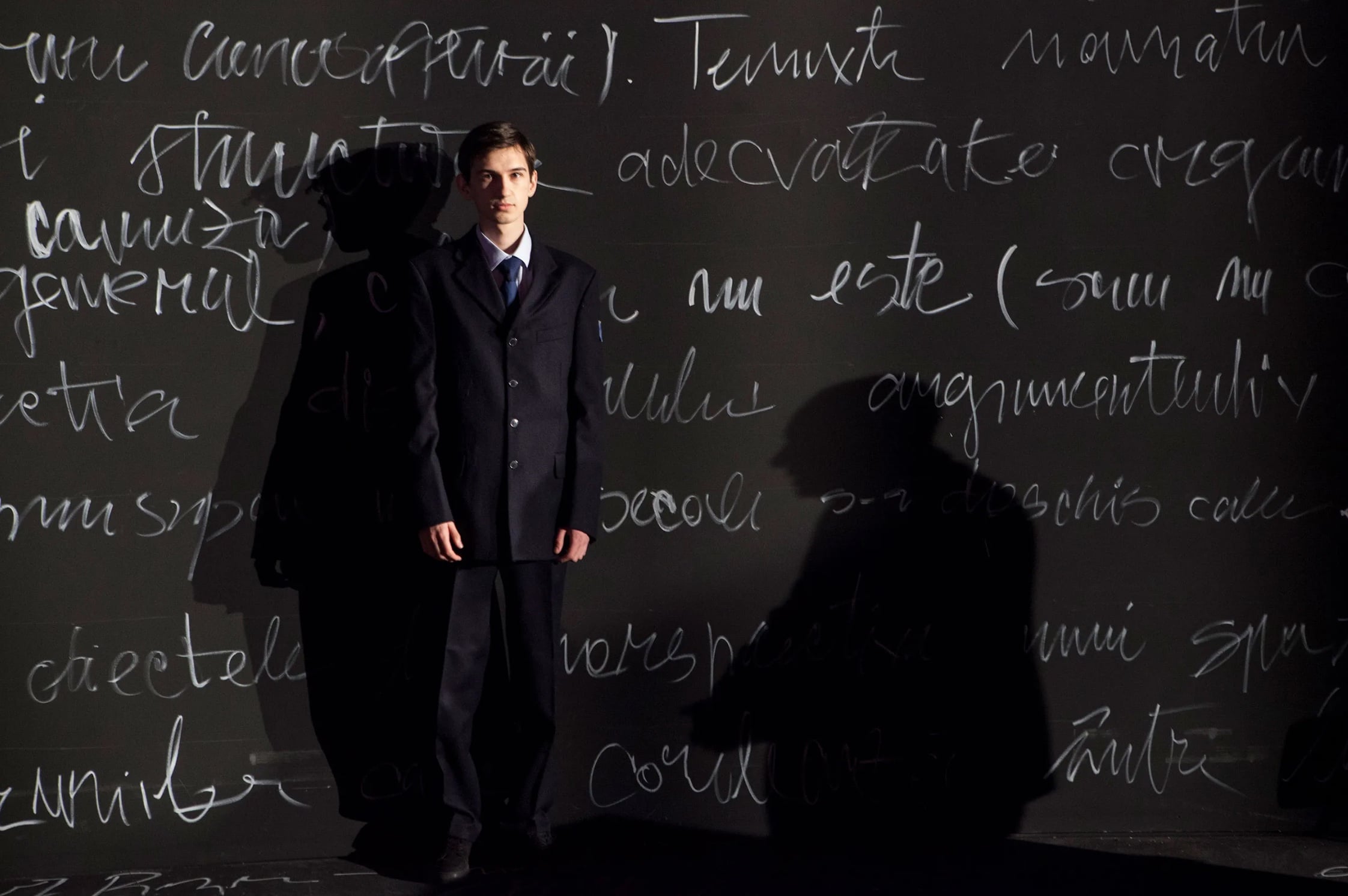
Şerban Lazarovici in Uppercase Print (dir. Radu Jude, 2020)
Uppercase Print (2020)
Another of Jude’s most underappreciated features, Uppercase Print saw the director broaden his inquiry into the ghosts of 20th-century totalitarianism, turning from wartime fascism to Romania’s Ceaușescu era. The film is an adaptation of a verbatim-theatre stage play by Gianina Cărbunariu, which dramatises a genuine case brought by the communist secret police in 1981 against a teenager named Mugur Călinescu. Călinescu (played in reconstructions by Şerban Lazarovici) had done no more than chalking protest slogans on walls – but the investigation to identify him mobilised hundreds of informants, including many of his own classmates. Jude’s fondness for working directly with historical sources, and his Brechtian approach to storytelling are on full display: the monologues and dialogues of Cărbunariu’s stageplay are drawn directly from interrogations and bugged conversations and delivered in a detached monotone. These scenes are intercut with television footage and propaganda newsreels from the era, creating an accumulative portrait of political submission and false consciousness.
The Potemkinists (2021)
One of a number of shorts that the ever-prolific Jude turned out during the pandemic, The Potemkinists crams many of his defining interests into 18 minutes of glorious satirical obscenity: a playful excavation of national myth, a deep knowledge of film history, and a witty dissection of the hypocrisies of contemporary culture. At the heart of the film are Jude’s beloved Sergei Eisenstein, the godfather of the Soviet avant-garde, and a little-known historical fact: the mutinous sailors of the Battleship Potemkin – whose rebellion inspired Eisenstein’s silent masterpiece of the same name – were ultimately granted asylum in the Romanian port of Constanţa rather than returning to Russia. Jude’s film imagines an encounter in 2021 between a sculptor (Alexandru Dabija) and a cultural bureaucrat (Cristina Drăghici), in which they discuss the former’s proposal to construct a new monument to the titular sailors on the site of a communist-era statue on the Danube-Black Sea Canal. Few filmmakers are as adept as Jude at reckoning with the 21st-century ghosts of 20th-century ideology, as The Potemkinists demonstrates.
Watch The Potemkinists on Klassiki now.
The collection Four Shorts by Radu Jude is available to watch on Klassiki from 8 August.
Listen to our podcast interview with Radu Jude here.


 Go back to journal home page