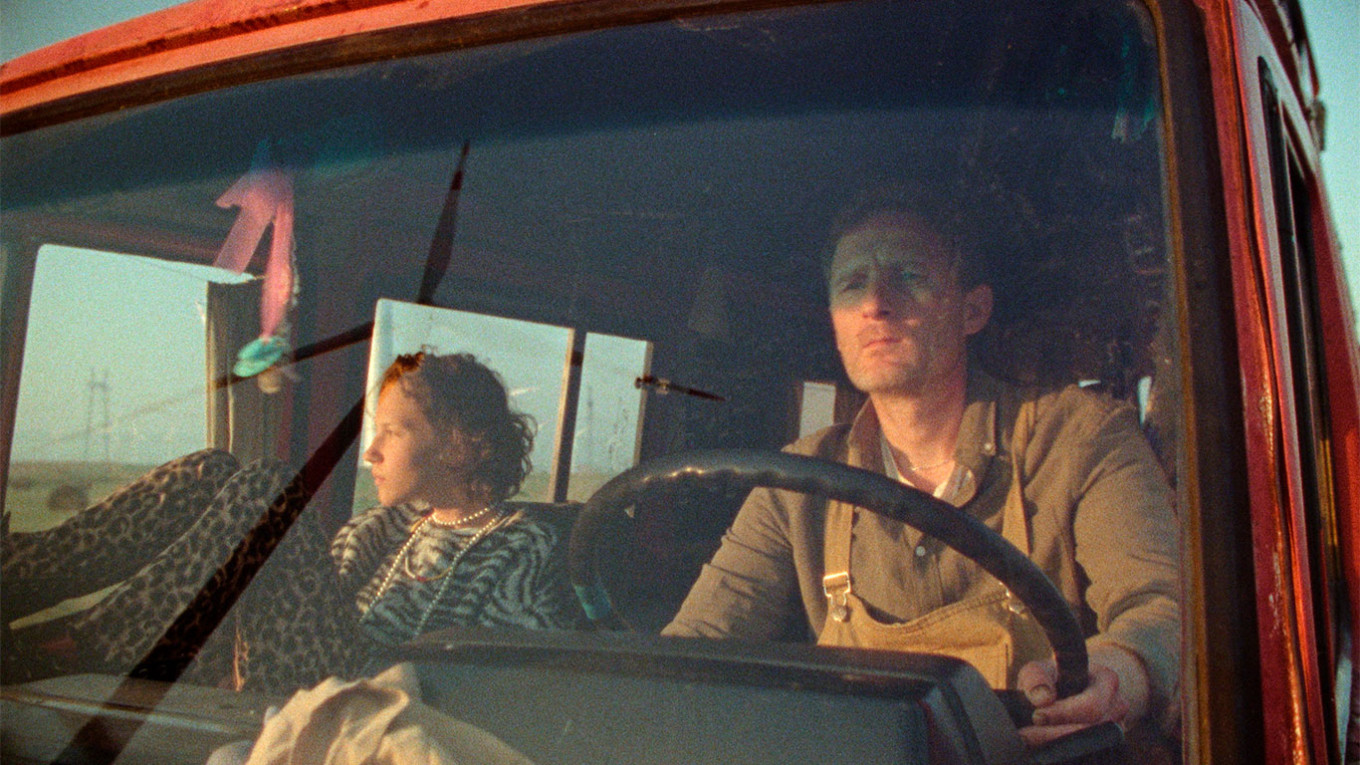
Maria Lukyanova and Gela Chitava in Grace (dir. Ilya Povolotsky, 2023)
One of the most compelling debut features to emerge from Russia in several years, Ilya Povolotsky’s Grace reimagines the road movie as a bleakly beautiful fugue, a minimalist odyssey suffused with longing and alienation. An unnamed father and daughter traverse the empty roads of provincial Russia in a battered old van, eking out a living selling pirated DVDs at the impromptu screenings they mount with an onboard mobile cinema.
Drifting from the sunlit uplands of the Caucasian south to the frostbitten shoreline of the far north, Povolotsky’s film offers oblique exploration of generational conflict, criminality, and the state of modern Russia, while never losing sight of the primacy of the visual. Premiering in the Quinzaine des Réalisateurs in Cannes in 2023, Grace suggests that there is still room for politically independent and artistically idiosyncratic filmmaking in Russia. To mark the film’s screening as our latest Pick of the Week title, we spoke with Povolotsky about his cinematic and narrative influences and the symbolic significance of the road movie.
I read that you trained as a civil lawyer and that you came to filmmaking by accident. Could you describe how that came to pass?
It was a pure chance. I was a law student and one day I accidentally found myself on someone’s film set. My friends invited me for a small part. I got hooked. To be honest, I was more interested in literature than cinema back then, but it saved me from [a career in] civil law so I can’t complain.
You’ve cited a number of influences on the film, including some famous Soviet-era directors like Kira Muratova and Sergei Parajanov. What is it in Muratova and Parajanov in particular that affected how you constructed this film?
It was more about the influence of these directors on me and my relationship with the cinematic language than about any specific allusions. The humanistic parables of Parajanov, with their poetic symbolism; Kira Muratova’s unique tone of voice, her remarkable characters, so “out of place” for the era, so filled with doubt, and hence asking and re-asking questions and constantly repeating themselves; the polyphony of Aleksei German Sr.’s works, which so precisely captured that epoch…
I was interested in how the kaleidoscopic, ever-changing background relates to the world of the characters, stuck in timelessness and unresolved conflict. And how this sense of movement reflects the conflict between the disillusioned post-Soviet generation and their open-minded children
Could you describe how the journey undertaken in the film from southern to northern Russia functions metaphorically?
Grace is tailored after the patterns of Eastern European parables about coming of age, about the quest for initiation. In such stories, the hero is forced to leave their carefree life and embark on a journey to unknown lands or even to the other world, from whence they can only return by obtaining something of great value, paying a high price for it. The route and the transaction are symbolic. As Rustam Khamdamov said, “We all knew paradise in childhood – there we were immortal.”
Would you say that you’re commenting on the Russian attitude towards the Caucasian region at all? I’m thinking in terms of the symbolic role it plays in the film, particularly for the daughter character.
No, that would be an excessive simplification. I’m really interested in the culture and history of the Caucasus, and not just the Russian perspective. The unique mythology, the highly diverse languages and customs of the peoples living here. I’m glad that I have the opportunity to explore them and tell their stories.
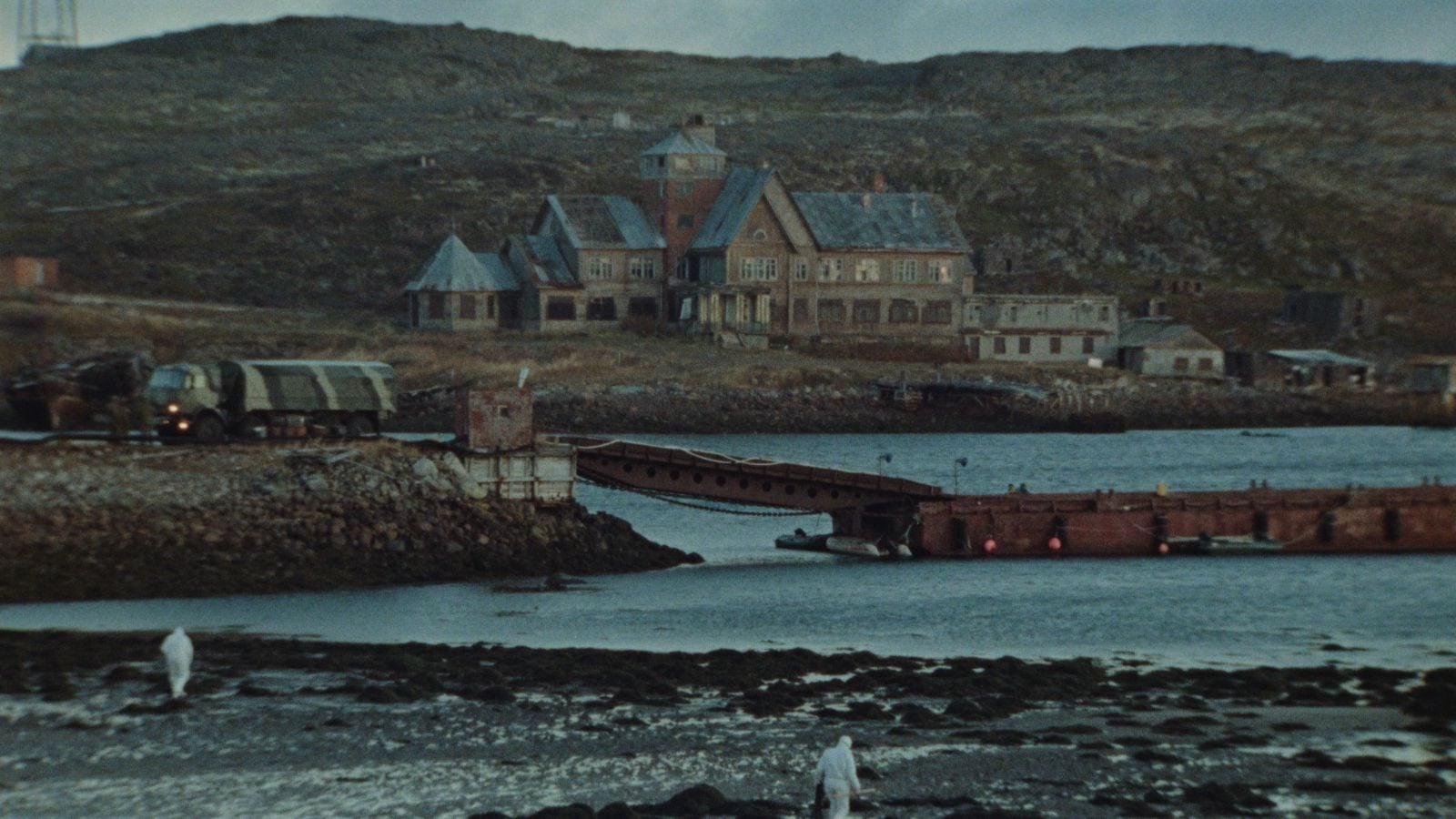
Grace (dir. Ilya Povolotsky, 2023)
The road movie and the coming-of-age story are such well-established genres. How do you go about constructing a story that draws on those tropes without resorting to cliche?
Well, sonnets are still mostly written in iambic pentameter, and in the last nearly two thousand years, Saint Anthony has been tormented by everyone except the lazy… More than the formal side of things, I was interested in how the kaleidoscopic, ever-changing background relates to the world of the characters, stuck in timelessness and unresolved conflict. And how this sense of movement reflects the conflict between the disillusioned and hardened post-Soviet generation and their open-minded and free children.
I’ve seen you speak in interviews about the importance of maintaining independence as a filmmaker in Russia today. What does “independence” mean for you in that context? Is it possible to work “outside of the system” now given the force applied by the state?
“Independent” means continuing to think for oneself, choosing themes and finding ways despite [external] censorship and self-censorship, propaganda, pressure, and the risk of persecution. Of course, in today’s conditions, it sounds almost utopian, especially for feature films, which are inherently dependent on money. But art has already shown resilience and resourcefulness in very dark times.
Watch Grace on Klassiki from 19 September – 10 October and explore our collection of Russian titles here.


 Go back to journal home page