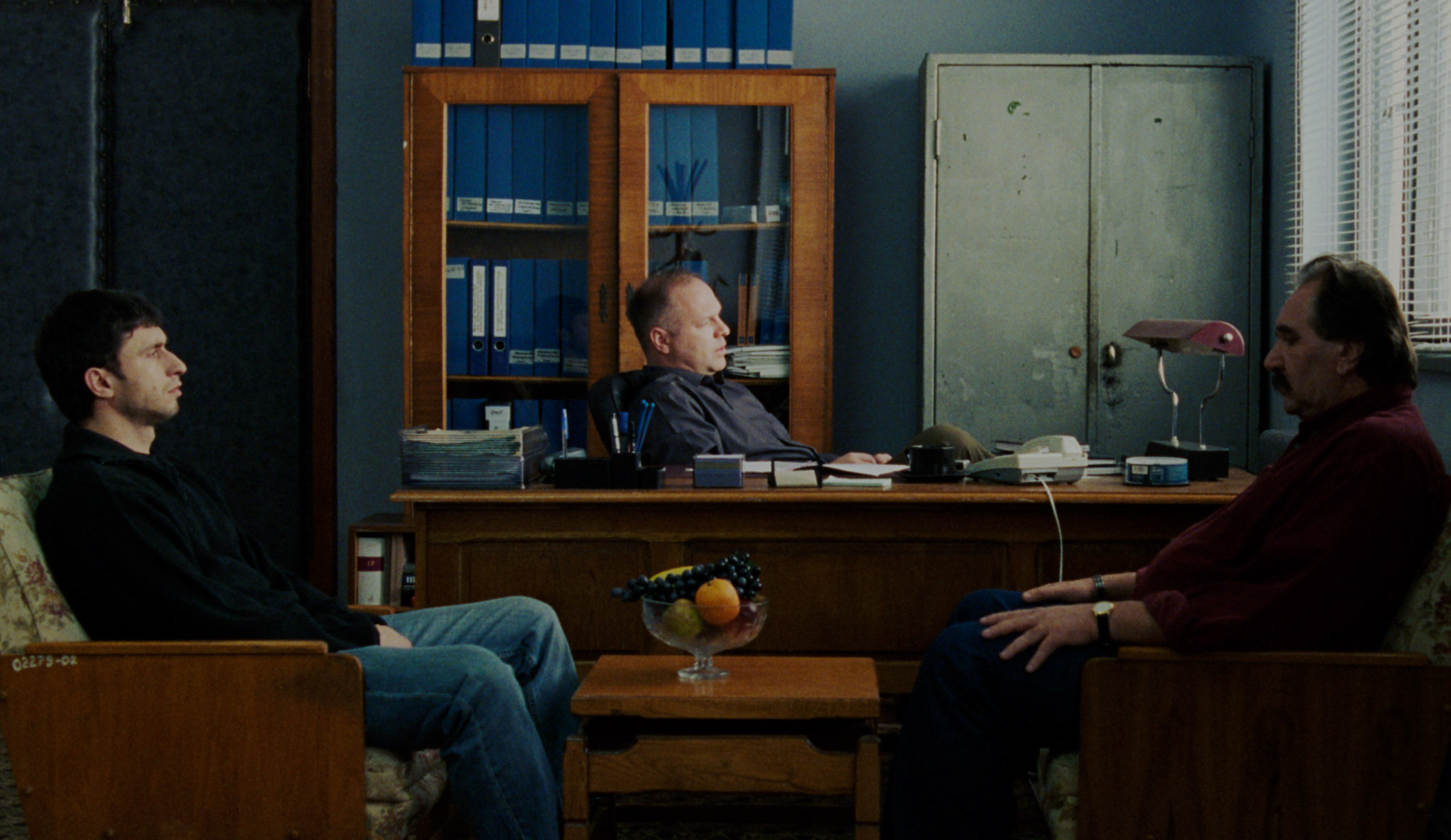
Dragoș Bucur, Vlad Ivanov, and Ion Stoica in Police, Adjective (dir. Corneliu Porumboiu, 2009)
The early figureheads of the Romanian New Wave were three directors whose wins at Cannes helped to kickstart the movement: Cristi Puiu (Un Certain Regard for The Death of Mr Lăzărescu, 2005), Corneliu Porumboiu (Camera d’Or for 12:08 East of Bucharest, 2006), and Christian Mungiu (Palme d’Or for 4 Months, 3 Weeks, and 2 Days in 2007). This trio each arrived with a seemingly ready-made sensibility that they would go on to refine and entrench in their subsequent films. Mungiu was the austere moralist, uncompromising in his dissection of Romania’s (post-)communist degradations (in 2012’s Beyond the Hills and 2016’s Graduation). Puiu explored social alienation at an intellectual remove in increasingly lengthy character studies (Aurora, 2010). And then there was Porumboiu, the funniest and the driest of the trio, whose talkative dramedies provided a discursive, genre-informed take on his country’s social ills.
Porumboiu’s filmography is founded on three fundamental interests, according to critic Lawrence Garcia: bureaucracy, language, and football. In common with his fellow New Wave mainstays, his breakout features tackled questions of national history and post-communist malaise; but where Mungiu and Puiu dealt in moral quandaries and gritty, durational realism, Porumboiu instead put the slipperiness of language and identity at the heart of his work. In 12:08 East of Bucharest, a local TV station’s attempts to celebrate the revolution that overthrew Ceaușescu descend into rhetorical farce, as the hosts become mired in a semantic debate about whether certain historical events occurred at all. Elsewhere, Porumboiu populated his films with hangdog everymen lost in discursive mazes of their own making: see the local bureaucrat with a utopian take on the rules of the beautiful game in Infinite Football (2018), or the desperate debtor dad of The Treasure (2015). But it is in the director’s two police films, separated by a decade, that his fixation on linguistic games and the seductive pleasures of genre work are at their most charged and captivating.
in the director’s two crime films, separated by a decade, his fixation on linguistic games and the seductive pleasures of genre work are at their most charged and captivating
In retrospect, Porumboiu’s decision to follow the critical success of 12:08 East of Bucharest with the downbeat ambiguity of Police, Adjective (2009) seems like another of his trademark jokes. Shot, like its predecessor, in Porumboiu’s native Vaslui by veteran New Wave cinematographer Marius Panduru, the film uses the framework of a police procedural to deconstruct the notion of liberal democratic “justice” from within. Dragoș Bucur plays Cristi, a young plainclothes officer tasked with trailing some weed-smoking schoolkids in the hopes making a meaningful arrest. In purposefully drawn-out stretches of almost documentary tedium, we follow Cristi’s painstaking surveillance through rundown streets. Dramatic tension arises only when our protagonist declines to arrest them for such a trivial crime and on the basis of dubious evidence. At which point, enter Captain Anghelache, played to blunt perfection by New Wave stalwart Vlad Ivanov. The fate of Cristi’s teenage miscreants, he reminds his young charge, is not a question of personal intuition, but of rigid legal definitions. To force his point home, he turns Cristi into a schoolchild himself, having him look up the words “conscience”, “law”, and “moral” in a dictionary.
Replacing the standard pay-off of the crime drama – a shootout, say, or a high-octane chase sequence – with an office argument about linguistics is pure Porumboiu. It’s a deadpan deconstruction of genre tropes that has also been meticulously set up over the preceding 100 minutes. We are grounded in the concrete reality of Cristi’s work on the streets in order to make the late swerve into metaphysics more revealing: “What we are doing here is dialectics,” as Anghelache tells his bemused staff. In the process, Cristi’s own pragmatic attitude towards language is turned against him. It’s a character trait that we have already seen play out in his relationship with his girlfriend Anca (Irina Săulescu): first, when he complains that the cheesy poetry of her favourite pop song – “what would the sea be without the sun?” – is nonsensical; second, when she highlights a grammatical error in one of his reports. Law and order in Police, Adjective are downstream from pedantry and casuistry.
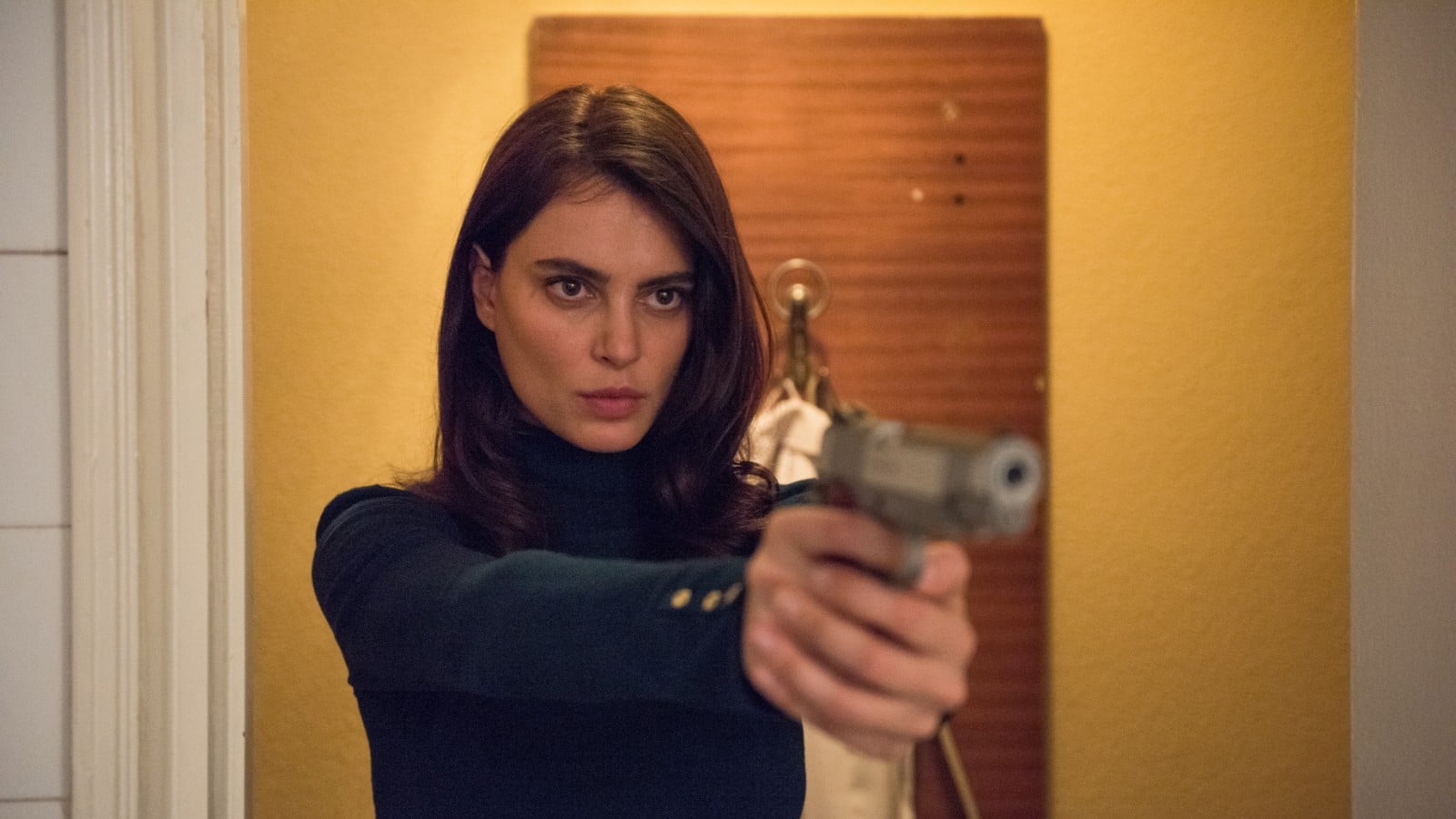
Catrinel Marlon in The Whistlers (dir. Corneliu Porumboiu, 2019)
Porumboiu’s return to the world of cops and robbers after ten years, The Whistlers (2019) is both a continuation and a departure from his earlier work. As an unofficial (and often tenuous) sequel to Police, Adjective, the film doubles down on Porumboiu’s fascination with language and the intersection of criminality and semantics, while upending our assumptions about his filmmaking philosophy; that he has not completed a feature since seems telling. Where Police, Adjective turned the crime film inside out with its deliberate tedium, The Whistlers leans into the thrills and spills of the genre, telling a twisted tale of international intrigue, femmes fatales, and triple-crossing fake-outs in primary colours. But this turn towards the conventional belies Porumboiu’s reliably conceptual take on all the gunslinging and seduction.
Ivanov is back as Cristi – implied to be the same Captain Anghelache of Police, Adjective, although confusingly bearing its protagonist’s first name. Ten years on and a number of promotions later, he has traded Vaslui for the capital Bucharest and a pedantic attachment to the letter of the law for outright corruption. The arrest of the weed-smoking teen in Police, Adjective is repurposed here as a villain origin story: the kid in question, Zsolt (Sabin Tambrea), pinned the crime on his brother, who committed suicide in prison. Perhaps as a result of his part in this miscarriage of justice, Cristi has lost his way, reduced to taking bribes from the gangsters whose drug smuggling and money laundering operation he is meant to be investigating. Zsolt, meanwhile, has become a menacing, crooked businessman. The walls are already closing in on Cristi – his steely superior Magda (Rodica Lazar) has bugged his apartment – before the arrival of Zsolt’s girlfriend Gilda (Catrinel Marlon), who promptly seduces our anti-hero into an increasingly complex web of double crosses involving mattresses stuffed with cash. Cristi finds himself on the Canary Island of Gomera, home turf of big boss Paco (Agustí Villaronga), where he must learn El Silbo: a traditional tribal language unique to the island that consists entirely of whistles.
the more The Whistlers leans into its crime film trappings, the less it seems to be concerned with law and order at all
After all the plot machinations, the introduction of Silbo promises to get viewers back to Porumboiu’s trademark absurdist comedy – but the exotic setting of Gomera, and the convoluted premise behind Cristi’s stranding there allows the director to have his genre cake and eat it too. Within the confines of a detective story, the symbolism of El Silbo is almost too obvious: who will be the whistle-blowers, and who will pay the price? The language is meant to imitate birdsong; is Cristi being set up as a snitch, singing like a canary? But there are deeper concerns at play that bring us back Porumboiu’s career-long investigation into the riddles of communication. In Police, Adjective, language was a political instrument. On Gomera, it becomes part of a much more expansive and elusive game of identities. Indeed, the more The Whistlers leans into its crime film trappings, the less it seems to be concerned with law and order at all.
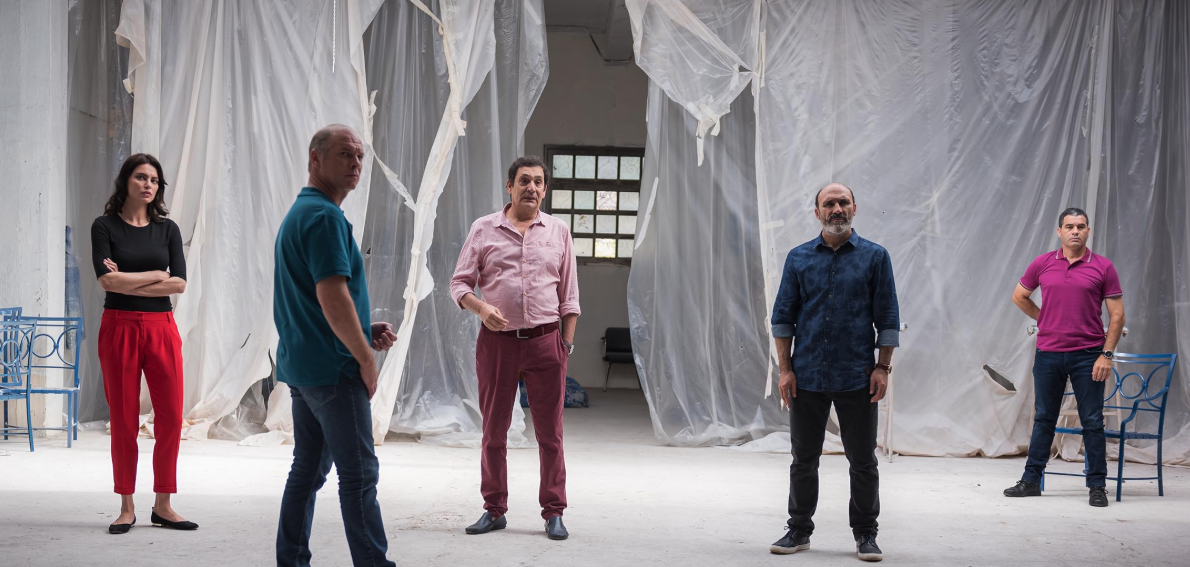
The Whistlers (dir. Corneliu Porumboiu, 2019)
Perhaps this explains the film’s increasingly gleeful deployment of meta-cinematic tricks and twists. The Whistlers jumps around in more ways than one. The narrative is split into chapters, which are presented non-chronologically. One moment we are watching a neo-noir thriller, the next a musical comedy. Porumboiu has fun assembling his film out of a wide range of influences: beyond the obvious homage paid by Marlon’s femme fatale to Charles Vidor’s seminal 1946 noir Gilda, starring Rita Hayworth, there are snippets of Alfred Hitchcock’s Riviera-set capers and the more revisionist westerns of John Ford. The sense of playfulness amid all the skulduggery and backstabbing is enhanced by the Pop Art cinematography of Tudor Mircea, which crackles with colour, and needle drops ranging from Iggy Pop to Offenbach.
By the time the bullets start flying, the dictionary corner of Police, Adjective feels like a distant memory. We might ask why Porumboiu felt the need to connect the two films in the first place, given how wildly different their takes on the same characters end up being. But the contrast between ramshackle Vaslui and verdant Gomera, between the grubbiness of furtive teenage joints and intercontinental drug rackers, is precisely the point. In pursuing his fixation on the ambiguities of language, Porumboiu leads himself, his characters, and his viewers into precisely this no man’s land, where the crime genre’s pure, imagistic thrills compensate for the troubling implications of a world in which everybody’s identity is but a whistle on the wind. That Porumboiu makes the trip down the rabbit hole so pleasurable is key to his offbeat charm.
Watch The Whistlers on Klassiki now as part of our new Gangster Tales collection.


 Go back to journal home page