Nine years after his previous film – during which time he nearly died of Covid and was forced into exile in France – Andrei Zvyagintsev has returned to Cannes with a new feature, Minotaur. The film, which uses the war on Ukraine as a backdrop for the director’s trademark dissection of modern Russia’s social and spiritual ills, has been met with rapturous reviews and is considered a prime contender for the Palme d’Or. To mark Zvyagintsev’s return, we’re republishing this 2024 piece on the ten-year anniversary of his earlier masterpiece Leviathan – a film whose subject matter and reception presaged Russia’s descent into the abyss.

Aleksei Serebryakov in Leviathan (dir. Andrei Zvyagintsev, 2014)
In 2014, Andrei Zvyagintsev’s fourth feature, Leviathan, premiered at Cannes to widespread critical acclaim. Considered a contender for the Palme d’Or, Zvyagintsev and regular collaborator Oleg Negin eventually had to settle for the Best Screenplay award. At the time, nothing about this seemed unusual: Zvyagintsev had been a fixture on the European festival scene for more than a decade, one of a number of “big name” Russian filmmakers – alongside the likes of Boris Khlebnikov, Yuri Bykov, and Kirill Serebrennikov – who were part of the furniture on the international middlebrow respectability circuit.
In 2024, the circumstances of Leviathan’s production and reception seem like remnants of a different age. Zvyagintsev has completed only one film since – 2017’s Loveless – and now resides in exile in France after a years-long, Covid-related medical emergency that nearly cost him his life. Russia is, quite rightly, a pariah state, and while Serebrennikov in particular continues to hawk his wares to the same tight-knit festival crowds, he too does so from exile, having spent several years in the meantime under house arrest on politically motivated charges. If Leviathan represented something like the last chance for a Russian filmmaker to bask in high-end Western acclaim, it also arrived a few months after the annexation of Crimea; in retrospect, the disaster that has since unfolded in Ukraine and Russia had already begun. Zvyaginstev is now in the process of finalising shooting on the oligarch drama Minotaur, his first film produced outside Russia: a symbolic moment that should give us pause and prompt us to look back to those strange days a decade hence.
Then-Minister of Culture Vladimir Medinsky launched a public campaign against the film after it premiered at Cannes… Nine years later, Medinsky was representing Russia at abortive peace talks with Ukraine following the full-scale invasion
Given the degradation of Russia’s cultural sphere over the course of those ten years, it can be hard to remember now the controversy that surrounded Leviathan on its release. As was fairly normal at the time for a production of that magnitude, around 35 percent of the film’s budget came from the Russian Ministry of Culture. Then-Minister Vladimir Medinsky, a hawkish social conservative and nationalist historian, launched a public campaign against the film after it premiered at Cannes, criticising Zvyagintsev’s portrayal of ordinary Russians and suggesting that the director was concerned only with “fame, red carpets, and statuettes”. This was roughly concomitant with the Russian parliament introducing a law that forbade swearing – a vernacular artform in full effect in Leviathan – in films and television.
Medinsky’s ire was drawn by Zvyagintsev’s witheringly comic treatise on life in provincial Russia. On the bleakly beautiful Arctic coast, mechanic Kolya (Aleksei Serebryakov) lives with his withdrawn second wife and restless son. When the land his family home stands on is targeted for development by the corrupt local mayor (Roman Madyanov), Kolya calls in help from Moscow in the form of lawyer friend Dima (Vladimir Vdovichenkov), all the while underestimating the dark forces circling above his head. Medinsky’s attacks didn’t stop the Russian Guild of Film Critics from voting Zvyagintsev’s film as the year’s best, a sign that subversion and crackdown still existed, at that moment, in uneasy lockstep. But the die was, perhaps, already cast. Nine years later, Medinsky was representing Russia at abortive peace talks with Ukraine following the full-scale invasion, the face of a regime committed to international criminality.
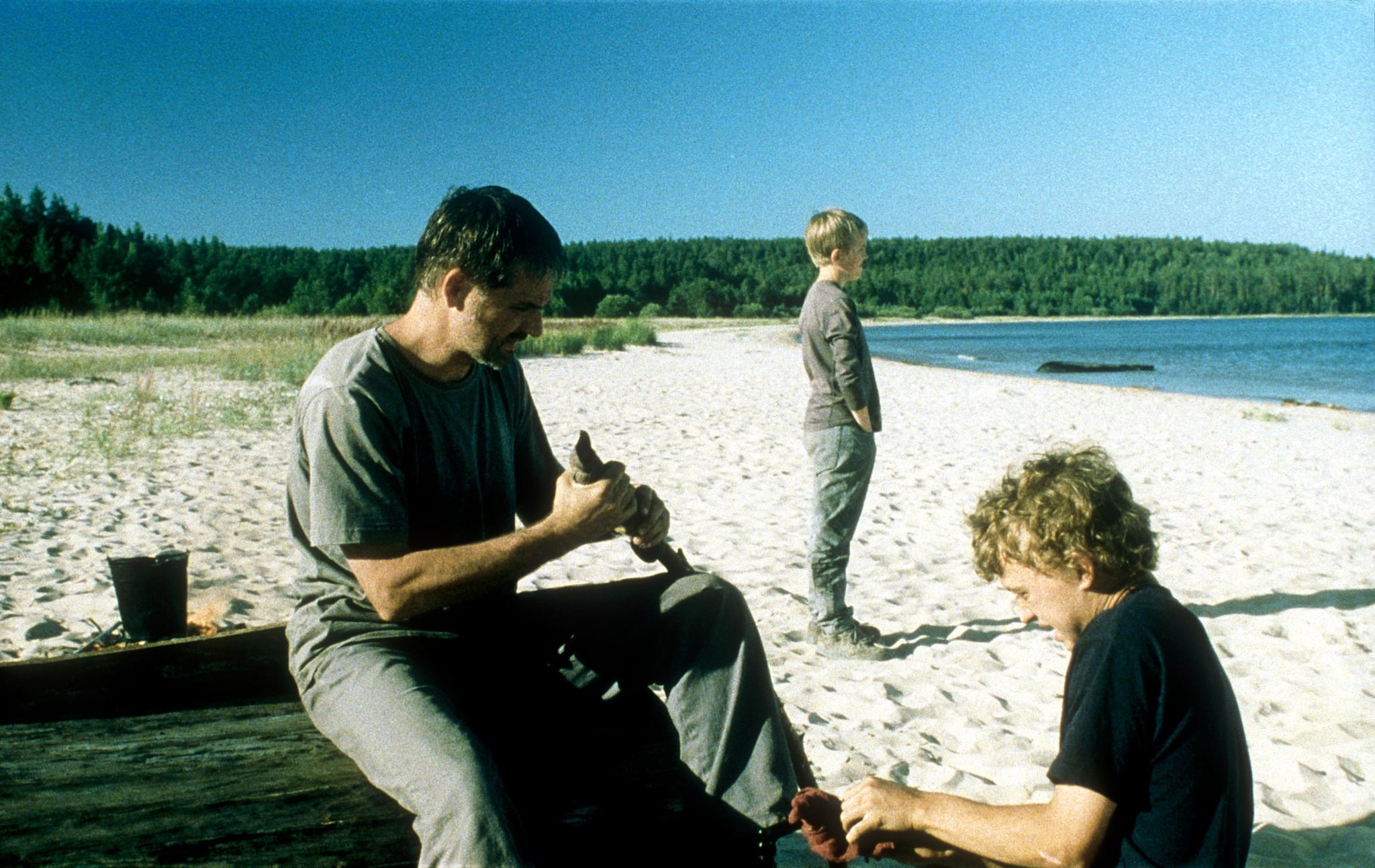
Konstantin Lavronenko, Ivan Dobroranov, and Vladimir Garin in The Return (dir. Andrei Zvyagintsev, 2003)
“Red carpets and statuettes” abroad, political grief at home: the dichotomous existence of the Cannes-crowd Russians created the cracks that would soon become a cultural chasm. Zvyagintsev’s career arc is suggestive of the noughties-era climate of cooperation and openness that pertained between Russia and the West, when the former was understood as a coalition partner in the latter’s disastrous wars against the perceived Islamist threat. Indeed, Zvyagintsev owed his early reputation as the next great hope of Russian cinema – in the parlance of the time, the “new Tarkovsky” – to his unexpected triumph at Venice with his debut feature The Return in 2003. That win helped to revitalise Russian cinema after the heavy slump of the immediate post-Soviet nineties. Along these lines, Zvyagintsev was posited within Russia as a figurehead for a kind of symbolic “New Wave” that emerged at the turn of the millennium, dubbed the “New Quiet Ones”, along with the likes of Khlebnikov (Koktebel, 2003), Aleksei Popogrebsky (How I Spent Last Summer, 2010), and Vasily Sigarev (Wolfie, 2009).
These directors, united by little stylistically but sharing a thematic interest in the slow-motion collapse of the social fabric in Putinist Russia, had come in for criticism at the turn of the decade for their lack of explicit political commitment: depression without rebellion, hence the “quiet” moniker. At a roundtable discussion at Sochi’s Kinotavr festival in 2011, Khlebnikov lamented his and his cohort’s lack of political courage: “They’re right to call us that [quiet],” he said. “We’re scared of all these cops. We look over our shoulders and whisper that they’re scoundrels and swine. To my mind, cinema should be much louder and freer.” Over the course of the 2010s, this call to arms was hesitantly taken up in films like Bykov’s The Fool (2014), Khlebnikov’s own A Long, Happy Life (2019) – and, most strikingly, in Leviathan. Writing in 2018, the scholar Justine Wilmes argued that “there has been a shift from the thwarted or potential heroes of earlier New Quiet films… to idealistic men of action who are crushed by the system – from inaction and inescapability to action and doomed failure.”
what makes it a great film, rather than just a representative one, is not its position on Putin and co, but how it uses the Russian setting in order to proclaim a universalist, even spiritual message
Leviathan, then, represented both the culmination of Zvyagintsev’s career to that point, and its transformation into something else: from the heady, nowhere-land symbolism of The Return and follow-up The Banishment (2007) to a steely-eyed vision of modern Russian society; and from the minor-key social commentary of Elena (2011) to a sweeping panorama of corruption, national history, and spiritual decline. It is important, though, not to slip into triumphalism in retrospect. If the New Quiet directors represented a new wave in Russian film, then it was one that never truly broke: international recognition did not help to bridge the gap between a largely urban artistic elite and the neglected provincial spaces about which they made their films. The law on swearing in film, as well as restrictions placed on distributions licences in the early 2010s, made it harder for this cohort of directors to get funding; they were also hit hard by the closure in 2005 of Moscow’s Museum of Cinema, which had acted as a kind of organisational hub for the grouping.
Leviathan, then, is a film rich with symbolic value, released at an inflection point in Russian cultural and political history, and hugely important for its director’s personal development. But what makes it a great film, rather than just a representative one, is not its position on Putin and co, but how it uses the Russian setting in order to proclaim a universalist, even spiritual message. This aspect of Zvyagintsev’s filmmaking has often been neglected by a Western media desperate to cast him primarily as a “good Russian” dissident – even when the director himself has implored them not to – and it is at its zenith in Leviathan. Zvyagintsev has always insisted in interviews that the film be read as a simple parable: a retelling of the Biblical story of the travails of Job, inspired by a real-life incident in 21st-century America (the suicide of auto mechanic Marvin Heemeyer, who killed himself after destroying several municipal buildings in Granby, Colorado in 2004 at the end of a long-running dispute with local authorities).

Aleksei Serebryakov in Leviathan (dir. Andrei Zvyagintsev, 2014)
In his magisterial essay-review of the film, the film historian Julian Graffy notes that while Zvyagintsev’s early films “were reticent, allusive, abstract, enigmatic, he now forsakes this approach for a new aesthetic of explicitness, density, fullness. Leviathan… contains more connections with the materiality of contemporary Russian life. It is also more direct about its intentions.” The power of the film derives from the way that Zvyagintsev draws out the spiritual lessons presented by Kolya’s struggles from the dark heart of this material “density”. The Return is a moving film, but the father-son relationship at its core is almost entirely allegorical, floating free into abstraction. Leviathan recognises that heaven and hell are built here on earth. This is not to say that Zvyagintsev does not adopt a political position: this is, after all, a film in which picnicking husbands take pot-shots at a portrait of Boris Yeltsin with a Kalashnikov, noting that they will leave his successor “to ripen on the wall a little longer” before subjecting him to the same treatment. But it is hard to rewatch Leviathan now and not to recognise his Swiftian portrait of small-town malaise as a kind of posturing, a secondary concern.
In his new role as emigré filmmaker, of course, Zvyagintsev’s dislocation has been made literal and (for now) permanent. “The force of inertia keeps my mind there, even though my body is somewhere else,” he recently told an interviewer. “I now live in France, but I’ve lived for so long in Russia that I feel, in some ways, that I continue to do so. I continue to breathe in Russia, I continue to feel the Russian context, and so I know that I can continue to bear witness to this society, even if I’m no longer there… What I don’t know, however, is when the moment will come when I consider that I can no longer bear witness to Russian society. When that will be, I don’t know, but it won’t be now.” Ten years on from his grandest and most flawed act of testimony, Zvyagintsev and Russian film continue to exert a gravitational pull on one another, if now from a distance.
Watch Leviathan on Klassiki now and explore our full collection of Russian titles here.


 Go back to journal home page