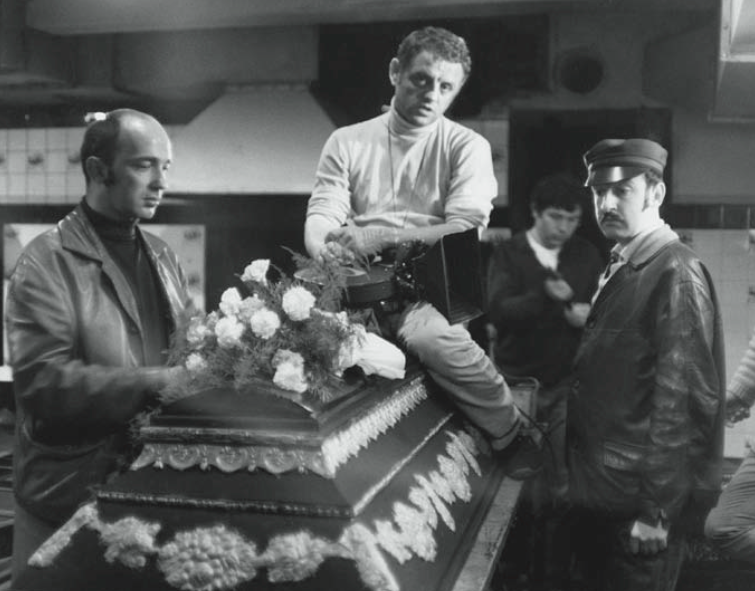
Juraj Herz (right) on the set of The Cremator (1969) with cinematographer Stanislav Milota (centre)
As October begins, and cinephiles everywhere begin their annual horror marathons in the run-up to Halloween, it’s worth asking: what is the greatest horror film to emerge from the communist bloc? For some connoisseurs of the creepy, there can only be one answer: Juraj Herz’s 1969 classic The Cremator, the most purely disturbing title of the Czech New Wave and an enduring vision of the depravity lurking just beneath the surface of bourgeois respectability. As a marker of the film’s canonical status, The Cremator takes pride of place in the “Night Terrors” horror strand at this year’s Samizdat Eastern European Film Festival, currently underway in Glasgow.
Herz’s adaptation of Ladislav Fuks’s 1967 novel of the same name is set in 1930s Prague and charts the descent into madness of one Karel Kopfrkingl (Rudolf Hrušínský), a respectable crematorium worker and pater familias who embarks on a murderous spiritual mission that blends bastardised Buddhism with the ideology of the National Socialist movement taking hold of the Czech middle classes. While fully deserving of the horror label – with the unassuming Kopfrkingl more than a match for the rampaging villains of slasher franchises – The Cremator, like all Herz’s films, transcends narrow genre conventions, blending the pitchest black comedy with surrealist flair and biting satire. It also draws on the trauma of his own life as a survivor of the Holocaust – an experience that would shape all of the director’s work until he was finally able to tackle that history directly in Caught by the Night, the 1986 concentration camp drama that Herz described as “my greatest horror”.
The Cremator is by far Herz’s best-known film outside of his homeland; its reliable inclusion in lists of the masterpieces of the Czech New Wave has canonised Herz as part of a movement that still defines outsider understanding of cinema from the region. Released mere months after Warsaw Pact tanks rolled into Czechoslovakia, the film stands for the kind of politically and philosophically daring filmmaking that was curtailed by the crushing of the Prague Spring in 1968. But while The Cremator was eventually removed from circulation in 1973, Herz’s career was far from over. Far from a New Wave poster-boy, he was Czechoslovak cinema’s great outsider, a position he exploited to maximal effect: over two decades marked by constant intrusion and obstruction from the authorities, Herz pursued the singular, gothic vision first realised in The Cremator – one of an expressionistic world undone by forces beyond rational control. His resourcefulness and bloody-mindedness, no less than his ability to adapt his macabre worldview to the demands of the material in front of him, produced a body of work that deserves to be better known.
Far from a New Wave poster-boy, Herz was Czechoslovak cinema’s great outsider. Over two decades marked by constant intrusion from the authorities, Herz pursued his gothic vision of an expressionistic world undone by forces beyond rational control
Herz’s upbringing as a Slovak Jew would shape his life in ways both minor and horribly profound. Born in Kežmarok in 1934, his family were arrested and interned by the country’s collaborationist fascist government during the Second World War. Herz was held in the Ravensbrück concentration camp; while he had his immediate family survived, some 60 members of his extended family were murdered. After this ordeal, he would go on to study photography in Bratislava, before making the move to Prague, where he enrolled in the puppetry department of the Theatre Faculty of the Academy of Performing Arts, or DAMU. Here he would befriend his “cosmic twin”, the great animator Jan Švankmajer – the two were born on the exact same day – whose fantastical, metamorphic creations found live-action counterparts in Herz’s own films.
Herz’s personal and professional background kept him at the fringes of the burgeoning Czech film scene of the sixties. The New Wave was closely associated with Prague’s more prestigious FAMU film school, a milieu in which the Slovak puppeteer Herz struggled to establish himself; in a 2002 interview, he recalls being chased out of screenings held by FAMU students. His attempts to adapt the Bohumil Hrabal novel Closely Observed Trains were thwarted when the project was handed instead to Jiří Menzel. His friend Jaromil Jireš attempted to include Herz in the 1966 Hrabal anthology feature Pearls of the Deep – often considered the “manifesto” of the New Wave and the launching pad for the careers of Menzel, Věra Chytilová, and Jan Němec – but his contribution, The Junk Shop, was excluded, becoming the director’s first standalone film in the process. Herz was forced to learn the trade on the job, dependent on the mentorship of sympathetic establishment figures like Zbyněk Brynych and Ján Kadár, under whom he honed his technique as an assistant director.
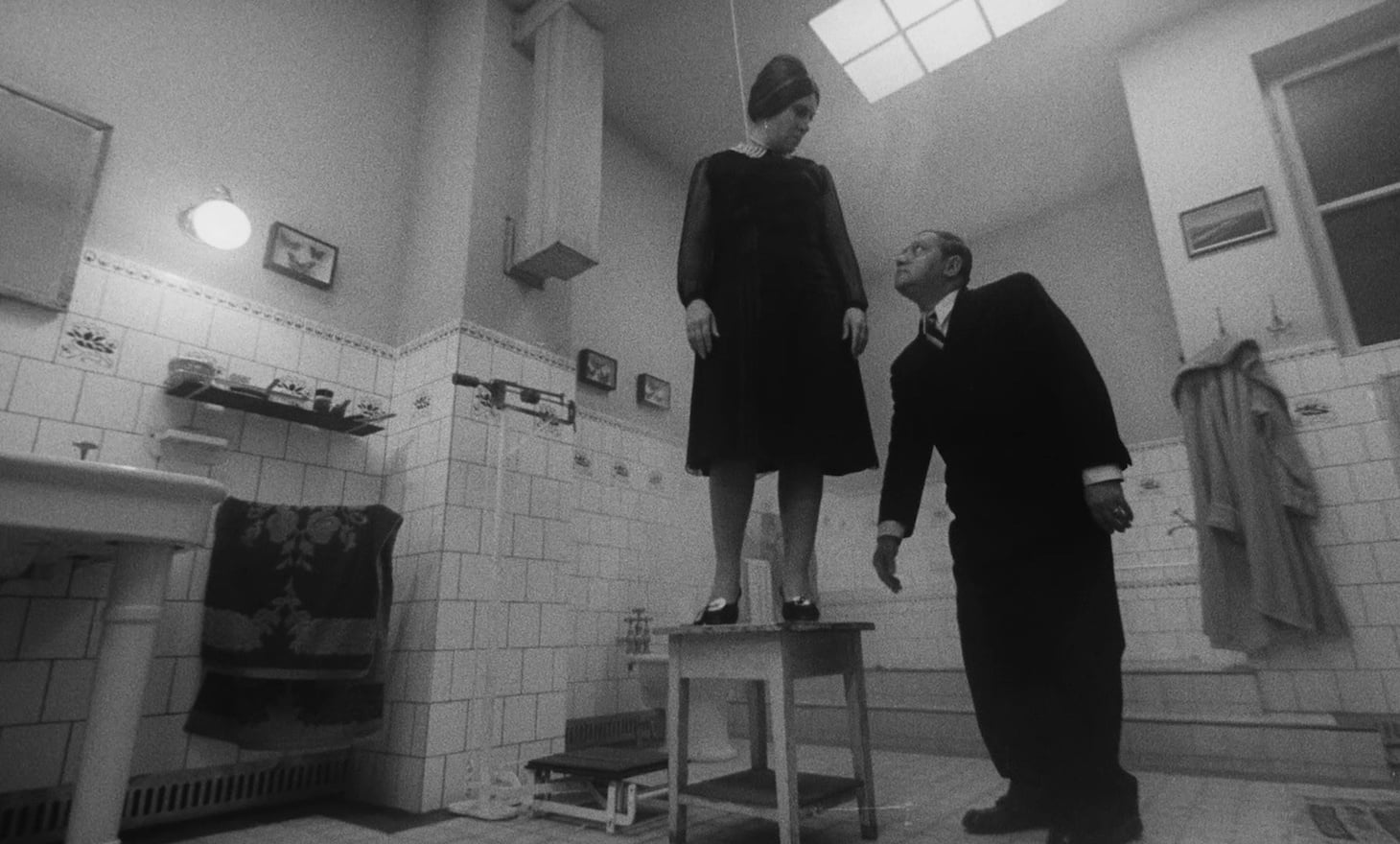
The Cremator (dir. Juraj Herz, 1969)
Herz’s taste for the macabre was on muted display in his feature debut, the psychological murder mystery Sign of Cancer (1965), before being given full voice in The Cremator. That film was only made possible by the liberalisation that accompanied the Prague Spring: “during shooting,” Herz later recalled, “it became clear that this was a unique chance which wouldn’t come again.” At this formative stage in his career, Herz recognised in Fuks’s novel that delicate blend of gruesomeness and wit that matched his own worldview, and he threw his creative energies into realising it on screen. “When I was working on The Cremator, I knew that it was the right thing to do – it is my feel for comedy, my feel for something that could be called a ‘horror comedy’, even if I don’t take it as a pure horror film: I think it is more a psychological thriller or psychological horror.”
Herz was right that The Cremator would prove a one-off. Like many others he contemplated emigration after the events of August 1968; ironically, he was prevented from doing so by his need to finish shooting the film, which was delayed by several months while leading man Hrušínský was in hiding (“somewhere in a factory,” in Herz’s words) following his activism during the Spring. Instead, like Menzel and Chytilová, he would stay in Czechoslovakia. The following 15 years were spent pursuing his gothic ideal through the labyrinth of the state studio system, a web of commissions, political pressures, and personal animosities. Somehow, Herz was able to turn this precarity into opportunity.
“I think Caught by the Night is my greatest horror. It is a real horror. There is no blood, but it is unwatchable for people with weak nerves. It is the atmosphere I experienced.”
Stories about the present day were politically fraught, so Herz sought solace in a series of fin de siècle adaptations. Oil Lamps (1970), from the novel by Jaroslav Havlíček, was a more restrained period piece. Its follow-up, Morgiana (1972), was full-blooded Herz, perhaps his most successful seventies feature. The life story of the Russian author of the source novel, Aleksandr Grin – an outcast who died in poverty, shooting crows in the park with a home-made crossbow for food – appealed to the director as much as the paranoid chamber drama of sororal blackmail and murder. The result is perhaps the most purely gothic creation of Herz’s career, a full-blown haunted house story replete with eery mirrors and heavy cobwebs. Perhaps predictably, Ludvík Toman, the chief commissioning editor of the state-run Barrandov Film Studios, accused Herz of sadomasochism and banished him to television productions for two years; when Morgiana won top prize at the Chicago International Film Festival, Herz did not find out until seven years later.
When he was allowed to return to feature filmmaking, Herz turned to the politically neutral ground of fairy-tale. He was offered the chance to adapt Beauty and the Beast – “which I wanted, because I knew I could include horror scenes” – but was forced to shoot a second fantasy film, The Ninth Heart, at the same time in order to cut costs. Both were released in 1978, cementing Herz’s reputation as a maestro of the macabre and a talented conjuror of atmosphere. The pulpiest and schlockiest of Herz’s films came four years later with Ferat Vampire, a John Carpenter-esque horror comedy about a car than runs on human blood. If the film is the clearest example of “pure” horror genre work in the Herz back catalogue, it was yet another nightmare of a production, subject to endless cuts and critiques; the director renounced the final cut and once again found himself cut adrift by the authorities.
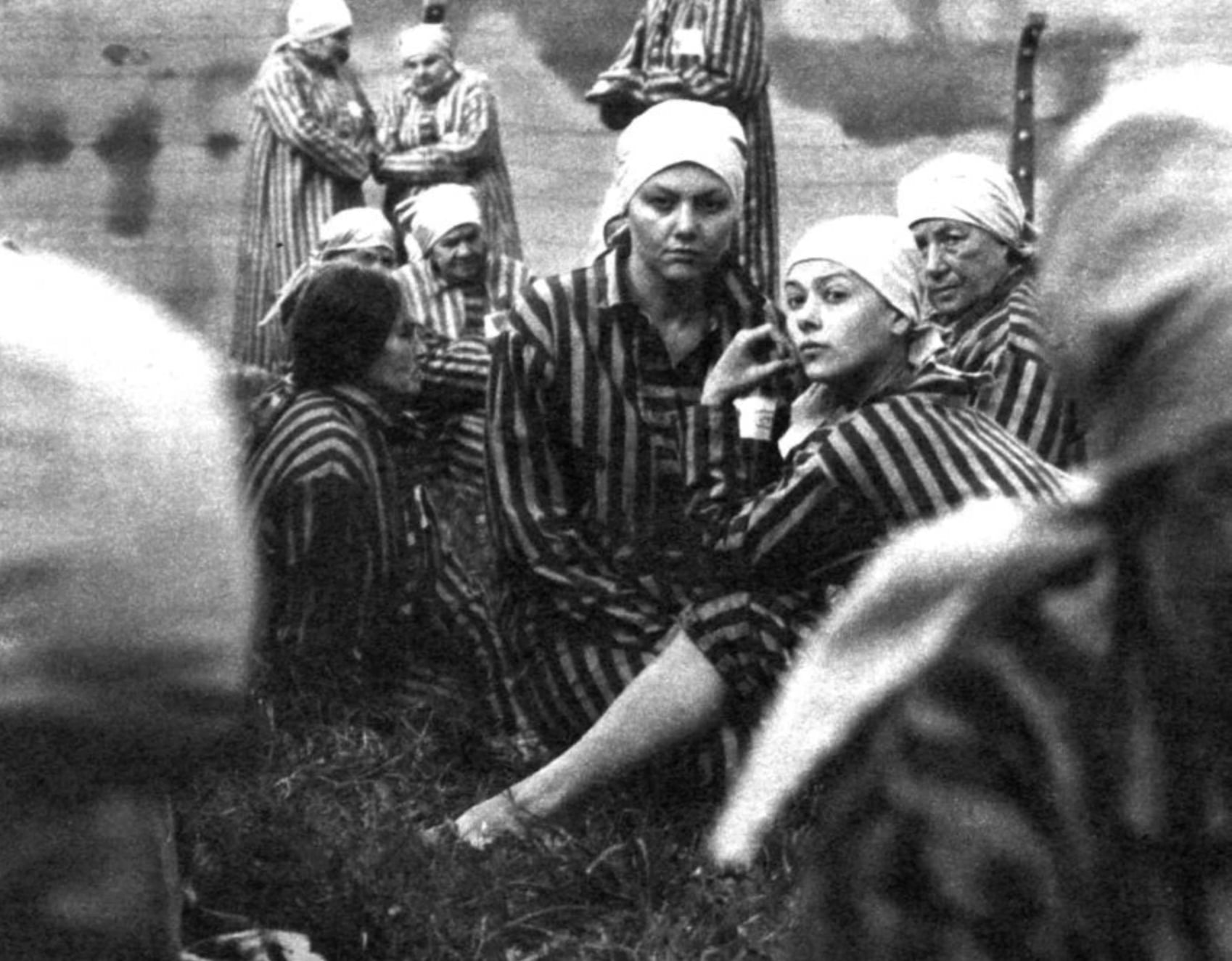
Caught by the Night (dir. Juraj Herz, 1986). Image: Jiří Kučera
Despite all this, though, his race was not yet run. In the doldrums of his latest ban, Herz came across an article mooting a potential film about Ravensbrück. Despite his pariah status, he asked the head of Barrandov for permission to take charge of the project. He was in luck: the film had been assigned to his old ally, Jaromil Jireš, who relinquished it. Remarkably, Herz found himself with the opportunity to return to the scene of his formative tragedy, the place (in his own words) that had instilled in him his impulses towards horror and black comedy. Caught by the Night (1986) is nominally based on the memoirs of fellow Holocaust survivor and Czech communist journalist Jožka Jabůrková, although Herz based his depiction of Ravensbrück on his own experiences there. The film’s use of suspense sequences and surreal, haunting flashbacks borrow directly from the horror playbook in an attempt to represent the psychological state of the Holocaust victim. The film is like a Rosetta Stone for the preceding years of Herz’s career.
In 1987, Herz finally emigrated to West Germany, his work in his native land complete. “I had been trying to make a film about a concentration camp using black humour for 20 years and everybody was horrified of mixing the suffering and terror of the Holocaust with humour,” he later claimed. “I think Caught by the Night is my greatest horror. It is a real horror. There is no blood, but it is unwatchable for people with weak nerves. It is the atmosphere I experienced.” Against the odds, Herz had fashioned an oeuvre that pushed the limits of communist probity in mapping out the territory of eastern European horror: “For me, the typical horror film is a chainsaw massacre. And of course, this wasn’t possible to do during the socialist era.” His influence on the genre in the region remains profound – it is hard to imagine a film like Ivo Trajkov’s 2022 Slovak folk horror hybrid The Ballad of Piargy, for instance, absent Herz’s work. We should celebrate one of Czech and Slovak cinema’s most insistently vital voices, and not turn away from the brutal history that inspired his most haunting visions – nor its echoes in our lives today.
The Cremator screens at the CCA Glasgow on 5 October as part of Samizdat Eastern European Film Festival. Explore our partnership with the festival here.


 Go back to journal home page