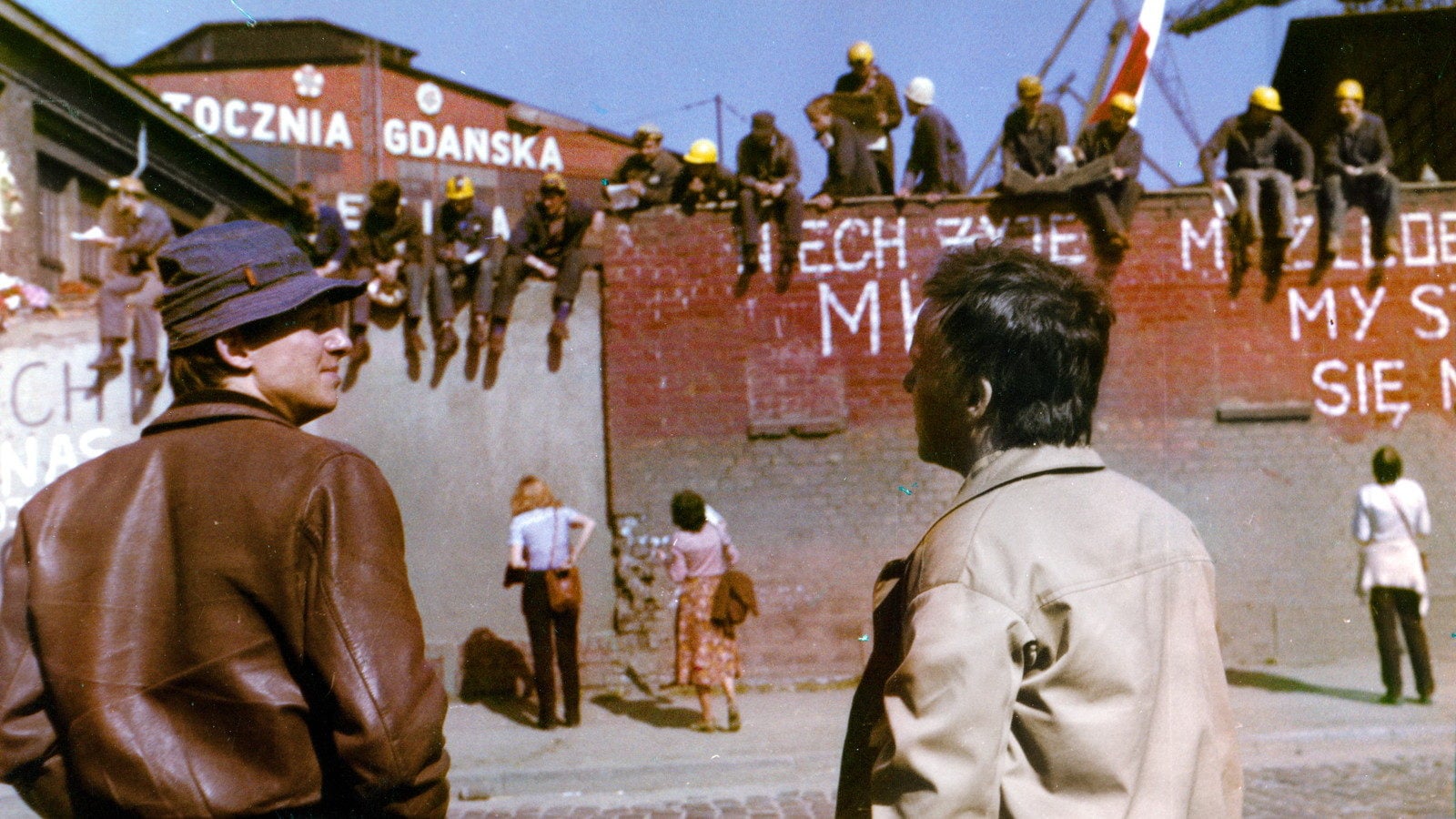
Man of Iron (dir. Andrzej Wajda, 1981)
National history and film history are parallel phenomena. It was his partisan commitment to both that made Andrzej Wajda a canonical figure: a director lauded by the establishment whose work often subverted the platitudes of establishment narratives. By returning to the well of Polish history so many times throughout his career, in so many modes, Wajda earned for himself the right to both flatter and denounce those in high places both under and after communism; hence the oft-cited remark from Polish prime minister Donald Tusk on the filmmaker’s death: “We all stem from Wajda. We looked at Poland and at ourselves through him. And we understood better. Now it will be more difficult.”
The nature of Wajda’s historical explorations inevitably evolved over his six-decade career. In an essay published shortly before the director’s death in 2016, Michał Oleszczyk outlines these transformations. Wajda emerged in the 1950s as a figurehead of the so-called “Polish Film School”, which revivified cinema in the country by turning back to the still-fresh atrocity of the Second World War and loosening the straitjacket of official accounts of what had occurred. Two of Wajda’s epochal early features were set during and immediately after the Second World War – Kanal (1957) and the iconic Ashes and Diamonds (1958) – and he returned to the conflict many times over, right up to his late-period cri de cœur Katyń (2007). As the Film School ran out of steam in the sixties, Wajda began to dabble in nouvelle vague and jazz-inflected formalism – see Innocent Sorcerors (1960) – as well as his earliest reflections on the place of the Jews in Polish history (Samson, 1961; Landscape after Battle, 1970; Korczak, 1990). The seventies saw Wajda shifting into a more poetic and expansive take on national history. Drawing on his artistic training in Krakow and his love for Polish Romanticist painting, he produced a succession of vivid, often epically long period pieces, a number adapted from his local literary favourites: the Napoleonic sweep of The Ashes (1965, from Stefan Żeromski); the nineteenth-century panorama of The Promised Land (1975, from Władysław Reymont); the fin de siècle realism of The Wedding (1972, from Stanisław Wyspiański); the 1930s-set social dramas The Birch Wood (1970) and The Maids of Wilko (1979, both from Jarosław Iwaszkiewicz).
on Wajda’s death, Polish prime minister Donald Tusk stated: “We all stem from Wajda. We looked at Poland and at ourselves through him. And we understood better. Now it will be more difficult.”
Even as they established Wajda as a pre-eminent stylist and dramatist, the historical sweep and visual decadence of these films threatened to estrange him from present-day concerns. Polish cinema was changing beneath his feet in the 1970s. The second half of the decade had seen the rise of a loose grouping of critical voices later dubbed the “cinema of moral anxiety” – a staging ground for the early works of major figures including Agnieszka Holland (Wajda’s assistant director on Man of Marble), Krzysztof Kieślowski, and Krzysztof Zanussi. These films had explored discontent in a minor key, using provincial settings and unremarkable protagonists as a means to dig under the skin of communist society. The economic decline that helped to fuel this melancholic worldview only worsened into the eighties, with rationing, shortages, and power outages prompting ever greater disillusionment with the authorities. Facing growing discontent, newly installed First Secretary Wojciech Jaruzelski imposed martial law on 13 December 1981, drawing the battle lines for the final decade of communist power.
Wajda’s unlikely response to this growing sense of crisis was an inadvertent diptych that represents perhaps his finest work: 1977’s Man of Marble, followed four years later by its ad-hoc sequel, the Palme d’Or-winning Man of Iron. Tearing himself back to the present day, he drew on and expanded upon the cinema of moral anxiety to create his own meta-cinematic reckoning with contemporary Poland: political in the immediate sense, almost journalistic in its hands-on engagement with unfolding events. Together, the two films tell a story of disillusionment with the mythology and spectacle of state communism and the eventual rise of its antagonist in the Solidarity trade union.
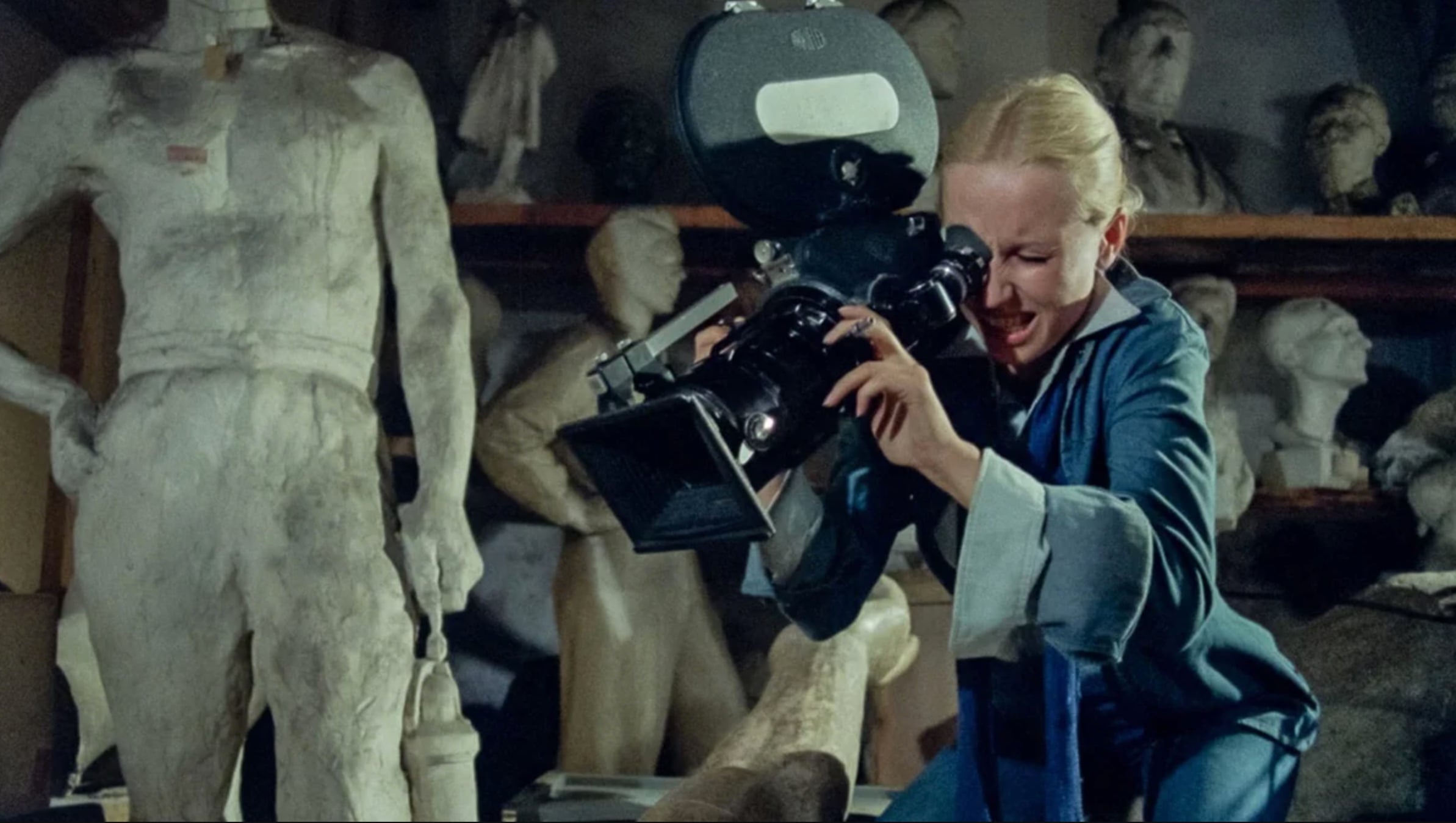
Krystyna Janda in Man of Marble (dir. Andrzej Wajda, 1977)
In content and production history, Man of Marble is a kind of history lesson in itself, speaking to the fluctuating conditions for Polish artists in the post-war decades: from the hard-line Stalinism of the fifties to the thawing of the seventies, and the return to authoritarianism by the eighties. Wajda’s regular writing partner Aleksander Ścibor-Rylski had completed the first version of the script back in 1965, only to see it promptly shelved. By the mid-seventies, censorship had temporarily softened, allowing Wajda a window to realise the vision – only for the film to find its release severely limited and positive reviews quashed once it was completed. Often referred to reductively as a Polish take on Wajda’s beloved Citizen Kane, Man of Marble follows a young filmmaker named Agnieszka (Krystyna Janda) down the propaganda rabbit hole as she attempts to make a documentary about Mateusz Birkut (Jerzy Radziwilowicz), a Stakhanovite bricklayer championed as a hero of labour in the fifties but now vanished into anonymity.
As Agnieszka uncovers the reality behind Birkut’s baffling fall from grace, Wajda crafts his most potent reflection on the intersection of cinema and political power, complimenting Agnieszka’s dogged integrity with deftly recreated and manipulated newsreels and interviews from the Stalinist era depicting Birkut’s supposed involvement in the construction of Nowa Huta – a huge housing project in eastern Kraków that symbolised the productive capacities of the socialist state. Janda’s performance is remarkable, moving seamlessly from seeming superficiality to ethical probity, and from youthful aloofness to disturbed disillusionment. Wajda never matched this film’s engagement with the ethical dimensions of filmmaking itself. There is a sly nod to his and his cohort’s training when he appends his name to the credits of one of the socialist realist newsreels that Agnieszka pores through in search of Birkut. (He also has fun contrasting this archival material with Agnieszka’s own hipness – symbolised by her insistence on using hand-held cameras and wide lenses, “just like in the new American films.”) In the final reckoning, both Birkut and Agnieszka find their idealism thwarted by the repressive impulses of their respective generations. And by making the manipulation of the image a diegetic aspect of his own narrative, Wajda subverts the very notion of onscreen heroism, leaving the viewer grasping for a moral core. In the words of John Orr, “Wajda refuses to believe in any propaganda, including his own.”
In the words of John Orr, “Wajda refuses to believe in any propaganda, including his own.”
If Man of Marble was Wajda’s reaction to the world of moral anxiety, then Man of Iron is a living artefact from the days of rebellion and reaction at the dawn of the eighties; the director was never closer to the history-making political actors he was putting on screen. For the nation’s filmmakers, the final years of communist rule in Poland proved a period of both brutality and opportunity: a decade that opened with the imposition of martial law and ended with the apotheosis of the Solidarity movement and the collapse of the regime. Among the many repressive measures introduced with martial law – from paramilitary patrols and a national curfew to widespread wiretapping and mass imprisonment without trial – was a tightening of cultural censorship. As a result, some of the most symbolically significant films of the early eighties received little to no domestic exposure until the end of the decade. Man of Iron was the most famous, but by no means the only case in point. The same fate that befell Wajda’s film – lauded at a major European festival but pulled from Polish screens a few weeks after release – also afflicted Wojciech Marczewski’s Shivers (1981), a withering examination of the Stalinist era that would later win a Silver Bear at the 1982 Berlinale. Ryszard Bugajski’s Interrogation (1982), about the forced confession of an innocent woman in the 1950s, was only released in 1989. The same year, Janusz Zaorski’s The Mother of Kings, about a loyal Party who falls foul of the post-war purges of the forties, suffered the same fate.
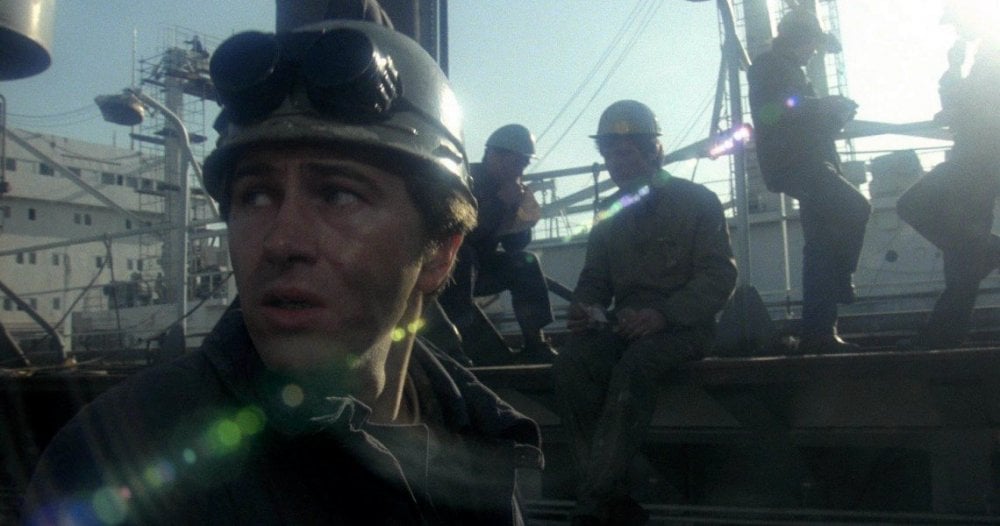
Jerzy Radziwilowicz in Man of Iron (dir. Andrzej Wajda, 1981)
At the close of Man of Marble, Birkut’s fate is left unclear. Wajda had wanted to show the character’s involvement in – and death during – the 1970 clashes at the Gdańsk Lenin Shipyards that prefigured the rise of Solidarity ten years later (a trauma that he had previously gestured to with the ending of The Promised Land, in which industrialists turn armed police on their workers). Soon the northern port city would force its way back into public consciousness, creating the conditions for the director to return to the Birkut saga. Under the leadership of electrician Lech Wałęsa, striking workers from the shipyards forced the communist government to recognise free trade unions in 1980, signing a historic accord on August 31. The agreement gave rise to the union Solidarność, or Solidarity, which would ultimately play a crucial role in the round table talks and eventual elections of 1989 that brought the communist era to a close. On 28 August, Wajda – at this point a cultural celebrity within Poland – arrived in Gdańsk to capture the rapidly escalating events there. A labourer escorting him around the shipyard suggested that he make a sequel to Man of Marble about the rise of Solidarność, and even proposed a title: Man of Iron.
Realising that the window to release such a film might be shut at any moment, Wajda hurried into action, rehiring screenwriter Ścibor-Rylski to help him pick up the threads of the Birkut narrative. In the words of Jonathan Bousfield, “Wajda was extremely aware that social protest was a public spectacle of short duration, and that by making a film of the Gdańsk events he was helping to ensure that they would resonate for a long time.” Man of Iron clears up the ambiguous ending of its predecessor: Mateusz Birkut is dead. His son Tomczyk (also played by Radziwiłowicz) is one of the leaders of the Gdańsk movement and now married to Agnieszka. Winkel (Marian Opania), a down-on-his-luck radio reporter, is sent to dig up dirt on Birkut Jr., but ultimately comes to side with the strikers. Wajda incorporates archival footage as well as cameos by Solidarność figureheads like Wałęsa and Anna Walentynowicz, the crane operator whose dismissal initially sparked the strike; the result is a fiction-verité livewire act.
“Wajda was extremely aware that social protest was a public spectacle of short duration, and that by making a film of the Gdańsk events he was helping to ensure that they would resonate for a long time.”
Like its predecessor, the film makes the very question of the historical record part of its action, incorporating archival documentary materials from Polish and German television, as well as extracts from existing documentaries about the industrial dispute. The figure of Winkel inverts Agnieszka’s previous journey from believer to sceptic, a thoroughly cynical operator moved to civic engagement. Written, shot, and edited in a matter of months, the film was rushed to Cannes in May 1981, where it won the Palme d’Or. “Never before has a film been awaited with such interest and anticipation,” the Polish magazine Przekrój declared on 23 August ahead of its nominal domestic release. But the imposition of martial law in December curtailed its full release. Wajda’s message foundered. Solidarity was forced underground. The tanks that Wajda had requested from military chief Jaruzelski for a flashback sequence in the film were used to suppress the population instead.
The movement that Wałęsa et al had begun would, of course, win the day; for many, Wajda himself would never again reach the highs of the seventies and eighties. If his output in the post-communist years remains comparatively overlooked, then it is not without merit – and much of it bears the same imprint of historical exploration that informed his masterpieces. Indeed, his final film, Afterimage, returns to the Stalinist era to tell the story of Władysław Strzemiński, an influential artist and theorist who pioneered the Constructivist avant-garde in Poland in the 1920s before being stymied by censorship. The film was released in September 2016, and Wajda died the following month. It is a bleak portrait, and it is tempting to read it as a downcast last testament from a director who saw the mistakes of the past returning in the present. To the end, Wajda’s films are infused with the politically amorphous idea that men make their own history – but not in circumstances of their own choosing.
Watch Man of Marble and Man of Iron until 26 March as part of our collection 100 Years of Andrzej Wajda: Men of History.
Explore our full collection of Polish titles here.


 Go back to journal home page