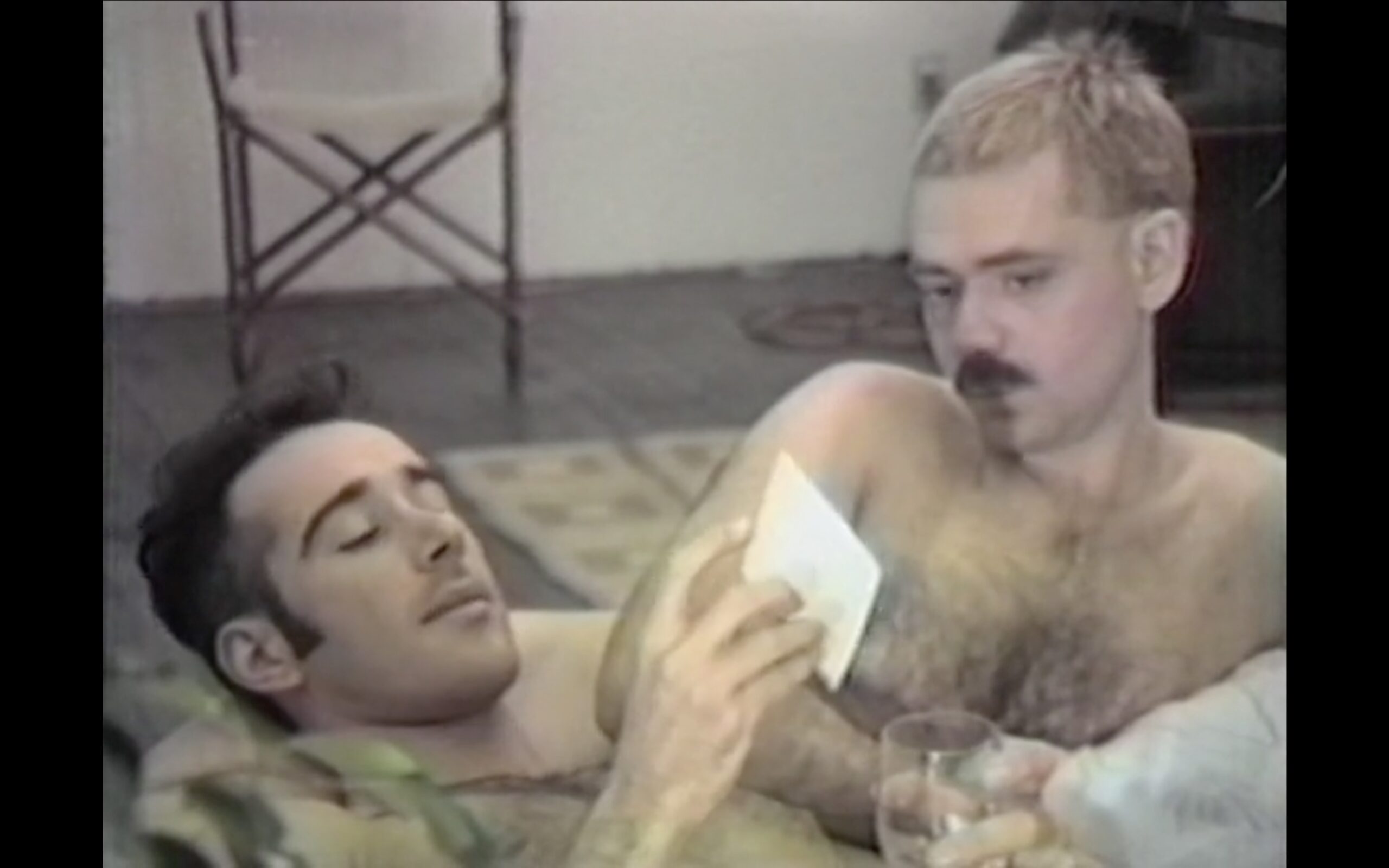
Moscow Does Not Believe in Queers (dir. John Greyson, 1986)
John Greyson is one of the key figures of the Toronto queer scene, a pioneering New Queer Cinema filmmaker and video artist. Since 1984, his many features, shorts, and transmedia works have used humour, song, and re-enactment to explore queer activist issues such as police violence, prisons, AIDS activism, transnational queer love and solidarity, homonationalism, and apartheid (both South African and Israeli). These include Urinal (1988), Zero Patience (1993), Lilies (1996), Uncut (1997), and Proteus (2003). In this conversation, London-based film worker and researcher Misha Zakharov speaks with Greyson about his unique short film Moscow Does Not Believe in Queers (1986). The film was made during Greyson’s ten-day visit to the Soviet Union as part of the Canadian delegation to the Youth Festival for Peace and Disarmament in 1985. A pun on the Oscar-winning Soviet rom-com Moscow Does Not Believe in Tears (1980), Greyson’s film – equal parts playful and scathing and soundtracked by the manically upbeat Talking Heads – attempts to make sense of the decline of Soviet sexual emancipation and the emergence of the queer underground. It features absurdist re-enactments with the early Soviet feminist icon Alexandra Kollontai, footage from local cruising spots, and clips from the Cold War spy thriller Ice Station Zebra (1968), starring Rock Hudson, who was at the time dying of AIDS-related causes – as well as explicit scenes of gay sex, which were meant to combat homophobia and AIDS-related sex stigma and hypocrisy at the time.
Moscow Does Not Believe in Queers screens on 9 April at Pan-Pan Gallery in Birmingham, as part of Carceral Cinema, a two-year project guest-curated by Misha Zakharov in collaboration with Flatpack Festival. Free tickets for this special event can be booked via the Flatpack website. Klassiki is publishing this abridged version of a longer conversation between Greyson and Zakharov; you can read the full text on the Flatpack website.
Very broadly speaking, could you describe the circumstances that brought you to Moscow as part of the Youth Festival in 1985?
It began for me with being a member of the International Lesbian and Gay Organization (ILGA). In 1985, there was a call for the International Festival of Youth and Students for World Peace and Disarmament. I was involved in disarmament politics, as many people were at the time, and within ILGA there was discussion about what it would mean to attend this huge festival of 30,000 students and young people as openly queer participants. In fact, it was quite accessible: if you had $300, you could sign up, provided you represented an organisation. My ILGA group said, “Sure, go and do your thing.” So, it was me and my camera, travelling with the Canadian delegation. The Canadian group met for weeks in advance, learned some Russian, and brought together people from all walks of life. They were intrigued: “Oh, a queer organisation – that’s going to be interesting.” The Canadian Left at that time was, of course, very aware of gay liberation struggles and our fight against the police. There was a broader understanding among progressive movements that queers were part of a wider left-wing movement.
Going to the Soviet Union, everyone was cautious. There was a sense of uncertainty – what was going to happen? As it turned out, there was less censorship than discomfort. For example, I was scheduled to give a talk on queers in the labour movement, but it was moved to a small room that nobody could find, and no one attended. I was, however, able to network and connect with some Dutch delegates – this is documented in the film – who were also trying to raise queer issues. There were perhaps ten of us in total, openly identifying as queer within the entire 30,000-strong conference. So, it became more an exercise in bearing witness than in making direct or meaningful interventions. Still, it was fascinating. I also encountered all sorts of technical problems with my equipment, so I had to reconstruct much of the film from scratch. There was very little usable footage, as you can see.
These elements came together to create a rather eccentric memoir-style essay film about being, essentially, a kid – I was 25 – travelling to the Soviet Union, networking, and trying to discover something of the gay underground at that time. I was able to connect with one of our translators, who was queer and introduced me to a bunch of guys and took me to a gay beach. These were very memorable adventures, but overall, the trip was characterised by a great deal of irony and framed by pop culture, including headlines about Rock Hudson. I became interested in how everything we experience of the world is mediated through the pop culture and mass media of the time, as well as the Cold War context. This was still the Reagan era, and we were deep in the Cold War – four years away from the Wall coming down. It was a fascinating moment to be there. Gorbachev gave the opening address at the youth conference at the big stadium.
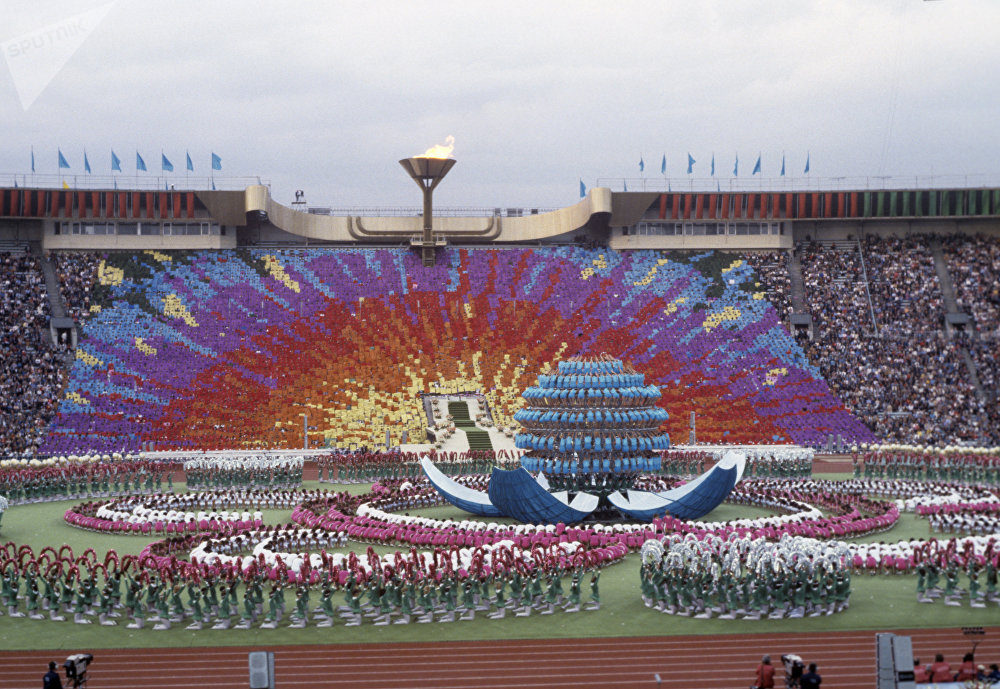
Opening ceremony of the 1985 International Festival of Youth and Students for World Peace and Disarmament
And were you out to the Soviet organisers, or were you there primarily as a Canadian delegate?
No – I was completely out as a delegate. I was representing ILGA; my official name tag said “ILGA, Toronto chapter.” So yes, I was very much out to the organisers, and that, in turn, led to things like being moved into smaller rooms and so on.
There’s currently a surge of work centred on various international events in the Eastern Bloc, such as Free Jazz Communism, an edition focused on the jazz festival in Helsinki in 1962 (organised by Finnish cultural workers, and which became a site of covert ideological struggle between communists and the FBI), or the Tashkent Afro-Asian Film Festival, the second largest in the Soviet Union, which brought together a unique gathering of people from what were then known as the Second and Third Worlds. These international events – youth, music, film, and literary festivals – functioned as a form of soft power and were, in many ways, pro-Soviet PR stunts. At the same time, forms of real, situated solidarity did emerge on the ground. Did you experience any genuine sense of international solidarity at the festival?
My overall experience of that kind of international gathering – whether it was the International AIDS Conference in Montreal in 1989, which we filmed (and where activists actually took over the stage), and which had around 2,000 attendees as opposed to 30,000 in Moscow – is that they are cumbersome, and very little actually happens at them. These events are really about networking. They are spaces where people meet and exchange ideas, but things don’t actually happen at them. There are always official proclamations, press conferences, et cetera. It is all extremely performative from start to finish. In practical terms, very little of it is “real” per se; it is largely constructed. But if you go in expecting that, then the stuff that happens between the lines – in the corridors, or while queuing for coffee – is where the interesting things occur and people meet. And of course, people are hooking up – despite the best efforts of the notorious old ladies at the end of every hallway in the very famous Hotel Cosmos [an iconic hotel just outside Moscow city centre, usually reserved for foreign visitors], trying to prevent people from room-hopping and hooking up.
the stuff that happens between the lines – in the corridors, or while queuing for coffee – is where the interesting things occur and people meet. And of course, people are hooking up – despite the best efforts of the notorious old ladies at the end of every hotel hallway
I guess I was also interested in what you mentioned about befriending members of the queer community, or underground, in Moscow at the time, and that you even stayed in touch with them. You also noted in our correspondence that you returned to Moscow in the late 1980s to premiere your film Urinal (1988) at the Moscow Film Festival. Could you perhaps say a bit more about that as well?
Sure! So, four years later – I’m pretty sure it was 1989, or maybe 1990 – my film Urinal was invited to a special spotlight on sex and cinema at the Moscow Film Festival. This was very much the festival signalling: we’re opening up to the West, we’re opening up to dialogue, and so on. There were some really remarkable films shown, including a new Russian film directed by a woman – something like a Soviet, or perhaps post-Soviet, equivalent of Catherine Breillat. [Greyson is likely referring to The Asthenic Syndrome by Ukrainian filmmaker Kira Muratova, which came out the same year.] During that trip, I also encountered this fascinating underground art collective. Some of them were junkies, and some of them were queer. They were determined to make a kind of collective video-art hybrid essay – I hope I get this right – it was this sort of crazy biography of Fassbinder. I really liked this collective, they were wild.
My other adventure involved our translator, who was quite a character. She insisted on having the Canadian delegation over for champagne and caviar at her house. Like most people, she lived in a state apartment, but hers was filled with White Russian family furniture that she had somehow managed to hold on to through generations. She was hosting this small, informal get-together with Russian champagne – which, as you know, is quite ubiquitous – and caviar. We were waiting outside, assuming we’d be picked up by a taxi or something, because she had said it would be easier if they just came to pick us up. Then a limousine pulled up. A man in the back seat said, “Get in! She’s waiting for us.” We were like, whoa, what’s going on? We got in, and it turned out that he was her boyfriend, and his big agenda was that he really wanted to practice his English. We asked him what he did, and he said, “Oh, I deal in arms and drugs.” And we thought, “Oh, he’s so witty. That’s so funny.” But no – he wasn’t joking. He really did deal in arms and drugs. It was the new Wild West of Moscow at the time.
In many ways, Moscow almost serves as a projection of contemporary fears – about homosexuality, AIDS, the Cold War, and the Soviet Union.
At the same time, it betrays my romance with the early Soviet era, particularly the feminism and queer possibilities of the 1920s, and especially the figure of Alexandra Kollontai. I was recently doing a Zoom with a Polish collective – they were living in a squat, stealing power and Wi-Fi from the building next door, and had decorated the whole space with Christmas lights. They gave me a hard time over my portrayal of Kollontai, asking why I put her in a fur coat. I explained that it was historically accurate – like many Soviet women and feminists of the time, she was very much out there. She was making a statement and transgressing gender norms, asserting herself as a dominant woman who likes lipstick and fur coats. I don’t think any of my films should ever be treated as historical record, but in that case, the portrayal of Alexandra captured something of her spirit – and why we still look to her today. She was an amazing figure.
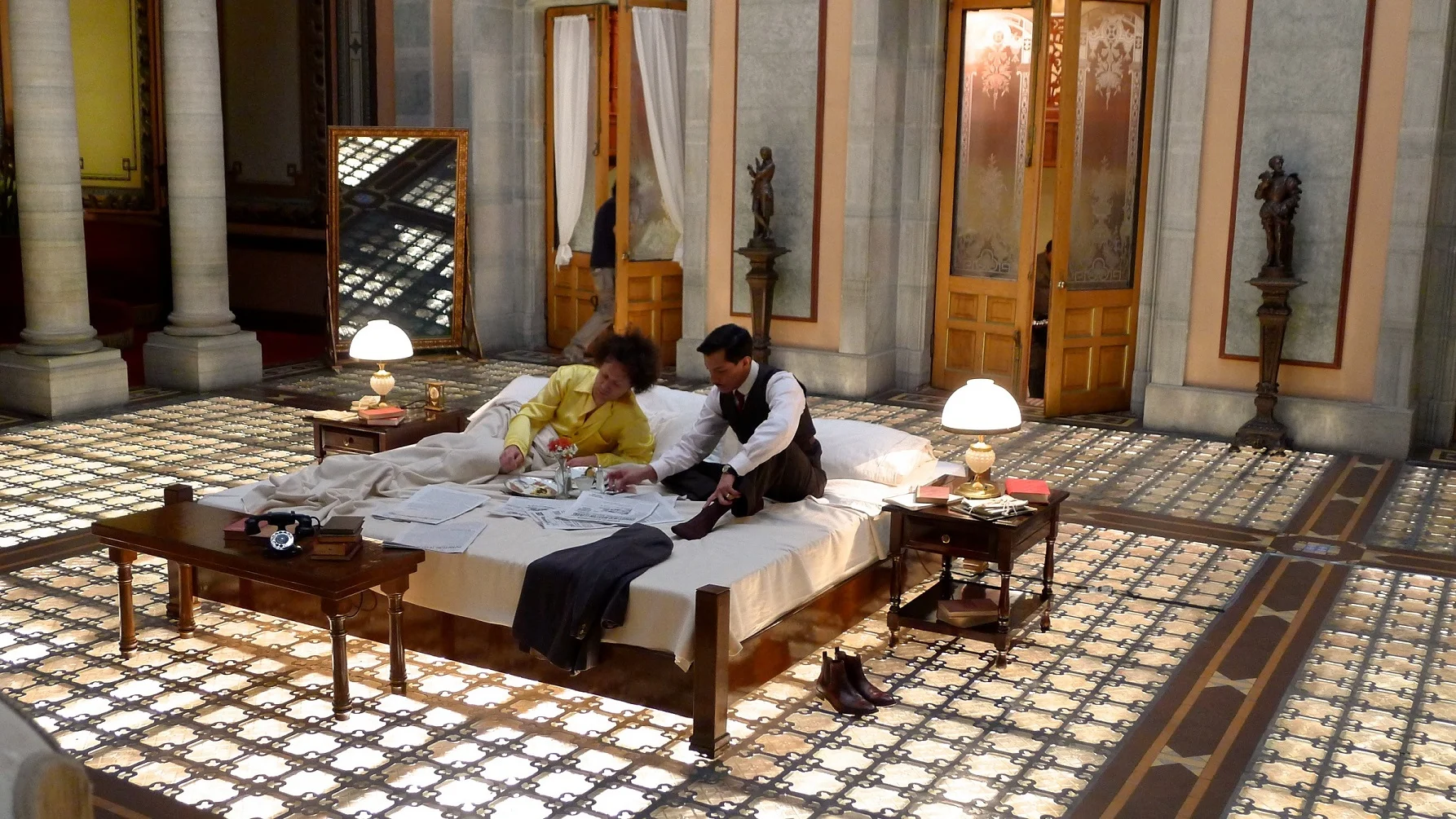
Eisenstein in Guanajuato (dir. Peter Greenaway, 2015)
Another Soviet queer icon referenced in your films is Sergei Eisenstein – in Urinal, for example, where he appears alongside other sexual outlaws and radicals such as Yukio Mishima, Frida Kahlo, and Dorian Gray. Did Eisenstein’s ideas about filmmaking, especially montage, influence you as a filmmaker?
Of course. Montage begins with Eisenstein, and what really excited me was montage inside the frame. Instead of one shot plus another shot producing a third meaning, I became fascinated by what happens when two images share the same frame via split-screen. Split-screen continues to obsess me – people joke that I can’t get through a minute of film without it, and I have to admit, they’re probably right. In October, I’m shooting a feature entirely in horizontal split-screen. The top half will depict 1982, the bottom half 2026, telling the story of when [French philosopher Michel] Foucault came to Toronto and the city experienced Foucault-mania. Foucault will be portrayed by my friend, performance artist Archer Pachawas, and we’re shooting around Halloween.
Returning to Eisenstein, he, like Kollontai, was closely connected to the Global South – he travelled to Mexico, later depicted by Peter Greenaway in Eisenstein in Guanajuato (2015). Did Eisenstein’s politics, especially his engagement with international solidarity, impact you?
Not so much with international solidarity. I found him an utterly inspiring artist and progressive. His politics were part of his internationalism, but they’re not especially reflected in his work, except for ¡Que Viva México!, which exists mostly in stills. Remaking it would be a fascinating queer archival restoration project. It was, as you know, a place where he clearly felt an extraordinary sense of freedom, away from the keepers and the minders and the eyes of the Soviet Union.
Many threads in this conversation connect back to Tom Waugh, the Montreal film scholar, who did some of the earliest work on queer Eisenstein, alongside [British film scholar] Richard Dyer. He’s also a close friend of [Canadian Estonian filmmaker] Steve Kokker [known for his 2003 documentary Komrades about homophobia and homoerotic tensions within the Russian army]. So, there are many pieces of the puzzle, all of which trace back to Tom Waugh’s work and internationalism.
the one thing America and the Soviet Union could agree on during the Cold War was their hatred of gays. So, we thought, let’s give them what they hate
In your tape, you also – and this really runs throughout your filmography – use explicit scenes of gay sex. They reminded me a bit of Barbara Hammer’s Nitrate Kisses (1992), which came out a few years later, where Hammer overlays the Hays Code [a set of industry guidelines for the self-censorship of content in American cinema from 1934 to 1968] on top of two gay men fucking each other. She uses gay sex as a political statement and a kind of militant one. I was wondering, were you also thinking about juxtaposing Soviet homophobia – and the broader systemic homophobia and sexual stigma around AIDS – with these scenes of explicit gay sex?
Exactly. It’s like the one thing America and the Soviet Union could agree on during the Cold War was their hatred of gays. So, we thought, let’s give them what they hate! These disembodied split-screen close-ups of gay sex are very much that provocation: what do they both hate? Well, it’s the homos. Everything else they disagree on, but they love to hate the homos. It’s also about the hysteria around AIDS headlines – trying to make the obvious point that both sides were leveraging homophobia for state ends. It’s a way to mobilise a voter base, to stir fear among a disgruntled or disaffected population.
Moscow feels almost auto-fictional – this distance created by including your alter ego and disembodying yourself, leaving your words voiced by others. Do you think we can trust you as a narrator?
It fits very much into the “me-search” journalism of that era. I wrote for Body Politic and occasionally for FUSE magazine – this was the underground journalism of the time. Adopting a voice that could be ironic, satirical, and campy was part and parcel of New Journalism. I see Moscow as autofiction, absolutely, as New Journalism, absolutely. There’s honesty in it. When someone’s account is eccentric and includes fantasies or dreams, it actually takes you there in a way that’s real, because fantasies and dreams are part of everyday life. I stand firmly by those tactics. Now, we live in a generation where me-search dominates our screens – everyone’s TikToking, narrating their lives. In that sense, there’s a kind of honesty in Moscow precisely because of its campy, layered storytelling.
One final question: Did you ever get to screen Moscow in Russia itself?
No – but just imagine how much fun that would be!
Moscow Does Not Believe in Queers screens on 9 April at Pan-Pan Gallery in Birmingham, as part of Carceral Cinema (2025–26), a two-year project guest-curated by Misha Zakharov in collaboration with the city-wide, community-oriented Flatpack Festival. Free tickets for this special event can be booked via the Flatpack website.
Misha Zakharov is a Russian-born, queer-identifying person of Korean descent as well as a pro-Ukrainian political refugee in the UK. He is a London-based author and film worker, with a particular interest in refugee world-making from below, South-South solidarity, and queer and decolonial perspectives on Eastern Europe, the Caucasus, and Central Asia. He is currently completing a practice-based PhD in Film & TV Studies at the University of Warwick.

 Go back to journal home page