The Klassiki Companion is our beginners’ guide to the key filmmakers, movements, and concepts in the cinema of Eastern Europe, the Caucasus, and Central Asia. As his films return to UK cinemas for a major retrospective this summer, today we introduce the singular world of Béla Tarr: the Hungarian maestro of melancholy whose epic body of work reimagines cinematic time and space.
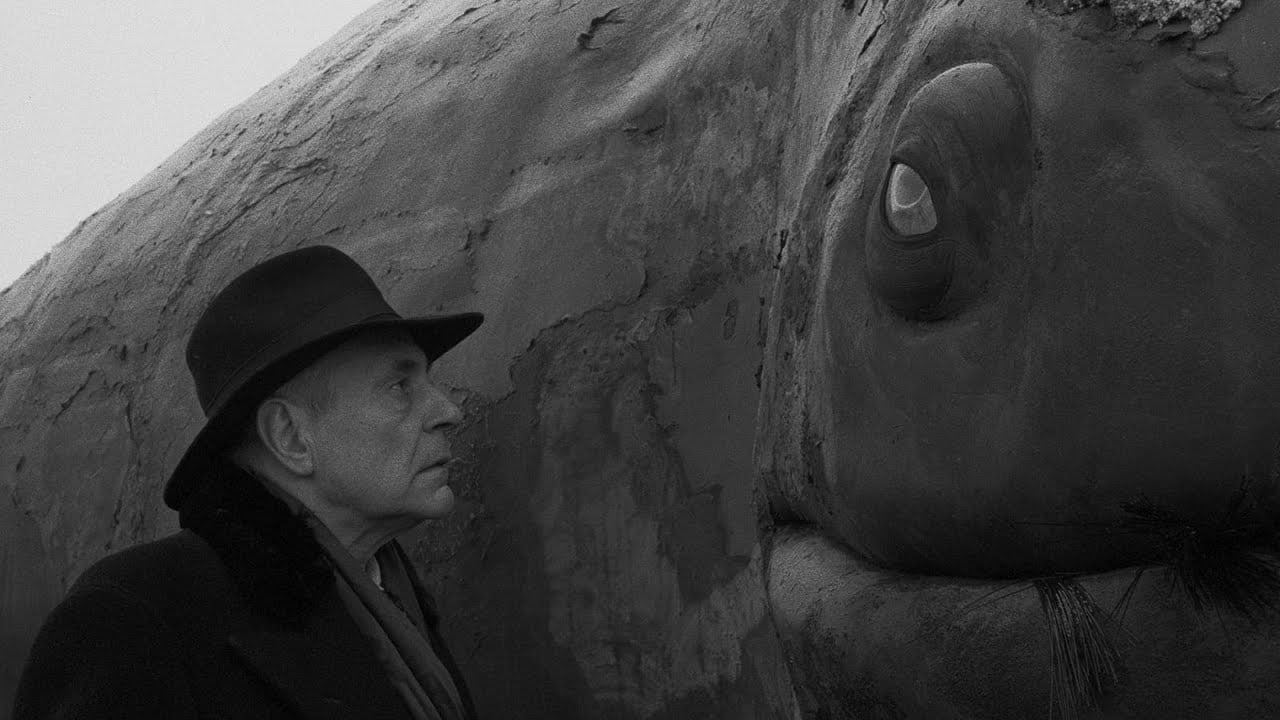
Peter Fitz in Werckmeister Harmonies (dir. Béla Tarr, 2000)
Few filmmakers are as distinct as Béla Tarr. A few seconds of footage would be enough for most cinephiles to recognise the man behind the camera. From his fifth feature, Damnation (1988) onwards, the Hungarian maestro has created a cinematic universe of unique dimensions. Populated by drunks, visionaries, criminals, and lunatics, his films unfold in languorous long takes; the black and white cinematography is exquisite, but it captures a world on the verge of devastation, one in which it is always raining or blowing a gale. The great critic Jonathan Rosenbaum called him “a despiritualised Tarkovsky”, and while his name has become a shorthand for bleakness on film, there is great humour and beauty in his compositions, which draw on the earthy visions of the Dutch masters as well as the genre conventions of American popular cinema.
With a full retrospective of Tarr’s work having recently swept across the UK, now is as good a time as any to revisit his peripatetic career – one defined by frustration as much as triumph – to understand how what the man himself sarcastically refers to as “brand Tarr” came to be. In the words of Rose McLaren, this is “an essentially disproportionate worldview that pits paradox against conventional logic, taste or taxonomy… it proves that beauty can inhere in something as simple as wood grain; and it suggests different ways in which to conceive of, even perhaps accept, cruelty and boredom.” Not that Tarr, notoriously loathe to intellectualise his work, would put it that way. “None of it is meditational,” he told Indiewire back in 2012. “You have to hold everything in your hands. Filmmaking is horrible work and you’re always fighting with the weather, the time, the money situation. When you’re on the set, you have no time for any intellectual effort. You have to just go ahead.” Or, in the more conciliatory terms of an interview conducted just last year: “Our world is what it is, but we’re here to make it better.”
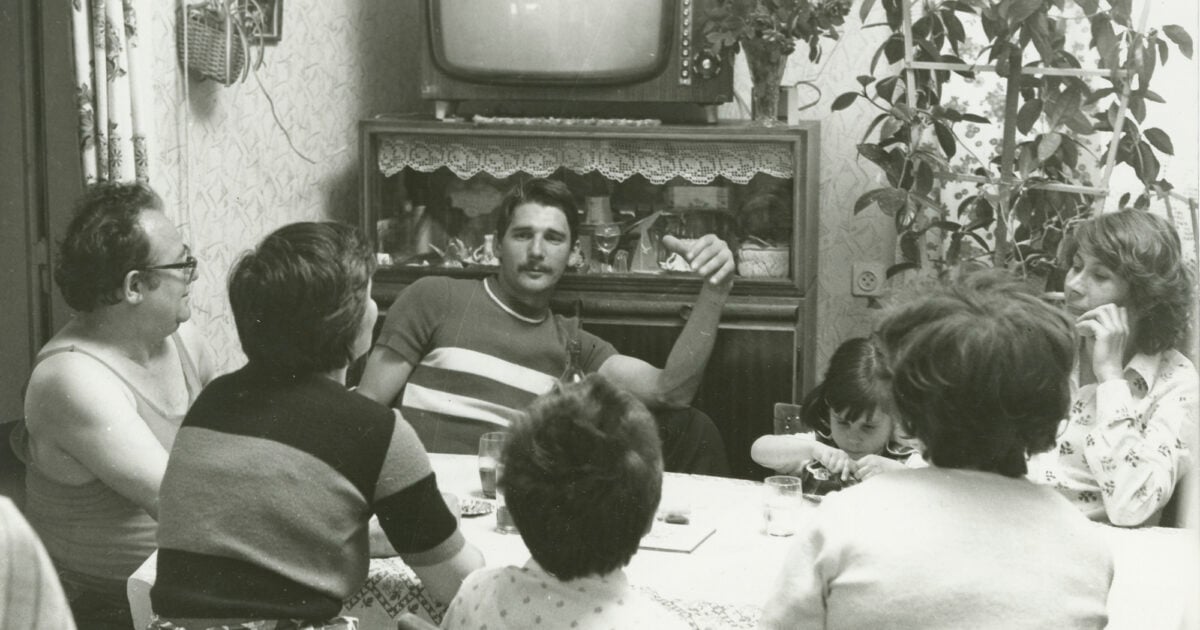
László Horváth (centre) in Family Nest (dir. Béla Tarr, 1979)
Early life and early films
Tarr was raised in Budapest in a theatrical family: his father designed sets and scenery and his mother was a line prompter. At 14, he was gifted a hand-cranked Quartz 8mm film camera; at 16, he produced a kind of guerrilla documentary, now lost, about a group of Roma workers writing to Hungarian General Secretary János Kádár to request permission to travel abroad. The film won prizes at amateur festivals in Hungary and might have stood the young Tarr in good artistic stead, had he not taken it upon himself to hire a projector to screen the film at workers’ hostels around the country without permission. For this act of impudence, Tarr received his first reprimand from the authorities, who let him know that he could forget any plans to attend university in Hungary.
Tarr’s wilfulness was of a piece with what he calls his “far-leftist anarchist” views as a young man. He has claimed that he never carried a schoolbag during the final years of high school, since “Mao’s bible in my pocket was more than enough for me.” Although he was already a devotee of the cinema of Miklós Jancsó – whose sinuous long takes are a clear influence on Tarr’s own work – he planned to study philosophy rather than filmmaking. When that plan was frustrated, he went to work on the Óbuda shipyards for several years. It was in this period that Tarr developed what he termed the “social cinema” of his first features, under the influence of the cinéma verité stylings of the so-called “Budapest school” of non-fiction filmmaking. Emerging from the small, experimental Béla Balázs Studios, this quasi-underground tendency made films on minuscule budgets with amateur equipment and non-professional casts. Their aim was to tackle social issues ignored in more mainstream fare: Tarr’s 1979 debut feature, Family Nest, concerns the housing crisis afflicting working class urban families. Shot in just five days when the director was only 22, the film won awards at the Mannheim festival in West Germany.
Following this unexpected international acclaim, the Hungarian authorities relented and allowed Tarr to enrol at the Hungarian School of Theatrical and Cinematic Arts. While still a student, he produced two more features with Balázs Studios – The Outsider and The Prefab People (both 1982) – which continue his preoccupation with the marginalised and downtrodden. The Outsider stars András Szabó as a depressed hospital worker and part-time musician circling the drain of alcoholism and sexual abandon, while The Prefab People offers a critique of consumerism among the proletariat in its portrait of a young family going off the rails. Watching this trilogy of early films from the vantage point of Tarr’s later canonisation can be disorienting: they bear very little resemblance to the stately, monochrome visions of his mature career. But their black humour and sense of earthy inhabitation are traits that recur throughout Tarr’s oeuvre.
“None of it is meditational. You have to hold everything in your hands. Filmmaking is horrible work and you’re always fighting with the weather, the time, the money situation. When you’re on the set, you have no time for any intellectual effort.”
Experimentation and execution
In a fascinating extended interview released last year, Tarr says of these early films: “When you’re young, you think that there are only social problems and when they are solved, there will be bliss. But then you get older and realise that these problems are not the ontological problems.” In the early eighties, he began to look for new formal approaches to match his deepening philosophical concerns. Along with a handful of other Balázs Studios comrades – György Fehér, András Jeles, Gábor Bódy – he established Társulás, a studio-within-a-studio that had next to no money but allowed plenty of scope for experimentation. After a 1982 adaptation of Macbeth for Hungarian television that played out in a single take, Tarr produced perhaps his most idiosyncratic feature, Autumn Almanac, the following year. A single-location chamber drama about the tensions between a quintet of troubled residents, Autumn Almanac recalls the melodramatic artificiality of Rainer Werner Fassbinder and the jerkily rhythmic editing of the French New Wave, all oblique angles and lurid lighting cues.
While Tarr was still searching for the right stylistic approach to match his increasingly mordant worldview, the pieces of his mature career were now falling into place around him. Since The Outsider, he had worked with the editor Ágnes Hranitzky, who would later become his wife and most intimate collaborator, credited as co-director on his final four features. Autumn Almanac featured the first score by Mihály Víg, from that point on a permanent fixture in the Tarr universe and who would go on to play the menacing lead in Sátántangó. When the novelist László Krasznahorkai was brought into the fold as screenwriter for his next feature, Damnation (1988), the central quartet that would define the Tarr “house style” for the rest of the director’s career was complete.
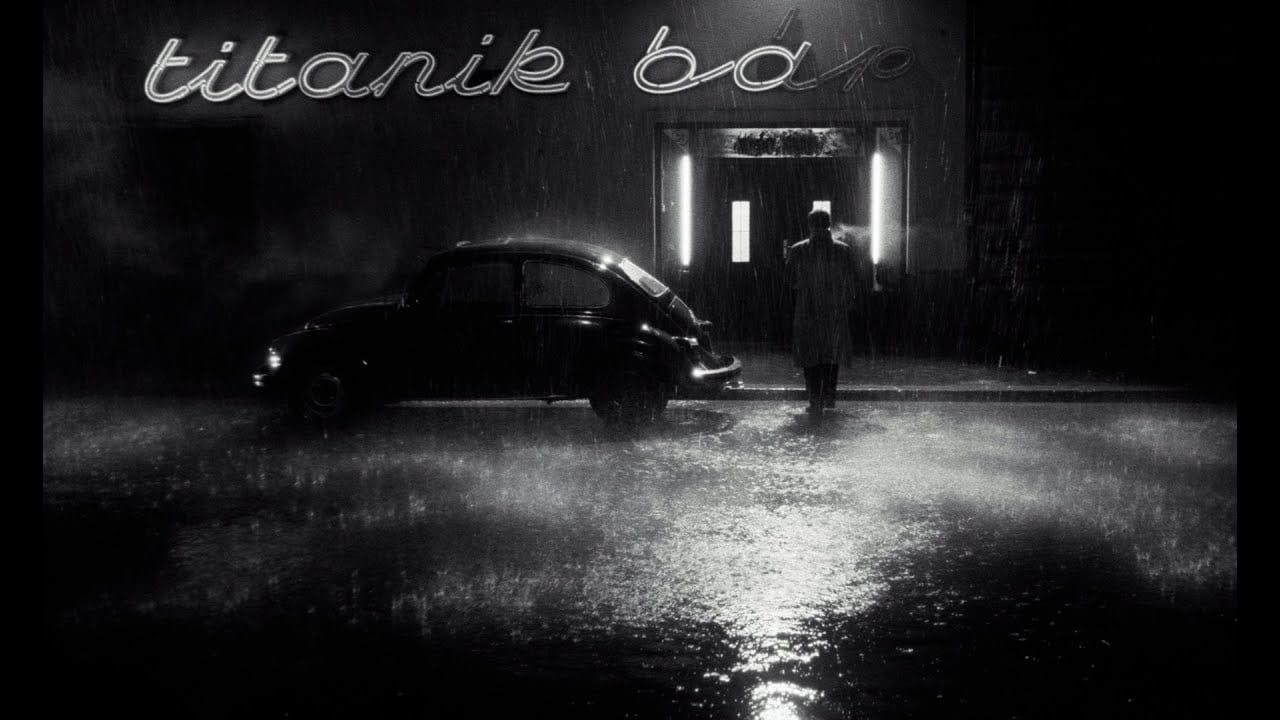
Damnation (dir. Béla Tarr, 1988)
Before then, however, Tarr had to face what he has since called “the darkest period of my life”. In the space of 12 months, Társulás turned out three radical features – Almanac, András Jeles’ Dream Brigade, and Gábor Bódy’s The Dog’s Night Song – that pushed the envelope too far for the authorities. Társulás was “executed”, in Tarr’s words, and its filmmakers disbanded. Before the studio was shuttered, Tarr and Krasznahorkai had already received approval to proceed with their adaptation of the latter’s debut novel Sátántangó; now, that project was left floundering. Desperate to pull his friend out of a spiralling depression, Krasznahorkai suggested that they distract themselves by working together on the script that would become Damnation: a brooding blend of genre elements (noir, western, even musical). Here, at last, we witness the first full bloom of the now-instantly recognisable “brand Tarr”: harshly lit black and white cinematography; exhaustingly long takes realised through ingenious camera choreography; visions of a provincial, somehow timeless Hungary populated by the doomed remnants of a collapsing social order.
Knowing better than to go to the state film body for approval, Tarr and Krasznahorkai instead cobbled together the money for the shoot from an advertising studio and untapped restoration funds from the national archive. The result, in Tarr’s eyes, was Hungary’s “first independent film”. When representatives of the Berlinale asked to screen it at the 1989 edition of the festival, the Hungarian authorities were thrown for a loop; they didn’t even know the film existed. Damnation was a hit, and Tarr and Hranitzky were offered the chance to move to West Germany. As state communism crumbled in Hungary and across Eastern Europe, the pair used their newfound freedom to lay the foundations for their next project, one that would go on to define Tarr’s career: a wildly ambitious return to Sátántangó.
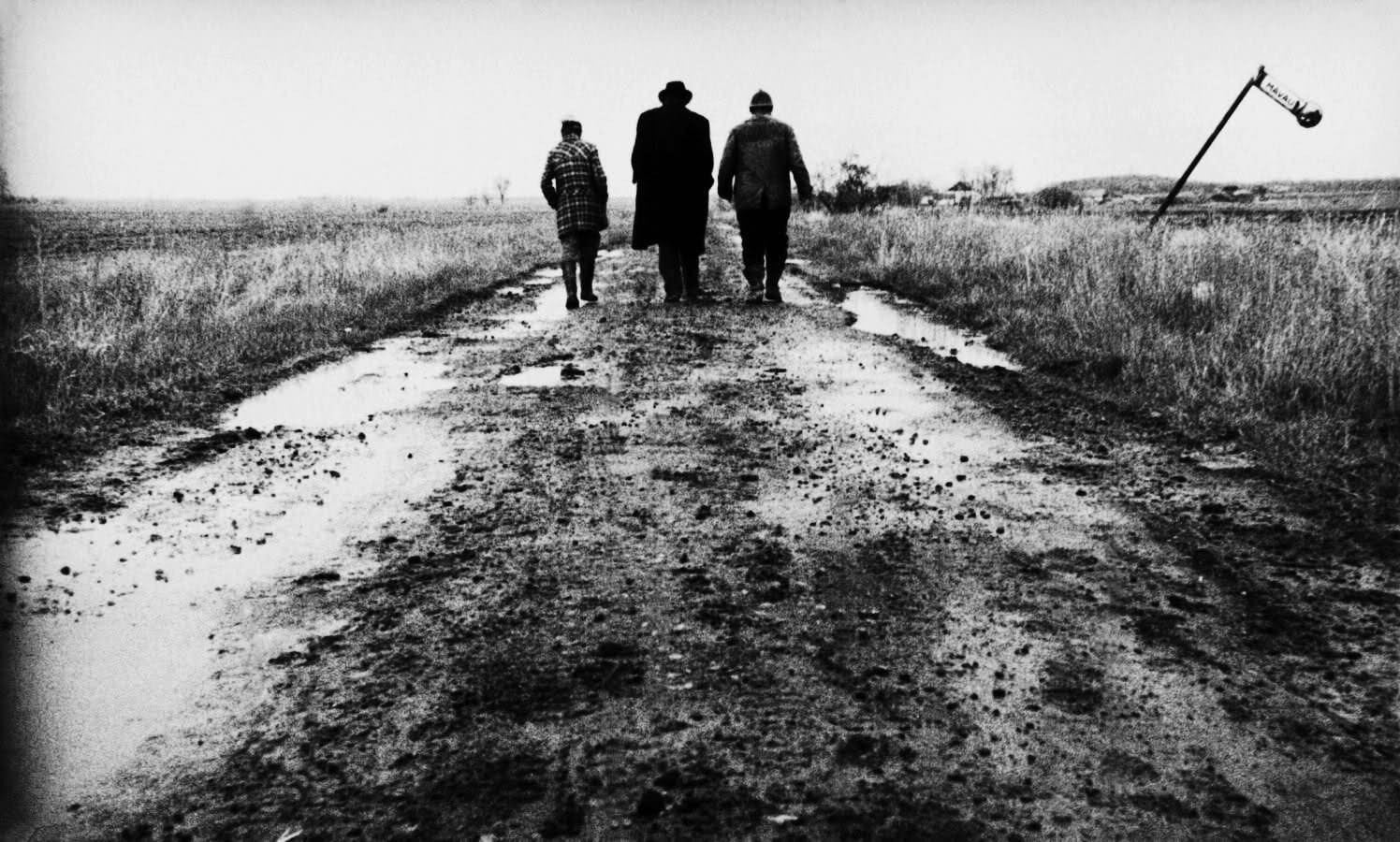
Sátántangó (dir. Béla Tarr, 1994)
Sátántangó and beyond
30 years after its release, Sátántangó (1994) stands alone as the great summation of Tarr’s work: an exercise in duration that moves to its own hypnotic rhythm, a reckoning with the political system under which he lived half his life that finds cosmic significance in the squalor that envelops its despondent cast of characters. Over seven and a half hours, we follow the interweaved stories of a group of collective farm workers who abandon their homes to follow a menacing, cultish figure named Irimiás (Mihály Víg), rumoured to have returned from the dead. There is true horror in the film – not least in the sequences involving the disturbed young girl played with inscrutable intensity by Erika Bók – but also a rich seam of black humour to go with the sheer beauty of Tarr’s elegantly unspooling compositions.
The film also represented the apotheosis of Tarr’s collaboration with Krasznahorkai. The author had based the 1985 novel on his own experiences living and working in Hungary’s “Great Plain” lowlands during the dying days of state agriculture. Tarr and his crew spent two years traversing the derelict Plain to scout locations and cast locals – and experience that the director credited with forcing him to reimagine his own cinematic language. “When I went, I understood the people in his novel in a totally different way from what I read… I had to develop a new film language, or find a way to film this reality.” Tarr’s great achievement in Sátántangó is to imbue the “hopeless inadequates” and “agricultural proletarians” who populated the landscape with dignity, even while documenting their spiritual decline.
“A filmmaker is a nice bourgeois job, but I really don’t want to do it. I’m not a real filmmaker. I’ve always been in it for the people and just wanted to say something about their lives.”
Tarr’s next feature, Werckmeister Harmonies (2000), was another Krasznahorkai adaptation, this time from the 1989 novel The Melancholy of Resistance. At a mere two-and-a-half hours, the film is a concentrated, intoxicating evocation of the writer-director duo’s philosophy of social collapse; the elliptic plot concerns a holy fool of a young man (played with wide-eyed naivety by street musician Lars Rudolph) whose hometown falls under the spell of a demagogic circus barker known as “the Prince” who rides into town with the carcass of a stuffed whale in tow. The film features some of Tarr’s most gruelling imagery, as well as moments of sincere emotional heft.
Werckmeister Harmonies was a troubled production, completed in fits and spurts as funding was found and lost over a six-year period (the final version has seven credited cinematographers). Another painful gestation period was to come before Tarr’s next feature, the Corsica-set Georges Simenon adaptation The Man from London (2007). The suicide of the film’s producer Humbert Balsan just days before shooting began plunged the international co-production into financial chaos. The final product lacks the feverish intensity of Tarr’s more famous works but remains a rewarding outlier in his later filmography: a noirish detective story set on the mist-drenched docks of Bastia, in which the narrative intrigue of the source material is swapped for a draining sense of dislocation.

Erika Bók and János Derzsi in The Turin Horse (dir. Béla Tarr, 2011)
The Turin Horse and “retirement”
Tarr’s next feature arrived in his old stomping ground of Berlin in 2011, where it won the Silver Bear for direction. That premiere also came with an announcement from the director: The Turin Horse was to be his final film. “A filmmaker is a nice bourgeois job,” he explained in 2012, “but I really don’t want to do it. I’m not a real filmmaker. I’ve always been in it for the people and just wanted to say something about their lives. During these 34 years of filmmaking, I’ve said everything I want to say.” Tarr and his collaborators had refined their style to the limits of their capabilities; not wanting to rest on their laurels, they walked away.
Based on a prose piece by Krasznahorkai rather than a conventional screenplay, The Turin Horse takes as its departure point an apocryphal anecdote about Friedrich Nietzsche, who was said to have suffered a nervous breakdown after witnessing a horse being beaten on the streets of the titular Italian city. Described in later years by Tarr as “a negative creation myth”, the film is a paragon of minimalist world-building, covering six days in the lives of a father and daughter (Tarr faithfuls János Derzsi and Erika Bók) eking out an existence amidst the howling gales of a deserted plain. This is Tarr at his most simple and therefore his most profound, operating at the level of a Buddhist koan: we have no choice but to go on living, even though life itself is an impossible task.
“If you are really pessimistic, you go up to the roof and hang yourself, not wake up at four in the morning and go into the countryside to film!”
At this point, Tarr had intended to move into production, with the aim of supporting younger filmmakers in Hungary – a plan that was abruptly halted by the obstructive bureaucracy of Viktor Orbán’s nationalist government. Instead, Tarr decamped to Bosnia, where in 2012 he established film.factory at the Sarajevo School of Science and Technology. Blending the spirit of his activist past with his latter day status as an arthouse luminary, film.factory was envisioned as a kind of academy where young filmmakers and theorists could interact and learn from Tarr and a host of visiting professors. It was shuttered in 2016 for lack of funds, although many of its graduates have gone on to promising careers; Tarr himself was an executive producer on the 2021 title Lamb by Valdimar Jóhannsson, one of his former students.
A handful of projects have emerged in the years since film.factory closed down: most notably short films and multimedia pieces for exhibitions in Amsterdam (2017) and Vienna (2019) about migration and homelessness respectively. But Tarr has receded into the background of contemporary film discourse, a reference point now rather than an active participant. As his singular oeuvre returns to UK screens, it is more important than ever to look past its bleakness to the sincere message of hope that underpins all the rain, mud, and alcoholic reverie, and which the director himself beautifully summarised in a recent interview: “If you are really pessimistic, you go up to the roof and hang yourself, not wake up at four in the morning and go into the countryside to film! I only ask this – how did you feel when you came out of the movie theatre after watching my film? Did you feel stronger or weaker? That’s the main question. I want you to be stronger.”
Watch Werckmeister Harmonies on Klassiki now and explore our full collection of Hungarian films here.


 Go back to journal home page