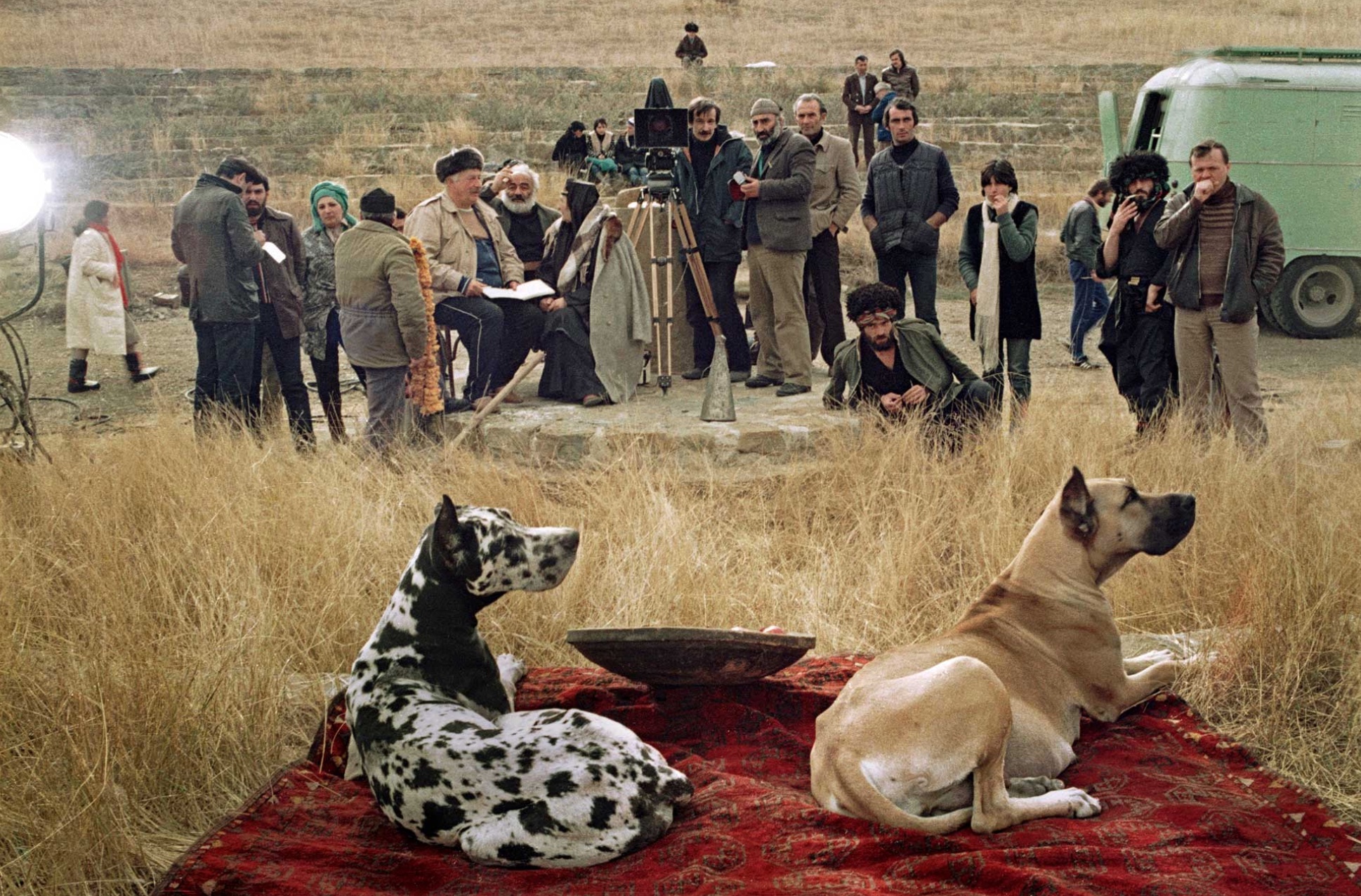
Sergei Parajanov and crew on the set of The Legend of Suram Fortress. Image: Iuri Mechitov
Sergei Parajanov was a cosmopolitan in the true sense of the word. An Armenian born in Tbilisi as Sarkis Parajanian, he studied in Russia, made his name in Ukraine, and ended his career in Azerbaijan. Thanks to a peripatetic life both permitted by the USSR’s vast territory and enforced by his brushes with the authorities, Parajanov has the rare distinction of occupying a central position in the pantheons of three different national film traditions. His Shadows of Forgotten Ancestors (1965) helped to reinvigorate post-war Ukrainian film with its folk-modernist reimagination of Hutsul culture, kickstarting the domestic movement known as “poetic cinema”. He is revered in Georgia – where he was born in 1924 – for The Legend of Suram Fortress, his 1985 adaptation of the nineteenth-century folklorist Daniel Chonkadze which marked his return to filmmaking after 15 years of censorship and imprisonment. His final completed feature, 1988’s Ashik Kerib, is a tribute to the folk legends of Azerbaijan. And The Colour of Pomegranates (1969), his most singular masterpiece, about the medieval bard Sayat-Nova, is one of the greatest accounts of the classical culture of his ancestral homeland of Armenia. As the man himself once said: “Everyone knows that I have three Motherlands. I was born in Georgia, worked in Ukraine, and I’ll die in Armenia.”
The singular style that Parajanov developed in his mature works offers a formal reflection of this hybrid life. With Shadows, he renounced the conventional dramas of his early career, delighting in the vibrancy and folkloric narrative swerves of his Hutsul source material. From Pomegranates onwards he honed a still-unparalleled “syncretic” cinema – that is, one that seeks to reproduce the affective power of a range of art forms, from iconography to modern painting, traditional and classical music, poetry, and textiles. What results are the signature Parajanov “tableaux” that constitute his later films: living, three-dimensional dioramas that reduce plot points to dynamic symbolism, bound together by the director’s irrepressible romanticism and surrealistic flair. In his art as in his life, Parajanov was not one for hard-drawn borders or boundaries.
“Everyone knows that I have three Motherlands. I was born in Georgia, worked in Ukraine, and I’ll die in Armenia”
The layman’s view of Soviet cinema is that any such formal bravado was instant cause for crackdown; Parajanov suffered more than most for his art, although his persecution cannot be solely put down to the supposed subversiveness of his art alone. His sexuality (we would likely label him bisexual today) and his support for Ukrainian nationalism had as much to do with it. His relationship with the Soviet authorities was not always adversarial – ironically, Shadows of Forgotten Ancestors, his contribution to the cause of Ukrainian cinematic separatism, had won numerous Union awards – but as his filmic style became more concertedly idiosyncratic, he was submitted to increasing pressure. He was eventually arrested in 1973 on charges of rape, homosexuality, and bribery and served four years in labour camps. Two more arrests followed, the final stretch in a Tbilisi prison coming in 1982, with the director persona non grata with the studio apparatus even when not behind bars.
Paradoxically, Parajanov owed his late career resurgence to the intervention of a Soviet chief: Eduard Shevardnadze, Party General Secretary and later President of Georgia, who suspended his final sentence and gave him a position at the country’s state studio. (Shevardnadze had form in this regard: he was also instrumental in allowing his compatriot Tengiz Abuladze to complete work on his controversial 1984 masterpiece Repentance, the first Soviet film to directly treat the question of Stalin’s purges.) Combined with the backing of acclaimed actor Dodo Abashidze – technically the co-director of Suram Fortress and Ashik Kerib – Parajanov was able to complete his last two features before his premature death in 1990. So it was that Parajanov’s final flourish as a filmmaker came back in the Caucasus, in the country of his birth, if not his Armenian homeland. In this context, the two films make for fascinating comparative viewing: two visions of Caucasian artistic and narrative traditions, both unmistakably Parajanovian but pulling in different directions.
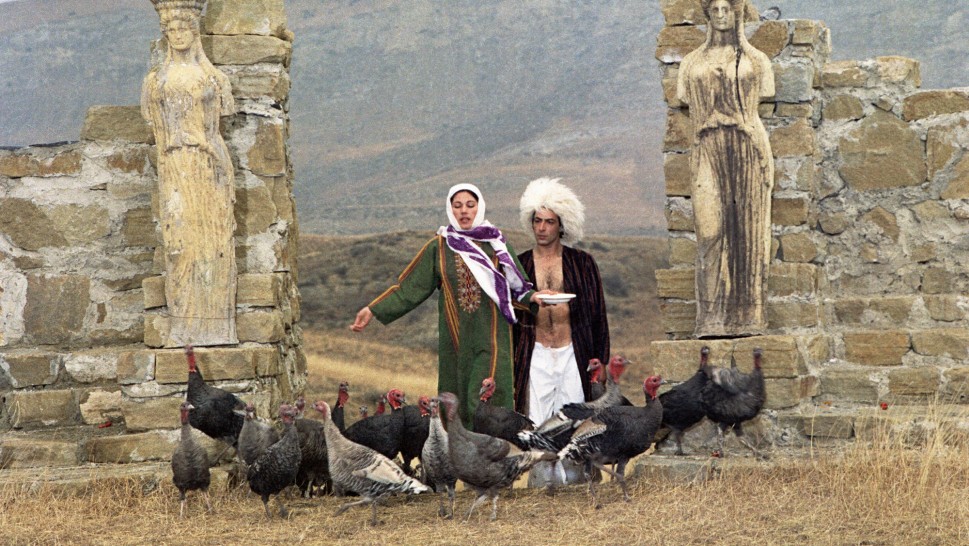
The Legend of Suram Fortress (dir. Sergei Parajanov, 1985)
In keeping with almost all of his post-Shadows work, the two films draw on and blend together layers of source material both native and imported. The Legend of Suram Fortress adapts folklorist Daniel Chonkadze’s 1860 reworking of a Georgian national legend. Ashik Kerib is based on the 1837 short story of the same name by Mikhail Lermontov, Russian Romantic poet and orientalist adventurer par excellence, and a long-time favourite of the director. Lermontov in turn adapted his text from a Tartar transcription of a romantic dastan – a form of oral epic, typically relating heroic deeds, popular across Transcaucasia, Central Asia, Turkey, and Iran.
Both films, too, are marked by a strange mix of convolution and abstraction when it comes to plot. In Suram Fortress, Parajanov unfurls two narrative strands at once, one taking place in the present and one in the past. The first concerns a wilful young serf named Durmishkhan (Zurab Kipshidze) who abandons his lover for a richer wife; the spurned woman then re-emerges as a seer (played by Georgian screen icon Sofiko Chiaureli) warning that Durmishkhan’s son Zurab must brick himself up in the foundations of the crumbling titular fortress in order to save Georgia from invading armies. In flashback, we also learn about the life of the Muslim merchant Osman-Agha (Abashidze) – revealed to be a Georgian Christian who abandoned his faith long ago. Meanwhile, Ashik Kerib relates the adventures of the eponymous minstrel (Yuri Mgoyan), who is forced to wander the land for 1,001 days and nights, lute in hand and guarded by the spirit of Saint George, to earn the dowry needed to marry the daughter of a wealthy nobleman. In both cases, parallel storylines and characters mirror one another intersect at crucial moments – but in Parajanov’s dioramic staging, it is easy to lose the narrative thread in a sea of aural and visual pleasure as events are transfigured into symbols and perspectival play.
“The allegories in Ashik Kerib are on a child’s level. They are not philosophical. If you are a poet, armour will interfere with your song; if you see the blind, give them a caress”
So, we have two tall tales, one Georgian and one Azerbaijani, although both originate in oral traditions that traverse nominal national borders and are reworked by nineteenth-century authors before being anachronistically reimagined by Parajanov and co. If the director ended his career with a double-headed meditation on Caucasian culture, then what is the vision of the region and its nationalities that emerges?
This is where a compelling tension arises. In one sense, The Legend of Suram Fortress speaks to the remarkable consistency of Parajanov’s cinematic sensibility, retained across long years of repression. But it also stands out in his filmography as unusually politically strident and wedded to a national (and nationalist) ideology. The legend at its heart is about the painful struggle for Georgian independence; indeed, it is dedicated to those who have fought for that cause. Much of the narrative intrigue (such as it is) revolves around the Durmishkhan and Osman-Agha’s decisions to renounce their native Orthodoxy in favour of politically expedient Islam. The titular fortress requires an act of wilful human sacrifice to bolster the military defences of the people. In the words of Emma Claire Foley, “under the pageantry, there’s an edge of brutality.” Perhaps this harsher edge reflected the cruelty that had been inflicted on Parajanov in the previous decades, as well as a necessary genuflection to the political powers in Georgia that had allowed him to work at this scale once again.
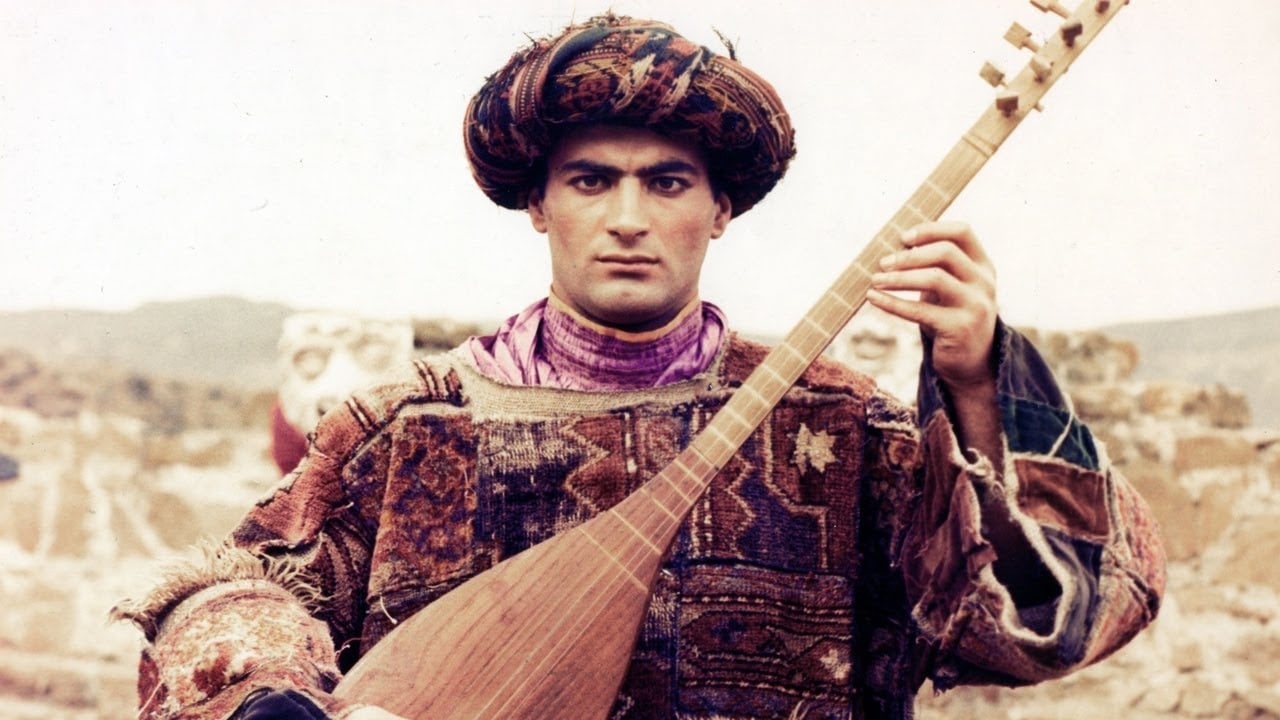
Yuri Mgoyan in Ashik Kerib (dir. Sergei Parajanov, 1988)
By contrast, Ashik Kerib fully matches its syncretic formal approach to an open-ended understanding of “national” folk traditions, presenting the native cultures of the Caucasus as a set of intertwined and mutually influential worlds, all brimming with colour, tragedy, and comedy. Although once again produced under the auspices of the Georgian national studio (and featuring a returning Chiaureli), the film was shot near Baku with a crew of local collaborators. The costumes, by Eka Magalashvili, are typically exquisite recreations of historical Azerbaijani fabrics, and the Azerbaijani composer Cavanşir Quliyev fashions a soundtrack that incorporated the pan-Turkic classical music known as mugham alongside traditional bard songs. Given all that has occurred between Armenia and Azerbaijan in the years since the collapse of the Soviet Union, it’s a strangely touching spectacle of international collaboration. (In this sense, Parajanov’s late career recalls the unlikely adventures of Hamo Bek-Nazaryan, “the father of Armenian film”, who worked across the Caucasus, including on The House on the Volcano (1928), his account of revolutionary activity in the Baku oilfields.)
At this twilight moment in his life, Parajanov seems to have rejected division and strict identification. Before he died, he gave full expression to his cosmopolitanism. Ashik Kerib is an Azerbaijani film and a Transcaucasian story, but it unfolds in the uncanny world of its creators’ imagination rather than concrete time and space. Indeed, Parajanov is at his most anachronistic here, adding bursts of electronic music and Schubert to soundtrack, arming extras with sub-machine guns. It seems likely that this dissolution of borders was linked to a growing awareness of mortality. The director was in poor health, plagued by health issues that had been exacerbated by the harsh conditions of his various imprisonments. The film is dedicated to Parajanov’s friend Andrei Tarkovsky, who had died of cancer two years previously in Paris. Parajanov himself died in 1990, before he could finish his next feature, The Confession – and before the final fall of the Soviet system with which he had had such an antagonistic relationship. When asked to explain the meaning buried within the exquisite images of Ashik Kerib, he insisted in the final instance upon moral and aesthetic simplicity and sincerity: “The allegories in Ashik Kerib are on a child’s level. They are not philosophical. If you are a poet, armour will interfere with your song; if you see the blind, give them a caress.”
Perspectives on Parajanov is available now on Klassiki. Subscribers can also watch a restoration Parajanov’s short film Hakob Hovnatanyan, as well as exploring our full collection of titles from the Caucasus here.
Listen to our podcast marking the centenary of Parajanov’s birth here.


 Go back to journal home page