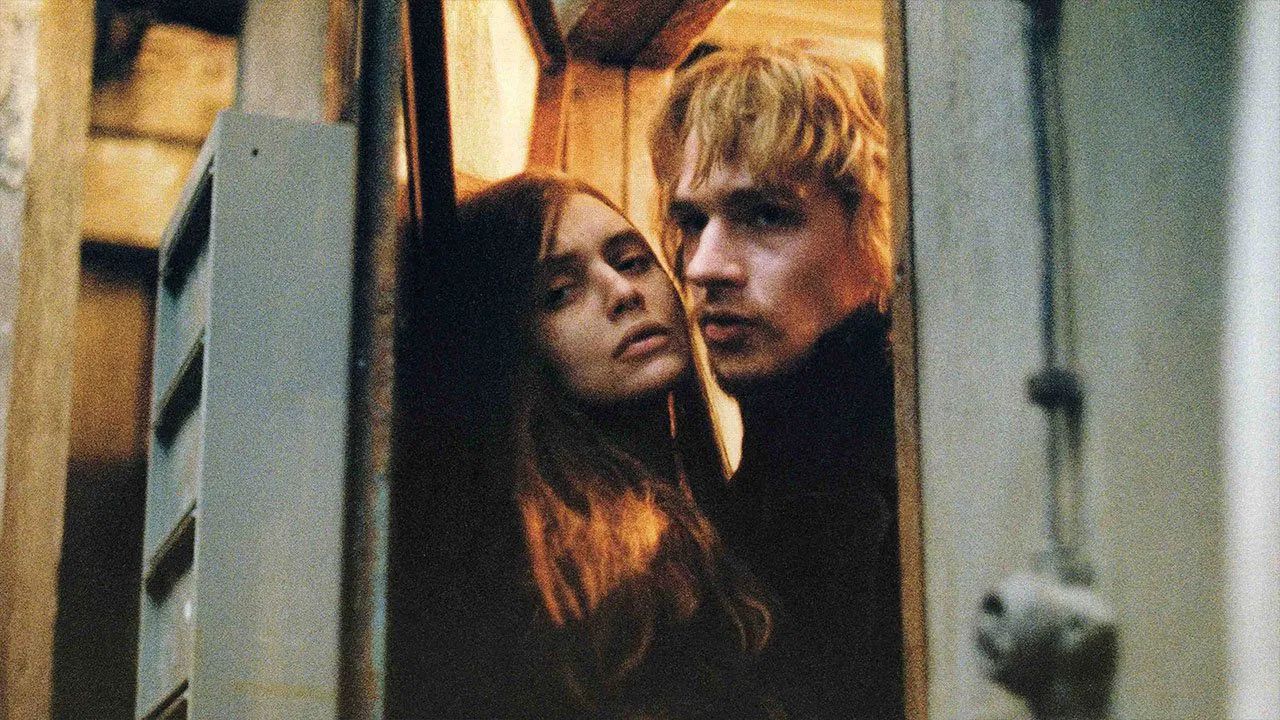
Yekaterina Golubeva and Guillaume Depardieu in Pola X (dir. Leos Carax, 1999)
Yekaterina Golubeva (1966-2011), or Katia, as she’s affectionately known among her fans, was a Russian-born actress who spent nearly half of her tragically short life between France and Lithuania, and whose spectral screen presence, at once ethereal and ferocious, continues to fascinate cinephiles – even more so after her untimely death at the age of 44. An unconventional muse to directors associated with the New French Extremity, Golubeva was notable for her portrayal of largely silent, often nameless characters who are always on the move: in Claire Denis’s I Can’t Sleep (1994), her one-time partner Leos Carax’s Pola X (1999), and Bruno Dumont’s Twentynine Palms (2003). Other films are haunted by Golubeva’s spirit, like Carax’s Holy Motors (2012) and Annette (2021), in which the characters played by Kylie Minogue and Marion Cotillard can be seen as stand-ins for Golubeva in Carax’s densely autobiographical narratives.
In the late 1980s, while studying at the Gerasimov Institute of Cinematography – the leading film school in Russia, also known as VGIK – Golubeva met the Lithuanian director Šarūnas Bartas, whom she later married. She acted in three of his films made in the 1990s (Three Days (1991), The Corridor (1995), and Few of Us (1996)) and co-wrote one titled The House (1997). She reportedly wrote both prose and poetry, though these remain to be rediscovered. Very little in general remains of Golubeva apart from her films. She gave very few interviews and maintained an extremely low-key persona, despite appearing in some of the most scandalous films of the late 1990s and early 2000s, which gained notoriety for their explicit depictions of violence and sexuality. Both of her partners in life and film, Bartas and the French director Leos Carax, with whom she made Pola X, are similarly reclusive.
Golubeva’s screen persona was associated with states of transition and movement… Despite the intimate nature of her films, this persona can be viewed as a symptom (and byproduct) of a much larger context: the collapse of the Soviet Union
In Natalija Ju’s documentary about her life, I Am Katia Golubeva (2016), a few prominent members of the Russian alternative arts scene of the 1990s, with whom Golubeva collaborated at various stages of her career – including the musician Andrei Makarevich and the theatre and film director Kirill Serebrennikov – highlight Golubeva’s beauty, sense of mysticism, and volatile emotional behaviour. She was indeed of indescribable, haunting beauty, something that her character’s great aunt jokes about in I Can’t Sleep: “Look at you, you’re a real beauty. When you don’t know how to do anything, beauty can be of big help.” She was also extremely photogenic, saying very little while mostly communicating through her looks and facial expressions. There may have been two reasons for this non-verbal style of acting: first, her lack of fluency in foreign languages in the early stages of her career, and second, the filmmaking methods of the directors she worked with, as they relied primarily on the representation of the body (like Denis and Dumont) or on intense visual imagery (like Bartas and Carax).
In Denis’s I Can’t Sleep, Golubeva plays Daiga, a Lithuanian immigrant who moves to Paris with the dream of becoming an actress. In this role, she mostly speaks Russian and, to a lesser extent, broken French. In Carax’s Pola X, she’s again in Paris, portraying Isabelle, a self-destructive war refugee, possibly of Romanian – or perhaps Romani – origin. Her character is introduced via an extended monologue, which she delivers in grammatically incorrect French. This linguistic tic does not provincialise Golubeva as an actress or deprive her of her agency; rather, she effectively co-authors her character through this broken language, distorting and recontextualising the original speech of her character from Herman Melville’s 1852 novel Pierre; or, The Ambiguities, on which the film is based. Lastly, in Dumont’s Twentynine Palms (2003), in which she plays Katia, a Russian woman travelling to the titular town in the American desert, her character only speaks French. This is despite her embarking on a road trip across the states with her American boyfriend, David, a photographer who, in turn, speaks very little French.
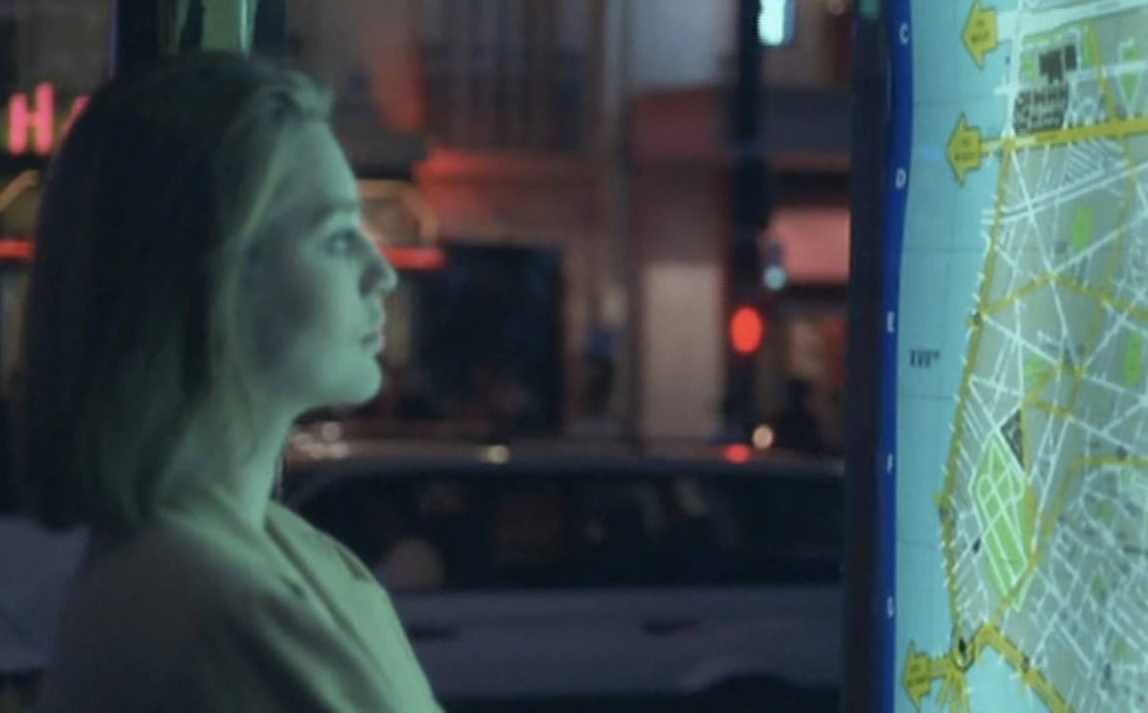
I Can’t Sleep (dir. Claire Denis, 1994)
From its inception, Golubeva’s screen persona was associated with states of transition and movement. In the music video for a song fittingly titled ‘Between Things Past and Things to Come’ by renowned Russian rock band Time Machine, Golubeva is seen in tunnels, metro trains, and on underground escalators, in a perpetual state of walking and exhaustion, shot in a hauntingly poetic time-lapse. I Can’t Sleep is framed by scenes of Golubeva arriving in and leaving Paris in her old car with a Lithuanian plate, mocked by the police officers who constantly harass her. In Twentynine Palms, the dysfunctional relationship between Golubeva’s character and her American boyfriend is subtly reflected in their bickering over who should be behind the steering wheel. In Pola X, her character is often associated with trains, which she and her brother-lover, portrayed by Guillaume Depardieu, take while commuting between the perilous urbanity of Paris and the idyllic French countryside, as well as with boats – one of which she jumps from in a suicide attempt.
In all three films, Golubeva is presented as decidedly “other”. Depending on the story and the director’s vision, Golubeva’s characters appear modern or pre-modern, fleshed out and realistic, or ethereal and exoticised. Denis stages her otherness through blocking, placing the actress off-centre and, in one iconic shot, beside a glowing map of Paris. Carax uses close-ups, often sexualised, to accentuate the foreign beauty of this supposedly Romanian woman. And Dumont depicts two lovers who are strangers to each other and to the ominous desert that surrounds them. Here, Katia appears as an outsider not only in relation to David but also to the very landscape she inhabits. Neither definitively Russian nor Lithuanian, French nor Romanian, Slavic nor Romani, Golubeva embodies the amalgam of the Eastern European outsider. Despite the intimate nature of her films, her screen persona can be viewed as a symptom (and byproduct) of a much larger context: the collapse of the Soviet Union. Daiga in Denis’s film is an emancipated woman acutely aware of her position as an Eastern European migrant labourer in the aftermath of the USSR’s dissolution; Denis humanises Golubeva’s character, creating an entire universe of other post-Soviet immigrants around her and openly acknowledging the economic realities of the era. Golubeva’s filmography includes many characters who are exoticised themselves or appear in exotic landscapes: Bartas’s Few of Us (1996), where she appears in the Sayan Mountains of Siberia, visiting a nomadic Tofalar tribe; Jacco Groen’s Solina (1994), where she portrays a nomadic woman with a bodily deformity; Denis’s L’Intrus (2004), in which she appears in a range of global settings, most notably a snow-covered landscape reminiscent of Siberia (filmed in the Jura Mountains on the French–Swiss border).
Neither definitively Russian nor Lithuanian, French nor Romanian, Slavic nor Romani, Golubeva embodies the amalgam of the Eastern European outsider
Most of the directors Golubeva worked with were white, male Europeans with a deeper understanding of the countries in which she was working and the languages she was expected to speak, leading to an inherent power imbalance. This was further complicated by her frequent collaborations with romantic partners. Yet many subtle clues suggest that Golubeva co-designed her characters: in I Can’t Sleep, her surname is Bartas, and at one point she states that she is “Šarūnas’s granddaughter”. Additionally, Bartas, Denis, and Carax formed a tight-knit circle linked by Golubeva’s presence in their respective cinematic worlds and appeared in each other’s films: Bartas appears in Carax’s Pola X and Denis’s Bastards (2013), and Carax appears in Bartas’s The House. This seamless interplay between life and art suggests both the deeply personal nature of these films and, at its most extreme, the potential dangers for those who find it increasingly hard to separate film from reality.
While her infinitely more successful American counterparts, such as Christina Ricci or Winona Ryder, rose to fame by embracing their goth personas within the Hollywood studio system, Golubeva mostly worked in niche European productions. In a rare televised interview from 2000, she admitted that she had fallen into severe depression during the filming of Pola X, resulting in two years of unemployability. The widely assumed (though never officially confirmed) cause of her death is suicide. Two other deaths further shroud her story in tragedy: her Pola X co-star Guillaume Depardieu, who died in 2008 from severe viral pneumonia, and her daughter with Bartas, Ina Marija Bartaitė, who was killed in a traffic accident in 2021 at the age of 24 – a tragedy dealt with in Bartas’s recent autobiographical documentary Laguna (2025).
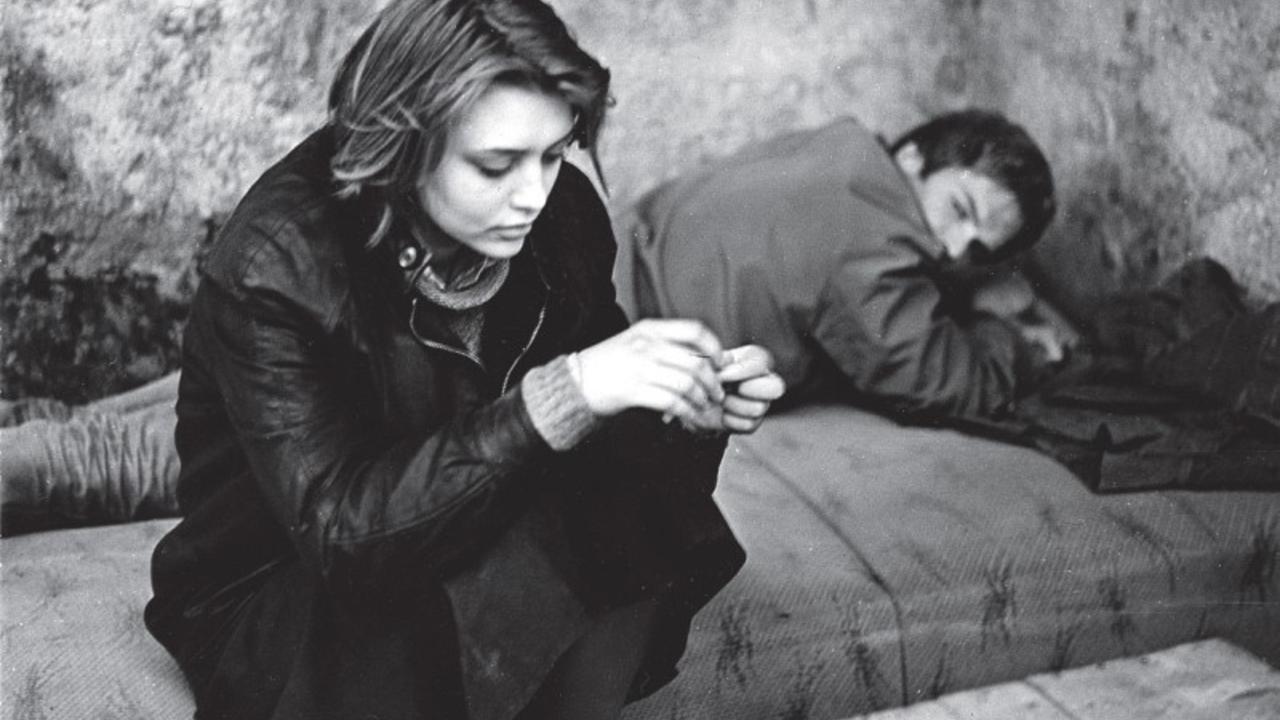
Three Days (dir. Šarūnas Bartas, 1991)
Fittingly, Golubeva’s restless journey didn’t end with her death; rather, she continues to haunt her partners’ films. In 2015, Bartas released a largely autobiographical film, Peace to Us in Our Dreams, starring both himself and Ina Marija Bartaitė, which includes archival photos and videos of Golubeva. In Carax’s Holy Motors, a fantasy-laden, meta-love letter to cinema released one year after Golubeva’s death, her alter ego, alternately named Eva Grace or Jean, is portrayed by the Australian pop singer Kylie Minogue. Eva/Jean meets her ex-lover, Mr. Oscar (played by Denis Lavant, Carax’s frequent collaborator and alter ego), at the derelict La Samaritaine department store after twenty years apart. Unexpectedly, she sings Who Were We, hinting at a child they once shared and lamenting that some people die while others continue living. At the end of their meeting, she commits suicide by leaping from the rooftop. The film, dedicated to Golubeva, includes cameos from both Carax and his daughter with Golubeva, Nastya, who bears a striking resemblance to her mother. Carax and Nastya also appear in Annette (2021), in which Marion Cotillard portrays yet another of Golubeva’s avatars, a famous opera singer named Ann Defrasnoux. Recalling Golubeva’s character in Pola X, who tries to take her life by leaping from a boat, Defrasnoux is accidentally drowned by her husband, the provocative comedian Henry McHenry, portrayed by Adam Driver and serving as Carax’s latest alter ego. In both these films, Carax’s offers a grandiose vision of his late partner as a dramatic singer. Golubeva, an anti-star who rarely spoke in her films, is resurrected by superstars – a pop icon and an Oscar winner – who effortlessly alternate between speech and song. Whether this is Carax’s attempt to elevate Golubeva to posthumous superstardom is an open question.
Either willingly or instinctively, Golubeva constructed her screen persona as mysterious, alien, and alluring, connected to themes of ghosts, decay, migration, and extreme sexuality. Perhaps truly honouring her means acknowledging that she wanted to remain a mystery. While she may have played into the stereotype of the “mysterious Russian soul”, imposed on her by European auteurs and appropriated by Golubeva herself to remain employable and relatable, her creative energy and screen presence could never be contained by such a label. She was a rebel and a punk, but, more importantly, one of the most original actors of her generation: someone who broke every rule in the book and challenged the very concept of Eastern European identity.
A restoration of Leos Carax’s Pola X, starring Yekaterina Golubeva, is screening at London’s Institute of Contemporary Arts on Sunday 9 August as part of the Final Film Festival. Get your tickets here.
Misha Zakharov is a Russian-born, queer-identifying person of Korean descent and a pro-Ukrainian political refugee based in London. He is an author and film worker, with a particular interest in refugee world-making from below, South-South solidarity, and queer and decolonial perspectives on Eastern Europe, the Caucasus, and Central Asia. He is currently completing a PhD at the University of Warwick.

 Go back to journal home page