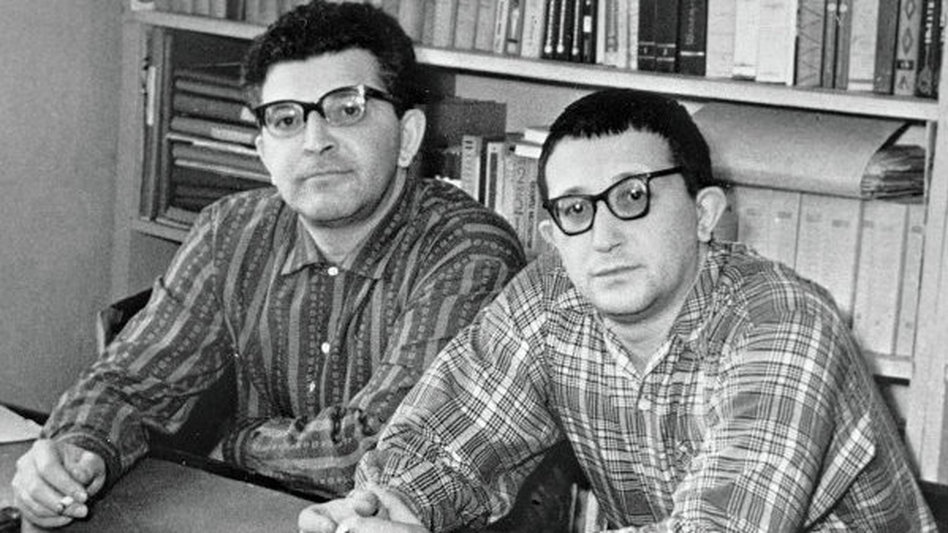
Boris and Arkady Strugatsky. Image: Melville House Publishing
“A car pulls off the road into the meadow and unloads young men, bottles, picnic baskets, girls, transistor radios… A fire is lit. Tents are pitched. And in the morning, they leave. The animals, birds, and insects that were watching the whole night in horror crawl out of their shelters. And what do they see? An oil spill, a gasoline puddle, old spark plugs, and oil filters strewn about…”
This evocative metaphor for the earthly experience of alien visitation comes from the Strugatsky Brothers’ Roadside Picnic (1972). In the novel, an otherwordly presence has left the planet marked with hazardous “Zones” possessed by strange, fatal forces. Like ants on the remains of a meal, humanity is forced to reckon with the aftermath of an event that they cannot hope to understand. It’s a wistfully cynical perspective in keeping with the brothers’ career-long reckoning with the potential and limitation of human progress, which saw Arkady and Boris Strugatsky elevated to the forefront of Russophone science fiction for more than 30 years.
Roadside Picnic is the Brothers’ best-known work in the West because it was adapted for the screen by Andrei Tarkovsky in 1979 as Stalker. While the Strugatskys contributed the screenplay for the film, in Tarkovsky’s hands the story barely qualifies as science fiction; still, for many outside the former Soviet Union it represents the first point of contact with a remarkable oeuvre. The 26 co-authored novels, plus many short stories, plays, and screenplays, written between 1958 and Arkady’s death in 1991 form an incredibly rich archive of speculative fiction, full of internal coherence and paradox that reflect subtle shifts in Soviet science fiction and society more broadly in the post-Stalinist era. And while he may have transcended it, Tarkovsky was working within a living tradition. The range of devices and influences deployed by the Strugatskys, as well as their enormous popularity, have made them ripe for screen adaptation since the 1960s. That the results vary so widely in terms of style (and quality) only speaks to the range of the Brothers’ imagination.
The range of devices and influences deployed by the Strugatskys have made them ripe for screen adaptation since the 1960s. That the results vary so widely in terms of style (and quality) only speaks to the range of the Brothers’ imagination
Arkady was born in 1925 in the Georgian Black Sea port of Batumi. As an infant, he moved with his parents to Leningrad, where Boris was born in 1933. The Brothers’ lives were scarred by the Nazi siege of the city during the Second World War. The younger Boris stayed in the city with their mother, surviving famine and bombardment; Arkady and their father, Natan, were in the process of evacuating east to the city of Vologda when their train was bombed. Arkady was the sole survivor. Aged 17, he worked on the outskirts of Orenburg for the rest of the war before being drafted, eventually going on to study English and Japanese at the Military Institute of Foreign Languages in Moscow. He worked as a teacher, translator, interpreter, an editor, collaborating with his younger brother on the side. Boris had studied astronomy in Leningrad, working at the Pulkovo Observatory until 1966. Their combination of scientific expertise with international literary influences informed their science fiction writing from the start. A first novella, From Beyond, was published in 1958, followed a year later by the novel The Land of Crimson Clouds. Their breakthrough work was the episodic novel Noon: 22nd Century (1961), the first incarnation of what would become the “Noon Universe” – a shared setting explored across a further nine novels.
The Strugatskys were taking their first literary steps at a time when science fiction’s place within Soviet culture was freshly up for debate. The fervent of the early post-revolutionary years had produced a rash of both utopian and dystopian visions of the future: from Alexey Tolstoy’s Aelita (1923) – adapted for the screen with Constructivist flair by Yakov Protazanov – to Yevgeny Zamyatin’s We (1921). The Stalinism that followed the twenties’ flights of fancy foreclosed many artistic avenues, sci-fi among them. The mainstream culture of the 1930s and ‘40s turned away from the stars to celebrate present-day achievements in the USSR’s fields and factories. Soviet sci-fi would not achieve real maturity until the post-Stalinist “Thaw” of the late 1950s. A country looking to cast off the shadow of earlier repressions and to redefine itself along optimistic and progressivist lines found in the burgeoning Space Race a vehicle for newfound scientific utopianism. The great cinematic proponent of this new brio was Pavel Klushantsev, whose hit Road to the Stars (1957) employed the innovative special effects that became his calling card to tell the story of the Soviet space program past, present, and future, from domesticated rockets to terraformed moon colonies.
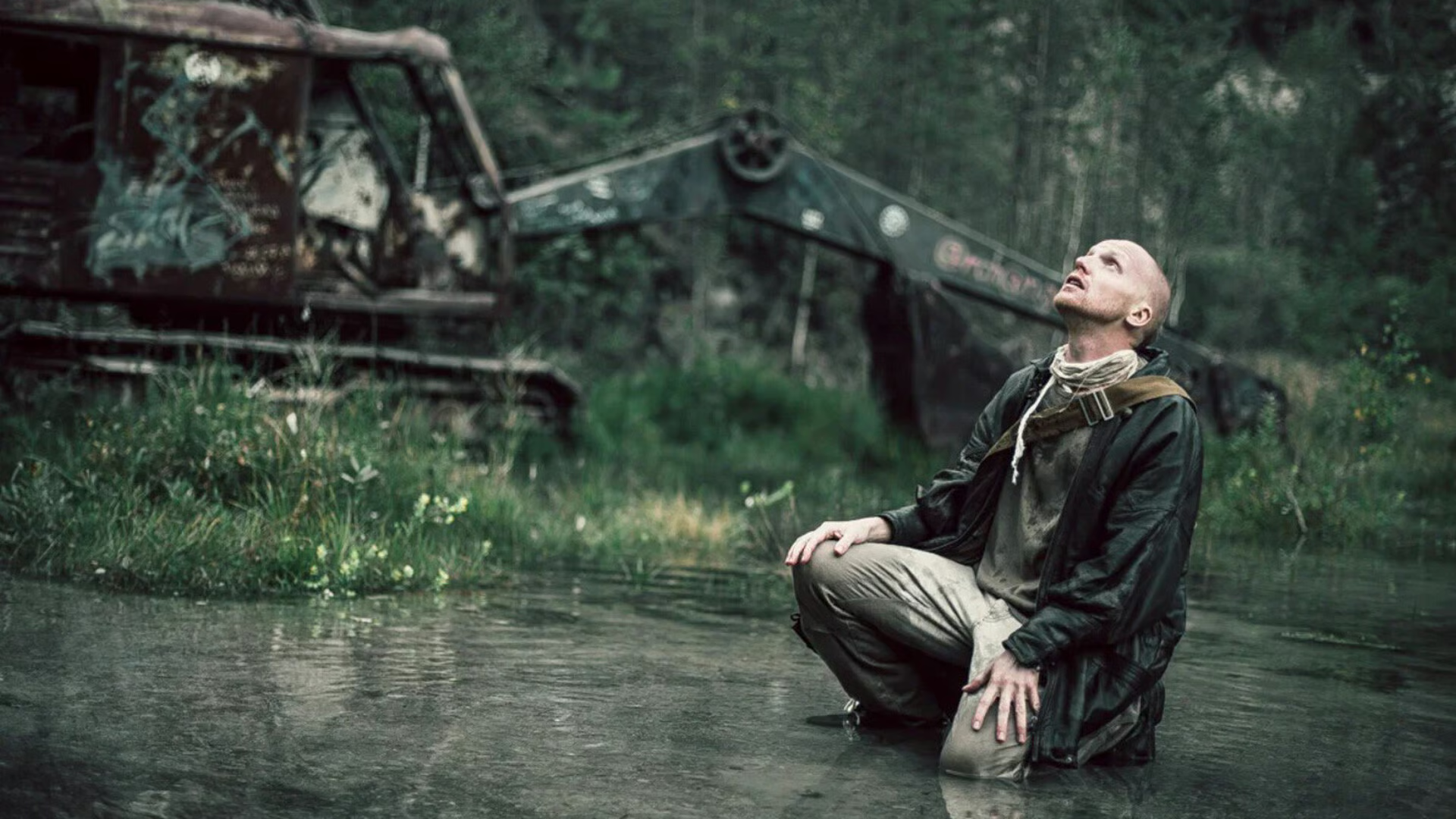
Aleksandr Kaidanovsky in Stalker (dir. Andrei Tarkovsky, 1979)
The twinned promises of the Thaw and the cosmos soon faded, however: censorship crept back in to culture, particularly cinema; Khrushchev was ousted in 1964; Yuri Gagarin’s premature death in 1968 was followed a year later by the Moon landings. So, the Strugatskys arrived on the scene at an inflection point: riding a wave of popular enthusiasm that was soon to break. Critics have noted that their work in the 1960s harks back to the ideologically inflected, socially minded science fiction of the 1920s: anchored by a professed faith in communism extending far into the future, but increasingly concerned with thorny questions of technology, progress, and the human element among the stars. Indeed, the Strugatskys have been hailed as pioneers of so-called “social sci-fi”, a subgenre less concerned with technology and space opera than with political and sociological conundrums. It was perhaps this ambiguity, which was to grow into more outright cynicism as the Brezhnev stagnation dragged on, that attracted later filmmakers to revisit and reimagine their work.
In the Noon Universe, socialism has replaced capitalism, freeing humanity to colonise distant planets while a World Council, composed of leading scientists, historians, and doctors oversees terrestrial affairs. Yet rather than a triumphalist score-settling, the Strugatskys conjure a cosmos in which we still have discoveries to make and conflicts to resolve. The existence of as-yet unencountered advanced alien civilisations hangs over proceedings like a shadow. The central theme of “progressorship” – the idea that humans should help to speed up the evolution of less advanced species – gradually becomes over the course of the novels a jaded reflection on the contradictions of social engineering. By the time we get to the desperate, ant-like “stalkers” of Roadside Picnic (1972) and the befuddled scientists of A Billion Years to the End of the World (1977), whose work is constantly interrupted by cosmic forces beyond their ken, the Brothers’ tone has noticeably darkened.
the Strugatskys arrived on the science fiction scene at an inflection point: riding a wave of popular enthusiasm that was soon to break
The stubborn Cold War reading that all “good” Soviet culture was on some level a hidden critique of the system still persists and has long been applied to the Brothers’ more downbeat writings. While this is simplistic, it is true that there was a period of attrition between their work being published and its adaptation for the screen, suggesting a degree of unease on the part of the state-run studios. Stalker was the first major attempt, arriving seven years after its source novel. Tarkovsky used the narrative skeleton provided by the Strugatskys to anchor his metaphysical investigation of the nature of desire, transforming the allegorical into the conceptual – much as he had done seven years previously with his much “heavier” sci-fi film Solaris, a reworking of the Polish author Stanisław Lem. Stalker is a singular experience, although it proved influential for future Strugatsky collaborators. In his 1988 feature Days of Eclipse, an oblique take on A Billion Years to the End of the World, Tarkovsky’s friend Aleksandr Sokurov reproduced Stalker’s blend of sepia and colour film, its sinuous long takes, and its melancholic insight into the limits of human inquiry. The two films share thematic preoccupations, too. Tarkovsky presents us with the Zone, an area governed by mysterious, potentially forces beyond human control; Sokurov’s protagonist is a doctor whose research into the medical benefits of religious faith is constantly interrupted by a stream of inexplicable obstructions and intrusions that seem to emanate from the very atmosphere of his remote Turkmen village.
If the Strugatskys lent themselves to the cerebral likes of Sokurov and Tarkovsky, their work could also be rendered visceral and concrete. After excavating the Stalinist era in his first four features, the great Aleksei German spent nearly 15 years labouring over his take on Hard to Be a God (1964), a key Noon Universe text; the film was completed by German’s son and widow and posthumously released in 2013. The Strugatskys’ novel concerns a planet, Arkanar, which is analogous to Earth, but which has never experienced a Renaissance and is thus stuck in a perpetual Middle Ages of superstition and anti-intellectual brutality. The hero is Dom Rumata, an Earth scientist sent to observe the evolution of Arkanar society while living incognito among them and forbidden from interfering in their affairs. Published the year that Brezhnev replaced Khrushchev, in Hard to Be a God the theme of progressorship is subjected to cynical satire, as Rumata grows ever more pessimistic at the potential for enlightenment to take root on Arkanar.
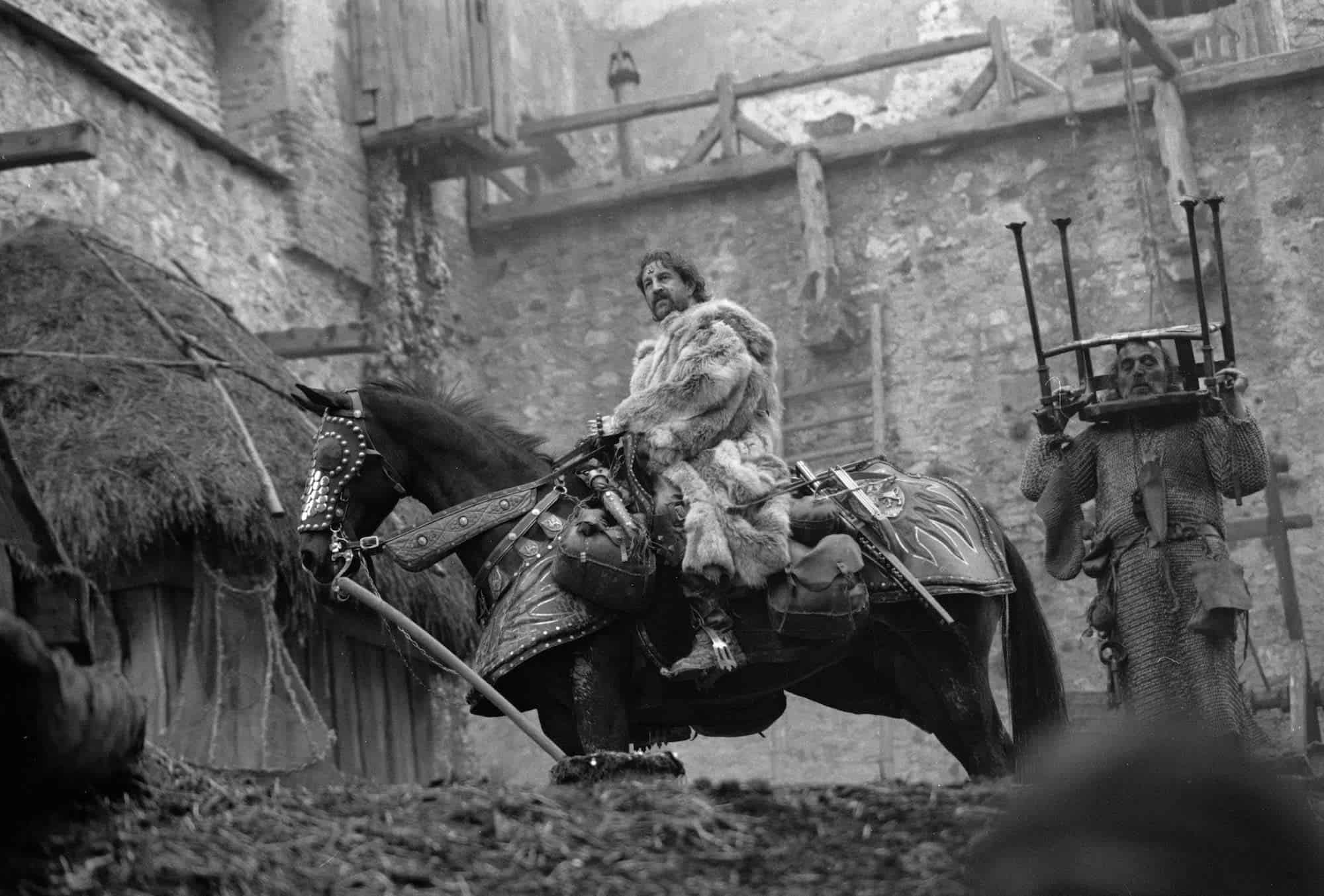
Leonid Yarmolnik in Hard to Be a God (dir. Aleksei German, 2013)
In German’s hands, Rumata’s dense inner monologue is transformed into a sensory overload of rain, mud, phlegm, and blood. Hard to Be a God might be the most gruelling masterpiece in Russian film: three largely plotless hours of serpentine camera moves through a fully realised medieval backwater, what critic Michael Atkinson calls “an utterly Boschian shitstorm of reeking ruins, animal parts, unruly fires, and deformed minions, shot in the late German’s typical all-in style, which you could call cinematic intubation.” Indeed, the sci-fi element is almost completely absent from the screen. German’s film is, if nothing else, a miracle of production design – something that it shares with The Ugly Swans, Russian director Konstantin Lopushansky’s 2006 adaptation of a 1967 novella. Lopushansky leans into the dereliction and disarray in the Strugatskys’ tale of a writer in the near future who encounters a community of renegade mutant children. The director’s debut feature, 1986’s post-apocalyptic fable Dead Man’s Letters, was in fact co-written by Boris Strugatsky, and likewise has much in common with Hard to Be a God in its monochrome vision of a forsaken world without a future.
Tarkovsky, Sokurov, German: the Strugatskys’ reputation among film lovers has been bolstered by their association with these arthouse icons. But their cinematic footprint is much larger than that. How many people outside of Germany know about Peter Fleischmann’s 1989 take on Hard to Be a God, for instance? Fleischmann’s prog-rock stylings and subpar psychedelia don’t bear much scrutiny, certainly not in comparison with German’s severity of purpose, but he does make room for a brief Werner Herzog cameo. His more lurid take on the Strugatskys feels of a piece with another more cultish adaptation that has recently gained traction among genre-friendly cinephiles – Estonian Grigori Kromanov’s 1979 version of Dead Mountaineer’s Hotel, a pulpy blend of noirish detective procedural and extra-terrestrial encounter tale. Featuring a winning turn from Kromanov’s compatriot Jüri Järvet and showcasing some striking modernist set design as well as a surprisingly progressive take on gender fluidity, Dead Mountaineer’s Hotel demonstrates the Strugatskys’ talent for cerebral entertainment. Some have also discerned a subversive undercurrent to this stylisation: in the words of critic Forrest Cardamenis, Kromanov’s setting the film in an unspecified Alpine locale “exemplifies Estonia’s dissatisfaction with Soviet rule and a kinship with the West.”
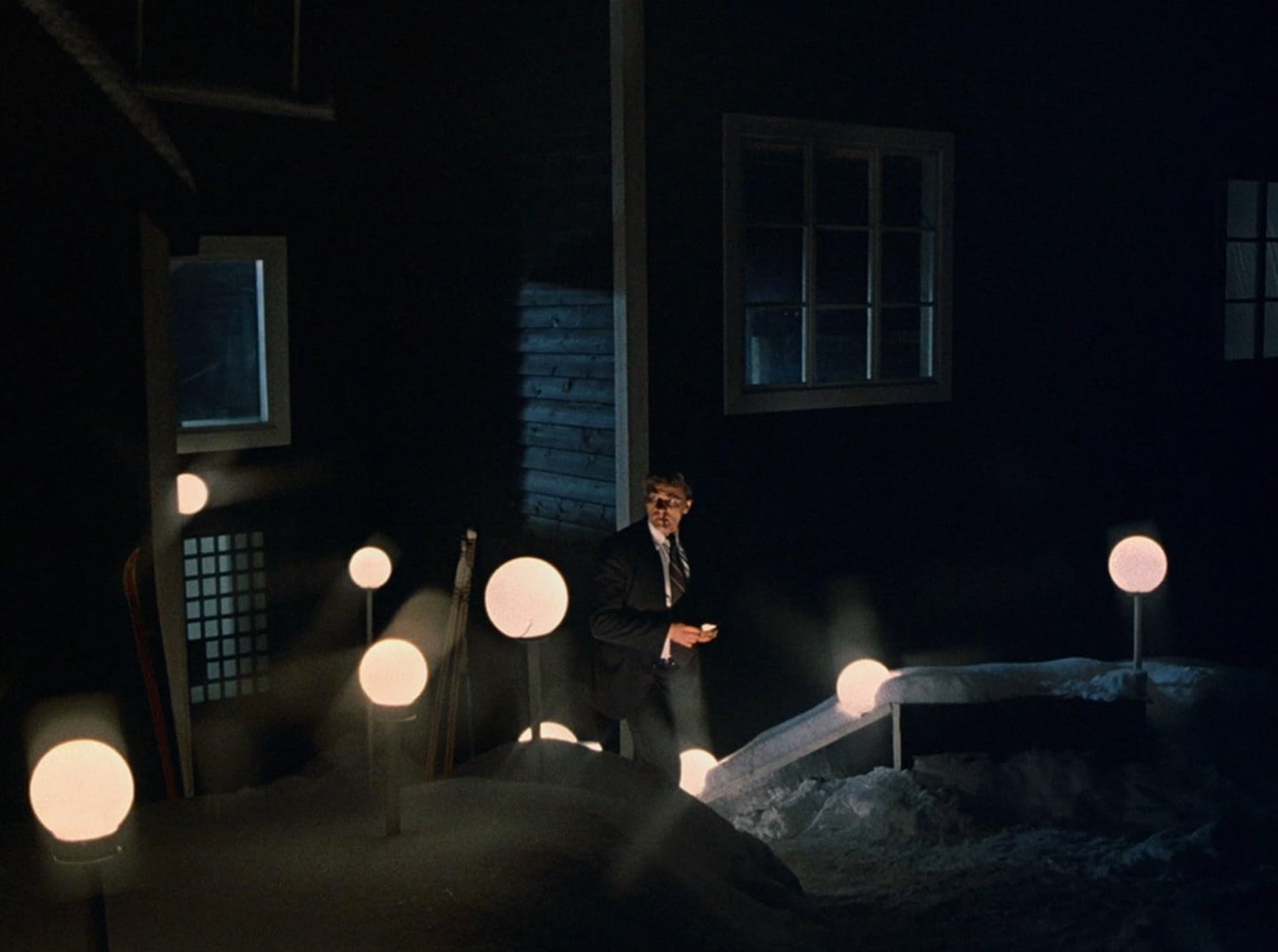
Uldis Pūcītis in Dead Mountaineer’s Hotel (dir. Grigori Kromanov, 1979)
Not all adaptations have been successful. The Strugatskys have lent themselves to the singular visions of studio craftsmen and auteurs, but they have also been bent into all sorts of shapes in their time. The very first attempt to bring their work to the screen came in 1965 with a short spectacle for Soviet television based on their then-contemporary story Monday Begins on Saturday; the result was a flop with audiences, critics, and the Brothers themselves. The same story was revived for a TV film in 1982 under the direction of Konstantin Bromberg, titled Sorcerers. But the resulting romantic musical comedy was so far removed from its sci-fi origins as to be meaningless. Fyodor Bondarchuk, the premier Putin-era purveyor of schmaltzy (and increasingly nationalistic) blockbusters, made a hash of 1969 Noon novel Prisoners of Power in his 2008 spectacle Dark Planet. And that’s without mentioning the S.T.A.L.K.E.R. series of video games launched in 2007, which mash together the lore of Roadside Picnic with the shadow of the Chernobyl disaster into first-person survival horror.
A new film version of Dead Mountaineer’s Hotel is also on the horizon, and it seems likely that, within Russia at least, the Strugatskys will continue to inspire adaptation for the foreseeable future. But something has perhaps been lost as we move further from the Soviet context in which they wrote these works. One doesn’t have to believe that the Brothers were secret dissidents against the Soviet system to recognise that it influenced their view of the modern world and its speculative futures. In Atkinson’s words: “the distinct personality of Communist bloc sci-fi tended to be far weirder, and far more wilfully modernist, than what we were used to in the twentieth-century West… Work after work could be characterised as an exploratory drill into unknowability, and a report on how that unknowability impacts modern technological humans.” It is the Strugatskys’ keen sense of the limits of our understanding that binds together the otherwise disparate adaptations of their works that Tarkovsky, Sokurov, and co produced.
Watch Days of Eclipse and Dead Mountaineer’s Hotel on Klassiki now.


 Go back to journal home page