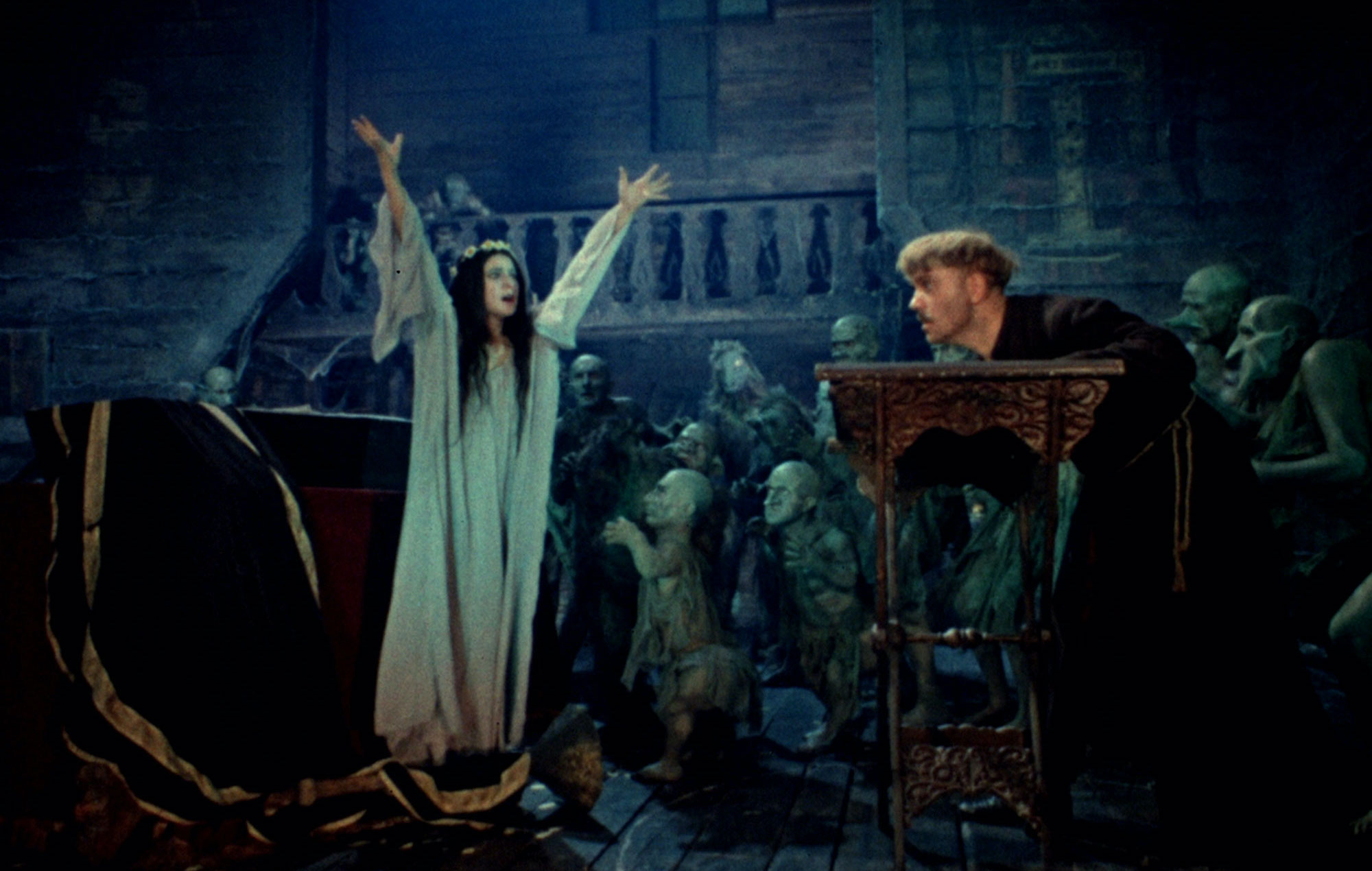
Natalya Varley and Leonid Kuravlyov in Viy (dir. Konstantin Yershov and Georgi Kropachyov, 1967)
If there was, as the perestroika-era catchphrase put it, “no sex in the USSR”, then film fans might argue that horror could be added to the list. An official disinclination towards lurid material meant that the gruesomeness that gives horror cinema its heft was seldom approved for distribution. The rare exceptions to this rule have thus taken on a special resonance for horror aficionados – and chief among them is Konstantin Yershov and Georgi Kropachyov’s Viy (1967), an adaptation of the eponymous story by Nikolai Gogol. If it’s inaccurate to describe Viy as the first (or only) horror film released in the Soviet Union, it’s certainly true that no other has found such a devoted international audience. The tale of a seminary student who must spend three increasingly demonic nights locked in a chapel with the corpse of a witch is good-humoured rather than outright chilling but benefits from the wonderful production design and costuming of Nikolai Markin and Roza Satunovskaya respectively.
It also helps to have Gogol in your corner. His reputable literary source material served Yershov, Kropachyov, and co-writer Aleksandr Ptushko well, earning them some leeway when it came to their depictions of the undead. Indeed, it is fitting that Gogol should stand behind the iconic Soviet horror film. First, he is one of the most readily adapted authors in the Russophone canon. Cinematic takes on Gogol span more than a century, from the earliest days of animation to contemporary CGI-strewn franchises in which the unassuming author is transformed into a devil-battling superhero. Second, Gogol is one of the progenitors of Ukrainian and Russian horror tout court. His lifelong affinity for the supernatural – whether the folkloric forces of mischief that populate his Ukrainian fables, or the urban uncanny of his St Petersburg stories – has proven hugely influential; a 1909 adaptation of Viy by Vasily Goncharov, now considered lost, was the first Russian horror film of all. Beyond his subject matter, Gogol’s writing seems to lend itself to the twists and turns that vivify the horror genre. His prose is both deeply moving and ridiculous, often within the same sentence; peppered with digressions, hyperbole, meta-literary diversions, sharp social critique, ghosts, demons, and madmen. As one critic has put it, “the only consistency [for Gogol] lies in the principle of non-consistency”.
Gogol’s affinity for the supernatural has proven hugely influential; a 1909 adaptation of Viy by Vasily Goncharov, now considered lost, was the first Russian horror film of all
To get to grips with the man behind Viy means wrestling with some pointed questions of identity and legacy. For starters: should we be speaking about Nikolai Gogol (his name in the Russian language he wrote in) or Mykola Hohol (as it would be in his native Ukraine)? The debate has rightly been supercharged by Russia’s ongoing invasion; it’s also key to understanding Gogol/Hohol’s supernatural tales, since they – and the films they have inspired – depend upon a strangely self-cannibalistic relationship to Ukrainian folk culture. A product of the Russian imperial project, in his early career Gogol/Hohol reached for inspiration back into a version of his own Ukrainian childhood that was part autobiographical, part folkloric, and part absurdist invention.
Viy was an early classic in an active writing career that lasted only a decade. It is one of four stories that make up the 1835 collection titled Mirgorod, named after the Ukrainian town close to which Gogol was born in 1809. Mirgorod was a sequel of sorts to his debut collection, Evenings on a Farm near Dikanka, published in two parts in 1831-32. Written under the guidance of Aleksandr Pushkin, Evenings on a Farm had proven a revelation. The collection contained some of the author’s most memorable creations – stories like Saint John’s Eve and The Lost Letter – and established the principles of his characteristically heady mix of humour and horror. It was these tales that would form the basis for Gogol’s cinematic afterlife. Following a silent take on The Night Before Christmas from pre-revolutionary pioneer Ladislas Starevich in 1913, the sixties and seventies saw a succession of popular reworkings of the Ukraine tales: Aleksandr Rou’s 1961 Evenings on a Farm Near Dikanka, Yuri Ilyenko’s 1968 The Eve of Ivan Kupalo, and Borys Ivchenko’s 1972 The Lost Letter. These latter two were to prove particularly significant for Gogol’s Soviet-era reputation as both a master of the macabre and, relatedly but more controversially, as a Ukrainian cultural figurehead.

Aleksandr Khvylya and Yuri Tavrov in Evenings on a Farm near Dikanka (dir. Aleksandr Rou, 1961)
Evenings on a Farm and Mirgorod established the author’s characteristically heady mix of humour and horror. Gogol was lauded for borrowing from the German Romantics in order to create something with a viscerally local character, deploying fairy tales in order to blend earthy realness with imaginative fantasy. As Gogol was beginning his literary career in the late 1820s, artistic nationalism was the order of the day, and the young author capitalised on his Cossack ancestry to match the zeitgeist. In letters to his family, and in his voracious reading on Ukrainian folklore, he mined the collective consciousness of the countryside for raw material. One of his chief inspirations was the Ukrainian puppet theatre tradition known as vertep, from which he drew motifs, plot devices, and stock characters – gypsies, peasants, Cossacks, and their shrewd wives. More than a century later, these exercises in literary nationalism allowed Gogol to be reclaimed by filmmakers from the tendency that would become known as Ukrainian Poetic Cinema.
Emerging from Kyiv’s Dovzhenko Studio in the mid-1960s, poetic cinema was Soviet Ukraine’s most consequential and innovative film movement. Poetic cinema drew on Ukraine’s long tradition of “folk modernism” in literature and the arts, as directors sought ways to put Ukrainian national identity on screen – in defiance of official efforts to promote a trans-national Soviet identity that elided cultural and linguistic differences. Poetic cinema drew on earlier cinematic pioneers like Oleksandr Dovzhenko, but also on Ukraine’s rich heritage in the visual and literary arts. Where Russian-Soviet directors like Rou and Kropachyov and Yershov tended to mine his work for cartoonish folk-kitsch, the poetic cinema crowd saw in his grotesque, proto-modernist takes on Ukrainian folklore the pre-history of their folk modernist icons. The demons and witches in these films signify both the otherworldly, and the earthy essence of Ukrainian identity.
Gogol’s monstrosities and grotesqueries are deployed in service not of some clearly demarcated battle between good and evil, but rather as evidence of the compromise at the heart of human nature
Ivchenko’s Lost Letter in particular captures something of the source material’s vibrancy – in part thanks to star Ivan Mykolaichuk, the singular icon of poetic cinema, playing a Zaporizhian Cossack. As was often the case with screen adaptations of Gogol’s work, Ivan Drach’s screenplay significantly reimagined the source text, complementing it with additional folkloric elements, notably in the music, which was compiled by Mykolaichuk himself. Despite the apparent constrictions of its adventure-comedy-musical genre trappings, Ukrainian film historians cite The Lost Letter as one of the first serious reinterpretations of Ukrainian-Cossack identity within mainstream Soviet cinema. Or it could have been, had it not been denied a release after an initial screening in Moscow – a dubious honour it shared with Ilyenko’s Eve of Ivan Kupala.
If Ivchenko et al modified Gogol to fit the times, then that was only fitting. The author was never a slave to his sources. In fact, he is more likely to use the expectations created by the deployment of familiar characters and situations in order to pull the narrative rug from under his audience’s feet. The ghoulish figure of the Viy itself also appears to have been a piece of Gogolian invention, despite the author’s note that opens the tale insisting that the monster is a “creation of the popular imagination… reproduced without alterations.” If it was instead a product of Gogol’s own inimitable imagination, then the monster, with its face of iron, its limbs like rooted trunks and eyelids that droop down to the floor, has proven one of his most durable creations – as Ershov and Kropachyov’s film attests.
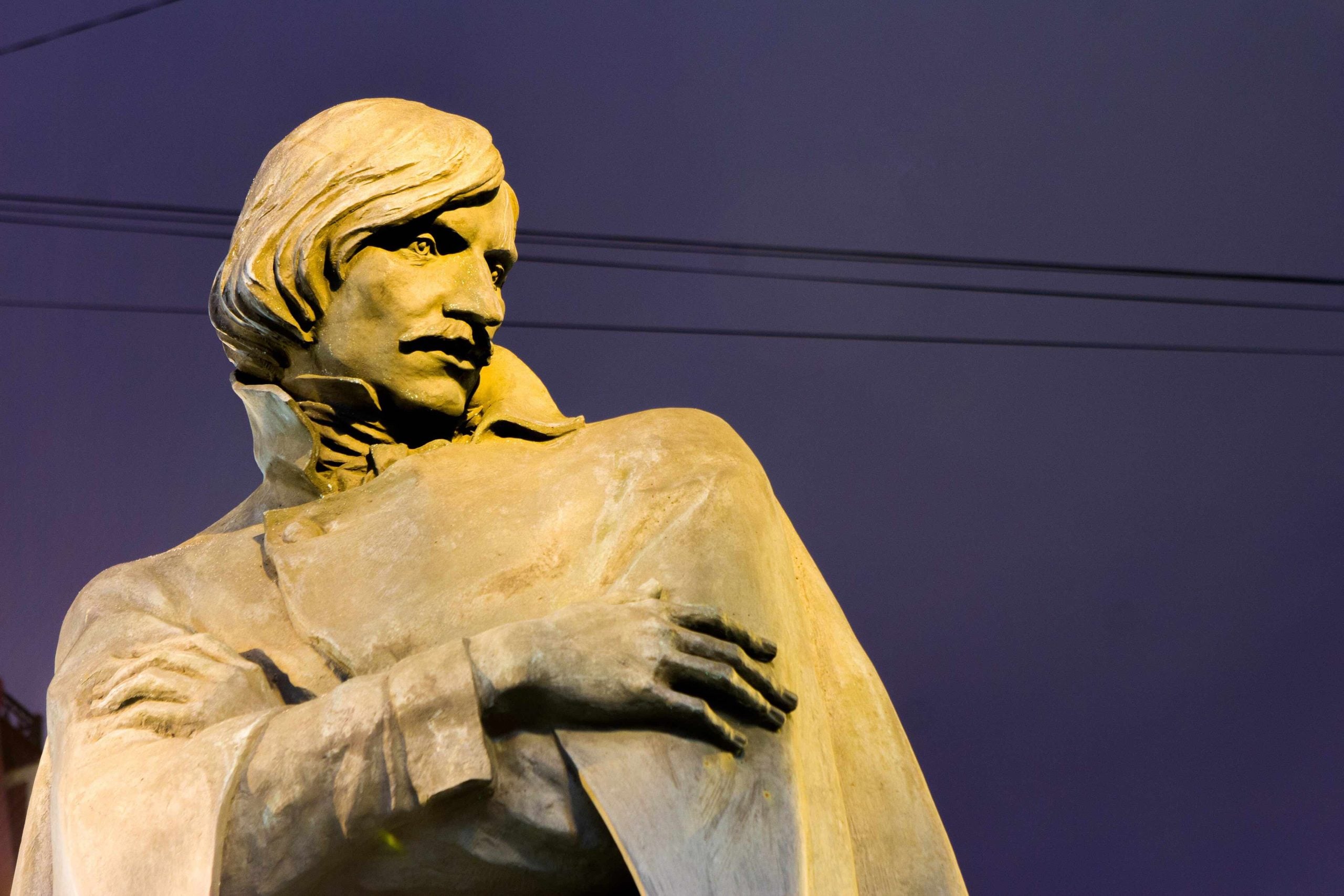
Monument to Gogol in St Petersburg. Image: Alexey Komarov/CC
Whatever his inspirations, Gogol had a lifelong affinity for the supernatural that sat uneasily alongside his increasingly ardent Christianity. His Ukrainian stories overflow with elements of what might now be called folk horror: witches in Viy and St John’s Eve; pig-faced demons in The Lost Letter. In his Petersburg tales this bluntly ghoulish approach is pared back into something more obtruse and uncanny. In his classic The Nose, for instance, the hero’s titular organ disappears from his face and takes to the streets in a story that hovers obscurely somewhere between allegory and farce. The Overcoat, meanwhile, ends with what may or may not be a visitation by the vengeful spectre of its deceased protagonist, Akakii Akakievich. As many critics have noted, Gogol’s monstrosities and grotesqueries are deployed in service not of some clearly demarcated battle between good and evil, but rather as evidence of the compromise at the heart of human nature. His sorcerers and possessed noses alike represent something intellectually incomprehensible and irrational but still uncannily familiar. But as Gogol came more and more under the influence of strict Christian doctrine, his eye for the demonic seems to have become increasingly unbearable. Convinced in his later years that literature needed to serve the cause of good in a Manichean world, he burned the unfinished second part of his masterpiece Dead Souls, and shortly thereafter died. In the words of Julian Connolly, “the God of Christian tradition is nowhere evident in the enchanted church [of Viy]. In His place stands a deity from a different realm.”
At times Gogol’s absurdities tipped over into outright social satire directed at the tsarist bureaucracy, which allowed the Soviets to adopt him as a hero of the little man and a chronicler of social injustice. The Overcoat was twice adapted for the screen to this end by iconic Soviet directors: in 1926 by Grigory Kozintsev and Leonid Trauberg, and in 1959 by Aleksei Batalov. An animated version by Yuri Norstein, the genius behind the children’s classic Hedgehog in the Fog, has been in the works since 1981 and is Russian cinema’s most tantalising unfinished masterwork – clearly, it is hard to pin down Gogol’s essence. Perhaps this is inevitable when it comes to such shapeshifting material. More than two centuries on from his birth, Gogol/Hohol continues to elude and unnerve.
Watch Viy on Klassiki until 30 December as part of our Halloween double header Two Faces of Soviet Horror.


 Go back to journal home page