The Klassiki Companion is our beginners’ guide to the key filmmakers, movements, and concepts in the cinema of Eastern Europe, the Caucasus, and Central Asia. In this edition, we’re introducing the world of the Kyrgyz Miracle: the forgotten new wave that emerged from a neglected Soviet republic in the 1960s to electrify the cinema of Central Asia.
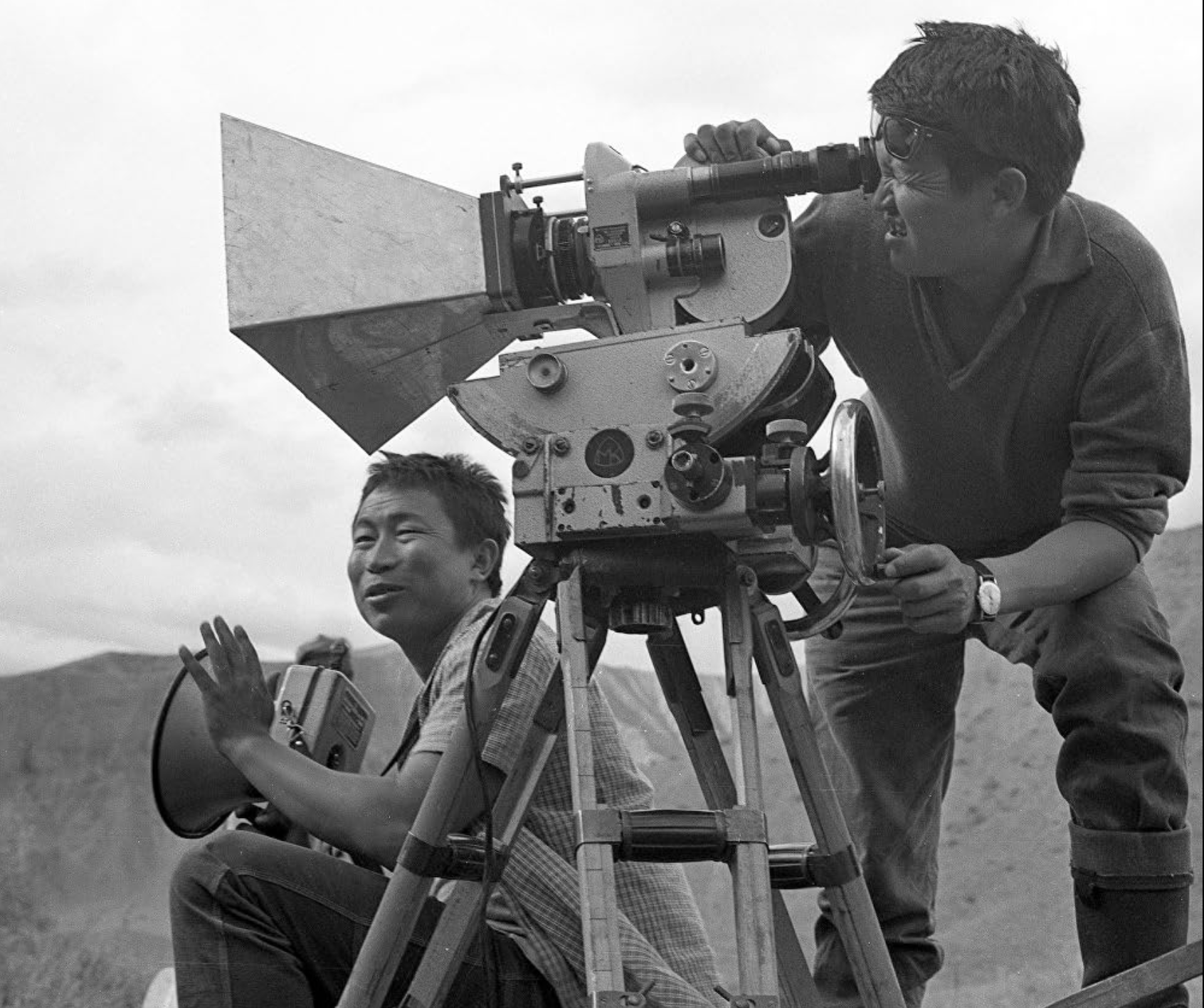
Tolomush Okeev on the set of The Skies of Our Childhood (1966)
Even the most conscientious Anglophone cinephiles cannot hope to stay abreast of every corner of film history. It is no reflection of the quality and breadth of Central Asian cinema that the region remains a blind spot for many; even a platform like Klassiki can only offer a restricted perspective on the film traditions of the five post-Soviet “stans”. And these handy regional groupings often obscure as much as they reveal. Even to speak in terms of “Central Asian cinema” risks eliding local diversity: from the Iranian-inspired school of Persian Tajikistan to the Kazakh New Wave of Rashid Nugmanov and co. But while the pioneers and contemporary luminaries of, say, Kazakh and Uzbek cinema are increasingly well-known (think of the post-Soviet peripheries of Sergei Dvortsevoy, or celebratory retrospectives for the likes of Ali Khamraev), Kyrgyz film remains stubbornly out of sight for many in the West. Barring the occasional European festival visit from Aktan Arym Kubat – the only Kyrgyz director likely to find himself programmed in these parts – Kyrgyzstan remains terra incognita for too many.
This week, Klassiki is hoping to turn the tide with the launch of our new collection, The Kyrgyz Miracle: Central Asia’s forgotten new wave, which presents three features from one of the finest schools of poetic national cinema you’ve likely never heard of. In the 1960s, the republic witnessed an explosion in filmmaking, with local talents joined by visiting directors from Russia and Ukraine. These films drew on national traditions, a profound connection to the landscape, and the contradictions of Soviet ideology to create a lyrical cinematic school that remains spellbinding to this day.
Any attempt to refine the historical record also represents an opportunity to reflect on the conditions that produced this cinema. Soviet Central Asia was a region of contradictory cosmopolitanism, neo-colonial exploitation, and uneven modernisation – a history reflected onscreen. In the words of the scholar Michael Rouland, Soviet films made in and about Central Asia reflected “the interests of Soviet nation-building, ideologically infused internationalism, rampant exoticism, and neo-traditionalist fantasy”. But if “the relationship between Russian and Central Asian directors was paradoxical due to conflicting ideas of identity and authority,” then that is all the more reason to immerse ourselves in the films themselves. When we do, we see how they speak to the present day even as they represent a history worth celebrating.
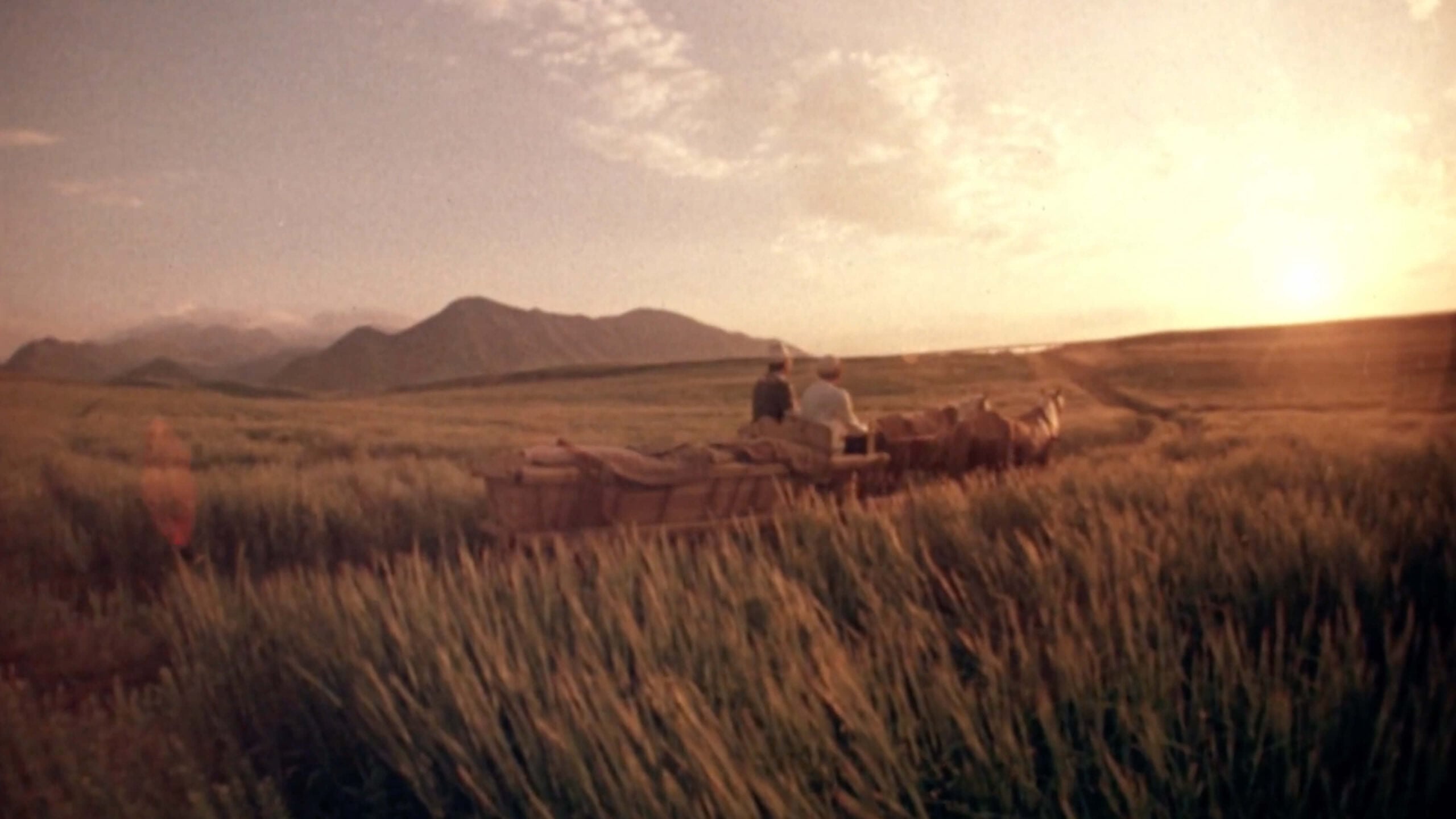
Early Cranes (dir. Bolotbek Shamshiev, 1980)
Arrested development
Film came late to Kyrgyzstan, by some distance the youngest of the national cinemas of Central Asia. What would become the eastern-most Soviet republic lacked the established urban centres of neighbouring Uzbekistan (where the film technology of the Lumière Brothers was presented in Tashkent as early as 1897, and the region’s first studio opened in 1925) or Kazakhstan (where the first cinema opened in Almaty in 1910), and so was not considered fertile ground for investment in cinema. At every step, Kyrgyzstan was a step behind. The national studio Kyrgyzfilm was only established in Frunze (now Bishkek) in 1941; its first feature-length documentary – Mikhail Slutsky’s Songs of Kirgizia – and fiction film – Vasiliy Pronin’s Saltanat – only arrived in 1947 and 1955 respectively.
That both films were directed by Russians and produced in collaboration with Mosfilm reflects the history of the region. The first generations of Central Asian film artists spent the twenties and thirties consulting on and acting in films produced in the region by outsiders from the former imperial heartlands. The slow accumulation of technical capacity and professional know-how during this period was accelerated when the major Russian- and Ukrainian-based studios were evacuated to the relative safety of the Central Asian republics during the Second World War; local artists were exposed to the high technical standards of their Muscovite and Leningrader colleagues while finding their opportunities reduced by the arrival of so many established names. Again, Kyrgyzstan missed out – no studio was sent to Frunze. That a Russian director like Pronin was considered a necessity for feature film production as late as 1955 tells its own story. In recent years, scholars such as Gulnara Abikeeva have argued that the relative late blooming of Kyrgyz film meant that its artists could foster a critical, even post-colonial edge much earlier than would prove possible in the more established cinematic republics. Likewise, it is perhaps because of its uneven, arrested development that unlike other national new waves, the Kyrgyz Miracle did not burn brightly before running out of steam, instead evolving in form over several decades; that the Kyrgyz industry remained comparatively small within the Soviet system also meant that a handful of directors exerted an outsized influence on that evolution.
The first generations of Central Asian film artists spent the twenties and thirties consulting on and acting in films produced in the region by outsiders from the former imperial heartlands
The parlous condition of the Soviet film industry writ large in the post-war years at least levelled the playing field. The dying days of Stalinist dictatorship saw a “film famine” of ever diminishing outputs spread throughout the republics. In Central Asia, this was compounded by events such as the Ashgabat earthquake that destroyed the Turkmen national studio in 1948; in Tajikistan, no feature was finished in over 12 years. By the 1950s, as the post-Stalinist “Thaw” began to spread across the communist bloc, conditions were improving; more and more students from Central Asia were making their way to Moscow’s film school, and co-productions and collaborations between local and Russian studios increased. The stage was set for the explosion of so-called “poetic cinema” that electrified Soviet cinema in the 1960s. Often, this aesthetic approach was a vehicle for the exploration of national character, and the formal establishment of film studios in the five Central Asian republics in the fifties and sixties helped to entrench these national differences just as Kyrgyz cinema was coming into its own.
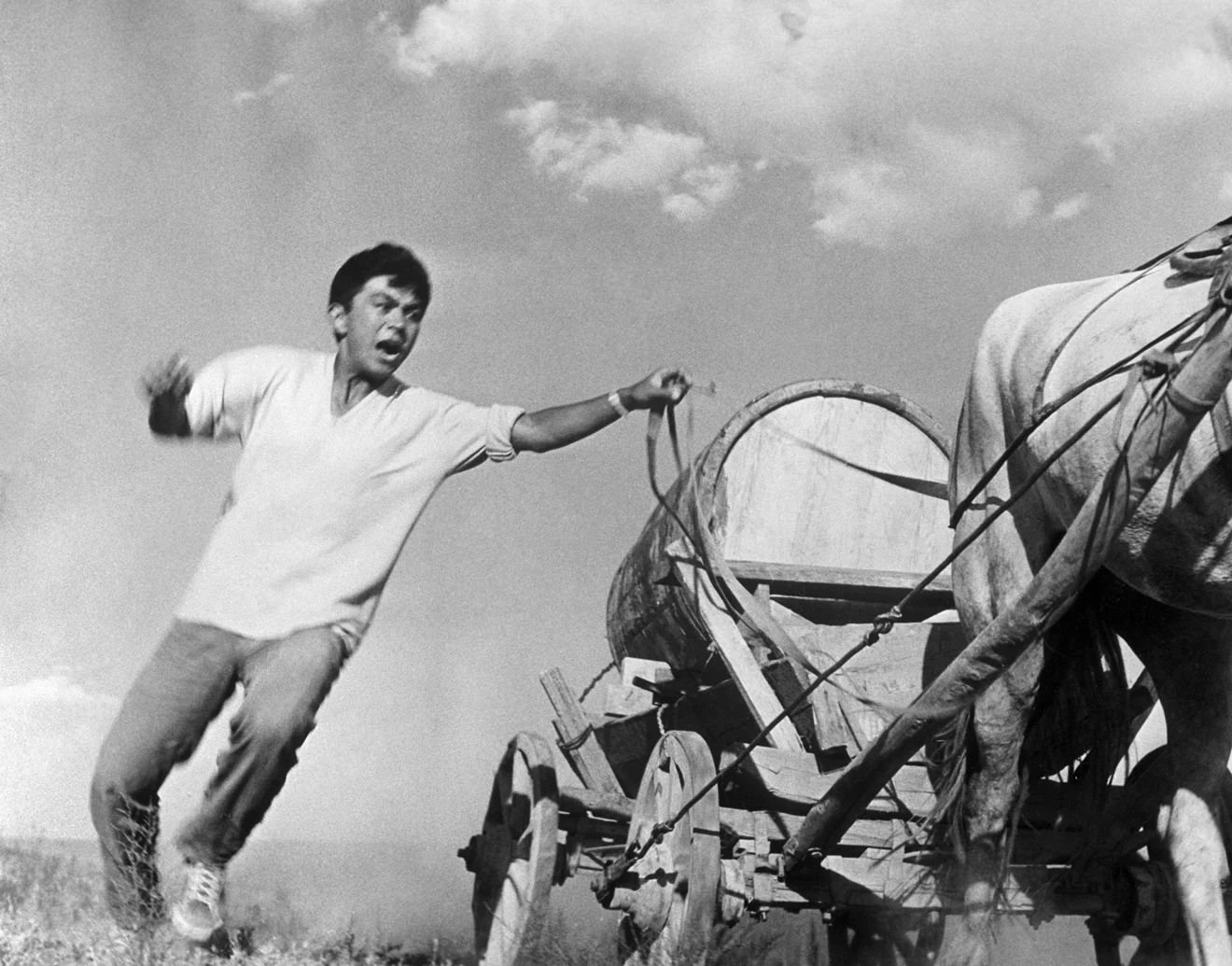
Bolotbek Shamshiev in Heat (dir. Larisa Shepitko, 1963)
Kyrgyz cosmopolitan
Soviet culture in general tended towards a kind of contradictory cosmopolitanism, making room for the expression of innumerable different “national” cultures while insisting on a trans-national shared identity for populations stretching from old Prussia to the Chinese border. In its formative years, the Soviet state proclaimed an anti-imperial agenda even as it fought tooth and nail to retain the territories of the former Russian empire – a war that was waged ferociously in what would become the Kyrgyz republic. Across the five Central Asian states, the relationship between the imperial centres to the West and local interests and talents was a complex and fluctuating phenomenon not easily reducible to rote arguments about colonialism and orientalism.
Influenced by the recent experience of imported talent and the need to maximise resources to counter historical underinvestment, Kyrgyzfilm in the post-war era was perhaps the most cosmopolitan studio in Central Asia, renowned as a welcoming place for filmmakers of different ethnic origins. As the film scholar Raisa Sidenova has noted, this reputation was owed in part to then-studio head Sharshen Usubaliev, who was proactive in recruiting talent from across the USSR, building an apartment block for incoming studio staff to help sweeten the deal. Two of the most important figures in Kyrgyzfilm throughout the sixties were the Jewish brothers Izya and Yuz Gershtein; the Lithuanian documentarian Algimantas Vidugiris spent his whole career at the studio. But fleeting visits could also prove deeply influential, as the remarkable case of Larisa Shepitko’s sojourn in the republic proves.
Shepitko, who would go on to become one of the most significant filmmakers working in Russia and Ukraine thanks to her features Wings (1966) and The Ascent (1977), had completed her studies at the prestigious Moscow film school VGIK in 1961. It was common for graduating directors to be sent to one of the “peripheral” republics to produce their first features, and Shepitko found herself in Kyrgyzstan at just 25 years of age, working on her diploma film Heat with a mix of Russian and local crew. Heat was followed in similar circumstances in 1965 by Andrei Konchalovsky’s First Teacher and in 1969 by Irina Poplavskaya’s perennially underrated Dzhamilia. As these young Russian and Ukrainian directors drew on Kyrgyz locations, narratives, and acting talent, so the evolution of the domestic industry was accelerated by the influx of these Moscow-trained filmmakers, who brought with them the energy of the Thaw.
Shepitko refuses to reduce the Central Asian experience to either the sublime harshness of the landscape or to the exploitative relationship between centre and periphery
Heat is such a vital title in the history of Kyrgyz cinema not because it binds a director of Shepitko’s reputation to the republic, but because so many of the people who would go on to define Kyrgyz film beyond the shadow of Moscow came together to make it. Its cast and crew list reads like a who’s who of the Kyrgyz Miracle. In the lead role as the shock worker Kemel is Bolotbek Shamshiev, who would go on to become one of the country’s most celebrated directors; his only real competition for the title of greatest Kyrgyz director of all time, Tolomush Okeev, worked as the sound engineer. Two of the assistant directors were Gennady Bazarov and Dinara Asanova, later important directors in their own right. And the film was adapted from his own short story The Camel’s Eye by the great Chingiz Aitmatov, undoubtedly Kyrgyzstan’s most famous literary son, endlessly adapted for the screen and later First Secretary of the Kyrgyz Filmmakers’ Union for more than 20 years. Indeed, one could chart a course through the Kyrgyz Miracle purely on the basis of his adaptations and screenplays: Heat, Dzhamilia, The First Teacher, Bazarov’s Mother Earth (1967), Okeev’s The Red Apple (1975), Shamshiev’s The White Ship (1975).
Heat is also a richly provocative text for its role as an artefact of a Moscow policy that continues to shape Central Asian geography. This is a film of the Virgin Lands Campaign, one of Khrushchev’s signature policies, an ecologically disastrous mass effort to increase the agricultural productivity of the southern steppes. The cultural byproducts of the campaign tended towards a kind of neo-Stalinist monumentality, and the colonialist implications of the policy’s acquisitive and extractive attitude towards these supposedly “undeveloped” territories are clear and troubling. But Shepitko and her collaborators manage to adopt a dialectical approach to the subject matter that makes grandiosity and lyricism two sides of the same coin, and places tradition and modernity, socialism and feudalism in productive tension. Shamshiev plays Kemel, an idealistic graduate who clashes with his authoritarian foreman Abakir (Nurmukhan Zhanturin) as they battle both the elements and the demands of communal life. The result is a film that refuses to reduce the Central Asian experience to either the sublime harshness of the landscape or to the exploitative relationship between centre and periphery. When Konchalovsky travelled to Kyrgyzstan to make The First Teacher, he was explicit about wanting to make a “Kurosawa” film with “Asian faces”. (He also married his young star actress, Natalia Arinbasarova.) With the sensitivity that would define her career, Shepitko instead produced a fittingly cosmopolitan Kyrgyz classic.
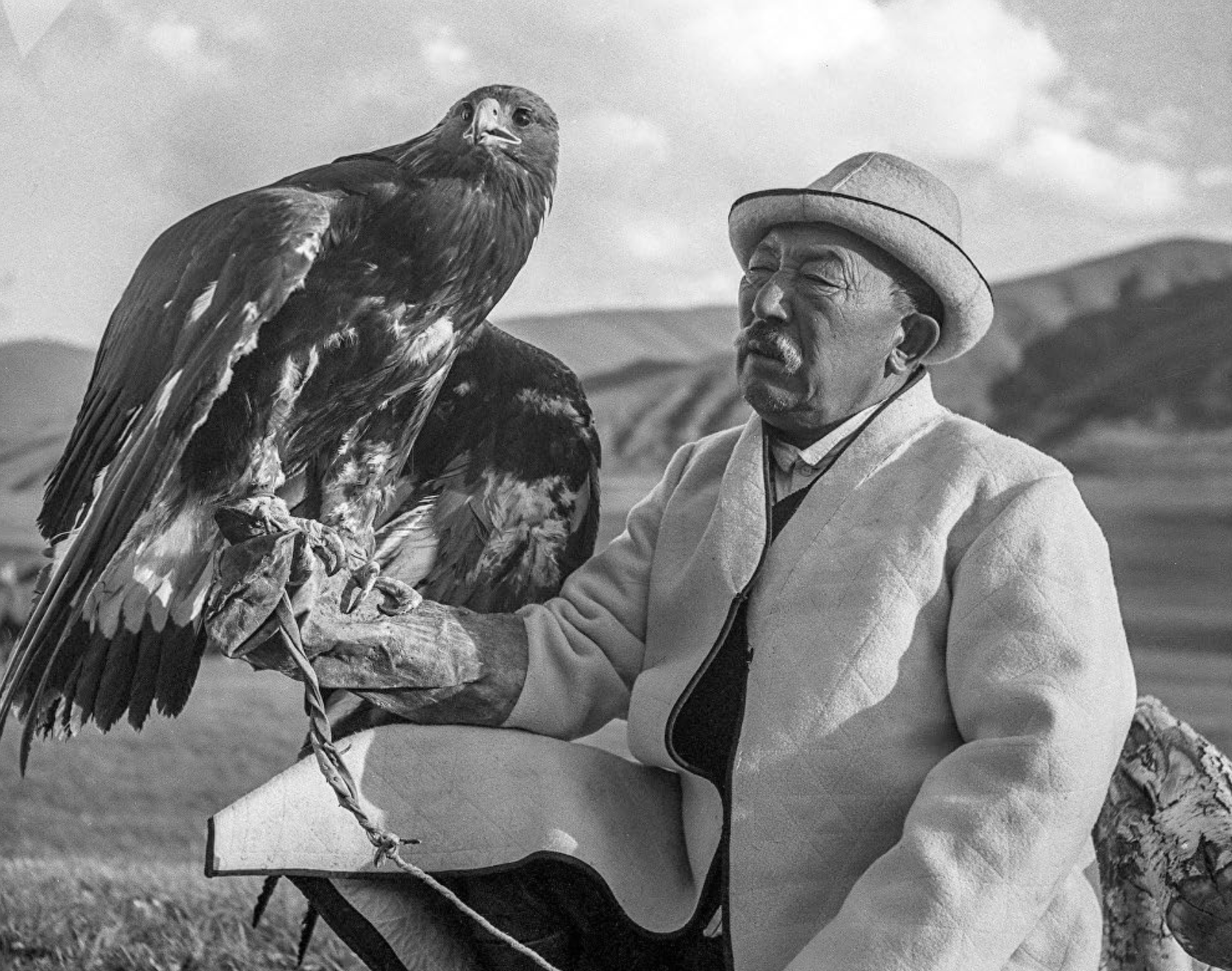
Muratbek Ryskulov in The Skies of Our Childhood (dir. Tolomush Okeev, 1966)
Okeev and Shamshiev
Across the USSR, the 1960s had seen the emergence of so-called “poetic” movements in the national cinemas of the Soviet republics as the Thaw spread across the communist bloc. From the documentary tradition of the Baltics to the folkloric Ukrainian films of Sergei Parajanov and Borys Ivchenko, “poetry” was deployed as a catch-all term used to distinguish often very distinct filmmaking schools from the mandates of “official” socialist realism. Often, this aesthetic approach was a vehicle for the exploration of national character, a topic that was never far from controversy and even outright danger in the context of trans-national Soviet ideology. This was certainly the case in Central Asia. In 1963, the Turkmen director Bulat Mansurov made The Contest, in which an ethereal style was deployed combining philosophical parables from native tradition with experimental camera techniques and an appreciation for the beauty of the region’s landscapes. Other examples were to follow in Uzbekistan (Ali Khamraev’s White White Storks; Elyor Ishmukhamedov’s Tenderness, 1967) and Kazakhstan (Shaken Aimanov’s Land of the Fathers, 1966) – and, of course, in Kyrgyzstan.
The two finest proponents of poetic cinema in the republic are also the two directors with the surest claim to the title of greatest in Kyrgyzstan’s history: Tolomush Okeev and Bolotbek Shamshiev. Their careers developed in tandem, the pair trading classic films across the 1970s in particular, with Okeev’s lyrical dramas The Worship of Fire (1971), The Fierce One (1973), and The Red Apple (1975) matched by the more genre-friendly exploits of Shamshiev’s Gunshot at the Mountain Pass (1969), The Red Poppies of Issyk-Kul (1972), and The White Ship (1976).
Like so many great Kyrgyz films, Skies of Our Childhood refuses easy binaries between tradition and progress, empathising not only on its flawed, vivid human characters but also with the eagles, horses, and mountains that define their lives
Okeev had studied at the Leningrad Engineering Institute, rather than pursuing film in Moscow, and his entry way into cinema came as a sound engineer (including, famously, on Heat). His directorial bow was the 1965 documentary short These Are Horses. A year later he followed it with a feature debut that many would still hail as the finest Kyrgyz film of all time, The Skies of Our Childhood. Set over the course of a single summer, the film follows a boy (Nasreddin Dubashev) as he tends to his family’s remote mountain pasture and witnesses first-hand the disruptive arrival of modern industry into their lives. Looking back on the film later in life, Okeev remarked: “I wanted to deal with the problem of the collision between nature and civilisation. I did it primarily because this problem worried me terribly. Almost no one mentioned the problem at the time.” To do so, he drew on his own rural childhood spent on the shores of Lake Issyk-Kul, where he was inculcated in the native narrative traditions that he would later alchemise into cinematic magic. “Instead [of galleries and cinemas] I had Issyk-Kul. There were the mountains. I was taught and raised in a way by the majesty and beauty of nature. Then there was folklore – songs, epics, ancient legends… For me this was the real, best academy for introducing me to art.” Like so many great Kyrgyz films, Skies of Our Childhood refuses easy binaries between tradition and progress, finding an empathetic perspective not only on its flawed but vivid human characters but also on the eagles, horses, and mountains that share and define their lives.
Shamshiev was born in 1941, the son of a poet from Osh. He was a member of the first generation to travel for their education to VGIK, graduating in 1965. Like so many of his compatriots, after his starring role in Heat, Shamshiev started out in documentaries, notably an account of the oral tradition in Kyrgyz poetry (Manashchi, 1965). His feature debut, Gunshot at the Mountain Pass (sometimes translated as Gunshot at the Karash Pass) remains for many his calling card. (As an aside, it is striking how many of the canonical titles in Kyrgyz film history were debuts – a fact noted by the critic and researcher Sultan Usuvaliev.) Adapted from the Kazakh author Mukhtar Auezov and set at the turn of the twentieth century, the film captures Shamshiev’s talent for taking the problematic and predictable aspects of Soviet genre fare – here, the neo-Orientalism of the so-called “Ostern” or “Red Western” – and finding the poetry within. It is also notable as the screen debut of the legendary Suymenkul Chokmorov, a Kyrgyz artist-turned actor who made such an impression on Akira Kurosawa when he was cast in a minor role in the Japanese master’s Soviet co-production Dersu Uzala that the director dreamed of filming him as a samurai in a face-off with the great Toshiro Mifune.
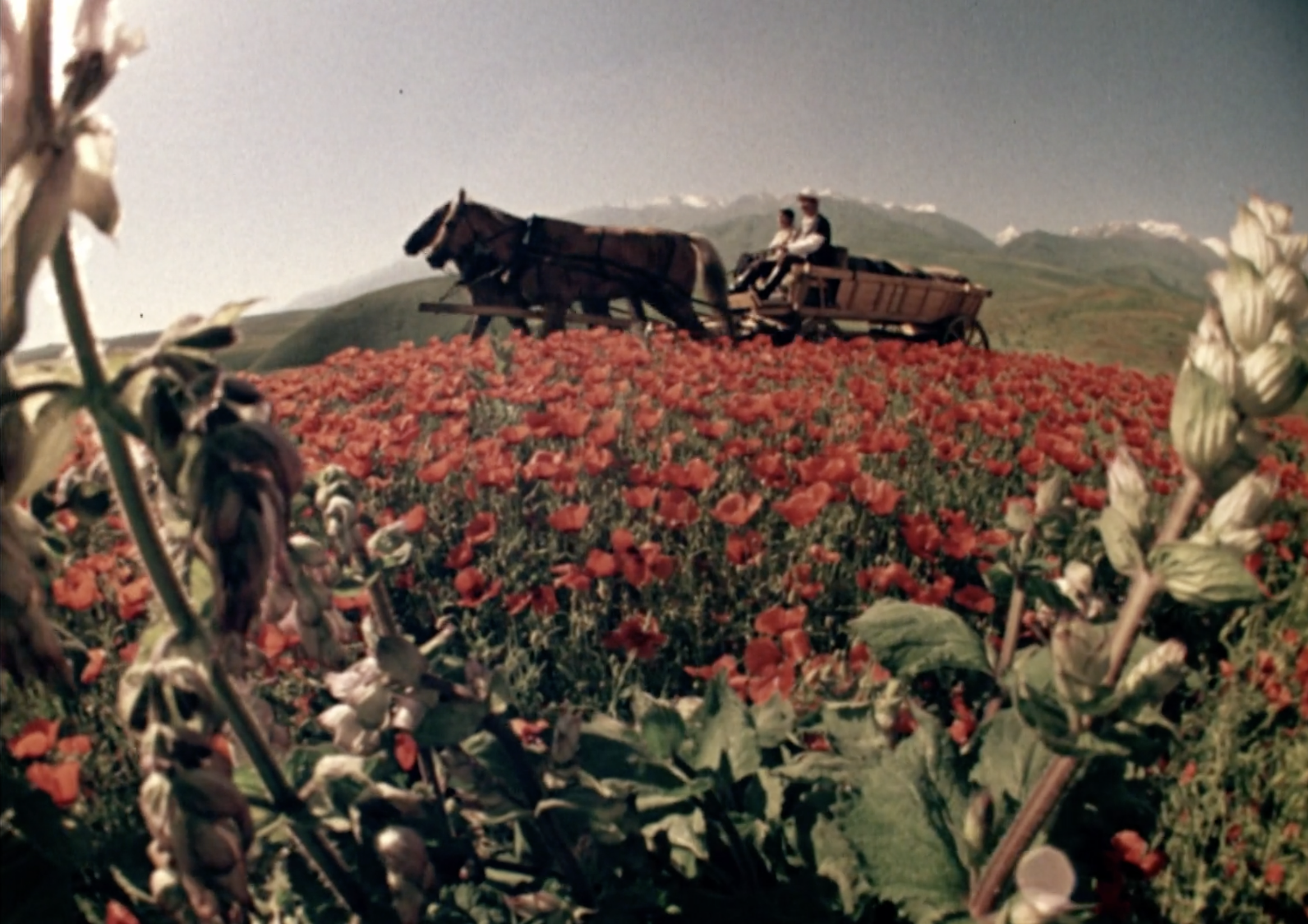
Early Cranes (dir. Bolotbek Shamshiev, 1980)
Looking back, comrade
Across the Soviet Union, the national new waves of the 1960s were bound up with the licentiousness of the Thaw. When the tide of liberalisation began to recede, so did much of the artistic energy at large. Debates around how to periodise the Thaw continue unabated, though many would cite either the ousting of Khrushchev in 1964 or the Soviet intervention against the Prague Spring in 1968 as turning points. In cinematic terms, the Thaw did linger, especially in more distant republics like Kyrgyzstan, if only because of the length of time involved in ushering a feature film through production and distribution. As Raisa Sidenova has noted, the cinema of the republics in the 1970s undermines the broad classification of the period as one of cultural “stagnation”. As we have seen, this was the decade that saw the mature masterpieces of Okeev and Shamshiev, as well as some of Gennady Bazarov’s finest work (The Pupil, 1976; Kanybek, 1978).
There were shocks to the system, nonetheless. In 1967, Yuz Gershtein completed a revisionist documentary about the Sovietisation of Kyrgyzstan, Look Back, Comrade, that combined a provocative historical perspective with experimental “polyscreen” visual techniques. Despite support from Russian grandees like Mikhail Romm and Grigory Chukhrai, the film was banned. When Gershtein travelled to Moscow to appeal the decision, he was told not to return to Frunze; he fled first to Leningrad and then later to Israel (his brother stayed in Kyrgyzstan). The incident shook the small, close-knit studio in Frunze, suggesting for the first time a hard limit to their formal and political ambitions.
If the energy of the Miracle had dissipated by the 1980s, ultimately replaced by a new sense of urgency and dissolution as perestroika extended into Central Asia from 1985 onwards, then the final Soviet decade did produce a handful of late flourishes that recall the poetic pinnacles of the sixties. Among other titles – Okeev’s The Descendent of the Snow Leopard (1984), Melis Ubukeev’s Provincial Romance (1981) – it is perhaps Shamshiev’s 1980 masterpiece Early Cranes that represents the warm twilight of the new wave. A Soviet bildungsroman set against the backdrop of the Second World War, the film contrasts the hardships of the present with a dreamlike evocation of the past. Emil Boronchiev plays Sultanmurat, a teenage boy forced to reckon with the harsh realities of the adult world when his father (the returning Suymenkul Chokmorov) leaves for the distant front. The film has a wonderfully liquid approach to time, as Sultanmurat’s reminiscences of his father blur with fantasies of his eventual return, each contrasted with the brutality of the present. Early Cranes offered an apotheosis of the ethos of the Kyrgyz Miracle: a profound connection to the natural world, expressionistic cinematographic flourishes, and an empathetic treatment of the temporal fissures that mark human drama across the generations. The era of independence would bring new challenges and new demands to bear on the freshly fragile world of Kyrgyz cinema.
The Kyrgyz Miracle: Central Asia’s forgotten new wave is available on Klassiki now.
Explore our full collection of Central Asian titles here.


 Go back to journal home page