The Watchlist is Klassiki’s occasional series of themed viewing recommendations drawing from the cinema of Eastern Europe, the Caucasus, and Central Asia. In this edition, we explore the early years of Soviet animation: a forgotten era of experimentation and entertainment.

The Scarlet Flower (dir. Lev Atamanov, 1953)
The state animation studio Soyuzmultfilm was one of the jewels in the Soviet cinema crown. With a history spanning nearly 90 years and still going strong today, it has produced iconic films and series that breached containment to become beloved outside of the former Soviet Union: Yuri Norstein’s Hedgehog in the Fog (1975), for instance, or the Cheburashka and Well, Just You Wait! series. These titles formed part of the studio’s so-called “golden age”, which began roughly in the late 1950s and flourished over the next three decades. But before that, Soyuzmultfilm experienced a formative period that is less celebrated, yet full of its own wonders.
Founded in 1936, the studio developed parallel to the Stalinist doctrine of strict socialist realism, yet its early films reflected avant-garde traditions that had supposedly been left behind. Indeed, many of the pioneers of Soviet animation, who formed the first creative groups at Soyuzmultfilm, were graduates of the legendary avant-garde studio known as VKhutemas. For these artists, the emerging medium became a platform for revolutionary ideas and daring aesthetic exploration. Internally, these pioneers struggled to preserve the experimental energy of their earlier work; externally, they faced the task of channelling that spirit into a form suitable for a younger audience. This Watchlist acts as a timeline, charting the Stalinist era and the early days of the post-Stalinist “Thaw” to explore the studio’s foundational years.
Kolobok (dir. Leonid Amalrik and Vladimir Suteev, 1936)
Kolobok, created in 1936, was one of the studio’s earliest films. It was directed by two prominent Soviet animators, Leonid Amalrik and Vladimir Suteev, both seasoned artists from the older Mezhrabpomfilm studio. With Kolobok, it is easy to trace the techniques and visual tendencies of the era. The newly established studio needed a solid foundation, so it adopted a Disney-inspired production model to ensure efficiency. Central to this approach was the division of labour, with specialised roles like in-betweeners, tracers, and painters. This streamlined workflow not only reduced costs and accelerated production but also led to a wave of Disney-like films. Kolobok was one of them, but still it retained a distinctly local essence. The film was based on a Russian national folk tale, one often heard in childhood. Amalrik and Suteev didn’t hesitate to bring their version to life, embracing a wild, eclectic mix of visual motifs. The animation exude authenticity: with rustic interiors, traditional clothing, and a natural, distinctly Russian forest setting, the film feels as though it was lifted straight from the pages of a classic fairy-tale. But while the original tale conveys a moral about a bread roll that runs away only to meet its fate, this version of Kolobok transforms the story into a lively, slapstick comedy. With delightful moments like an extended chase scene brimming with inventive obstacles, the film is a playful reimagining of the classic.
Puss in Boots (dir. Zinaida and Valentina Brumberg, 1938)
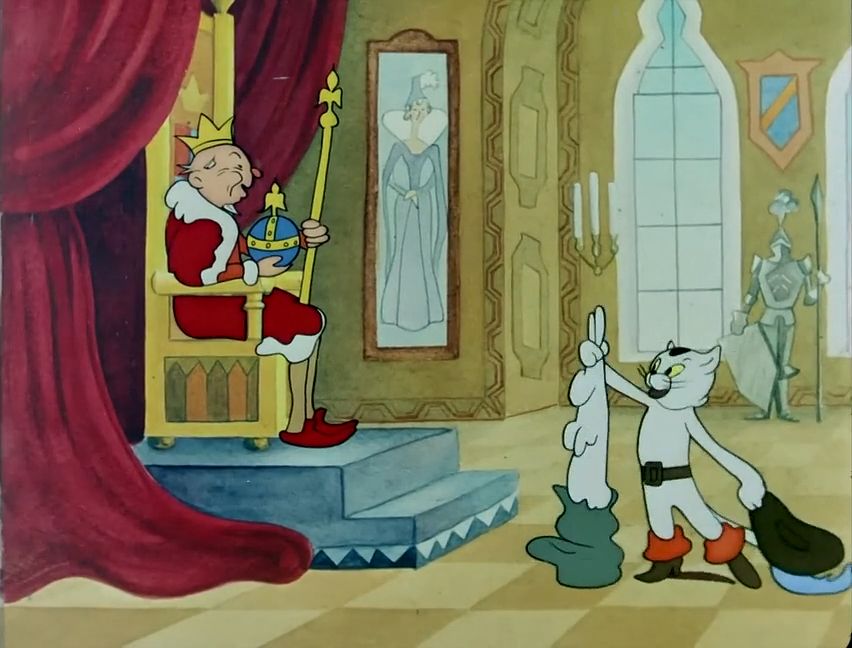
Puss in Boots (dir. Zinaida and Valentina Brumberg, 1938)
An integral part of the studio’s work was adapting foreign classics. The plots were already beloved by younger generations, and what’s more, they legitimised journeys into unknown, sometimes exotic worlds. Examples include The Enchanted Boy (dir. Vladimir Polkovnikov and Aleksandra Snezhko-Blotskaya, 1955), The Golden Antelope (dir. Lev Atamanov, 1954), and, of course, Puss in Boots, animated by the Brumberg sisters. While remaining faithful to Charles Perrault’s original plot, the film unfolds in carnivalesque style. The Brumbergs were pioneers of Soviet animation, forever youthful and playful, regardless of their age. Their remarkable career spanned nearly 50 years, from the late 1920s to the mid-70s. Educated at VKhutemas, in the heart of the avant-garde, they were less confined by academic conventions and more inspired by a spirit of creativity. While the style of Puss in Boots may differ from their other works, it retains a captivating childlike sparkle. This charm emerges from a blend of elements: the characters break from conventional designs, the backgrounds embrace a more painterly style, and the songs create something like a fundament for the action; the music not only accompanies the story but guides it. This approach gives the film a rhythm, much like a classic musical, where the songs drive the progression and energy of the entire narrative. While traces of Disney’s influence are evident – such as the use of four-fingered characters to streamline animation – the film carves out its own.
The Telephone (dir. Mikhail Tsekhanovsky, 1944)
Soon after the war began, Soyuzmultfilm was evacuated to the Uzbek city of Samarkand, where it shared space with directors from Lenfilm. It was a challenging time, marked by limited resources, extreme circumstances, and often accidental collaborations. Most of the studio’s artists focused on making anti-war propaganda posters, while many others went to the front themselves. Only a few animation films were made during that period, including The Stolen Sun (dir. Ivan Ivanov-Vano, 1944), The Tale of Tsar Saltan (dir. Valentina and Zinaida Brumberg, 1943), and The Telephone (dir. Mikhail Tsekhanovsky, 1944). Tsekhanovsky had relocated to Samarkand along with the Lenfilm group, but soon joined Soyuzmultfilm to continue his work. A renowned cartoonist, he gained popularity with his earlier film, The Post (1929), a short animation based on a poem and considered to be among the greatest achievements of early Soviet animation. His contribution to wartime animation similarly drew from literature: for The Telephone, Tsekhanovsky adapted a beloved Soviet poem by Korney Chukovsky of the same title. The story revolves around a man who keeps receiving phone calls from various animals, each asking for his help with their problems. Notably, the film not only brought Chukovsky’s words to life, but also featured the poet himself on screen. This interplay of live-action footage and animation, with frantic animals pleading for help as Chukovsky responds, creates dynamic and distinctive storytelling – it’s as if the author is reading his own poem for the audience. The Telephone avoided delving into the complexities of the current moment. But it offered a light-hearted, yet morally focused form of entertainment: something that was in high demand during those challenging times.
A Winter Tale (dir. Ivan Ivanov-Vano, 1945)
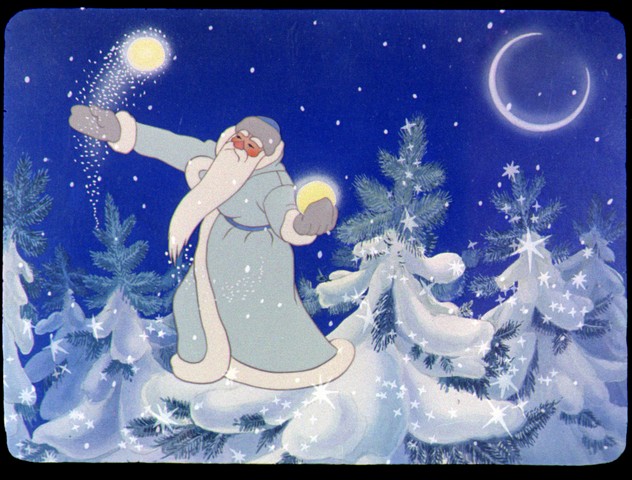
A Winter Tale (dir. Ivan Ivanov-Vano, 1945)
A Winter Tale, created near the end of the war, is a remarkable gem. It was directed by Ivan Ivanov-Vano, one of the foundational figures of Soviet animation. Early in his career, Ivanov-Vano discovered a deep love for fairy tales – informed variously by folklore, Western traditions, and modernity – and remained devoted to them throughout his artistic journey. The Moydodyr – Wash ‘til Holes (1939), The Tale of the Dead Princess and the Seven Heroes (1951), and Left-Hander (1964) are prime examples of his work. Yet, even within his diverse body of creations, A Winter Tale stands out as something exceptional – likely because it deviates from conventional plot structures. The story is a rather simple one: winter arrives in a forest, and its inhabitants gather together to celebrate the New Year. While working on the cartoon, Ivanov-Vano teamed up with Evgeny Schwarz, a renowned Soviet writer, to create a seamless flow of action. The film offers a dreamlike journey; the magic lies within the images of whimsical transformations and interactions. (One of its most memorable moments is the appearance of a girl emerging from a snowball.) But what ties it all together is the sound: the film is set to the music of Tchaikovsky. It doesn’t just guide or dictate the narrative but enriches the atmosphere.
Watch Ivanov-Vano’s The Battle of Kherzenets on Klassiki now.
Song of Joy (dir. Mstislav Pashchenko, 1946)
Set in a serene forest, this animation tells a story of a girl captured and frozen by the evil Polar Night, who wishes to prolong winter forever. Her brother teams up with a group of animal friends and embarks on a daring rescue, bringing warmth and spring back to the world. Director and screenwriter Mstislav Pashchenko was a student of Tsekhanovsky. Entering the world of animation slightly later than many of his avant-garde peers, he nonetheless drew heavily on their experience. His work on Song of Joy started during wartime at Lenfilm, but the project was eventually restarted at Soyuzmultfilm after the conflict ended. Maybe this distance made all the difference: there’s a rare sense of danger underlying the story. The Polar Night is personified as a force of pure evil, but by acknowledging its existence, the film subtly underscores the necessity of overcoming it. The clash between the Polar Night and spring serves as a vivid allegory for the struggle between despair and hope, embodying the post-war desire for renewal. Moreover, it’s hard not to interpret this yearning for spring and warmth as a metaphorical anticipation of the Thaw – a period that would soon reshape the cultural and political landscapes of the country. This animation, alongside Grey Neck (dir. Leonid Amalrik and Vladimir Polkovnikov, 1948), captures its epoch, finding spiritual recovery amidst chaotic circumstances. Its lyrical yet profoundly human touch resonated widely, securing Soyuzmultfilm its first international award at the Venice Film Festival in 1947.
An Unusual Match (dir. Mstislav Pashchenko and Boris Dezhkin, 1955)
The Scarlet Flower (dir. Lev Atamanov, 1953)
Soviet animation offered a treasure trove of folklore and fairy tales, deeply inspired by the Russian traditional arts. Filmmakers infused their visuals with elements of folk paintings and the motifs of the lubok tradtion of popular prints, bringing back to life ornaments that were otherwise preserved in museums. Among iconic examples of Soviet fairy-tale adaptations, The Scarlet Flower directed by Lev Atamanov, stands out. Based on Sergei Aksakov’s Russian retelling of Beauty and the Beast, the film explores two contrasting worlds. Оn the one hand, the story is grounded in the daily life of a historical city, filled with charming houses, bustling fairs, and lively piers. On the other, it delves into the Beast’s surreal realm, where nature takes over with wild, untamed beauty and illusions break the sense of objectivity. Intensive floral imagery overwhelms the screen, almost to the point of excess, but it remains utterly captivating. The film also introduces one of the most distinctive Beasts ever depicted: he resembles a gentle, wounded creature, with eyes that glow brightly from the shadowy depths of his fur. Apart from its aesthetics, The Scarlet Flower also showcases a unique production process. It is an excellent example of rotoscoping: an animation technique where motion picture footage is traced frame by frame to create lifelike movements. This way the action feels more natural, and the characters more real.
Watch The Scarlet Flower on Klassiki now.
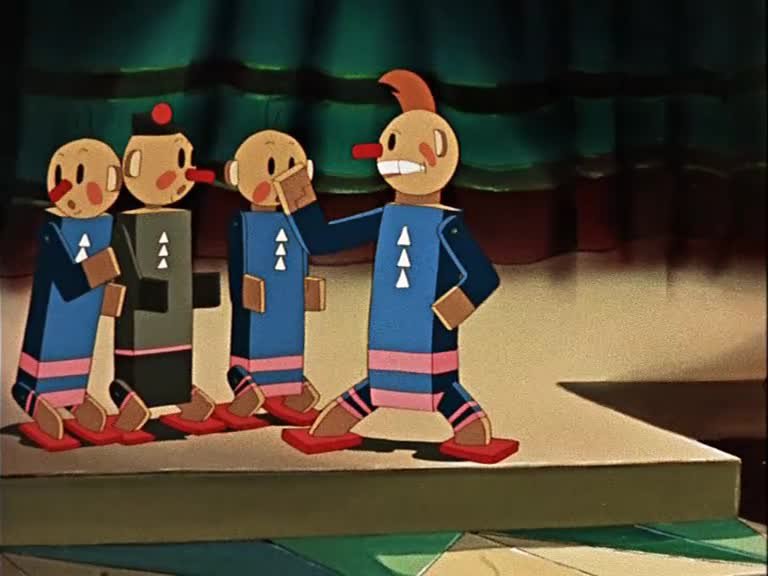
An Unusual Match (dir. Mstislav Pashchenko and Boris Dezhkin, 1955)
An Unusual Match was brought to life by the duo of Pashchenko and Boris Dezhkin. Dezhkin, a passionate sports enthusiast, began weaving sports themes into his work as early as 1946, starting with that year’s Quiet Meadow. That charming cartoon laid the foundation for what would become his creative hallmark. An Unusual Match is distinguished by its setting, transitioning from enchanting forests to the kind of shop that could easily exist in any Soviet city. Here, a new shipment of wooden footballers makes its arrival. Unwilling to tolerate the newcomers’ arrogance, the soft toys rally together and challenge them to a match. What starts as a simple game quickly evolves into a grand event, uniting all the shop’s residents in a lively and spirited spectacle. Grounding fantasy plots in urban modernity wasn’t an entirely new approach: films like Fedua Zaitsev (1948) and Girl in a Circus (1950), both crafted by the Brumberg sisters, had already explored this territory. However, An Unusual Match stands apart for its exceptional sense of humour. The critique of conceit is wrapped up in numerous gags, entertainment takes precedence over didactics. Above all, the playful mischief of An Unusual Match radiates a distinctly cinematic charm. The diversity of forms and shapes highlights an eagerness to break free from the rigid canons that had long defined the medium. Its success paved the way for a sequel, Old Friends (1956), which was just as delightful as the original – if not more so.
Explore our collection of animated titles here.
Alisa Goruleva is a Berlin-based filmmaker and film scholar specialising in archival cinema and Soviet film history.

 Go back to journal home page