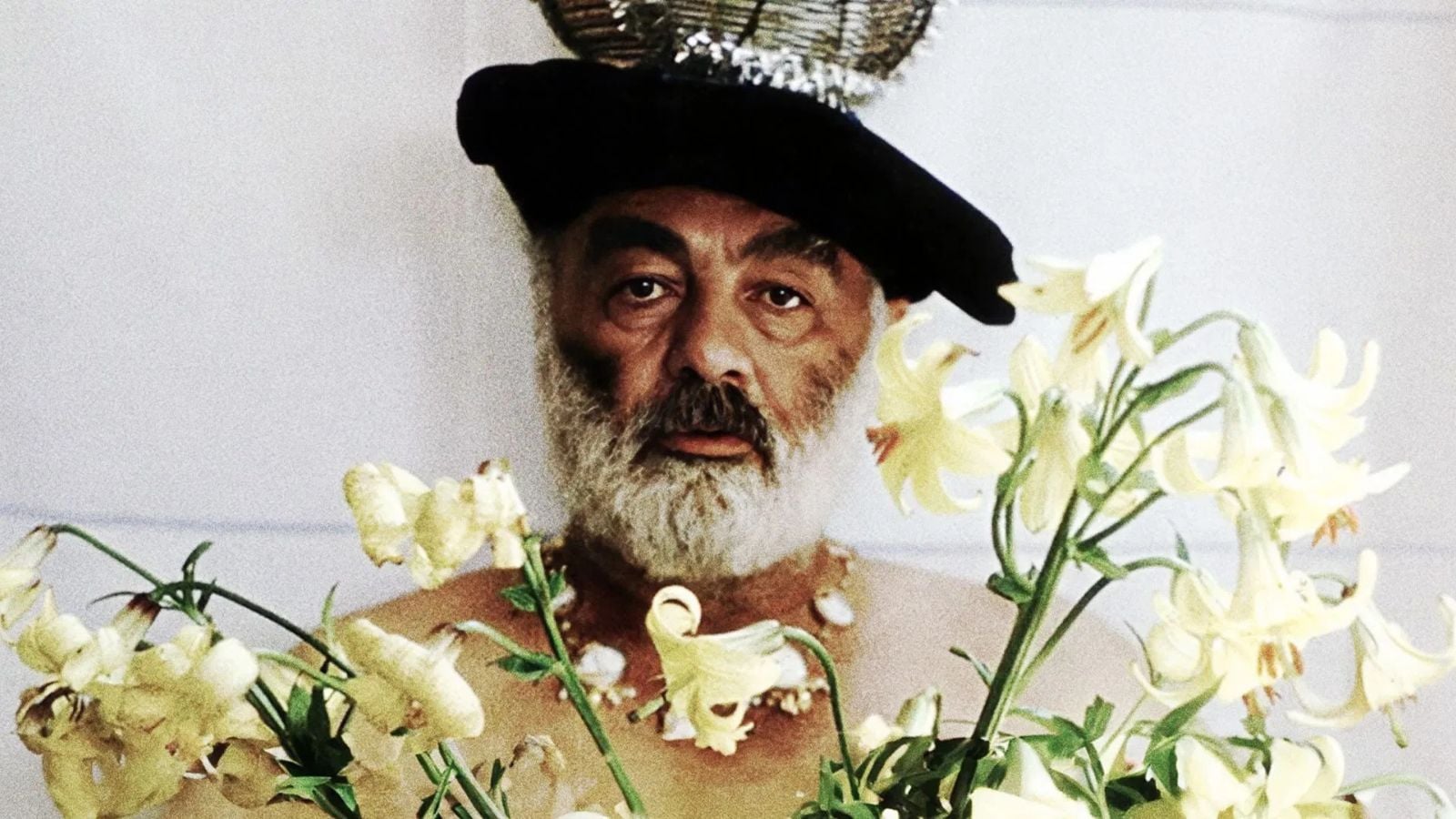
Sergei Parajanov
When Martin Scorsese first saw The Colour of Pomegranates, Sergei Parajanov’s dazzling 1969 tribute to the Armenian poet Sayat-Nova, he opined that he “didn’t know any more about Sayat-Nova at the end of the picture than I knew at the beginning, but instead what Parajanov did was he opened a door into a timeless cinematic experience.” Scorsese’s rapturous response to Parajanov’s work – “like opening a door and walking into another dimension, where time has stopped and beauty has been unleashed” – is one familiar to generations of the director’s admirers, whose ranks have only been bolstered in recent years by restorations of all of Parajanov’s features, as well as his criminally under-seen shorts.
On Klassiki, we’re currently celebrating that strange and beautiful dimension that is Parajanov’s creativity with our new collection Perspectives on Parajanov, which features the streaming premiere of Armenian director Zara Jian’s revelatory documentary I Will Revenge this World with Love – S. Paradjanov (2024). Jian delves into her compatriot’s work in search of inspiration in the face of a world riven by war, deploying staged reconstructions, archival footage, and talking head interviews with luminaries including Atom Egoyan and Emir Kusturica. Accompanying Jian’s film are Parajanov’s own late-career masterpieces. The director made his return to filmmaking after 15 years of imprisonment and censorship with The Legend of Suram Fortress (1985), a dazzling reimagining of Georgian national myth and perhaps his most politically strident film. Meanwhile, his exquisite final feature, Ashik Kerib (1988), is an intoxicating homage to the folk legends of Azerbaijan and a transnational tribute to the past and present of the Caucasus that turns orientalism on its head.
To mark Parajanov’s centenary year back in 2024, we spoke to film writer and programmer Carmen Gray about his career for an episode of the Klassiki Podcast. To mark our new collection, we’re publishing this abridged transcript of highlights from that conversation. Klassiki subscribers can also watch Parajanov’s breakthrough feature Shadows of Forgotten Ancestors as well as a restoration of the rare short Hakob Hovnatanyan on the site now.
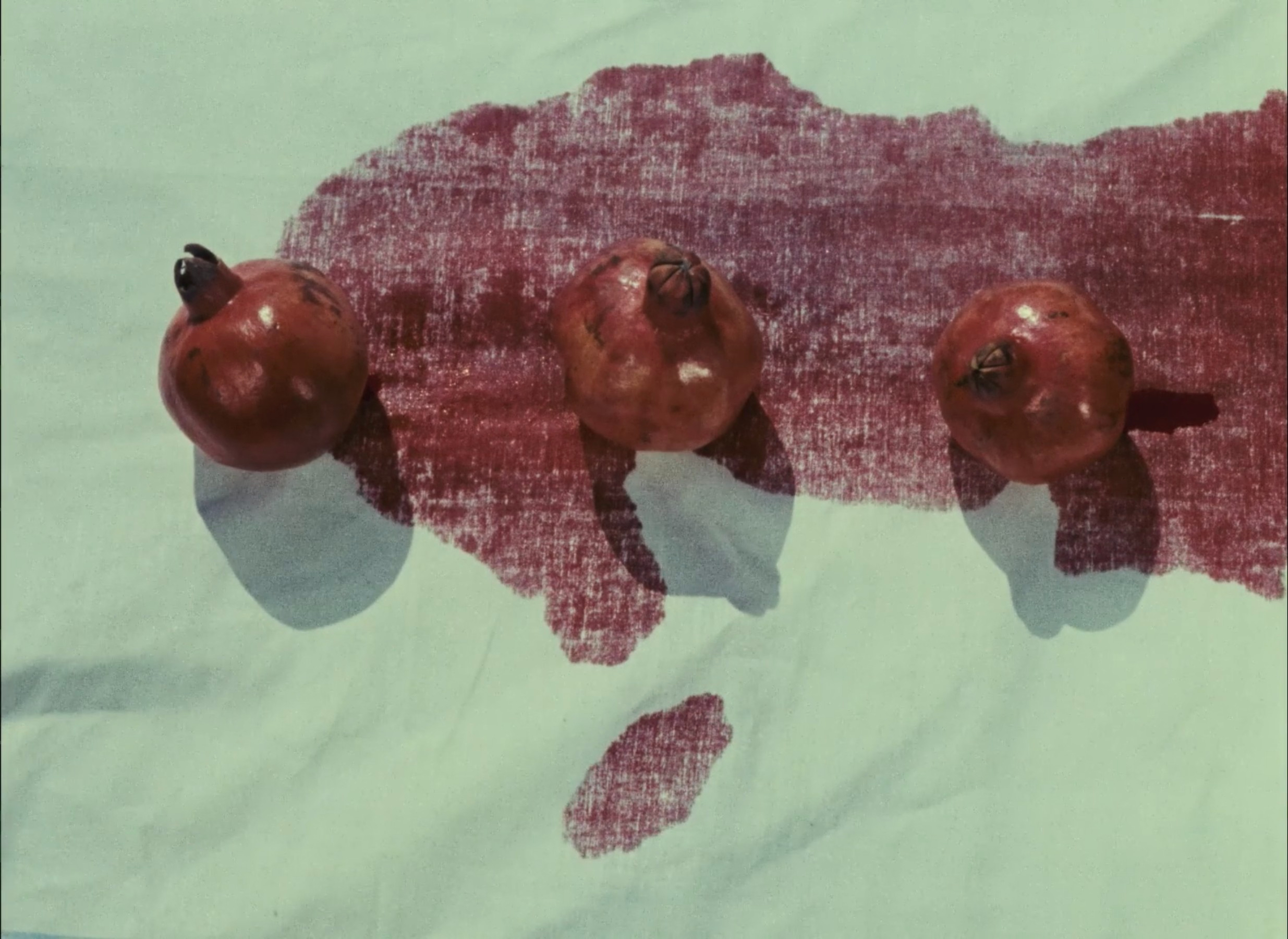
The Colour of Pomegranates (dir. Sergei Parajanov, 1969)
A trifecta of questions to start us off: what does Parajanov mean for you? What did he mean for Soviet cinema in his time? And what does he mean now?
I think he’s not only one of the masters of the region – I’m really into Eastern European cinema and the cinema of the Caucasus – but he’s one of the greats, full stop. Not only for his craft: there’s a real poetry and imagination to his filmmaking which is unique, but also as a figure. He stands for openness and imagination against any kind of conformity or oppression. Also, as a queer filmmaker and someone who was seen to have nationalistic tendencies, supporting the “smaller” cultures of the region against the Soviet monolith. Personally, he was the first filmmaker who introduced me to Georgian cinema, which I later really got into. Where I grew up in New Zealand, we had a local DVD store where you could rent The Colour of Pomegranates and The Legend of Suram Fortress. Those were the only films dealing with the Caucasus that you could find. I watched those as a teenager and was really amazed by them.
I think he confirms some stereotypes about Soviet cinema, while confounding them at the same time. The Brezhnev-era seventies are known as this era of grey stagnation, but it’s also the time when you start to see the emergence of a kind of Soviet arthouse with Andrei Tarkovsky, Aleksei German, Gleb Panfilov, Georgian directors like Tengiz Abuladze and Otar Iosseliani. And Parajanov is a totemic figure for this strand of individually and artistically minded Soviet filmmaking.
He’s friends with Tarkovsky, [whose feature debut] Ivan’s Childhood inspired him to break away from the socialist realist tradition. He studied in Moscow, and he started off making films that were more in line with state diktats. The dreamlike elements of Ivan’s Childhood inspired him to go in that direction. I think all those filmmakers were inspiring each other, and in practical terms supporting each other. So, when Parajanov was in prison, Tarkovsky and others were heavily petitioning for his release.
he’s one of the greats, full stop. Not only for his craft – there’s a real poetry and imagination to his filmmaking which is unique – but also as a figure. He stands for openness and imagination against any kind of conformity or oppression
That question of “folk” culture and the national cultures of the individual states encompassed by the Soviet Union is also paradoxical. It varied over time, but as a rule there was this idea that expressions of “national”, folkloric culture were fine, as long as they were formulaic in the sense of not diverging from an ideological message at heart. It’s not that unusual that someone would make films based on the folklore of Ukraine, Armenia, Georgia; what’s unusual is the extent to which Parajanov immerses himself entirely in those worlds and leaves the ideological behind.
I would say he was quite political as well. He had expressed some solidarity with Ukrainian nationalism as a movement. I think there’s a combination of things that put the authorities on edge. He studied in Moscow and then he made films in Ukraine. At first, he was supported by the system before he was banned. I think it was a combination of the stylistic elements plus him being a queer filmmaker that he was targeted for. These folk cultures, his solidarity with nationalisms, I think the state started to see it more as a stirring up of separatist sentiments.
He studies in Moscow, moves to Ukraine, where at first, he’s making studio-friendly films that he later disowns. He sees Tarkovsky’s film Ivan’s Childhood in the early sixties, which opens his third eye, and he goes on to make Shadows of Forgotten Ancestors in 1965, his first mature masterpiece. It’s an exploration of Hutsul culture in the Carpathian Mountains in western Ukraine.
Shadows is basically about a blood feud. It’s based on a novel by Mykhailo Kotsiubynsky. He’s moving away from socialist realism now with this more surreal folk fable. It also has elements of magic; the incorporation of the occult and magic would remain important throughout his later works.
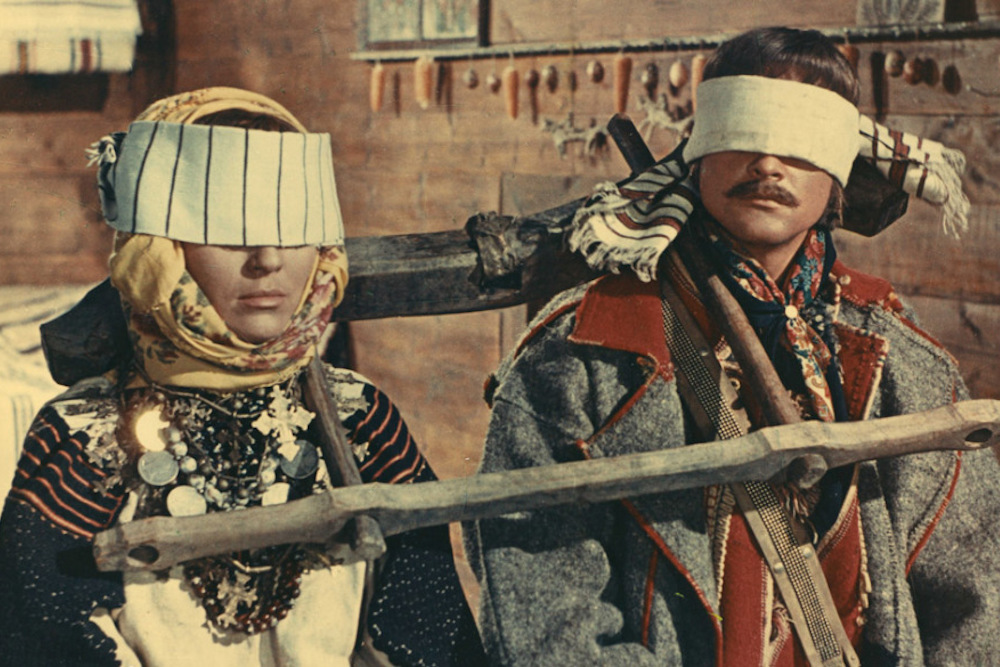
Shadows of Forgotten Ancestors (dir. Sergei Parajanov, 1965)
At the end of the sixties, he goes to Armenia, the homeland, as it were, to work on Sayat-Nova, or The Colour of Pomegranates, as it’s best known in English. This is another step even further into the beyond, artistically speaking. If you had to describe the look and sound of that film, what would you say?
It’s based on an eighteenth-century Armenian poet and lute player, Sayat-Nova, but it’s not in any sense a conventional biography. It’s made up of these amazing moving tableaux of dreamlike images, esoteric objects – skulls, peacocks, candles – which are intended to show the inner world of the poet rather than a narrative. Very imagistic, with this folkloric focus on the homeland: a pomegranate that’s been cut and is bleeding juice in the outline of ancient Armenia. There’s a real focus on martyrdom as well and resistance in the three films made in the Caucasus. None of this sat very well with the Soviets.
It’s Parajanov’s synaesthetic approach: to convey through film the sensation of a variety of different art forms. As you say, he shoots in these tableaux that recall medieval manuscripts and landscape paintings. There are very few words, given that it’s a film about a poet. This is also the point where he starts getting in trouble. In 1973, he’s arrested on a number of different charges – including illegal trading in antique furniture.
I think he was officially arrested for Ukrainian nationalism, homosexuality, propagation of pornography: a raft of charges that was clearly politically trumped up. He served four years of a five-year sentence in a labour camp. Even in prison, he was making things out of whatever he had access to: coins out of bottle tops, sewing with what was to hand. He just had to create.
There’s a real focus on martyrdom as well and resistance in the three films made in the Caucasus. None of this sat very well with the Soviets
Eventually, he’s released, but until the mid-eighties he’s still forbidden to make films. When he is allowed to, he makes two more features: The Legend of Suram Fortress in 1985, which is an exploration of Georgian tradition and folklore, and Ashik Kerib in 1988, which is an exploration of Azerbaijani tradition and folklore. To your eyes, is there a difference between those last two films and Colour of Pomegranates?
I think the remarkable thing about Suram Fortress is that it’s so similar. He has this very unique signature that remained just as strong. It’s a similar style, and again a story of martyrdom. In this one you have a serf who’s been freed by his master and who bricks himself up in the foundations of a fortress as Georgia comes under invasion from the Muslims. I think it’s quite similar in ethos and visual extravagance and invention. Imprisonment didn’t quash his desire to experiment; if anything, it probably made him bolder.
You mention the recurring idea of martyrdom for the homeland or national identify. I think it’s that aspect of his films that might help us frame Parajanov for the modern world. The question of national identity in these post-Soviet states is obviously incredibly complex, vexed, and important. In places, it’s militarily under threat.
Also culturally. In Georgia, as we speak, there are people on the streets protesting against a government that has become more inclined towards Russia and authoritarianism. A hundred years on, it’s notable that history has gone in circles, and we’re back to the same place. In Georgia, there’s a boycott of the national film centre because of censorship and the threat of cultural imperialism, as they see it.
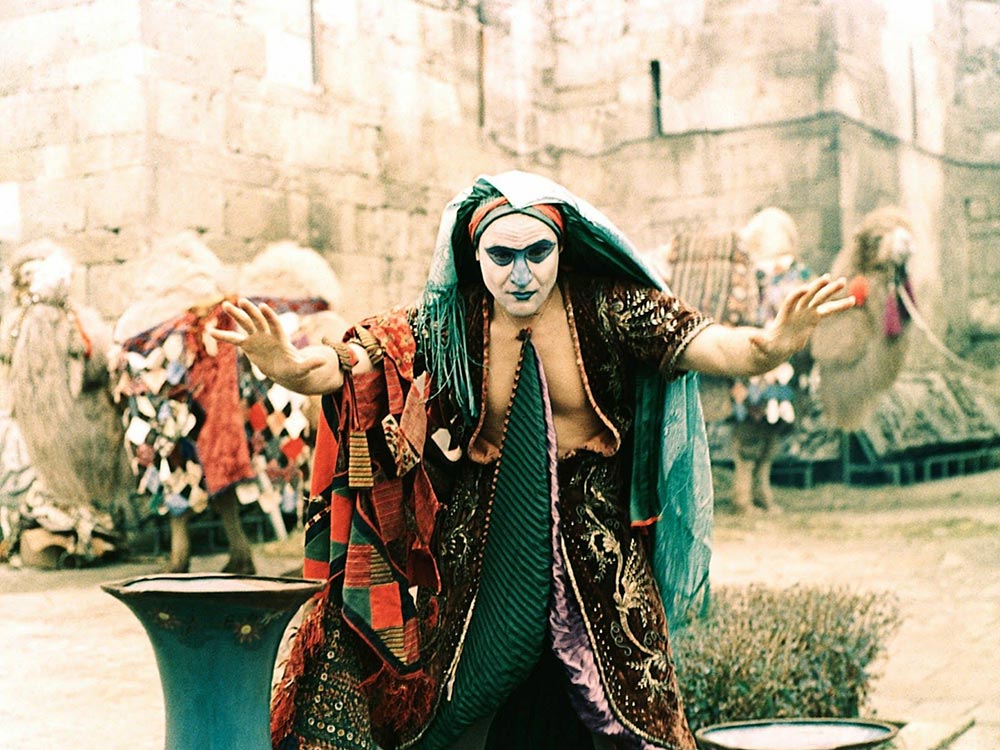
The Legend of Suram Fortress (dir. Sergei Parajanov, 1985)
What’s interesting about Parajanov is that he never allows us to fall back on an easy or comforting myth of a unitary national identity: he is a trans-national, trans-Caucasian filmmaker, an Armenian raised in Georgia who went to Ukraine and made one of the most important films in Ukrainian film history. All of his films drew on the transit of cultures and ideas [that has informed Caucasian history]. He does speak to the importance of maintaining a sense of cultural identity, but he’s trans-national in that sense.
He is and he isn’t. You have to remember that in Georgia there are only a few million people. That sense of cohesion and preserving a culture against a much larger force: while he was working in these different places, I think he would also say that that cohesion within a smaller culture is also important. So, I wouldn’t see him as a trans-national filmmaker.
you’re always walking a fine line between appreciation and appropriation. But I would say that with Parajanov, he’s an insider. He himself said: I’m an Armenian born in Tbilisi, sitting in a Russian jail for Ukrainian nationalism
This puts me in mind of something that the curator and writer Dan Bird told me on a previous episode of the podcast. Dan is someone who’s worked with Parajanov’s materials for a long time. He cited this line that Parajanov used towards the end of his life: that he himself, in retrospect, had adopted a “colonial” approach the cultures he’d worked in; now we’d maybe call that “cultural appropriation”.
I guess you’re always walking a fine line between appreciation and appropriation. But I would say that with Parajanov, he’s an insider. He himself said: I’m an Armenian born in Tbilisi, sitting in a Russian jail for Ukrainian nationalism. He was involved closely with all of these cultures. Even in Ukraine, he was working for the national film studio there and studied under Ukrainian directors.
I suppose the tell is that he is respected and celebrated in all these countries.
I think there’s a lot of solidarity there too in terms of Russian imperialism. There’s a lot of commonality between those cultures that he’s a part of.
I think one final thing to mention in terms of Parajanov’s relevance today is his film’s relationship with gender and sexuality. They offer a very fluid and performative take on those questions that seems particularly important given the ways in which regressive attitudes are today being deployed once again in the very countries he was working in.
If you look at The Colour of Pomegranates, there are a lot of scenes that are homoerotic; there’s also a lot of gender fluidity in general. The actress Sofiko Chiaureli plays five parts, some male and some female. There’s a fluidity of interpretation as well.
Perspectives on Parajanov is now available on Klassiki.


 Go back to journal home page